In this lecture, the speaker urges listeners to remain patient for the coming of the Mashiach, emphasizing that apparent delays are part of divine timing (sadiq be‑emunatoichye). He contrasts this with a relativistic attitude (ish be‑emunatoichye) and argues that Judaism demands a righteous faith, not personal convenience. The core of the talk focuses on the Jewish belief in kriyat ha‑metim (resurrection of the dead). He recounts the biblical vision of Ezekiel’s dry bones, describing how God restored a long‑dead tribe, and cites the Gemara (Sanhedrin) which lists denial of resurrection as a grave sin. The speaker stresses that only the tzaddikim (righteous) will be resurrected, linking this to the concept of sadiq be‑emunatoichye. Finally, he asserts that the Torah’s complexity proves its divine origin, beyond any human author. The lecture blends scriptural exegesis, halachic references, and motivational rhetoric to reinforce belief in the Mashiach, resurrection, and the uniqueness of the Torah.
Chapters
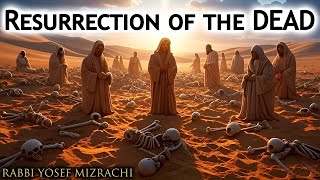
God said, I know you're waiting for Mashiach for a long time. Don't lose your patience, even if he disappointed you so far, even he's getting delayed. Hitma'amea. He will come, I promise. He will not be late. It looks like that he's late. When he come, everybody will understand that it was in a perfect timing. You know how it is, sometimes you think the plane, the plane, the bus, the plane, it delay, delay, delay. But when you land, then you realize what we got saved from. All kinds of things like this. And then you say, well, really it was no delay. It was supposed to be like this, and that's the best way. That's Sadiq be-emunatoichye. Now, what does it mean, sadiq be-emunatoichye? Many people in Israel, they say, ish be-emunatoichye, Rabbi, leave me alone. Let everyone live according to his belief. You do what you want and let me do what I want, right? Ish be-emunatoichye. But they don't know that the Torah never say ish be-emunatoichye. The Torah say sadiq be-emunatoichye. Only a righteous person would live forever thanks to his a munah that made him tzaddik. The Torah continues. Many of us, many of us has a problem believing that there will be one day kriyat ha'metim, the resurrection of the dead. We know according to the Nevu'ot, one day the Mashiach will come, and after the Mashiach, it will be time that all the people, all the righteous Jews that died in the past, will all come back to life. Even those who are dead for 2,000 years, 3,000 years, 500 years, doesn't matter. All the bones will connect and the ligaments and the flesh and the skin will all come back and the soul will enter the body and the person would rise from his grave. It sounds like, you know, Alibaba and his stories, right? But it already happened. It's already happened once in history when, listen good, Hashem came to Prophet Yechezkel and he said to him, And this is what he said: And the hand of God was on me, and he took me with the spirit and put me in a valley full of bones. Full of bones. He made me go in circle around all the bones. There's many, many bones in the desert, and the bones are very dry. You know how dry the bones— if it's dry, you can snap it in a second. It's hundreds of years old. This is the tribe of Ephraim. Who left Egypt before Moshe. They went before and they all got killed. So we are talking now about 700, 800 years after their death. Now Hashem asked the prophet to bring them back to life. It's in, it's in the Tanakh. I want you to know that the Gemara brings a list in Masechet Sanhedrin who are the Jews that, God forbid, have no share to the world to come. One of them is a person who say, I don't believe that the dead will will rise from the grave. I don't believe in it. I'm realistic, Rabbi. I believe in Shabbat, filly, no problem, but I don't believe in the resurrection of the dead. So that's why we have it in the Tanakh. And Hashem said to him, do you think that these bones can come to life? And I say, Hashem, you know. And Hashem told him, start saying your prophecy. And the skin started to come, and all the pieces of the body started to go back. And what happened? These people got up and there was big noise, thousands of people and noise. Everyone checked the sand from their body and they get up and they don't understand what happened. They were dead for 800 years, from, for, for about exactly 800 years. But when Hashem said to the prophet Yechezkel, tell me, do you believe that these bones can come back to life? And the Prophet Yecheskel answered Hashem, you know. We would say right away, of course Hashem, they can all come back. But Prophet Yecheskel told Hashem, you know who can get up and who not. Depends who is a tzaddik and who is not. Only the tzaddikim get up. You should know I'm your God. Every page in the Torah can show you full proofs that a man could never write it, no matter how brilliant he is. Take all the scientists, take anyone you want, not one of them was able to write such a Torah.