Live Coaching Call: Why He Still Feels Stuck With Porn
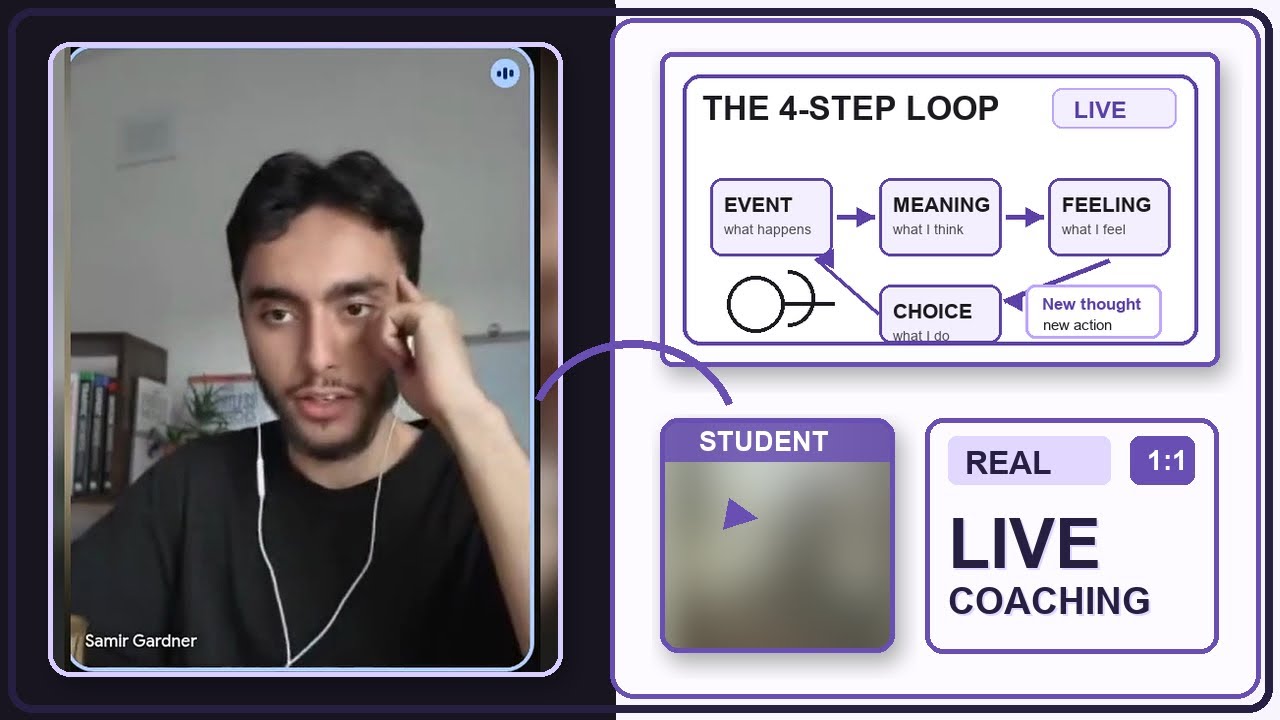
Samir Gardner coaches a client stuck in porn and masturbation cycles, explaining that stress comes from how we interpret thoughts, not from the activity itself. Trying not to think about something amplifies it, like the white-bear experiment shows. Instead of counting sobriety days, redirect your attention to work or exercise and let urges fade.
Chapters
In this video, you'll see a real coaching call. I'm helping one of my students understand why he feels stuck fighting porn, lust, and old habits. His face and his name is hidden for privacy, and I will never share anything without someone's permission. But I want you to see how part of the process works. Because a lot of men, they're stuck fighting urges. They're stuck fighting their own thoughts, temptations, triggers., and it doesn't have to be that way. And that's exactly what I tackle in this live coaching call. So take a notepad, write down some notes because you'll learn a lot. I think that porn and masturbation is very different when it comes to it being an escape, a distraction, a— because of dopamine and so on. But all of those things, and of course you'll learn this more in depth, uh, throughout the course, the videos and so on. All of those things are not true. When it comes to porn and masturbation, porn and masturbation, what is it objectively? It's a video on the screen, right? So for example, do you watch porn to relieve stress?
Yeah.
Okay, I'll ask you this before I explain it to you. How does porn relieve stress from your perspective?
Um, Well, it just like, you know, it gives you like the, I guess, like that kind of like rush kind of feeling. And it's like, it just feels like good. And you're like, okay, you know, it kind of distracts you from like whatever was happening before. Like, yeah, if I'm like stressed out for the day, like maybe I'll be stressed out afterwards, but I feel like kind of like in a bubble in a sense. Yeah. For like even just like a moment or whatever, like, you know. Yeah. So then that kind of like relieves the— or not really relieves the stress, but kind of like puts the stress away, which in turn relieves the stress for like that. Okay.
That makes sense.
Okay.
And you said there was a rush. And a rush, do you mean dopamine rush or just mean a rush like what, adrenaline?
I guess kind of both. Yeah, because I don't really get the whole dopamine rush thing. I don't really get dopamine. Like, I don't get the concept too much. I haven't looked too far into it, but it does feel more like an adrenaline rush. Like, shoot, like, I can, like, I don't know, jump off of a rock or something like that into the water.
Okay, let me explain to you something. When it comes to that rush, the rush that we get oftentimes comes not because of sexual pleasure, but because of the negative emotions that we feel combined with the pleasure that we think we're going to get. You feel nervous, you're like, I'm gonna do something which I know I shouldn't do. It's like the forbidden fruit effect. I'm doing something that I shouldn't be doing. Because of that, it feels more pleasurable in my mind.
Oh, that makes sense.
Yeah. So, so, so it's not like the rush that we get is not like an adrenaline rush because it feels so good. It's more like our heart is beating fast and we're a bit more nervous about it. We're even stressed out because we know we're doing something wrong, but at the same time, we're getting something we think is powerful. It's not necessarily powerful, but we think it's powerful. It's like, imagine I told you run 1 mile. And you'll get $1 million at the finish line. You'll get like the same feeling technically. You'll feel like that adrenaline, like, okay, you know, let me go after it. And at the same time, you're going to feel like that pleasure, that anticipation, that like, I'm going to get this, I'm going to get this reward. But you feel like that tension, like, oh yeah, let me go and do it. Let me go and run. And so that's what happens. Now, when it comes to stress relief, Stress relief is, it's very simple. Why do we feel stressed? We feel stressed because we think, and that's the key thing, we think in our minds that the situation we're in, so let's say for example, we might get fired from our job and we feel stressed. We think that we're going to lose something. We think, it doesn't mean that we are actually going to lose something, we just think. That thought, I'll just show you like a graph actually. You see this, okay? Like let's say there's an external event, like someone cuts you off in traffic. We do not necessarily get angry. We get angry because of how we interpret the event. So for example, someone cuts me off in traffic and I think in my mind, this guy is such a dickhead. Like he just wants to cut me off in traffic. He's trying to do something bad to me. Why does he do this to me? What am I going to feel? I'm going to feel angry in that moment because I think I should feel angry. I'm thinking of these thoughts, like, it's unfair that damn jerk, no, I'm not going to stand for it. You can get cut off in traffic the same exact way at the same exact time and think, oh, maybe that was my fault. Maybe that's why he cut me off. I don't know. Or maybe I'm the one at fault, or I shouldn't get angry because anyways, I need to focus on the work that I have to do in like in a few minutes. So let me just ignore that. And what happens? You don't feel any type of anger even though someone cuts you off. The stress, for example, we feel it because we think of certain thoughts like, oh no, like I might get fired, you know, and if I get fired, my parents are going to say this, and if I get fired, then I'm going to lose all of my money and I'm going to go broke. Like, you see, it's these thoughts that creates the stress. It's not the event itself because someone could get fired and think, I mean, someone might get fired and think, oh, what can I do? Can I just like ask maybe my boss what I can do better and just focus on that? And because of that, he doesn't really feel stressed. How does porn relieve that? Our minds, when they think of something stressful, it then creates the stress. So whatever you're focused on that is making you stressed out is going to create stress. But the key thing is the moment you switch your focus to anything else and you forget about that stressful moment, the stress is relieved as a byproduct. There's no chemicals, there's no dopamine rush, whatever. It's just when you decide to focus on something else, your mind can only think of one thought at a time. You cannot have two thoughts at the same time. You can try it if you want, you'll see you won't be able to.
Yeah, it just gets like mumbo jumbo.
Mm-hmm. But yeah, you can switch between thoughts, but you cannot think of two thoughts at the same time. The moment you're focused on that one thought, which is, let's say, for example, the stressful event, and you switch to something else, whether that be porn, whether that be video games, whether that be a book you read, whether that be a workout, whether that be your job, stress is going to be relieved as a byproduct because you're not focused on what is making you stressed out. The point with this is to show you that porn and masturbation, there's nothing special about it. It doesn't like provide certain chemicals that just relieve stress because it, it targets certain parts of your brain. No, stress is created in your mind, and the moment you stop focusing on the stress, it disappears. So when you watch porn, all you do is you stop focusing on the stress, and because of that, it disappears.
That makes sense.
And it's cliché to say it because you probably heard that before, but really, to be honest, you got to stop counting the days. I'm not forcing you, but I'm just saying it would be very beneficial. The reason being is not that days have some form of like magical superpowers that just makes you relapse. When something is constantly on your mind, you can't really move on from that. By definition, if you're worried about that, you're not free. So the thing also is, for a lot of people, it's almost like a source of pride. Like, I'm on day 30, I'm on day 60, I'm on day 90. They don't necessarily need to say it out loud, but it's like an achievement to themselves. And once it's an achievement, what happens? We make it harder on ourselves because we think an achievement must be hard. In order for me to achieve something, I need to work hard. What's the point of just achieving something if it was just a decision I made. Yeah, that's not an achievement, that's a decision. So there's, there's nothing to be proud of. So what is that ironic process of the mind? This is what psychologists have researched, and you probably know, you've heard probably before of like the whole thing of don't think of a white bear. Have you ever heard of that?
Uh, yeah, wait, yeah, I think so.
Wait, explain it to me so I make sure we're on the same page. And, uh, yeah, can you explain it to me? Do you know, like, what happens when you tell people to not think of a white bear? And you don't have to know the answer.
Yeah, but yeah, they like immediately— well, I'd see them as immediately thinking of a white bear.
Yeah, yeah, those Or like, don't look down. Uh-huh. And they've done like actual studies. It's not just like Samir Gardner stuff that, yeah, it's just logical. No, they've done studies on that. They use actually carrots as an example and say, try to not think of anything related to carrots, carrot cakes, and so on. They saw the same results that those that fight the hardest to remove thoughts, desires that comes from, from your thoughts, end up having more of these thoughts. Now, not only do they have more, but they are more likely to come back again. So think about it like this. Instead, what do we need to do? Imagine there's a bully in front of you. You see him and you're like, don't bully me. You try to talk to him and you try to like, you know, get his attention so he becomes friends with you and so on. What happens then? You get bullied.
Then he pays more attention to you. Yeah.
But initially, the bully might come up to you to bully you. If you don't really react and you don't really care and you don't really give him much importance and you don't give him much attention, the bully might come again like once or twice, but then he doesn't get what he wants, which is attention. He doesn't get anything. And because of that, it just stops coming. So it just gives up. To give you another analogy, and I'll just write this down. So the bully analogy, and then there's the smelly sock. So the socks analogy. So imagine you're in your room and there's smelly socks that they're there and it really smells bad. Imagine you just go in your room and you're like, oh man, it smells bad. And you just go out of your room and then you try to come back again because you want to work. And then I know it smells bad. Then you go out and you do the same process again and again. The smell will always be there if you keep on going out, coming back, going out, coming back. But the moment you say, you know what, I'm just going to sit there, I'm going to accept that the smell is there and it really smells bad. After a few minutes, you don't even know that it smells bad. You're just there in your chair working on your laptop and someone might walk by and be like, oh man, it smells so bad. Like, how can How can you be there? Like, it's just, it's horrible. And you're like, I didn't even notice it. And that's the same exact way that your thoughts work. Your thoughts, the moment you try to remove them, the moment you try to suppress them, they then get that attention in that analogy. They then are repulsive. They're always there, the smell of those socks. It's always there. But the moment you're like, okay, yeah, I have these thoughts, I have these desires, they don't mean anything. That's when you stop caring about these thoughts and these thoughts, they stop coming to you. Does that make sense so far?
That makes sense. Yeah.
Any questions though?
No, those, I mean, That clears it up pretty well. Okay, cool.
Now, uh, 2019, there was a study in Canada about thoughts and they realized based on the research that as human beings, on average, we have about 6,200 thoughts per day, 6,200 thoughts per day. That's a lot of thoughts. The thoughts you have when you're bored and you're thinking of anything and like, would it be PMO? Would it be social media? Would it be your work? Would it be your family? Would it be some random thoughts about food, anything? And you think about the wall in front of you.
Yeah.
You have all of these thoughts. So the question I'll ask you, why is it that the thoughts about porn and masturbation are more important? Was the other thoughts that, you know, the random thoughts that we have about, oh yeah, I want to eat that food, and then you don't care, you just forget it. And then you're like, oh yeah, I want to hang out with this guy, it's been such a long time, and then you forget about it. Why is it that thoughts about porn and masturbation and lust are more important to us and we try to fight them more?
Well, I guess it goes back to the other ones, uh, because of the fact that we're trying to fight them, um, they become more of a, like you said, like the achievements. Yeah, like, because you want it to go away as soon as it comes in, then you fight it going away, and then you pay more attention to that one. Whereas, like, food, if you want food and you don't really care about, like, uh, what type of food you eat, you're like, oh, I wanted to eat some Hot Cheetos, and it comes up and you're like, ah, never mind, it just goes away. You don't really Yeah. You don't think about it.
Exactly. That's, that, that's how it works. So that's, that, that's it. We think that our thoughts about porn and masturbation, it reveals something to us. Oh, I'm still maybe struggling with this, or why do I have an urge about this specific type of woman? Maybe there's something wrong with me. Then what happens? We just start worrying about that. This is what we call sometimes in psychology, people call it sticky thoughts. Where they just become more and more sticky. And the beauty of this though, like the moment you just decide to change, they just disappear. It doesn't take years. It just disappears gradually over time. And we're talking about sometimes days, sometimes a few weeks. There was a research done on people that had hallucinations, that heard voices, and they compared two groups. One group did not get treatment because they felt they didn't need treatment and they were just living normal lives like everyone else. Despite hearing voices in their minds. Another one, the other group was groups that were in treatment. So they were getting treatments for their voices because it impacted their lives. They couldn't, for example, function properly in society because these voices were impacting their lives. And what they realized, there was one single belief that impacted the decision to go for treatment or not, or to live normally in society or not. It was simply the belief of one of the group that did not get treatment and that were just living normally in society like everyone else. They believe that the thoughts were not stronger than them. By thoughts, I mean the voices, because like, of course, like voices are in our minds. And they believe that they were just not stronger than them. They were just like there and they had full control over them. Whilst the other one believed the opposite. They believed that these voices meant that there was something wrong with them and they started panicking because of that. You see the reaction, they have these thoughts, these voices, they're, oh man, there's something wrong with me. And because of that, they couldn't function properly. It became like a self-fulfilling prophecy where they started thinking, oh, I have a specific problem. I can't function anymore because I have this. And I've been told that if I hear voices, then that means that I can't, for example, I can't, for example, work a job and so on. And I need to get treatment. Do you see the point with this?
Yeah, I see it. And the self-fulfilling prophecy makes the most amount of sense in that scenario. Like, yeah, because you think it's a problem or because you make it— because you think it's a problem, you make it a problem. Which in turn makes it harder for you to deal with that said problem that you just made up.
Exactly.
Giving power to something that's not, that doesn't have power. That makes sense. Mm-hmm.
Because your thoughts are just thoughts. Your thoughts are like clouds. They're in the sky. They're just there and they're just passing by. And at one point you won't see them anymore. If you think, oh no, these clouds are always gonna be there and you start panicking about them. See, like the problem is that they're just passing by. If I'm on a balcony and have a random thought about jumping off the balcony, which would mean I would die— pretty sure like everyone experiences these thoughts about like doing some very random, like, horrible things. Or like you're in a store and you could steal like this thing that's very expensive, and then you're like, you think of what would happen if you stole it, how you would have it. But you don't think, oh, because I'm having these thoughts, there's something wrong with me. I might be a psychopath, or I I might be like someone that is mentally ill or something. You just think these are random thoughts. I'm just like thinking of something random and you don't panic over that.
Oops.
Guys, did you have any questions?









