Why You Keep Coming Back to Porn After 7-14 Days
Samir Gardner explains why people relapse around day 7-14 after quitting porn: the coping mechanism is gone but the stress, loneliness, and shame it masked remain. Instead of willpower, he suggests identifying what emotion porn solves for you, then sitting with that feeling rather than fighting the urge to escape it.
Chapters
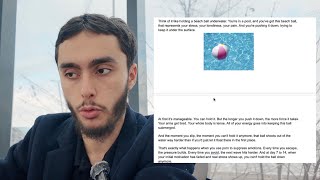
Today, guys, we're going to explain why you keep coming back to porn after 7 to 14 days. This is one of the most common struggles I see within the people I talk to, where they tell me, look, Samir, I managed to go a week or two, but then the urges, the desire gets so strong that I just end up giving up. And I'm going to explain why this actually happens and what is the actual solution. So let's get into it. I just wrote the document and I want to go over it. So what happens is you quit porn. You, you managed to do it for 7 days, maybe 10, maybe even 14, and then out of nowhere you go back. You don't understand why, because you had the motivation. You probably told yourself that this was going to be the last time, and you, you felt good for a while, and you just overall thought that, yeah, this time it's going to work out because I'm never ever going back to this again. I made the promise to God, maybe, or I made the promise to myself. One night, maybe it's the stress that hits, or the loneliness, or the sexual thoughts that just won't stop, and suddenly you give in. And I'll explain why this keeps on happening and how to actually break this once and for all. Let's understand first that for years, or maybe for your entire adult life, you've been using pornography as a coping mechanism. You feel stressed? Porn. Feel lonely? Porn. Emotional pain? You go to porn. Sexual frustration? You go to porn. Boredom, you go to porn. Research has pointed out that one of the main reasons why people go to pornography is simply for coping, to regulate unpleasant emotional states and cope with stress and negative emotions. So it's not just about lust, it's mostly about escape. Here's the problem. When you decide to quit, you remove that coping mechanism. The one you use all of your life. You just take it away. Of course, you have the good intention of removing porn, but there is a problem. Of course, over the first few days, you're fine, you're doing good. Sometimes you might feel bad, sometimes you might feel extremely motivated, and the guilt from the last relapse, you can still feel it. You're like, yeah, I remember how it felt, therefore I don't want to feel like this again. So the pain is kind of pushing you forward. This is what we call, or what people call, post-nut clarity. But around day 7 or 14, that motivation obviously fades away. And motivation never lasts anyways. And real life doesn't stop. So the stress is still there, the problems are still there, the adversity, the challenges, maybe the pain you never dealt with are still there. They're right in front of you. And now you have no tool to to deal with them. This is what I call the coping vacuum. You took away your mind's only strategy for handling negative emotions. So there is a moment, and you know exactly what I'm talking about, where the stress becomes so heavy or the frustration becomes so intense that your mind says, facing this is not worth it, just watch porn. The stress was always going to come. The question is, can you actually deal with it. There's also the fear underneath, and this is where it goes a bit deeper than that. The fear underneath every relapse— I do not like using the word relapse or urge or addiction because it implies that it is something that will limit you, but I'll use it just for the sake of making things more simple to understand. So when you quit, there's a part of your mind that starts running worst-case scenarios unconsciously. You're kind of asking yourself, well, what if I go longer? And the problems, they just keep on increasing? Or what if, and this is very common, I get overwhelmed by having to face life without that coping mechanism? Or the most common one, what if the sexual thoughts, they just keep on piling up to the point where you feel like you can't control yourself, all you can think about is intimacy all day long? What if the stress, the loneliness, the pain, sometimes it's trauma, sometimes it's other things that really drain you mentally, what if they never go away? And sometimes it's really that fear that really drives the relapse, not the desire itself. It's the fear of what happens if I sit with that emotion without escaping. And in psychology, this is what we call experiential avoidance. It's the unwillingness to just remain in contact with these uncomfortable internal experiences. On the surface, it's one of the most common reasons why people go to sexual behaviors. You're not addicted to porn. You're more so terrified of what you'll feel without it. The issue with this is that the more you avoid the emotion or the problem that's behind the emotion, the bigger it gets or the worse the problem gets. Think of it like this, okay? I'll give you an analogy. Imagine you have like this beach ball, as you can see here. And we probably did this as kids. You're in the pool and you've got like this, this ball that you just like put under you and you try to just submerge it, but it never works. So this beach ball kind of represents, let's say, your stress, your loneliness, your, your pain, and you're pushing it down. You're trying to keep it under the surface. Of course, at first it's, you can handle it, but the longer you push it down, the more force it takes. Your arms, they get tired. Your whole body is tense. All of your energy goes into keeping this ball submerged. Well, the moment you can't hold it anymore, the ball just shoots off the water way harder than if you were to just let it float in the first place. That's exactly what happens when you use porn to suppress emotions. Every time you escape, the pressure builds. Every time you avoid, the next wave hits harder. And at day 7 to 14, when your initial motivation has faded and real stress shows up, you can't really hold the ball down anymore. So what is the solution? What can you do about it? Now that we understand the problem, let me give you the shift. Most approaches to quit porn, they focus on resistance. Fight the urge, fight your thoughts, try to socialize so that you don't think about it, try to get yourself busy, get that accountability partner, that community, count the days. And to treat porn like that is to tell yourself, I really need to resist it. But resistance is just avoidance. You're still running from the emotion. You're putting a wall between yourself and this instead of actually facing it. And of course, the studies on avoidance coping versus approach coping consistently show the same thing. Avoidance will give you short-term relief, and this is pretty logical, but it will increase your psychological distress over time, it doesn't get better, it gets worse. And we all know this, but what actually works is the opposite of resistance. You learn to face the negative emotion, not just to tolerate it, not just to get through it. You learn to actually want to face it, which is one way to go about it, to intrinsically desire confrontation with that discomfort. This is one way that you can go about it. You can learn to like to face the negatives in life. And this is where the Fortress Method actually gets its name, because when you stop fearing the emotion, when you actually understand that you can actually desire to face such problems, that you are in full control of how you react to the problem, you don't need willpower or another technique. There's nothing to resist when there's nothing to be feared. So here's what I need you to start doing, okay? Listen carefully. First, you wanna identify what porn is actually solving for you. What do you think porn is solving for you? Not in general, but really specifically. What emotions are you escaping right now in your life? Is it the stress, the loneliness, you feel inadequate, you feel unworthy, sexual frustration, you feel like you're never going to have intimacy? Be honest with yourself. And then second, The next time the desire hits, don't fight it, okay? And don't give in. There's many ways to go about this, about how to deal with the desire itself. I do have videos on that on my YouTube channel that I highly suggest you watch. But you wanna ask yourself, what's the absolute, okay? And this is really going to make the unconscious conscious and allow you to break that cycle. What is the absolute worst thing that would happen if I just sat down with this feeling and if they didn't watch porn? Really think about it, okay? This is very important that you think about that. What is the worst-case scenario? And be honest with yourself. What is your worst fantasy when it comes to facing life without porn? You might initially just say, oh no, nothing, like life is just going to be better. But there is always a fear. There is always something that you need to uncover because that single realization is going to begin to break that cycle for you. And then third, and this is critical, work on the actual root cause. There are so many myths, and this is the sad reality within this space of quitting porn, the porn recovery movement, that these myths, they keep you stuck. Myths about like why you watch. We often blame trauma, we often blame dopamine addiction, brain changes, but you need to really understand what does porn actually mean to you. What is the meaning you attach to porn? What addiction actually is? You need to debunk those myths because as long as you believe in them, you'll keep fighting a war that doesn't even exist in the first place. I highly suggest you watch my other videos on this channel where I break those other myths down one by one, and I have plenty of videos on different topics. Now look, I want to show you evidence that this actually works, okay? Because this is not just theory, I've been coaching men over the past few years go through this exact transformation. For example, one of my students named John, John right here, as you can see, John struggled with this for years. Being in his mid-30s, he would often go a month without it. This was his common pattern. He'll go a month without porn and masturbation, and then it would come right back. And one of the reasons why it kept coming back is what I just described. He had that fear around relapsing. Because in the past, and this is the common struggle that the people that come to me for help have, which is they manage to go a week or two or even up to a month or maybe sometimes even more. But for some reason, every time they hit this specific number of days, like 7 or 14 or 30 days, they just suddenly come back to it and they don't even understand why. They just suddenly feel the desire just surge. And for some reason, this cycle doesn't just happen for like a few times, but for a few years, you feel confident, you feel motivated, you know, okay, this is going to be the last time. Now I actually need to change my life for good. Now I need to draw the line in the sand. And then the cycle repeats itself. And you would even sometimes cope through fantasizing about intimacy, try to essentially deal with the desire in another way. But all that did was to just keep the cycle alive from a different angle. So when John went through the Effortless Method, we removed that inner conflict. We addressed that fear. We debunked these myths about himself and about porn, and the whole thing shifted. And today John did a complete 180 because he went through the other courses, the other programs in the past, and he tried so many different techniques. He felt hopeless, but now he is free and there's no battles anymore. He realizes that, he realized that he doesn't need to live in that fear anymore. He's not pursuing, and this is the most beautiful thing, he's pursuing things that porn held him back from for years. He's writing his own book at the moment. He's becoming a role model for his kids. He's working on new projects. His entire life did a complete 180 and I'm so happy to see this. And this is also the case for Joey, for example, And Joey was stuck with this habit ever since his teenage years. And he was now in his 30s. Obviously, like pretty much everyone that I've coached, they've tried everything. Keeping yourself busy with being around other people, trying to fight the urge, and none of it really worked. These are what we call short-term techniques. Yes, you deal with the desires, you can say the symptoms, but you don't deal with the root. And Joey was not the guy that lacked discipline. He was hardworking. Doing the good habits and so on, but they just didn't really understand the real root cause. And when Joey went through the process and he actually saw the real root cause, the struggle actually stopped. And today he's completely free, no desire to come back, his confidence is back, he's building a business, he's building bigger projects, which I'll just keep private, but he's no longer fighting this. And we also have Cyrus. Cyrus, it's been over a year now he's been free. And before, he would struggle with PMO for multiple years, and he genuinely believed that it would be nearly impossible for him to quit. That's what he said in his own words. And that wasn't because he didn't try, and that's not because he didn't have a strong reason why to quit. It was definitely ruining his life, and he felt hopeless. But after going through the coaching, for the first time, he understood why quitting had felt so hard, that it was actually possible not just to quit, but to quit permanently and effortlessly. Now he's completely free, no more fighting, no more fear of going back. You need to understand that it's not just about self-control, it's not just about keeping yourself busy. My students here, they don't need to use discipline. They actually decided to stop trying to resist and they started actually facing what they were running away from. And this is what is truly beneficial. The moment you face life, you can only grow because you'll solve these problems. You'll Pursue those goals just like John did, just like Joey did, and your life will only go up. Of course, you're gonna face highs and lows. You will make so much more progress in your relationships, in your goals, in your life, in your relationship with God, and so on. And there's gonna be the full link to their full video testimonials in the description so you can see their transformations. In summary, the 7 to 14 days cycle, it doesn't mean that you're broke. Broken. It doesn't mean that you are addicted beyond repair. It's really easy to think that when you have evidence behind that. What do I mean? When you tried over and over again and you tried your best and you tried the new technique and every time you hit that same wall. It's just that your approach hasn't actually changed yet. You can't just remove the coping mechanism without actually addressing why you needed to watch porn in the first place? Why did you felt like you really wanted to do it? You can't just resist the emotion instead of facing it, because then your mind, you, will always decide to go back to what's familiar, because that's all you know. That's the easiest and most effective thing to do. But the moment you actually stop fearing the emotion, the moment you see through the myths that kept the fear alive, the cycle can break. Not through willpower, not through discipline, through simple understanding. And this is what the Fortis Method is built on. If you want me to personally help you figure out your triggers, your fears, and build a plan around your life, I actually made the private guide that I only share with my students on how to handle strong urges. The link is in the description. It's going to be the first link. I'll see you guys in the next one.









