Ep 134: Bilal and Chelsea - From homebirth to hospital birth, adapting to the unexpected.
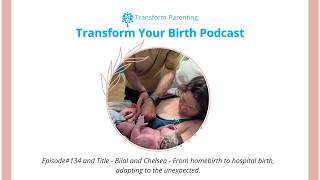
In this Transform Your Birth podcast episode, host (Speaker A) interviews Chelsea, a chiropractor and mother, and her partner Bilal about their second pregnancy and birth. Chelsea describes a challenging second trimester marked by prolonged morning sickness, fatigue, and disrupted sleep, which contrasted with a more positive first pregnancy. Both parents discuss their original plan for a home birth, the preparation of a birth pool, and the expectation that labor would begin within 24 hours of their waters breaking. After the waters broke at 38 weeks + 2 days, no contractions started for five hours, prompting a hospital visit for fetal checks. Because the 24‑hour window elapsed, they were transferred to a hospital where a midwife‑led induction with syntocin (oxytocin) was administered slowly. Chelsea recounts the intensity of synthetic contractions, the use of a birthing pool, TENS, breathing techniques, and counter‑pressure support from Bilal. She also notes challenges with continuous fetal monitoring in the water. Bilal emphasizes his role in emotional and physical support, encouraging Chelsea and helping her stay present. Both reflect on the importance of flexibility, trusting the body, and maintaining a calm mindset when birth plans change. The episode concludes with practical advice for expectant parents: stay adaptable, trust professional relationships, and focus on the birth’s core purpose rather than rigid expectations.
Chapters
And well, hello everyone, it's the Transform Your Birth podcast and I have a return family, gorgeous family. I just adore them, you know, done a lot of my work and I, I'm so blessed I get to know these people and fall in love with them and their kids. It's Bilal and Chelsea and little Sammy, and he's so cute. But that aside, They— my recollection of Bilal and Chelsea's first podcast was very much around— we talked a lot about bodywork and preparation and all the, you know, she did all the right things. And then, you know, talking about this pregnancy, it was a very, very different experience. So tell us, Chels, you can start us off. How are you feeling about this pregnancy and what sort of preparation did you do this time?
So I, I'm a chiropractor, as is, um, Vala, my husband. So that's a huge part of the body work that you're obviously mentioning now. And that's something I definitely did throughout this pregnancy, is I got adjusted a lot. Um, I would say mentally I was really struggling with the concept of having two kids and what that would look like. And obviously that comes with a pregnancy. And I think I got in my own head a lot because I had a much less um, enjoyable time pregnant second time around than what I did first time around. Yeah, a lot of, a lot of angst and stress and worry. Um, and I had morning sickness until well past 20 weeks. Um, and then a lot of fatigue in the last few weeks. So I think I had about a 6-week period of like the second trimester that everyone talks about being the good trimester. I think mine was only about a 6-week period. Something else that was a really interesting one for me is I would wake up at 3 o'clock in the morning and I just wouldn't be able to get back to sleep. And that would be where I started my day. So my beautiful toddler was sleeping through the night and I was not. And I was like, what's going on? And I would just be awake from those days and then go to work and back that up with parenting and, and all that.
So it was a very different experience. Sense. Can I ask a quick question about that? Is there any link between this 3 AM wake-up and little Sammy now?
No. My friend is doing some additional, um, women's health study, and apparently it is a bit of a link with, um, blood sugars.
Ah, interesting.
Yeah.
Okay, because what does happen in pregnancy is the quality of your sleep changes, and it just is there to highlight that we often don't need as much sleep as is what we think. But of course, you know, blood chemistry and things like that are always going to play an organ function, are going to play a role in sleep and sleep cycles. So that's interesting. Yeah. And how are you feeling about the idea of having a second baby, Bilal?
I'm loving it now that he's here.
You found the pregnancy easy, did you?
Yeah, I won't speak to that. I won't get myself into trouble. It is really interesting going from having a child to then being pregnant and going through it again. Admittedly, while we always anticipated a second child, this wasn't planned at this time. So I'll be open to say that. And I think what you grapple with that's different to So the first time around, you really can dedicate all your resources to, to, um, being present for a pregnancy and the birth of the child. The second time around, you've, you've got a beautiful little human there. So a lot of it, um, is now, you know, how much energy do I have? How much time do I have? Where do I put my focus? And for me, there was definitely a, a reflection on, of, you know, where's my headspace and my presence at? So even more so than the first pregnancy. So that was my experience. It was absolute— I was really excited, actually. So maybe a bit different to Chelsea's, um, you know, experience. And not to take anything from that, away from that, but I was just excited.
Dull some of your excitement because it was not the same level.
I did. And, and, um, at the same time, it was, it was cool. I was okay with you know, bub's coming. So I was like, bring it on. Like, it was a surge of motivation.
Yeah, beautiful. So how did the labor unfold this time, or didn't unfold actually?
So we had such a beautiful experience first time around that we were really motivated to have a home birth this time. We were through the hospital, there's a home birth program, and we had our birth pool here all ready to go. We had nearly everything ready for the day of. So my waters broke, it was a Wednesday, which is the day that our daughter is in daycare, which is what they tell you. They say when baby comes when you've already got one, they either come on the day your kid's in daycare or overnight. So that was quite funny, but I was only 38 plus 2.
Okay.
So we were gonna use that Wednesday when she was in daycare to finalize all of our supplies. And also, 'cause we were intending to have a home birth, I didn't have a hospital bag packed because that wasn't the plan. So there are a few things we still needed. So my waters broke at 10 in the morning and I called Bilal and he was like, "Oh, shit, we're about to go out to Kmart today and get all those things." So he was able to go and get all of those and then rush home to me, which was great. And I was like, "Don't worry, there'll be plenty of time. Just take your time, get here when you do." I was still all very relaxed. I had the classic um, for me, that is, the waters breaking before anything else started. A few hours went by and nothing happened. Nothing happened at all. So at about 3 o'clock, we went to the hospital so they could do all the fetal checks and just make sure everything was fine.
And how long after that was your waters breaking?
So it was about 5 hours after waters broke. Nothing had still happened. Just went into the midwife for a check. I think I was due to have an appointment that day any— yeah, it was just my regular appointment that I was due to have that day. Um, went in for all of our checks and they— hospital staff couldn't have been happier. They were like, 'It's fantastic, very happy in there.' Um, but just no contractions. So they sent us on our way back home and said, you know, 'You still qualify within the home birth program if things go within 24 hours of waters breaking, so we'll give you a call tomorrow morning if you don't give us a call overnight when we hope that this baby will come and, uh, we will, you know, hear from you at that next point. So our daughter stayed at the last parents that night, and I woke up at 7:30 in the morning and nothing had happened yet.
Did you feel at all— one of the challenges that can happen when waters break at the beginning and nothing sort of unfolds from there, it can invoke this desire and need to try and control and make things happen. Did you feel the pressure to make things happen?
Um, I was pretty exhausted. So I know, like, I've heard some people, you know, go out curb walking and climb stairs and do squats and do all that, and I didn't do a lot of that. I did some of that, but I didn't do a huge amount.
Yeah.
And I think that ties back into probably my mindset of that I wasn't quite ready for this to happen yet, and I thought it was a bit early as well.
So if I can add to that, um, I think, well, you know, 24 hours had passed, which excluded us from the home birth program, which meant we ended up going to the hospital, and it was still a midwife, um, led birth that was assisted. So what was really incredible was, um, there was an induction that happened, and he didn't take— once contractions started, um, going, uh, Sammy, he was born maybe 2 hours after that, that point. So he wasn't far off it.
Yeah.
Um, anyways, it wasn't what we planned, but it was from my perspective too, what was— what I learned through your course was still really applicable at that point too, and very important. One, to be support for Chels, because, uh, naturally, you know, there was a disappointment with not having the home birth available at that point, but also keeping her mind on track that there's still this beautiful human waiting to arrive. So, you know, you need to, even amongst all the exhaustion, to put your, your focus into, okay, cool, I'm going to be present with, with this, you know, labor as much as possible. So I, I think, you know, kudos to Chels for just being kind of back into it, was, was ready to birth our boy, and, and she did it so beautifully, even with induction, which we know can lead to other complications.
So coming back then on that realization, Chels, Were you, were you able to adapt mentally to the change of plan?
Um, yes and no. So what I do remember is one of my least favorite parts of last birth was the car ride to the hospital because I was in contractions. So driving to the hospital this time in no contractions was actually really lovely. I was comfortable. So that, like, there were aspects that was really nice.
Yeah, yeah.
And but what I was nervous about is because the waters had broken the kind of the only tool in the hospital's repertoire was oxytocin or syntocin.
Yes.
And I was really nervous about the cascade of intervention changing rapidly from kind of my— particularly, I guess, the ideal scenario of a home birth, of what we wanted.
Yeah. Into them.
I was, I was really nervous that things wouldn't progress and then I would be stuck in their, their times of what had to happen. And I voiced this to my midwife, who was wonderful about it, um, that, you know, that if in 2 hours nothing has happened, then we have to add something else, and we have to add something else. Um, so I was very nervous about that, um, before commencing the syntrose, and I just kind of shared that with her, and she was really wonderful in helping me with that. Mental hurdle, but it was a big change.
Yeah.
Yeah.
And I think that's what allowed you to adapt quicker as well.
Yeah. I love, I love to hear, you know, the care. This is the benefit of having relationships with the people that are caring for you, where you can speak honestly with someone who's prepared, who's there just for you. She's not being called between 3 or 4 different rooms. Yeah. Who's there just for you, has a relationship with you, knows what, what's important to you and what isn't. And, you know, when in, certainly in the way that I try to prepare families is for birth under all circumstances, so that if you're going down one path and you have to pivot, that you're able to roll with that and still bring all your tools and anchoring yourself to your ability to stay calm and optimizing that hormonal release and still feeling the care of your partner and all of that, then, you know, we can pivot and adjust and that's life, isn't it? I mean, you just never know. Never know where life's going to take you.
Yeah.
But I think that, um, the challenge in any situation like that is, well, one, there's that birth readiness, which is, oh, this is early, I'm not ready. I didn't, I didn't have my nesting, which sort of got me to the point where I was just, you know, I call it the effort moment where you're just ready for anything, where you're in that lovely nesting phase and then you just get sick of being pregnant. You're like, radio, bring it on. And then the woman releases. She has this emotional release, and then she's created those beautiful conditions for labor to start. And when that doesn't happen and you're having— you're being caught on the hop a little bit of adjusting from, you know, okay, we thought it was going to be a home birth and now it's going to be in the hospital, and we thought that labor would start and now we're going to have to help it continue, it can be a lot to get your head around. How do you think, Chels, you were able to— like, what helped you to adapt in that way?
Um, it would definitely be the support of the midwife and blah blah, yeah, for sure. But something we definitely spoke about on our car ride into hospital was, oh, we're not leaving without a baby.
Like, that's a—
yeah, it was a beat. And that was a really lovely kind of reframe, is that our baby's coming today one way or another. Because, yeah, it had been that 24-hour period where they obviously want things to happen for risk of infection. So that was a really lovely, you know, we're definitely meeting our bub today. This is happening. That's probably the most powerful thing Yeah, that, um, we were able to use.
So getting your mind on board and yeah, it's so— women are so vulnerable in that space to have people surrounding them who can just keep their mind in the game and guide them and love them through the unpredictable nature of where these journeys can take us.
We actually, um, didn't have them— we were in the Continuity Program, but we didn't have the midwife that we were with continuity. With— it was her buddy, her buddy. Um, I had— I hadn't met her. No, I hadn't met her prior to. Um, but she was lovely.
She was really good.
And obviously a really good handover had been done because I was in the day before, um, with labor not progressing. So they, they had done that really well, because if, if nothing developed, then she knew that she'd be handing my, my case on based on her her shifts. And so when I did speak to Piper about it, she reassured me that they would titrate my syntocin really slowly and then be able to do something. Something else that was quite interesting is that when I arrived, she did a check for me to see how far progressed I was, and with no contractions, she said I was 3 to 4 centimeters. And she also said that she would write 3 in her report to give me kind of that extra time per se. Yeah, in terms of progression, after hearing what I had said about the nervousness of that cascade of intervention. Yeah, really lovely.
Well, let's get into the thick of that now, because, um, in most hospitals and the policies are around— if you were having a home birth, they'd probably give you a lot longer and say things like, um, you know, don't have sex, don't go and swim in public pools, and, you know, to minimize risk of infection. And if you're at home, the chance of infection are very, very low. Unless you do something weird and wonderful with your vagina, I don't know what else is going to get in there. Um, sorry, that was a bad visual, wasn't it? Um, so I forgot where I was going with that, but they're having to, um, adjust to this new process, the process of induction. Can work very well if it mimics a normal labor. And typically in an induction process, they would look at cervix and see what it's doing and try to get the cervix to dilate. But yours already was, which was really good news. Secondly, they would break your waters. Well, that had already happened. And third, then they bring in the syntocinin. And as Chels said, you know, they were going to titrate it gradually over time. And that's something always to ask if you're facing an induction. It works well if it mimics a normal labor. The we have with inductions is if we put too much in too soon, and every woman has a different metabolic response to those drugs, and how that responds with her body is going to be very individual. And if it's not watched and, and checked, it can be too much too soon for both the mother and the baby, and then you're off having a caesarean because baby gets distressed. So it must have been very reassuring that they were totally on board with the way you wanted to approach that.
And they definitely did it very slowly because I had an hour's sleep once my syntocin started. Oh, nothing happened. I was very able to— I was very exhausted, obviously, um, at that point in pregnancy. But also, I just— they said, you want to have a nap, see if we can maybe get through? And then, yeah, I can't remember if I woke up from contractions or if I woke up and contractions started soon after. Do you remember?
I think, um, oh, anyway, they were still pretty, they're still pretty mellow, right?
Remember them happening. Yeah, I was like, oh, maybe that's one. That was kind of my reaction. So they were very, they were very calm to begin with, but then, um, they definitely ramped up after that. Oh, that was something else, um, that was reassuring for me. I had requested a room with a pool And they were able, they were able to have one for me because I loved that experience last time.
Nice.
Which is key to this story. So there was, there was definitely one available.
Yeah. So tell us how it unfolded. Bilal, how did she respond? You would have been watching. What did you notice during labor?
Active labor? Yeah. Oh, one thing that I said in the, our first interview that, that still applied today is, um, Chelsea's not, uh, she won't give obvious signs other than contraction and that's it. Um, so kind of ramped up. It really happened quick and, um, she was amazing and I was just with her the whole time to just make sure that she's comfortable, she's, you know, focusing on the right thing. So she, she was— there's something to say about doing it the second time around and kind of being somewhat familiar. So she was very calm throughout the active labor. Um, there was a point where she got tired and she felt like it was really— it was more intense than doing it with the first sort of birth that we had.
Yeah.
And in hindsight, that was, that was probably the turn for her and into transition stage. Yeah, the transition. And, um, that's all it was. It was, uh, oh, I, I— this is hard. It was like, not— it wasn't this big thing. And so I just kept encouraging her and saying, hey, you're actually doing really well. And, um, she was navigating it well, and she did amazing as she did the first time around. And then, uh, I think she got to a point where she said, yep, I want to put myself in the pool. I, I'd sort of noticed that point a little earlier, and I, I told the midwives to turn on the water and start filling it up.
Yeah.
So yeah, she kind of was— she, she just knew where she was without knowing, if you know what I mean. So I did not know where I was, and, and it's, it's not about the— so much the conscious control, but rather just listening to the rhythms and then following those rhythms. And in that moment she just said, yeah, I need to get into that pool. And, um, it was perfect timing because he was born.
I was gonna say, yeah, I remember with, uh, daughter, I was in the pool for about 2 and a half hours before he arrived. So that moment of it being really hard, I was like, I think I just need like a bit of reprieve.
Yeah, where it felt.
And one thing additional that we had is we had the constant fetal monitoring, and it was, um, a band and around my belly. And so they could— and we had a lot of troubles keeping it on because I was doing a lot of movement in the room, constantly going to the toilet, as you do. Um, and then when I got in the bath, they had the, the waterproof version that they could put on, and she basically had to like push it into my belly while it was on there. So that was not enjoyable. Either. And so I was in my happy place on all fours in the, in the bath, and she was like, oh, can you roll over onto your back? And I rolled over and she pushed the monitor onto my belly. I was like, oh, it's go time! Because I thought I was maybe going to be in there for 2 hours or so like I was last time, because it's that comparison and that you think you do. And he was born 20 minutes later. So my active— there was 2 hours of kind of no reaction to the syntocin. It was about 2 hours of active labor, and there was 20 minutes in the pool, and he was born.
That's the transition.
Yes. Yeah.
Yeah. Chels, how did you— how did the sensations feel with the Synto compared to what you had first time?
I definitely recall it being more intense second time around, and it is that that syntocin doesn't cross the blood-brain barrier that I didn't get that natural impact. And that's where I felt the contractions were a lot more intense. But also, your mind has a clever way of getting you to forget what it was like first time around.
But I do think it was a lot more intense, but it was a lot shorter too.
Because of the speed. Yeah. And also he was a bigger baby. Um, he was an extra 500 grams bigger. So I'm really glad he didn't come much later than when he did.
He wasn't undercooked. Nope. No. See, this is the thing people have got to realize. We, we think this magic number of 40 weeks is, is full term. Actually, full term is 37 weeks. 95% of babies are born between 37 and 42 weeks. So babies at 37 weeks are not necessarily— or 38 in your case— they're not necessarily early.
They also changed my due date at the 7-week scan, right? And I obviously am aware of the date that I conceived.
Yeah, yeah.
I think he was actually 39.
Okay, there you go.
And then that's quite reasonable for the size he was.
My granddaughter was born at 42 weeks and she did not look at all overcooked. She was perfect. So it just took them longer to cook. Yeah, that's it.
Yeah, yeah.
Can you remember what you were doing with your mind, Chels, in that intensity?
Um, I just remember I was looking for something else for relief. So we were using the TENS machine outside of the bath. I was obviously definitely doing my breathing during those contractions because it was very intense. Um, I remember not liking the comb last time until I was in the water, and so I used that heavily once we got in the bath.
Yeah.
Um, I think I used the shower.
It was, it was a different environment.
It was a different environment.
Yeah.
And I definitely did a lot of hanging on to you.
Correct.
My arms up around his kind of neck and then kind of letting my pelvis relax and rock from side to side. That was definitely a strategy that worked well.
Yeah, movement was key.
Do a lot of counter pressure.
Yeah, yeah, I gave— so I used, um, just counter pressure on the pelvis, different times, different angles, just based on what she needed, her responses. She, yeah, she was leaning on me when she had some of the contractions.
Yeah, only that 2-hour period.
Yeah, there were a couple moments where she said it was intense, so I just decided to, you know, sync breathing and told her to just follow my breath and we'll do it together.
Yeah.
Um, for, for the rest of it though, she did pretty amazing. And if you were observing it from a third person, you'd think, wow, that was pretty, pretty smooth. Like, it went really well. So, um, Chelsea didn't— what I was observing is she doesn't really overthink in those instances. I think it, like I said, this time around, her saying it felt intense was like more, more, you know, it was, it was the only thing that was going through it. Like, you know, and that was it.
There was no panic.
There was Yeah, yeah, it was, it wasn't this, oh my God, I'm struggling, or I'm not going to make it. But there was an acknowledgement of, yep, cool, this is quite intense and hard. And, and that was really it. So you could really see she was just in her zone, man. Yeah, I was just there just supporting her during all of that.
But tell us, both of you, what was it like when Sammy landed? Like, with that moment of meeting, it was so wonderful.
It really was. Yeah, lifting him up onto my chest, I think too, it was definitely a lot of relief because the intensity stopped, which was nice.
Yeah.
Um, but it was, it was phenomenal.
And he just, he just came up and he just snuggled in.
He did, straight away, straight away.
Like, he just knew.
Cool.
I know where I'm at.
We didn't know if he was going to be a girl or a boy, and last time you got to sneak a peek and you knew what maha was before me. But, um, he was straight on my chest and no one saw anything, and I don't think we found out for about 10 minutes. Wow. Holding this beautiful baby and, um, appreciating his arrival.
It's funny, isn't it? People forget to look. I find that amusing. They just—
they had the towel straight on to kind of keep it And I do remember very awkwardly getting out of the bath, and then after we dried him off for a little bit, then, then we had a look.
Yeah, yeah, yeah, yeah.
So that was revealed. It was revealed.
It's always a nice experience.
So you veterans, you've had two now. Let me, let me hear what, what advice would you give to, um, or not advice, but what wise thoughts would you give to someone preparing to have a baby? I'd like to hear from both of you.
Definitely have some flexibility to pivot from your plan.
Nice.
Yeah, it's so hard because it's, you know, you want to lay down a plan because you want that manifestation of your ideal journey and your ideal scenario. But we reflected that we still had a really beautiful birth and it was completely different to what we wanted. Yeah, the takeaway for us is we still got our water birth, we still got a wonderful environment with our music playing and our fairy lights there and us being together and welcoming a beautiful baby into this world. But it was in the suites, which last time we had the birth center, it wasn't at home. There were lots of things that were really different, um, but we were still very much able to appreciate the magic that had just happened.
Yeah, beautiful. And Bilal, what about you? What would you— what wise words would you offer?
There's something beautiful about pregnancy and birth, and I would say it's something that carries through to life, which is you don't need to be in control of, of how it happens. Um, you know, we've evolved generations of— and this is the one process where, you know, you got to really trust your body. And, and while there's having some information and knowledge is really good, um, not to overthink not to, um, not to doubt if it can be done or not, but to actually learn to really trust your body and trust that things will happen the way they're meant to, in a beautiful way. And so that's, you know, that's me trying to really contain my, my wisdom into something really simplistic.
Mm, so very true. Well, my darlings, that's another wonderful inspirational story reminding us that we've got what it takes to welcome these babies calmly, gently, lovingly, under all circumstances, if we choose to get our minds in the game and, and work together as a team like Chelsea and Bilal. Very, very solid team together. It takes, you know, a family to bring these babies in. And I would encourage you to really appreciate the roles that both the birthing woman and the people she loves with her, um, have a very significant role to play. That sometimes Plan A goes to Plan B and sometimes even Plan C. And it doesn't mean that anything's been lost. It's just a different pathway. And that really is what parenting is about. You know, we can't control parenting, we can't control birth, but we can influence it. And we do our best to just pivot and work with what life presents us and what our children present us. And Sammy gave you both a great lesson in letting go of any ideals and working with what is. So I hope you've enjoyed today's episode. It's been a joy for me to connect with this beautiful family again. And I'll see you, hopefully you'll tune in again for our next story. Thanks for listening. Bye.
More from Tracey

Ep 140: Kate — A healing VBAC: Facing fears, finding trust and birthing a big baby

Ep 137: Eli - Yoga teacher, two very different births, induction and power of breathing

Episode #136 Dominique: Physiological birth, using the power of the mind, importance of preparation.
Ep 135: Bilal - The importance of the nervous system.Chiropractic care through pregnancy and birth.
Ep 133: Daniella - Homebirth, partner support, the love she felt meeting her baby.