EP 138: Amy - Unpacking the first birth when preparing for the second birth
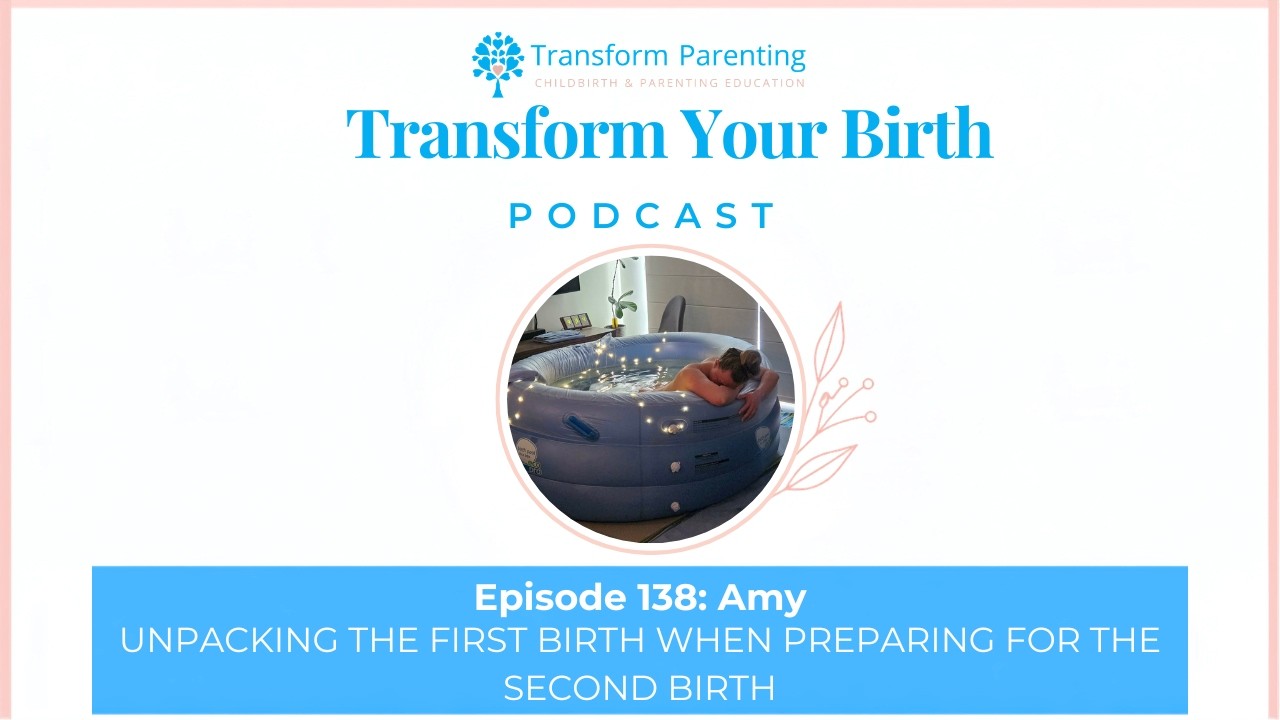
In this episode of the Transform Your Birth podcast, host Tracey Anderson Askew interviews Amy, a mother of two who shares the contrasting experiences of her first and second births. Amy recounts a first hospital birth that involved a premature urge to push, a walking epidural, a Syntocinon infusion, and a brief NICU stay for her son due to retained amniotic fluid. She reflects on the mental and emotional gaps in her preparation, noting that she focused mainly on physical measures (perineal massage, dates, tea) and lacked subconscious work, leading to fear of an emergency cesarean. The conversation then shifts to her second pregnancy, where Amy deliberately deepened mental, emotional, and spiritual preparation: extensive breathing practice (listening while falling asleep), affirmations, bodywork (external and internal pelvic release), and partner education through the Transform Parenting/Transform Your Birth course. She chose a planned home water birth with a continuity midwifery team, used tools like a TENS machine, hot water bottles, and a stretch‑and‑sweep, and ultimately broke her waters to accelerate delivery. The birth proceeded smoothly, with the baby arriving quickly after membrane rupture. Amy attributes the success to the mental work, breathing, partner support, and a clear birth vision. Throughout, Tracey emphasizes the importance of anchoring to love, letting go of fear, and creating a birth vision. The episode concludes with Amy’s empowering message to believe in oneself.
Chapters
Welcome back for another good episode of the Transform Your Birth podcast. And with me today is lovely Amy, who's had 2 births. She had her first son 2 and a half years ago, and little Frankie is now just on 4 months old. And she's with us in the podcast, so if you hear little baby noises, you'll know what that's— what that is. Thank you, Amy. Welcome, darling.
No problem. Thank you for having me.
Yeah, I am always so grateful when people reach out to be happy to share their stories because story is a great way to learn about birth through the art of storytelling. Not all stories are helpful. Sometimes stories can leave us feeling fearful. And the goal of this podcast, for those who are just joining for the first time, is to really explore what moves the needle in birth. And Amy's going to share with us today 2 birth stories, which is always good to hear because every birth teaches us something that often makes us approach things very differently as we go through time. And Amy's story is the epitome of that. So Amy, let's go back to when you were pregnant with your son. How were you feeling about birth? Were you fearful? Were you feeling confident? And what sort of preparation did you do?
Okay, so, um, when I fell pregnant with my son, I think I probably came from a reasonably privileged position of my mum had 2 home births with my brother and I, and she always spoke about birth as a really positive thing.
Right.
Never spoke about birth as being painful. It was always just an intense experience. So I had grown up with that as my kind of internal monologue around birth. And it was, you know, something that women could do. Like, women are made to give birth. We're strong. We're, you know, it's— yeah, didn't go into it with any kind of fear, really. More excited anticipation, I suppose. So we, in terms of preparation, my husband comes, he's got another son to our former partner and they unfortunately had to have a cesarean. So he had never gone through labor or experienced that side of birth.
Hmm.
So it was really important to me that we did your course, the Transform Parenting, Transform Your Birth course. So that— more so that he could get mentally prepared, I think. Because, you know, I don't know about you, but with my husband, there's only so much you can do as a partner to explain things or try and prepare them. It needs to almost come from somebody else.
Are you saying he doesn't listen to your advice, Amy? Is that what you're saying?
I mean, yeah.
What?
Um, yeah, exactly. So, so, uh, we, we did your course, which was amazing. And honestly, I mean, like, I got a lot out of it, even though I, I felt like I came from a pretty, pretty positive, um, standpoint to begin with. I also should probably caveat, I had started doing a midwifery degree, so I've Done half of my midwifery degree. So I have some of that in the background as well.
Yeah.
But I think what was almost more important was what my husband got out of your course. He just— on the day that my son was born, he just really— he was amazing. He stepped up. He was all the things you want in a birth partner. Yeah, it was really fantastic. For both of our births. Our second was much better, but the first was still an awesome birth.
Yeah.
So we did your course, we did your breathing exercises a fair bit. I actually did your breathing exercises a lot more in my second pregnancy, but I can talk about that, you know, when we get to it. We did, you know, the typical things of Um, perineal massage. I saw a women's health physio. Um, I did, you know, the antenatal exercise classes. I'm trying to think of what else I did. Oh, you know, I ate the Medjool dates and I drank the raspberry leaf tea and did all of those kind of physical things.
Yeah.
What I have to admit is, and it's only having had a second birth and a second pregnancy that I can reflect on that first one and say, I didn't— I don't think I did enough of the mental preparation.
Mm-hmm.
I think I was one of those, as Rhea Dempsey puts it, a naive birther. Like, I, you know, I had all the want and all the positive of, she'll be right, I can do it, and then did the physical preparation but didn't think much more about the kind of mental and emotional side of it. Um, which is what I really focused on with the second pregnancy.
Oh, I'd be really curious to dive into that. Well, why don't Why don't you share what happened and then how your mindset played into that?
With my first birth?
Yeah, with your first.
Yeah, so, um, with my first birth, we went through the continuity program in Canberra, um, had an amazing midwife. She was just— we, we clicked really well. She's actually a friend of mine now, um, and, you know, loved the whole program, loved the process. I got to about, I think I was 41 weeks, 41 and 2 days when I went into, or when I actually had our son. And woke up one morning, I mean, I felt great, but woke up one morning, thought I was busting to wee, hopped out of bed and thought I'd wet myself. I was like, okay, we're just at that stage of pregnancy where, you know.
Yeah.
You know, falling apart. Um, turns out obviously my waters had broken, but I didn't have any contractions. It was kind of pretty slow moving. Ended up calling the hospital. My midwife was on 2 days off. It was her second day of being off. So I thought, oh, I really don't want to have this baby today. It's got to wait until tomorrow because My midwife's, you know, not going to be in. Anyway, by the time— I think we ended up having to go into hospital to— or we went into hospital. We didn't have to, but we did just to double-check, given that I was post-dates, to double-check how everything was going. We went in. My body had started laboring, so I'd started having really mild contractions. CTG was fine. Bub was really happy. So I opted to come home and continue laboring at home until I felt that I needed to go into the birth center. I think we were at home until probably 1 or 2 AM. And all of a sudden, I was having this really strong urge to push. But I kind of knew in the back of my mind that Well, actually, it wasn't even in the back of my mind. I knew in very much the forefront of my mind that it was too soon. I knew that my body wasn't actually ready to birth. The contractions didn't feel strong enough. I didn't— it didn't feel like I was at that stage of labor.
Mm-hmm.
And so then I guess I kind of started to panic a bit because At no point in my pregnancy and labor preparation had I considered that that would be something that might happen.
Yeah.
Yeah. So I let a little bit of that fear in. And then everything that I did became about trying to stop that sensation, which I now know is something you cannot do. Anyway, so we decided to go to hospital. We had a midwife that we'd never met before who was lovely, but, you know, someone I didn't know, she didn't know me. We did have a student midwife who was awesome and had been a birth doula for a long time. So, you know, she was really fantastic. Kept laboring. I think I was about 5 centimeters when we got to hospital.
At all.
And continued laboring. I can't remember at what stage we got to, but it had been a number of hours and they wanted to, you know, check me again. And I think I'd only progressed a centimeter or so. And, but yeah, so I'd progressed probably about a centimeter, but my contractions and that urge to push had increased.
Mm-hmm.
And so I kind of kept saying to the midwife, like, is there anything that I can do to stop that sensation? Because I was really worried that, um, because, uh, my son was really low in my pelvis and he was sitting right on my cervix, I was worried that that would then, um, swell my cervix and/or do damage to his head, or, you know, and, and that labor would start to kind of almost reverse and I'd end up in an emergency cesarean. So really what I unpacked after all that was that my fear was around having an emergency cesarean.
Yeah.
And anyway, I did work on that, but I can get to that later. Um, so in the end, we ended up having Because my contractions had slowed down, even though the intense feeling of needing to push had increased, there was a really strong suggestion that I have Sinto, which I hadn't wanted. I didn't want any intervention. However, this fear was in the back of my mind. And so, and because it was, you know, it was a new midwife, somebody I didn't know, I didn't I kind of almost lost that autonomy or empowerment to be able to say, that's not what I want. This is, you know. So we ended up having Sinto, and because of that, I ended up having a walking epidural. And then within, I think it was within 2 hours of having the epidural, I'd fully dilated and it was time to start pushing. By that point, my midwife had arrived. She'd come, you know, clocked back onto work. And so she was there for the actual birth, which was really great. And was fortunate enough that I didn't have any additional kind of doses of the epidural, so I could still move my legs a little bit.
Yeah.
Unfortunately, I couldn't feel any of it, but I could— I still have movement. So managed to push him out naturally, sort of. I guess that's not naturally because I had the intervention, but managed to push him out. Didn't have any tearing. And I mean, at the time, for all intents and purposes, I, you know, I felt like it was still a great birth. You know, I didn't— yeah, there was nothing kind of really traumatic about it. Hmm.
We then—
my son ended up going to— about 2 hours after birth, he ended up in NICU. Because he had quite a bit of retained amniotic fluid in his lungs, which put a pretty big dampener on the whole thing, because he ended up being in NICU and/or special care for about 5 days.
Yeah.
So, that was an experience I never wanted to go through again. And we were very fortunate in that he was full-term. He was otherwise very healthy and it was mostly precautionary.
Yeah.
You know, but still not the experience you want to end on when you're welcoming your first or any babies into the world.
I think it's often the hardest thing. Women can go through very complex birth, and then if there's separation afterwards, that's often the part of the birth that they find the hardest, even with a complex birth. So it is difficult to be separated from your babies. We know that NICU is there to help them land safely, and we're very fortunate to have it, but it doesn't make the feelings of it very— any easier.
Yeah, yeah, that's right. And again, something that I never in my wildest dreams anticipated. I mean, I know, you know, probably most people who have their babies end up in NICU say that. Yeah, not something that I had ever considered might be an outcome.
Yeah.
But anyway, he's happy and healthy these days. And, you know, after 5 days we got to bring him home and then it was really on. Yeah. So I guess, you know, then you fast forward to falling pregnant last year with our daughter Frankie and Um, thinking, okay, right, I've got to, you know, now I've got to get back into the mindset of like birth prep. And, and I probably didn't do anything for a good few months until I got to a point of, all right, this birth's gonna creep up on us way quicker than we're expecting. What do I need to do to get in the mindset of this? What I really need to do is work on my mental state of— I knew immediately that my biggest question mark was, what am I going to do if my labor goes a similar way to last time?
Mm-hmm.
Am I going to, you know, is the only solution having an epidural? Is that, you know, or do I— anyway, so I had all of those questions going through my mind, and as always. There's only so much you, you as an individual can process without any kind of external help or advice or, you know, education. Um, we were very fortunate in that we got back into the continuity program.
Mm-hmm.
Um, however, we had a different midwife because, um, our previous midwife herself was on mat leave, which I thought was very rude, but The height of it, having a baby when you needed it. I told her that too. We ended up having a really beautiful midwife again, you know, for our second. And very fortunately, she was able to offer us a home birth. So our first midwife with our son had actually also offered us a home birth. When I mentioned it to Andy, he went like, I don't even know, gray-white. He just— it was immediate. He, you know, I thought, oh, okay, maybe not this time then.
It just—
the thought of it was way too much for him.
Mm-hmm.
Um, and really, I think I'm, I'm grateful that we had the experience we did in hospital in terms of You know, it was my first labor. I didn't know how I was gonna go, even though I, you know, had all these hopes and dreams for it. So it was really great to be able to do that in one respect, in a hospital setting, to go, okay, that's how I labor generally. You know, that gives me a kind of a baseline. That's what the hospital experience is like. What could we do differently, and how much better could it be? So when our midwife, Frankie, offered us a home birth, I thought, yeah, actually, I think that's what I'd like to do. I don't think I want to repeat my son's birth.
Yeah.
So I spoke to my midwife at the time about, you know, what, what happens if we do that? If my body kind of prematurely pushes again, what do I do? And she kept kind of saying to me, well, second time around will be different. No matter what, it will be different because your body's done it already. That's just nature. That's what's going to happen.
Yeah.
It's extremely unlikely that your body will prematurely push. However, if it does, It's probably, you just go with it. Your body, your cervix will move. You know, like, I mean, we can't guarantee, as you said, you never guarantee what's going to happen in labor. But chances are your cervix will just move out of the way. So I spoke to her about it a lot. We actually did a debrief with you about it. Um, well, about the whole birth, um, unpacked a lot of that and came back to that no matter what happens, birth with love. Yeah. Um, preparation-wise with this—
Can we just go, just talk a little bit about what needed to be unpacked from that first birth? You talked about your resistance to Caesarean. And you also talked about not being prepared to feel that urge to push, knowing that you're not quite there.
Yeah. So what needed to be unpacked was really, I guess, letting go of the fear of the unknown.
Right.
Letting go of how it might happen and coming back to that, no matter which way I birth, what I can control is how I emotionally respond to it. So if it ends up that we have to have a cesarean, that's for a reason. And emotionally, I can birth with love, even if it's an emergency cesarean that I didn't necessarily want.
Mm-hmm.
So I think working through that fear of, I guess, letting go of— I should probably also say I knew that this pregnancy and birth would be our last. So I kind of knew that this was, I suppose, almost my last opportunity to have a natural birth that I really wanted. And so there was, I guess you could see that as a lot of pressure. Yeah, absolutely.
It can be.
Yeah, um, but I think for me it was almost more of a— it was a motivator to do as much as I could to kind of prepare mentally and emotionally, knowing that, okay, well, if we get to D-Day and things don't go exactly, you know, the way we want them to go, I've done everything that I could physically, emotionally, mentally. Spiritually, you know.
I think that's a very, you know, we focus a lot in pregnancy care on the physicality of it. We measure blood pressure and, you know, pee on sticks and we do all these things to measure and quantify. But what we don't tend to focus on is that mental emotional side of things. And we think that if we read a lot or we listen to a lot of podcasts or whatever, that that will be enough. But from a subconscious point of view, the subconscious is the part of the mind that dictates physiological response. It's also the part of the mind that holds onto fears because it's protective by nature. So any fears that are not resolved can actually get in the way of a woman being able to work with birth, not against it. And so what Amy's talking about, pardon me, what Amy's talking about there is such an insightful little piece when it comes to preparation that one of the things to know is you're walking into the mystery. You don't know what's ahead. And that can be very unnerving, particularly for modern women, because we like to be in control. And we are a lot of the times. We are in control of a lot of things in our lives, although that's perceived control.
Mm-hmm.
But that walking into the mystery is what is Mother Nature's beautiful intelligence of getting us to grow. She wants to shake our foundation. She wants us to wake up to the fact that we aren't in control, that we are more than what we think we are, and to do the transforming that is inherent in the whole process. And so, you know, how do we get comfortable with that unpredictability of what is ahead? And the way that I've always anchored women, and Amy mentioned it, is we can't control what happens. We can't control— there's a lot of forces at play that we're not in control of. But what we can do is anchor ourselves to love, to birth with love, not fear, and to do whatever we can to stay as calm as possible regardless of what's happening. If you end up having a caesarean, it's that birthing calmly, gently, lovingly under all circumstances is the way that, you know, I prepare women to anchor themselves. So with that unpacking and coming to terms with the unpredictability, knowing the only thing you could know is that it was going to be different, how did that land in your system?
Yeah, so I I think in terms of— sorry, ask me that question again.
How did that unpacking of those fears, the fact that you knew it was going to be different again, the fact that you knew you were going to be walking into the mystery, how did that land in the system after you did your preparation, your birth debrief with me?
Really great. Just it. So the unpacking for me was, yeah, I guess getting down to what that, what that issue, you know, what, what it was that I was really nervous about, or, or if there was a fear, or, you know.
Yeah.
And it was simply, I mean, really, I, I didn't want to end up in an emergency caesarean.
Yep.
But the only way that I could have hopefully any influence over it was exactly that whole letting go mentally of the unknown. And, um, so I did a lot of— I again came back to your breathing exercises because they— and, and it's funny, I actually approached those very differently this time around. The first time I was very conscious and very deliberate in my listening to them in terms of, you know, every night I had to, I sat there on the couch and I listened to the, you know, this time round, I made a point every night to listen to them. But instead of sitting on the couch and like really, you know, listening, I would do it as I was falling asleep. So I would put it in my ear and start off You know, I mean, I was very awake when I started, but often I fell asleep to them because I was so, I guess, in that meditative state that, to be honest— and I don't know if this is for everybody— but I found it almost became far more subconsciously ingrained than the first round.
Right.
Um, because there was an element of conscious breathing and whatever. But then I fell asleep quite quickly into it, or I, you know, went into that other zone quite quickly that when it came to labor, I didn't have to think about the breathing.
It was just there.
Yeah, that feeling, feeling like I needed to try and calm myself down or to remain calm wasn't even a thought for second— my second labor.
Yeah.
You know, the first labor, it was very much like, okay, you've got to breathe and you've got to, you know, like, I really— I was really there with it. Um, but this time around, not at all. Um, and so that was one thing that I highly recommend to any women out there.
Yeah.
Do the breathing. And if it is simply sticking it in as you drift off to sleep, great. If it's, you know, doing it while you're doing your cleaning, great. Whatever, whatever it is that works for you, do it.
That, that's what you've described there is this, the way the subconscious works is it's less about we learn and we remember, and it's more a state of becoming calmer. So we're not trying to make ourselves be calm. We're not trying to hold on to calmness. We're not trying to make calmness happen. We're allowing it to come through. And when that, that sub— look, as I always say to people, do the course. It's great information, terrific. Partners get a lot out of it. But it's what you do when you leave that moves you from a state of thinking differently to laboring differently. Like you enter into a state of becoming different. And the way you know it happens is there's an automatic and effortlessness to it. It's just a physiological change that you can feel in your nervous system.
Yeah.
And ultimately what you're doing there is you're downregulating stress. You're moving into deeper and deeper states. You're moving into that path of least resistance where your body can absolutely optimize because there's no fear, no tension, no resistance to whatever it is you're experiencing. They are so very powerful and transformative.
Yeah. Wholeheartedly.
Yeah.
That and affirmations. So I, I did this time around, I did read, um, Rhea Dempsey's Birth with Confidence.
Yes.
And you know what's really funny about that? I, I read the book because it was recommended to me by a number of people. Um, actually, the, the first woman that recommended it to me was, um, a woman who had recently had a home birth and was at the home birth information session that I forced my husband to come to before we decided to go with it.
Yeah.
Midwife was, you know, hosting or hosting, providing an information session at the birth center. And I had kind of said to Andy, my husband, look, I know you're really on the fence. And if anything, you're slightly on the other side of the fence to me about this. I know you're also not going to take whatever I say as gospel. So you need to come to this and hear it from me.
Yeah.
And it's funny. It's just, it was one of those, I guess you call it serendipity moments of, oh yeah, when we left that information session, I thought, this is exactly the path we're meant to be on. And it was exactly this. I had that same moment with our pregnancy with Archie, my son.
We'd—
sorry, a bit of a tangent quickly.
Yeah.
So before falling pregnant with our son Archie, I'd experienced 2 miscarriages. So when we fell pregnant with him, we ended up going, you know, almost the pendulum swung entirely the other way. We went to see an obstetrician. Which again, never in my pre-fertility or pre-pregnancy parenting days would I have ever thought that that's the path I would end up on. But we were seeing an obstetrician and— sorry.
It's okay. We've got another little one in here. Hey, Archie.
Sorry about that, Tracey.
It's okay. We keep it real on the podcast. We don't care. It's a family event.
Um, so we, we ended up going down this path of obstetrics because I really— I had a lot of anxiety around holding the pregnancy.
Yeah.
Um, and so, you know, it— by going through an obstetrician, we were able to have an ultrasound every pregnancy. We were able to— you know, it felt like somehow that, um, really intense monitoring would make a difference.
Yeah, yeah.
Again, you know, on reflection, I know that that's not the case. Um, anyway, there was that, that pivotal moment at 20 weeks— or sorry, it might have been just before 20 weeks— I got the phone call from our midwife for our Sun saying, offering us a spot with the continuity program. And I remember speaking to one of my really good friends and saying, I really feel torn. I really don't know what to do. The birth center is what I've always wanted, but I have so much anxiety over this pregnant, you know, pregnancy generally now and, and distrust with my body. And, and she just said, this is just the universe telling you that, hey, Don't forget about who you are at the core and what really matters to you. Go with this option. And so we did. We went through, I mean, as we've discussed, we went through the birth center and it was amazing. And I, you know, so anyway, I just—
It's very easy to make decisions based in fear.
Exactly. Yeah.
So what you did is you moved away from fear and you moved towards actually a greater truth that had been living inside of you. That's a powerful decision right there.
Thank you.
Yeah.
And it was exactly reflecting on that decision in that moment with this pregnancy when we'd been, you know, my midwife for Frankie's pregnancy had offered us a home birth a couple of times in, you know, in various appointments. And each time I thought, my husband will never go for it. You know, And then I got to this point where I was like, hang on a minute, it's not about him. I'm the one that has to do it. And actually, he can just get on board. So we ended up going to the information session. At the information session, there was this woman who had just recently had a home birth and had had a home birth with our midwife. And she was talking about Rhea Dempsey's book and how great it was. And again, for her, it was her second labor and birth, and she'd read Rhea Dempsey's book the first time around, and so she reread it the second time around, had an amazing birth. At the information session, our midwife had another midwife there to share in the session. Um, that midwife was actually somebody that I had studied with, and beautiful woman, and they work together majority of the time. So when you have a home birth, you have to have a second. Um, so our midwife, um, said, you know, this other woman was her preferred Kind of second midwife, I suppose. And I walked out and I just thought, yeah, this is that.
I want those 2.
Exactly.
I'll have— I'll have that. I thought, yeah, he got on board.
Yeah, so hubby got on board, and then he, he, he not only got on board, I remember the first time we had to come into hospital after we'd had Frankie We were sitting in the birth center waiting for our midwife to, you know, postnatal appointment. And there was another woman in there who was pregnant. And all of a sudden we were talking about home birth and how amazing it was. And my husband turned to me after she left and said, have we just become home birth vegans?
Home birth vegans.
Oh my God. So, you know, how do you know when there's a vegan around? They'll let you know. When there's somebody who's had a home birth, they'll let you know. Now he tells everybody about how great they are, and, you know, everyone should—
Oh, he's a convert. So tell us how it happened. Tell us about the second birth.
The second birth, um, I have to just like preface this with I had really put a lot out into the universe. I, I mean, I, I did everything that I could, I felt that I could do. I read the Birth with Confidence book. I listened actually to The Great Birth Rebellion.
Yeah.
But specific episodes I really honed in on. Okay, what is it that I need to work through? And it was the fear of cesareans, the fear of pushing prematurely, and also just like generally, hey, let's get back to the whole relaxing into this and accepting what will be will be. Um, so really got in the zone for that stuff. I didn't do any of the, um, perineal massage. I didn't do the raspberry leaf tea or the Medjool dates. I just thought, nah. What I also did was, um, I saw Lo and had some bodywork done. Oh my God, Tracey.
Yeah, right. So Lo Mathias is, um, she's on it on the podcast. You'll see an episode with Lo and she does internal pelvic release work, which helps women to relax into the pressure that happens within their bodies with a baby in there. And ideally create more space for baby. Yeah. Wow.
He also reminded me that Even though I had labored before, that body is a different— I mean, not physically, like, obviously I am still me, but it's quite physically different, emotionally, spiritually, everything.
Yeah.
To the body that I am, or I was, pre-Frankie's birth. And so we did external bodywork as well as the internal pelvic floor. And I just— everyone needs to do it.
I don't—
I like, oh my God, she was amazing. Really beautiful person, really gentle. Just, it— I feel like it, you know, it was another one of those things of, okay, now I physically put my body in the best position it can be in.
Yeah.
As well as doing the mental work and the emotional work. So when it came to labor. I also had been, you know, I mean, I talked to myself a lot. I talked to the universe a lot. Um, I had, I think I described it to pretty much anybody that the universe just really understood the assignment and nailed it.
Are you telling me you made things happen? I think I might have. You were in control?
I think I put it out there and it was all like, sure, why not?
Yeah. Look, I think I think you did the work, and, and I don't think you can underestimate what we can manifest within ourselves when we unlock ourselves, we unlock our bodies, we unlock our minds. Yeah, you got to tell us what happened. I'm sitting on bated breath here.
So, so I, um, a few of the things— so just a few of the things that I really wanted were, uh, because we were going to be at home I wanted to have a water birth, so we hired a birth pool. I wanted my mum to be here to look after our son.
Mm-hmm.
As I mentioned before, I've got a stepson who is, you know, I mean, he's 14, and I didn't think he would, you know, be that into being here. So we had kind of a contingency for if he was here, what would we do? The— just all the stars aligned. It wasn't our week with him. My mum at the time was looking after my son on Wednesdays, so, you know, she was here on the Wednesday. She always stays overnight because she lives out of town, so she was here the night that I went into labor just naturally. Um, yeah, so I had an appointment with my midwife on the Tuesday I was 40 weeks and had kind of said to her— oh, well, sorry, she had told me that the second midwife who I really wanted, I just knew that they were my team that I needed to, you know, wanted, not needed, wanted. She was going to be going on leave on the Thursday afternoon for 2 weeks. So I was like, pressure's on. I've got 2 days for this baby. Let's get it done. Um, so, you know, chatting to my midwife and she said, look, you kind of— you're doing the things that you can do, you know, apart from—
Just gotta let it go.
Sex with your husband or, you know, doing, um, a stretch and sweep. You kind of, you know, it is what it is. I thought, yeah, you know what, let's do a stretch and sweep. I didn't do that with Archie. I know it might not happen, you know, it might not eventuate into anything, but let's give it a go. I'm happy for that. I know it's technically intervention, but I'm happy if it means that I've— if nothing happens and I get to next week and I go into labor, I think I would reflect on it going, What if I'd done a stretch and sweep?
I think they only work if you're ready.
Yeah, that's exactly what our midwife had said. So anyway, we did that Wednesday. Nothing really, you know, I got to about lunchtime. I thought, I don't think it's worked. Nothing's really happened. And then I went to, you know, and I started feeling like really almost Really mild period pain. Oh, could be, but you know, that can also fizzle out. I went to the toilet and wiped, and my whole mucus plug was there. I thought, whoa, okay, didn't— I didn't see that last time. That's pretty cool. Um, by Wednesday night when we were going— just before we're going to bed, I started noticing that I was getting these sensations pretty regularly. And I kind of just quietly looked at my, you know, phone, checked the time. It was every 10 minutes.
Okay.
All right, cool. That could be, that could be something. Let's just go to bed, try and get some sleep. Went to bed. 11 o'clock, I woke up with a contraction. Okay, I'll go to the toilet and then I'll, you know, just see, you know, sit with it for a little bit and see if there's anything. And I might try and Went back to sleep. Then I woke up at midnight with what my friend would describe as a spicy contraction. I thought, oh, okay, I might just get up and sit. We've got, um, you know, a rocking chair in our room, um, with all the preparation throughout. Well, we didn't know we were having a girl, but preparation for a daughter. I'll just get up and I'll sit and I'll just listen to my breathing exercises and get really in the zone. And hopefully, you know, that creates the environment for oxytocin to not— you know, as, as you've discussed, not in this, um, chat but in the past, you always talk about oxytocin being the shy hormone. Let's just see if we can encourage her to, you know, do her thing. So I sat in the chair and listened to the breathing, and I just I went off into that meditative state. And I don't know what— I can't really— I think it was probably an hour later. I must— maybe the breathing episode or something had— the track had finished. And so I went to, you know, open my eyes to turn it back on, and my husband's sitting up in bed just watching me. Oh, sorry, was I being noisy? He goes, is everything okay? What's happening? Oh, look, I'm just in the early stages of labor. You go back to sleep. Nothing to see here. I said, okay, I might just go and get the birth pool ready and, you know, just like get everything kind of like the birth pool pulling up and everything's sorted and you just keep doing your thing. Okay. So I kept just, you know, going through it. He came back in about 20 minutes later and he said, How often are they happening? I don't know. I'm not— not— they're not— then, you know, they're very early. Like, it's not intense. It's not, you know, I'm breathing through it. It's fine. So he timed me, and it was every kind of 4 or 5 minutes, lasting for a minute. And I thought, oh, I thought it was about 20 seconds.
Yeah.
I'm just going to call our midwife because, you know, she really— she needs 40 minutes notice. I think it's better if we just call her and we could talk to her about it. I thought, way too soon. And I mean, in one sense, it kind of was, because our daughter wasn't born until kind of, I think, nearly 10 AM. But it was that universe thing happening of he called our midwife. By the time she'd gotten ready and hopped in her car, to call the second midwife who lives much closer to us. The second midwife, when she was hopping in her car, she got a phone call from another woman who was laboring, who wasn't her woman, but was a woman she'd kind of taken on at the last minute and was going to be— she was going to be birthing in the hospital. And she had this moment of, oh, do I go to Amy's home birth? Or do I go to this woman's birth in hospital? Anyway, she'd taken the phone call from our midwife first, so she went, no, I'm going to go to Amy's birth. She really wants me there, and it's a home birth. I'm doing it. So had Andy not called at the time that he did, we wouldn't have had the second midwife.
Mm-hmm.
Anyway, they came over. I have— I suffer from FOMO. So I'd been really beautifully laboring in our bedroom in the dark and quiet, just, you know, listening to the breathing and your dulcet tones, really perfectly in the zone. And then I could hear the midwives arriving. Oh my God.
Say hi.
So I came out and, you know, and then my mum had woken up and And Andy just said, nah, your labor is going to slow down. We've got to get you out of your thinking brain, back into the zone. So he ushered me back into the white bedroom and kept waiting.
Smart man.
He— I cannot tell you, Tracey, your, your course prepared him very well.
So he, he really nailed it, hey?
You really nailed it. Um, basically, yeah, so we— I just kept laboring. Contractions were progressing nicely. Um, I ended up using a TENS machine when it felt like things were really intensifying. Had a TENS machine and a hot water bottle. Those things are legendary. I don't know why people don't use hot water bottles more.
They're fantastic. That's huge.
So we got to a point where I said, all right, um, can I hop in the bath now? You know, and, um, both the midwives had said, yeah, go for it. If, you know, if your labor slows down, like if it's too soon, your labor is going to slow down and then you just get out. Okay. So I hopped in and that was amazing. The feeling of being in the water. Oh my God. But my labor did slow down a little bit. And so then reluctantly, I hopped out. I went to the toilet and thought, I wonder where I'm at. I want, you know, I wasn't exhausted. The contractions, I felt like I was handling. But if I'm being completely honest, it was so uneventful that I was almost getting a bit bored.
Right.
I really wanted to meet this baby.
Yeah.
You know, so spoke to the midwife, and my— our main midwife, and she said, look, I can check you if you want, and depending on where you are, if you want, we can— I suspect that you're probably 8 centimeters, and if you want, we can break your waters, but it will really intensify, and baby will be born probably within half hour, 45 minutes. I thought, let's do it. I'm really keen. I just, you know, it's— and like I said, I wasn't at any point over it. I was— I felt like labor was great, you know.
Mm-hmm.
I was loving it, but I also was like, yeah, I could do this for another 5 hours, but I kind of just want to meet this little human. Um, so anyway, yep, we, uh, checked my cervix. I was 8 centimeters, broke my waters. My waters were really tough, so, um, had we not broken the membranes, I probably would have, um, had Frankie on call. Um, but I'm totally cool with the fact that I didn't. And it absolutely did get intense. I hopped back into the birth pool, and I feel like it was only 2 contractions and she was born.
Wow.
At no point in that did I feel like— Rhea Dempsey talks about this crisis of confidence. I kept waiting for it to happen. I kept waiting to get to that point. And I'd had affirmations written on a little whiteboard and all these strategies. And I remember Melanie Jackson from the Great Birth Rebellion talking about that point of crowning of just remember, it's just a stretch. And I remember because I had all of that was a new experience to me. I remember thinking, it's just a stretch. And I think I actually said it out loud. And so birthing her, her actual head coming out was really slow. And then suddenly she was here.
And I thought, Wow, I can't believe it. You did.
Um, it was amazing. It was just the best. And then to top it all off, she's a girl. Like, now I've got one of each.
After 2 sons.
Yeah, right. Like, yeah, just incredible.
Um, wow. So when you look back at that now, Amy, what do you think made the biggest difference?
I think, I think probably, oh my gosh, um, the mental and emotional work that I did on preparing my mind for— well, yeah, that and the breathing. I think just Reminding myself that I can do it, that labor is— it's not bigger than me, and that it's a privilege. And yeah, I mean, I'm not really sure that I could nail it down or, you know, reduce it down to one thing. But absolutely having a partner that's incredibly supportive makes a huge difference too.
Yeah, I hear that a lot. It's, you know, the body, preparing the body, preparing the mind, having a partner who knows what they're doing and utilizing the breath. Because when you breathe a certain way, that sends very powerful signals to your body as to whether you're in danger or not. And the deeper you can go into that parasympathetic response, the better. Amy, Thank you so much. Your story is a beautiful story around doing the work of mental and emotional prep and spiritual. I'd call it spiritual as well. I liked how you talked about the universe and putting it out there and having a bit of a vision around what you wanted your birth to be. That's something sometimes we're scared to do.
Mm-hmm.
But it's one of the things that I often encourage. Well, I do encourage all of my couples is to create a vision around your birth because your mind moves towards what you focus on. What you focus on, you fuel. And so having a vision of the people you wanted there, how you wanted it to be, having the water, having your mum there, all of those little components did end up coming together for you. And who knows how that works.
Right.
But every birth takes us on a bit of a ride, and you rode that train beautifully. to awaken more and more of yourself and what you could bring to this experience. So absolutely magnificent. Thank you so much. Is there one little message you want to finish with?
Oh goodness. Um, just, uh, well, my God, believe in yourself, I guess. Yeah. I love that. Yeah.
Women have done this forever.
Absolutely.
Beautiful. Well, thank you listeners for tuning in. It's such a privilege to bring these amazing stories to you. And birth is one of those catalysts into parenting. So it's something to pay attention to, and it is worthy to do the work to be prepared, can at least move the needle in the right direction. See you again.
More from Tracey

Ep 140: Kate — A healing VBAC: Facing fears, finding trust and birthing a big baby

Ep 137: Eli - Yoga teacher, two very different births, induction and power of breathing

Episode #136 Dominique: Physiological birth, using the power of the mind, importance of preparation.
Ep 135: Bilal - The importance of the nervous system.Chiropractic care through pregnancy and birth.
Ep 134: Bilal and Chelsea - From homebirth to hospital birth, adapting to the unexpected.
Ep 133: Daniella - Homebirth, partner support, the love she felt meeting her baby.