Transform Parenting Pathway Information Session
Tracey Anderson Askew presents Transform Parenting Pathway, a 12-pillar online program for families from pregnancy through early parenting. The facilitator model runs six months of fortnightly sessions plus six months of monthly follow-ups, costs AUD 4,500, and trains midwives, doulas, and birth workers to guide parents through identity shifts and inner work rather than information alone.
Chapters
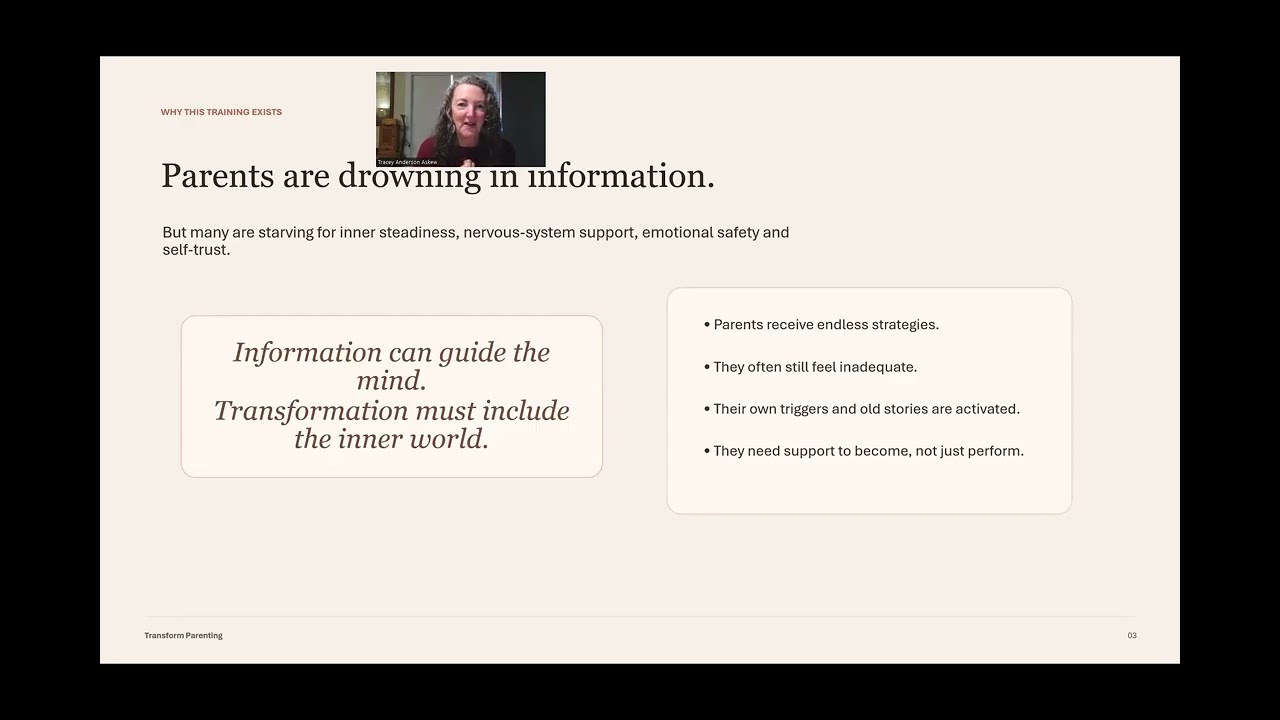
Welcome everybody. Thank you for showing interest in the Transform Parenting Pathway. I'm, I'm so very, um, touched by the extent of the interest, which has been lovely. And, um, I was just telling the girls beforehand, I have felt so blessed to do the work that I have, but it's, um, it felt very heavy of recent times, and I think I realized that I'm actually blocking what's possible here, and I really want to open up Transform Parenting to others, and particularly the pathway. So that's what tonight's about. Um, so let me just, um, help. Like, if you're watching this, it might be a good idea to grab a journal or a pen and paper because I am going to do a little bit of an experience of the sort of stuff that we do. Um, I'm going to start with my background. We'll look at the pathway, you'll have an experience of the pathway, and then I'll open it up to questions. So, um, feel free to do that. So let me share a bit of a story for this woman here. This was my Maggie. So here I was at 38 weeks pregnant, realizing, oh my God, I've got the wrong doctor. And that was a huge thing to discover at a late time. But that pathway led me to realizing a couple of things: that different doctors have different ideas about the best way forward, but it also led me to meeting this beautiful woman, Maggie. And when I met Maggie, it was— it truly was love at first sight. There was just something about her that just struck or, or nourished something very, very deep inside of me that I kind of wasn't really aware of. And, and one of the things about working with Maggie and what was so different being with her was that, you know, when I'd go to the doctor, they'd measure and they'd weigh and they'd do all these things. But when I was with Maggie, she'd sit down and she'd say, how are you, darling? And when she got to know me, she wanted to know a little bit about my background. She wanted to know how supported I was. She wanted to know about the relationship with my husband and how he felt about becoming a father. She included him in the conversations. What a concept! And she wanted to know if I wanted to breastfeed. So there was just questions she asked me that made me realize, oh, there was this feeling of, oh, you actually get this. I don't know how I knew that to be true. And of course, this was an independent midwife of 30 years experience, so she really did know what she was talking about. So it was very clear to me that I needed to be with this woman. And as I got closer to birthing day, my blood pressure went up, and she gave me a blood pressure machine. She wanted me to check it, and it was apparent that it wasn't always up. It was only up when she came, and I blamed her. I said, 'It only happens when you come.' And as we got talking, she realized that there was a part of me that was quite fearful And we got to talking about that, and she did a bit of a fear release exercise. And as part of that, she got me to do a birth picture. And this— I found a picture of my birth picture, which is amazing— which, once we release the fears, she got me to focus on what it was that I wanted to achieve in the birth, not what I didn't want to achieve in the birth. And so this was a whole different way of working with people that I'd experienced And Maggie, in that labor— God, this just makes me cry when I just look at this— of, um, how she worked with me and how she helped me as a first-time mother to find the power that I had inside of me to birth this baby. I mean, look at the way she's looking at me and Peter. I was so surrounded by love. And there it was. That was my transition into parenting. And so as a result of that experience, a whole new me had emerged. I remember saying to my husband, you know, I feel like everything before today was a dress rehearsal, and now this is the real thing. So something got ignited in ways that I couldn't have even imagined. And so I tell you that story because I think when I look at the impact that Maggie had on my life and then the impact I've had on others, I think we can't imagine how a good conversation or relating to each other on those deeper levels can unlock what we all have inside of us, which is a deep, profound inner intelligence and knowledge about what is right for us and what is the path forward. And so Maggie helped me to really understand that. Now, when I think about my pathway as a result of that, you know, I've worked with families for over 25 years. And firstly as a doula, that's where I wanted to start, and then an educator, and finally a therapist. I've created programs and workshops and podcasts and, resources. And I've worked from birth, from pregnancy through to birth, to toddlers, to early parenting experiences. And I've been influenced by teachers of the subconscious like Marisa Peer, Joe Dispenza. I've explored the neuroscience. I've looked at internal family systems, which is the stuff we do with the inner guidance work. I know a couple of you have done that. And really, when I reflect on my journey, I was like a detective. I just always wanted to know what moves the needle. What can I do as somebody— like, I never saw myself as above anybody. It was more a case of what can I do to walk beside the people that I work with and help guide them on their path? Not give advice, not become more noise, but to actually light the path and light the way and help them to discover their own inner truth and their own inner resources. And so one of the things that I've discovered is families don't need more information. Information now and bloody AI is a whole other level too. Like, my, my current Thrive group really pushed back on the first exercise I gave them, which was to stay off Google and AI. And one of the mothers said, oh, but AI talks to me so nicely and it even puts emojis. I thought, that's kind of it, isn't it? That's what we want. We want people to speak to us nicely, but we also need, I think, elders or people who've traveled the path before us to help guide us, not just in terms of tips and tricks and techniques and all of that, but something much deeper, much more profound. So let me just take you through now. A few things, a few ideas about how this is quite different, this approach to, say, any other childbirth education. Parents are drowning in information. There is a lot of noise, and information can guide the mind, but transformation is the work of the inner world. And that's really what's going on, okay? They need support to become, not just to perform, not just to survive, not just to get through it. And modern parenting is intense. It's very intense because it's expert-guided, it's emotionally draining, it's child-centered, it's fueled by technology, it's very expensive, and it leaves parents feeling inadequate, confused, overwhelmed, and not enough. And so when it comes to finding our way through it, there's different parts of ourselves that we need to explore. Now there's this place in the middle which is that grounded, centered self. I call it Self with a capital S, or sometimes in the inner guidance work we call it self-leadership. And when we come from that place where we're not in defense, we tend to make better decisions, we have a greater sense of what's going on for our children, and we have access to a higher wisdom which is inspiration, intuition, creativity. What gets in the way of that is our defense systems, okay, which is the unconscious programs that sit deeply inside of us, and under certain conditions they get triggered. And when they get triggered, it changes the way we want to potentially show up as a parent. And of course, parenting is such a triggering event. Parenting Your parents, as well as your significant people in your lives, are always the greatest teachers, and they're the ones that help us with those old stories, experiences, and imprints that come up and hijack ourselves. And so exploring this part of parenting is what helps us to build a whole different relationship with our children. It's what helps us to show up very, very differently. So we're going from behavior management to a space of consciously becoming. And so the question is, what is being awakened inside of us when we become a parent? What is being activated? I say time and time again, it's not the type of birth that matters, it's what's being activated in that mother as a result of the experience and as a result of having a baby and as a result of having a partner or significant people in her life. And in parenting, we've focused a lot on, you know, getting them to sleep and feeding, getting— overcoming feeding challenges and, um, all that information, but not enough on what is being activated inside the mother to help her to navigate her path. So the program feels very, very different. And it's a 12-pillar journey through the family of becoming. So I'm going to show you now a different part. One of the things— sorry, to get out of this.
Sorry. Hey.
Here we go. So what I've done is I've created— I've, I've pulled together and curated. I mean, God, I've had so much content. You can imagine the things I've been creating over the years, and it was a little bit overwhelming. But what I was able to do is to really curate it and to really look at how we can, um, deal with pregnancy, birth, and connected parenting from the inside out. So this is the online portal, and this is something that you'll be able to have and keep, um, as a, I guess, a library of possibilities and ways of working with people. So in the earlier, um, the earlier modules is the pathway, the core belief that sits behind it, and the flavor of this work. It looks at the modules which are the 12 pillars, the delivery options for facilitators, so under what conditions you might offer this work in whatever container you might be working in, the facilitator's role, the facilitator training outcomes, and the detailed curriculum. And tonight you're going to get access to that, those modules, um, they don't cost you anything, it's just for you to have a look more deeply to see if this work calls to you And then the part of the modules that are part of the mentoring option is looking at pregnancy as an identity transition, attuning to the baby within, helping parents to really connect to that baby, the inner authority in pregnancy. So really learning, you know, how to step up and start to advocate for yourself, choosing your model of care. These are, these are real needle movers. Preparing for birth and creating the right support, dealing with, with advice and other people's stories. That tends to be the biggest challenges. And then of course we've got the birth process. Now the birth process is very much around based on the Transform Your Birth program, but we look at the newborn care and basics, the stages of labor, as well as postpartum recovery. There's a whole lot of lessons in there. And then the parenting journey, Connected Parenting from Inside Out. So we're looking at bonding, promoting healthy development, and understanding your baby's cues. And then this piece, which is really working with the mind, and it's the mind that holds those unconscious programs, the old stories, the old imprints, the old experiences. And so creating a vision for your birth The emotional preparation exercise, harnessing the power of the mind, learning to trust your body in labor. And these once again is the Transform Your Birth stuff. To birth choices and the birth map. And it goes on into parenting, landing as a family, learning your baby's cues, feeding, sleep, and connection. What babies need when they arrive, what you will need, the matter of sleep. Breastfeeding, getting set up, birth integration. And then we look at the thriving as a new parent. So all of this is really the culmination of the work that I've been doing in different boxes, but I've put it all under the one, um, umbrella. And then we go into parenting of older children, so triggers, limits, playful connection. And ultimately, there will be core facilitation practices. So one of the things that is really something I've honed over a long, long time is how to be an effective facilitator of these types of experiences and learning. Because the information is there and it's in the modules and you'll always have access to that. But it's the ability to use it in your unique circumstances that is an important part of the learning that will go with this. And so we'll look at the practices. There'll be an assessment and certification pathway to help you, um, you know, achieve your learning goals. And then also we look at licensing and IP protection. So when I think about this work, you know, I'm very focused on, um, giving people access to the information but not being dogmatic about how you use it and under what conditions you use it. The only thing I would ever ask is that you obviously obviously reference Transform Parenting and help to build that name as being something that not only reflects my work but the work of a whole lot of others as well. Okay, does that sound good? All right, let's have an experience now. Would you like an experience? So how about you just get comfortable in your chairs, making sure you're sitting on your sit bones and your diaphragm is open. And if you're in a position to do this, just give yourself a moment to just really tune in. So perhaps you close your eyes, but you don't have to. You might to leave your eyes open or closed and just do those 3 slow breaths, very deliberate. Breaths, letting it be gentle and slow, communicating to your mind and body that there's no hurry for that next breath, no hurry at all.
That's good.
And this is a little exercise on the parent you are becoming as a result of this experience. Parenting does not just ask, what does my child need? It also asks, who am I being invited to become? And you don't need to be perfectly calm, just let yourself arrive. Feel the breath going in and the breath going out. I'd like you now, in your own mind's eye, to bring your own child to mind, or if you don't have a child, a child that you support future child, or a child who needs safe adults that you might know. So just bring a child's little face into mind. It's no judgment, we're just noticing now. And I'm going to ask you a question, and when I ask this question, I want you to notice what arrives as a result of this question. And the question is, what does this child awaken in me? Not what's wrong with them, not what needs to be fixed, just what is awakened in me. What does this child awaken in me? Let the answer come from your body, not the performance mind. See if you can detect the difference. And when this child is struggling, what part of me tends to show up? Is it the fixer, the controller, the rescuer, the avoider, the perfectionist?
The critic or the overwhelmed one?
There's no shame about this, just awareness. We all have parts like these. And so when your child is struggling, what part tends to show up? What's the strongest part? And as a result of this awareness, what quality am I being invited to grow? Is it your steadiness, your calmness, perhaps trust, trusting in the child? Maybe it's softening or yielding into what is.
Maybe it's boundaries or leadership or compassion or courage.
Patience, or the ability to come back and repair. See, the goal is not perfect parenting. The goal is more conscious choice coming out of those parts, those unconscious stories, into self-leadership. And we can't do that if we don't notice. So what is the one quality you feel invited to grow as a parent, a professional, or a facilitator? I'll say them again. Is it steadiness, trust, repair, courage, patience, softness, acceptance, and yielding? Boundaries, calmness, presence. What this is doing is helping us to become more present. And so what you just experienced is really the heart of the pathway. We're not asking, how do I stop this behavior? We're asking what is being activated in the adult, what story is running on underneath the reaction, what does the nervous system need, what kind of family culture are we creating, what repair is possible. And you learn how to hold this kind of process safely, with warmth, with structure, boundaries, but also practical Integration, implementation, change, creating change. And so we're guiding people inwards through these reflective prompts, nervous system noticing and self-pacing. We're naming the patterns, the stories, the triggers, the defenses, the values and the needs, and we're creating repair, new stories, connection, loving limits. Creating our family culture and the practical side of parenting as well. Okay, so just pop in the chat for me. You can come back out when you're ready and just pop in the chat for me. What were the things that— what was the word, the one word that's being activated in you as a parent Hope. I like that one. Beautiful. Any others? Compassion. Steadiness. Presence. Safety. Mm, nice, Samantha. It's excellent.
Self-leadership. Beautiful.
I think in my presence— sorry, in my parenting at the moment with adult children and now being a granny, which is just so very exciting, um, what's being activated in me is another level of letting go. And yielding acceptance. Yeah, so we're always changing, and our children do remain your greatest teachers. Doesn't matter how old they are, it is a life sentence. You know that, don't you, people? Okay, so let's just have another look at now a little bit about the Transform Parenting pathway. So what I've developed is the online platform which goes with this, which means that you can access any of the modules at any time depending on what sort of work you're doing. So it's always there for you to go back to and reflect and utilize both for your own parenting but also beyond that. And the whole, um, mentoring is I'm a great believer in experiential learning, so it'll be me taking you through certain exercises to support your own inner guidance around this. We can't take people where we haven't been ourselves. And so because we are talking about the inner journey, we need to have a great sense of our own inner landscape. And I know a lot of you do because a lot of you have already done the inner guidance work with me, and that's such a powerful foundation for this type of approach, because that self-awareness helps you then to guide other people in the same space. So we're looking at 6 months fortnightly catch-ups for 2 hours to go through the 12 pillars, but also to do the exercises ourselves. So it'll be very much a personal development program as much as it is supporting you to offer this to other people. Um, I have set the date for Friday the 19th of June from 1 till 3. The cost over the 6 months is $4,500. It's a fairly significant investment, but it does include that online platform, and it'll also include another 6 months of monthly catch-ups. Because one of the things— I think my, probably one of my most significant goals in this work is to create a community where we can come together and continue to support each other to grow. Because 6 months is going to offer you a beautiful pathway of growth. But it's the— it's then taking the work and implementing it and having a safe landing place where we can catch up and support each other and continue to grow in this space. So I don't see it as a 6-month experience. I see it as much more significant than that. Because ultimately I want to see the impact of this work grow beyond what I can do. And, um, I plan to do a bit of grandparenting in all of this as well. So I think I've said all of that. Yeah, practitioners called to deeper family work, especially those who know there's more happening beneath the behavior and advice. So it's for birth workers, hypnobirthing, calm birth educators, um, family support workers, and also parents, which should be on there but it isn't. Oh yeah, parenting it now.
Parents. Yeah.
So I want you just now to just reflect on— notice what's happening for you now and just get a sense of whether this work is calling you. Let this information land in your body. I don't want you to make a decision from scarcity or from, you know, hustle from me, although I can hustle. Um, I wanted— I want people to do this that feel called. I really do believe people in this field tend to be called to do this work, and this is another opportunity to take the work that you're doing or the parenting that you're doing to a whole new level. And I've included parents in this because whether you, um, you know, have an ex— like a background in this field, or you've been a birth worker or not, that, that's a great foundation to have for this work. But parenting itself is the foundation of this work. And so if you feel called as a parent to work with other parents, whether it be as a parenting coach or running new mothers groups, women's circles, All of that is open and available to you. So I'm not, you know, giving you this idea that you, you know, I want you to work this way or you work that way. I'm gifting you with the opportunity to take some very well-developed teachings into different containers. And the only thing that I would ask is that this work is always referenced. I mean, this work was developed through the support of the Joe Dispenzas and the Marisa Peers, and I always like to acknowledge the people who taught me what I knew— know. And the same for this work as well. Okay, um, so if there are any questions now I'll just pop this on here for a moment. If you've got your phone, you may want to, um, just use this QR code. I think it will also come to you via an email. Hopefully Carmen's got that sorted. But what happens now is you fill out a form. You don't have to commit. You fill out a form giving us a little bit of an idea about who's interested. And even though we've set Friday as the day, I am open to it being at other times. So that form will give you an opportunity to express the times that you might be available. And I am open to working on a weekend around this, so a Saturday or a Sunday— probably not Sunday, Saturday, could be an afternoon. Um, so that is absolutely a possibility of doing it another time besides the Friday. I just set it as a date, um, it's just a place to start, but it Um, this particular QR code will take you to a form, and also as part of that, it will give you the first few modules of the online platform. So you can go through those modules and really get a sense of the flavor and what it is that this work is about. Hopefully I've given you a bit of an idea of that tonight, but just for you to go further. So that's there for you to look at, and once you fill out the form then I'll probably give you a ring and talk to you about, um, the interest and how it might go and when we might start, and then we'll be off and running. So now is the time for questions. I'll just have a look at the chat to see if there are any questions. Doesn't look there is at the moment, so Anybody like to ask me anything? Awkward silence. Yes, Samantha, go darling. Thank you.
Do you see, um Can you give some examples of where you would see people working? And if, if this would lend itself to what I'm about to say, if you didn't necessarily, even at least initially, didn't want to set up, say, your own business, you know, if that was too big and scary or overwhelming or too much work for the moment.
Yeah.
Were there— is there any kind of areas where you could see this working, um, in other— in, you know, you know, yeah, you know what I'm talking about.
Yeah, yeah, yeah. So from a midwifery— because I know you're, you're an emerging midwife— from a midwifery perspective, this would be particularly if you got into continuity and you actually have the time and the space to talk to women on this level, this would take your work to a whole new level. You would be able to pardon me, identify the sort of, um, limiting beliefs and fears and things that could get in the way of birth. You would know how to help them to process that, like my Maggie did for me. Um, postnatally, you would be directing them more towards their inner resources rather than, you know, becoming the hero of their world and giving them advice, and which a lot of midwives do because they've got all this experience, so they just spew that out on the, the new mother. Um, so I think from a midwifery doula point of view, it would deepen your work enormously, um, because it would take the relationship with the woman to another level if she's ready and open for that. You know, it's, it's a very individual thing. From the point of being in the community, I could see running, um, like creating women's circles is a great thing. Women love it. And you could, um, it just— and it doesn't even have to be a business, it can just be a gathering and people contribute for your time. Um, I can see that some people— I, I can see that Transform Parenting itself will also have a reference for people who've done this training and could act as a parent guide or a coach or a listening partner that people— because what I'm finding, particularly in the village that I've got going now, we've got over 100 families in the village, which is really wonderful, some more active than others, but just the idea of having a community that people can go to and bringing in certain people from this training to run sessions with my villagers. And, and so Transform Parenting might also be an opportunity to be paid for that work, like lovely Kylie who's on here. She's one of my favorite Thrive facilitators who comes on and helps run groups. So I'd like to see Transform Parenting accessing more families and running more activities, and I can't do it all. I also see that the Transform Your Birth course is still quite popular, although my numbers have dropped. I think the cost of living has been, um, weighing on a lot of people. But even that course is something that I can't keep doing on my own. I want other people to come and share the load and teach different parts of it and co-teach, so that if I get sick— because right now I've got so much fear— and if I get sick and I've got 20-odd people turning up on a Saturday, that can be a real difficult things. So I think there's lots of possibilities. A lot of people on this call, I think, are mainly from Canberra, but my goal is to roll this out to other places around Australia as well. And that, you know, and having the support and to build the brand of Transform Parenting is, is it's like the mothership that can be there to support people, can hold space for people's learning, to create a community of family workers, whatever we end up calling that. But this initial cohort will be pretty special because you'll be sort of the founding group. You will be getting it a lot cheaper. I plan on charging a lot more than $4,500 um, when it, when it really is running, because it is a huge body of work that will support people in all sorts of different ways. Um, so yeah, I, I really can see it spreading across a lot of different platforms. Does that answer that question, Samantha? Yeah, yeah, I want more playmates. Yeah, so the, the founding cohort will be pretty special because they'll also be helping me to continue to develop the work and, um, yeah, giving me feedback on what's being effective and what isn't.
Yep.
Any other questions?
I just put a couple in the chat there, Tracey. Thank you so much for the session. I had chills when you showed your birthing photo. Um, so beautiful. So thank you so much. Um, I just wanted to ask a couple of out-of-the-box questions, like, will you talk about your business logistics? Because I found you have such a great model, like, especially like appointment reminders and how to— like, I don't know much about all that stuff. That was my first question. Um, and then my second question was like, would you cover tough scenarios? Like, I'm just fearful that what if, you know, I have 20 people and but one person freaks out and has a bad experience and like how to cover that. Is that something that would be covered as well?
100%. That is the facilitator role is one of the most significant parts of being able to deliver because information is great, but it's the application of it that's important. And so when you're working in a way that's a lot more, um, that's deeper and can be triggering. It's very, very important you set the scene for that. So a lot of that is around the foundation that you lay from the very, very beginning. Um, also knowing what's in your scope of practice and what then needs referring. So, but I want to take the pressure off you to feel like any of you have to get it right. When we go in with positive intent to be a guide walking alongside someone, we're not presenting ourselves as an expert. We're not presenting ourselves with the answer to everything. We're not presenting ourselves as, you know, someone highly professional. And, you know, I tend to think professionals tend to pathologize birth and parenting. We're not doing that. We're coming back to grassroots community connection. But it's a little bit more like a role of eldership. It's, I've traveled this path and now I'm going to support you to travel your path. So if somebody was, um, really struggling, or you were able to help them to unlock a story that came with a lot of big feelings and the need to move through that, well, one, you have me, because I can work with— I did my clinical hypnotherapy training last year, and I'm working more and more with complex cases. Um, you've got referrals through Transform Parenting, but also beyond that as well. We have a resources page that we can always continue to update as we develop this work. So, and you would be very, very well supported because you'd— even after the 6 months mentoring, I don't want it to stop there. If there is a charge, it will be very nominal. It'll be more about a membership charge than, you know, continually having to pay. That's not what I'm interested in. I'm interested in me getting this work out to more and more people, but also creating community in that and continual support and catch-ups. I'll call them catch-ups after the 6 months of mentoring. And I'm, I'm going to be curious, Alicia, because I'm not sure about how this is going to play out, whether 6 months will be enough. Maybe I'll just keep going, you know, um, to, to really access some of that content. Um, but the first cohort that I take will also be, um, you know, the 4.5 Is It. You can also— I don't think I said this, but you can pay it weekly or monthly, which brings it down, I think, $200 a week or something like that, some somewhere around there. That's so if the actual amount is a bit too much, then you can always pay it off in a way that's more doable for you. Did that answer your question?
Yeah, and just the other— sorry, I asked too many questions.
No, never too many.
It was just about business logistics. Would you talk about that side of it?
Yeah, so business logistics. I mean, I believe it or not, am pretty good at that. Because I have a husband who's very good at it, and I— there was no way I could have built what I have without his support and guidance. So business modeling and things like that can also be a part of the mentorship and part of this process. I think my, my goal is to keep things as simple as possible when it comes to that type of stuff. So, um, You know, whether we expand the Transform Parenting platform to include other people besides me, I think is probably going to be the, the best way that where you can take advantage of the brand awareness and we can grow the brand together. That's what happened with Calm Birth. When I first started Calm Birth, there was nothing, and it was all of the work of the people teaching Calm Birth that built up that organization, and it was wonderful. And I can see the same thing for Transform Parenting. Where you don't have to go out and start from scratch. You can work under the umbrella of Transform Parenting. So that's a possibility. But I'm also open to people taking this work and using it in the container that they're already in. So there's no— I mean, it is still a bit of a work in process. Sometimes a lot of this stuff I haven't quite thought through. I'm just really keen to see who's going to show up, who's interested in doing this type of work and what sort of impact we can have, and we'll work it out as we go.
Sound good?
Great. Thanks, Madeline.
Laura.
Hello. That was beautiful. Thank you, Tracey. I also had chills from those photos. Thanks for sharing. It was very special to be able to see that.
Yeah, it was amazing to go back and pull them out.
I tell you what, you had to pull out the cobwebs.
I bet.
Sorry, I'm very tired at the moment, but, um, I have a question around— and it's probably something you work out as you go through this first sort of 6 months— but you've got those beautiful, like, birth debriefing aspects of your work and RTT and all that sort of stuff. Do you foresee in the pathway— RTT, of course, you need to be specialized, etc.— but do you intend to teach the birth debriefing process, or would that be like a clear— well, not clear, but like a— from this point you might refer onwards for a woman, or, um, that, you know, someone you're experiencing something with, with someone, and you might go, perhaps you might want to refer on to Tracey for RTT or something like that. Like, do you intend to have that kind of part, like that sort of referral process inbuilt? Or I'm thinking more of the Birthday Brave process, to be honest, because you had the birth experience in the list of things that you can go through? Um, yeah, is that an additional part, I guess, to your training?
Yeah, one of the modules is birth integration, so I suspect when we go through that one, um, we will be talking about debriefing. Um, I think the answer to that would be If you've had a relationship with a person, like what a doula does, a relationship with a person where you've supported them and they're in a journey attuning to their babies in pregnancy, recognizing that they have the answers, trying to come more from that inner guidance approach, and then they have their baby and then they're struggling to integrate that experience the best person to support them would be somebody they already have a trusting, kind, you know, relationship with that's been their guide all the way through. So yeah, I do foresee that people will be able to do birth debriefing, and I have a very clear, um, like, well, I've trained— I've done some training with doulas. I think Kylie's done it, which was over 3 hours, and I took people through my process around birth debriefing. And the beautiful thing about birth debriefing is you don't have to have the answers, you just need people to hear themselves, and you need to help them to see what's being activated. So yeah, I can see where people could do birth debriefing. Having said that though, if it's a particularly difficult birth and they're experiencing trauma or flashbacks or things like that, then it's probably best to refer on.
Yeah, thanks, Dylan.
Any other questions? Well, I might pull up that—
oh yeah, I had one in the chat.
Oh, can you read it to me? Sorry, I didn't even think to look in the chat, and that's where I told you to go.
Um, my question was around, um, and it was, um, off the back of something that you said about walking alongside and we're not experts. Um, is there a perception, and maybe you kind of Maybe you kind of head this off at the pass, for lack of better words, um, before you kind of, um, start working with people. But is that what some people expect, an expert? And you're gonna, you know, at least initially, and how do you tackle that kind of possible expectation? Or is that not what you really experience?
It's— well, you set the scene always at the beginning. But secondly, people will go to you for information, and they'll ask you questions, and they'll say, 'What do you think about that?' And a beautiful comeback with that is, 'I have a few ideas about what you've just asked, but I'm more interested to know what you think.' And what, what comes to you when you ask that question? What's inside of you right now? What's your sense? And then when they tell you, then you validate their sense. So this is, this is what my Maggie did so well, Samantha, my midwife. She would, you know, say, well, what's your sense of that? And she used to say, you know, women always know. They don't know that they know, but when you ask them, they know. I've never forgotten that, and it's been a big part of the way that I do tend to work with people. Although the more knowledgeable you come, the more quicker you are to want to verbal diarrhea people with what you know and what you learn. So even I get bloody caught in that little game sometime, even though my whole orientation is they know better than me. Um, so sometimes it's harder. The more you know, the more you want to share what you think you know. But the, the real premise of this is that the inner guidance is there. Having said that though, there can be things that get in the way of that, which obviously are our own stories, our own imprints. When we get triggered, the parts of us that are in defense or in fear or in, um, not enoughness, all these different parts which can sort of come in and stop people being able to access their inner guidance. So the ability to know and understand and how to work with that and gently guide them back to self-leadership is a really big part of how we work. So, and people really appreciate that because they often say, oh yeah, I kind of did know. And I often see, I often hear women, they say, I love seeing this in Thrive after 10 weeks, and hopefully earlier than 10 weeks, but they'll often say things like, 'Oh God, when I stopped listening to the advice and started listening to the baby, everything got better.' And you can see their confidence start to grow. And, and, you know, even when they get it wrong, that's the path to getting it right. It's the path to learning. And so I just, yeah, believe in lighting the way and just gently pushing back against any sort of projected expertise. That's why when I work with a lot of people, I always tell people my horror stories. I tell people that I put my son's head through a windscreen, like, you know, just so that they know that I'm not perfect. And because it's very easy to put someone like me on a pedestal because I sound so wise sometimes. The reality is I've had a shit show in my parenting. Like, I still have moments with my parenting. You know, this is not a destination, it's a continual journey. And when we've walked the path, which a lot of us have now because we've got kids that are getting older, then our ability to support others through that is based on just knowledge of what the path is. Which is an activation and an awakening.
So just, just one more question, something quite different, um, just quickly. You mentioned something about, um, I'm not sure exactly what word you use, but in terms of, um, like a qualification or a certification, what, what does that look like at the end? To be honest, because we all know that there's registered training providers and that's sort of that sort of thing. So can you kind of like touch back on that?
Yeah, oh, it's a great question. I am a work in progress, and whether I get this into an RTO or, um, accredited somehow will be further down the track. Um, but the accreditation will be just a bit of a demonstration that you have been learning. Particularly, I think, if I invite you onto the website or, you know, I start to refer people, um, to anybody who's done my training, there will be— have to be some evidence. Now, I haven't worked that out yet because I truly am a work in progress with this. Um, so there is that— needs to be a demonstration. And then ultimately what I see is as a result of doing this, you would then have a license to use the program and the online platform that becomes yours. And your license to use it would— so for example, if you found yourself in a situation of like what Laura was asking, um, oh, I've got a woman who's asked for a birth debrief, I'll just go through this module and just remind myself of what I've got to be cognizant of when I sit down with this woman and how to set it up and what sort of questions that can be helpful for her to unlock and excavate her story. And so it's there for you. Yeah, so it's more of a licensing, I think. When I was with Kahnbeth, I was involved in the fran— it became a franchise, which kind of was fine in the initial stages until I read the bloody documents. And oh my God, there was so much control and restriction, which is understandable. People want to protect their IP. My IP, I want to protect and respect, but I actually want it to proliferate. I want it to grow. So I'm a little bit less concerned about that stuff, which is why I think the licensing approach is a better approach.
Yeah.
Did that help, Samantha?
Is that— yeah.
Yeah, thank you.
Thanks. In terms of though, things like tax and like, you can't claim these as professional development hours, which some of you, that might be important, the midwives here, because I'm not registered with the College of Midwives or anything with this particular course. However, I can give you a proper tax invoice which can be a tax deduction. Particularly if you start earning money from doing this, you can claim this is your training expenses on your tax. So that's good to know, isn't it?
Hmm, any other questions?
We've hit over our hour somewhere. If you need to hop off, that's fine. Please feel free to reach out. That QR code is just filling out a form. It's not a commitment. Um, if you want to know more or you just want to be on the list, maybe it's not right for you at this time but you're interested further down the track, then fill out the form and write that in the form. That way when I do go for another cohort, um, you'll be first people contacted around that. Okay, so that is there for you.
All right, nothing else, Francis?
Have you— see, I have a question, but I'm sorry, is that you, Francis?
Um, I'm hesitant to ask Tracey because I missed the— it is, it is. Um, can you hear me okay?
Yes. Yep.
Oh great.
Um, for Transparency.
Actually missed the presentation of bedtime. So this is already answered, Phil. Tracy, just because you do so much work, like, um, you know, you've got Thrive, you've got Inner Guidance, you've got, um, supporting families, like there's a whole lot, like your scope is massive. Um, in terms of this training, like what facilitation comes under it with the programs? Um, like is it more of what the libraries in the village like, no, that's already covered, I'll just watch the replay. But I was really curious about what comes under this umbrella and what's outside the scope.
That's a really good question, and I didn't answer it in the presentation, so I will now. Um, when I looked at pulling together this work, it was like this curation of huge amounts of content, and the thing that was the most important to me was to because, and, and I mean, we know this continuity of care of a known midwife changes everything, right? Because of the relationship that gets set up. But even that is really only the pregnancy and the birth and 2 weeks later. The continuity that I've created from pregnancy all the way through to early parenting is a whole other level of continuity. And so I wanted to look at all of my content and bring it into a pathway that was more aligned to the inner journey, not more noise and information. I mean, I got loads of bloody, um, sessions on, you know, tummy time and baby massage and all these other wonderful things that I've had over the years. It's not that. So what does it include? It includes the trans— it includes some stuff with pregnancy that is— was sort of in the Transform Your Birth online course, a little bit of that, but some extra stuff that I've created. It includes the Transform Your Birth course, it includes the Thriving as a New Parent course, because that really moves the needle for things that people are experiencing in that time. And the methodology Francis, and you can, um, you understand this because you've done it, that has a very strong inner guidance and connection stuff from that work. That's a little bit like the guiding methodology all the way through it, the noticing and understanding what's being activated, parts and things like that. But it, it's still different to that though. It's not that either. Um, a little bit of a dab of RTT in there. So it's a little bit like I've taken all the ingredients and made a new, new dish. Hopefully that, that answers that. Is— does that make sense? But it's definitely Transform Your Birth and Thrive.
Yeah.
That's awesome. No, I trust you make a good cocktail, Tracey Anderson Askew.
Um, so the, the mix doesn't surprise me. Um, with Thrive, how— and like, it's, it's all— I just love that, you know, this is just vision, and so I understand it's unfolding. Um, but how— and like, so once you go through, because I'm like, oh, Thrive, that sounds amazing, but I can see obviously you keep like that integration of care would keep going for older children as well. Um, so is that where you get like— yeah, I guess like what would you say after the Thrive? Yeah, I guess I'm thinking, uh, so Tracey, if we just vision again, vision time.
So it's—
let's just say it's a year down the track, you've had either 6-month cohort, they've had time, they've gone through it, um, they're in the local communities, they're forming like little hubs.
Yeah.
Concretely, what are they then in a position to offer to their communities?
I, I don't think there'll be anybody who's as crazy ass as I am who will do all of it. I think people will be drawn to different parts of the journey and create opportunities for themselves to support people, whether it be in pregnancy, birth, or later on. Um, unless they really are drawn to the whole journey. It's been my path, and I don't know why. Probably because I started as a teacher and I had a deep fascination for children, and so the parenting component was just a natural transition, um, for— even though I started in the birth work, it just became so obvious, and I found out I was quite good at it. Plus, I raised bloody 4 children, so like that in itself is a qualification like no other. Um, but I never came at the parenting work from a place of expertise. I came at it from what's going on for you, you know. I mean, some of the stuff, there was tips and tricks I offered as well. I think that can be helpful. Um, but really, probably with the pathway, there may be opportunities to do more training in parenting, um, so later in the pathway. But I think the Thrive is sort of that first year post-birth. Having said that though, the methodology that threads it all together is as relevant for toddlers and young children and tweens and teens. I think it, it really gets threaded through the whole thing. It's less about the age of the child and more about the relationship between the parent and the child and how they're able to really cultivate that and their attunement to the child and their knowing of the child. So it's more from that perspective. So in many ways it does go much further, but from the online component at the moment, um, the— yeah, the Thrive stuff's there. But I'm just not sure how— if there's any more content I need to put on, because that will too be a work in progress.
Yeah, cool.
All right, my darlings, well, thank you to the people who are here, and also for anybody who's been listening to this. I'm very grateful that you've given me time in your life to hear about my vision, and I'm wishing you all the very best. And if you're interested and want to get on the ride, whether it's now or in the future, by all means just fill out the form. But if you are keen to be in the foundational, um, cohort, let me know that and I'll be in touch. Okay, lots of love.
More from Tracey

Ep 140: Kate — A healing VBAC: Facing fears, finding trust and birthing a big baby

Ep 137: Eli - Yoga teacher, two very different births, induction and power of breathing

Episode #136 Dominique: Physiological birth, using the power of the mind, importance of preparation.
Ep 135: Bilal - The importance of the nervous system.Chiropractic care through pregnancy and birth.
Ep 134: Bilal and Chelsea - From homebirth to hospital birth, adapting to the unexpected.