457. Tiny Experiments with Anne-Laure Le Cunff

Anne-Laure Le Cunff discusses her book Tiny Experiments and how to use an experimental mindset when facing uncertainty. She explains why linear goals fail, how to design small experiments to test ideas, and the concept of 'surface area for luck' that comes from trying things without knowing the outcome.
Chapters
Just a few weeks ago, one of my teen daughters was stressing about packing for vacation because she didn't know when her period would start. Ah, the joys of becoming a woman with inconsistent periods. Thank goodness we got Katee by NYX Period Undies in the nick of time, giving her peace of mind that embarrassment wouldn't ruin her trip. As a middle schooler, she already has enough worry and stress. Those puberty years are a difficult time for so many reasons, but it doesn't help to worry about leaks at school, sleepovers, and sports. Thankfully, KT has completely changed how my daughters feel about their periods. KT period undies look, feel, and wash like normal undies, but they are reusable so she can use them every month. My daughters had so much fun picking from the different colors and styles since these don't scream, I'm on my period underwear. I wish I had these when I was a teen. Finally, period protection that keeps up with long school days and everything in between. Check them out. Go to knicksteen.com. That's K-N-I-C-K-S-T-E-E-N.com. Knixteen.com and use code POTC for 15% off. That's knixteen.com, code POTC.
Instead of clinging to those linear goals that only give us the illusion of certainty, it's a lot more helpful, a lot more generative to let go of those rigid plans and experiment instead. And so instead of starting from a place of certainty, starting from a place of curiosity, asking ourselves, okay, what is my hypothesis? There's a lot of uncertainty, but that could actually be an opportunity for growth and discovery if I allow myself to sit with the discomfort of not knowing what's next.
That was Anne-Laure Le Cunff on Psychologists Off the Clock.
We are 5 experts in psychology here to bring you cutting-edge and science-based ideas to help you flourish in your relationships, work, and health.
I'm Dr. Debbie Sorensen, a clinical psychologist practicing in Mile High, Denver, Colorado, author of ACT for Burnout and ACT Daily Journal.
From America's heartland, I'm Dr. Emily Edlund, a clinical psychologist based in Chicago, Illinois, and author of Autonomy Supportive Parenting.
Calling in from Vienna, Austria, I'm Michael Herold, ACT coach, confidence trainer, and the author of an upcoming book on developing your confidence and social skills.
From Boston, I'm Dr. Yael Shonbrun, faculty at Brown University and author of Work Parent Thrive and an upcoming book about misunderstanding.
And from coastal New England, I'm Dr. Jill Stoddard, author of Be Mighty: The Big Book of ACT Metaphors and Imposter No More.
We hope you take what you learn here to build a rich and meaningful life.
Thank you for listening to Psychologists Off the Clock.
Hey listeners, just a super quick reminder that you can listen to the podcast ad-free by supporting us on Patreon for just $5 a month, or you can support the podcast with a one-time donation on Buy Me a Coffee. Thank you to everyone who's already supporting us. Be sure to stay tuned to the end of the episode for our co-host's discussion of today's interview.
Anne-Laure Le Cunff is an award-winning neuroscientist and entrepreneur. She is the founder of NessLabs, where her weekly newsletter is read by more than 100,000 curious minds. Her research at King's College London focuses on the psychology and neuroscience of lifelong learning, curiosity, and adaptability. Her book, Tiny Experiments, is a transformative guide for living a more experimental life, turning uncertainty into curiosity, and carving a path of self-discovery. Previously, she worked at Google as an executive on digital health projects. Her work has been featured in Rolling Stone, Forbes, Financial Times, Wired, and more. Welcome to the show, Anne-Laure. I'm so happy to have you here and discuss the amazing work that you've been doing.
Thank you so, so much for having me.
So you have a really interesting hero story, like an origin story of how you got to do what you're doing now. Could you give us a brief overview of the career that you were in and what happened?
Yes, I, uh, kind of think about my career in terms of two chapters. The first chapter was, I would describe it as very linear in the sense that I had a very clear plan, a very clear definition of what success was supposed to look like, and I spent a lot of energy just trying to climb the ladder, trying to be successful in a very conventional way. I was working at Google at the time. Which I thought was my dream job with an amazing team working on great projects. But because I was so worried that someone would discover that I didn't belong there, I was also what you could call the yes girl. I would say yes to absolutely everything because I didn't know the term imposter syndrome at the time. But yes, absolutely. That was classic imposter syndrome, which a lot of people respond to, and that was my case as well. With trying to prove in every way possible that you belong, and that includes trying to be as supportive as possible to your team, even if that means sacrificing your own mental health or your own social life in the process. And it's only after I had a health scare and did something absolutely ridiculous that I had a wake-up call and realized that something was wrong. So What happened was that I was getting ready to go to work. I was brushing my teeth in front of the mirror and I noticed that my entire arm had turned purple. So I went to the Google infirmary because we had that at the time and they checked my arm and they said, you need to go to the hospital. So I went to the hospital and the doctor had one look and said, you need to get surgery as quickly as possible. You have a blood clot in your arm that is threatening to travel to your lungs.
Mm.
Very dangerous.
Yes. Life-threatening condition that needs to be treated as quickly as possible. Instead of saying, yes, let's do it. Let's do the surgery. I said, oh, one second. I need to check my calendar. And this is really when I noticed that my priorities were completely out of whack. And that really made me question the way I was navigating my life. And that was for me the beginning of the second chapter I'm in right now, a chapter that is a lot less linear and a lot more experimental, and which ended up inspiring the, the book that I have written on this topic.
I found myself in a similar situation a few years ago when I had an accident that broke a leg. And I remember being on the operating table, like partially sedated. And while, like, all the operating was going on, like, the thinking that Michael was going through wasn't self-care, wasn't self-compassion. It was like, who do I need to email to make sure that from tomorrow on, the team is taking over and doing this? It's like, that is ridiculous. Like, this is not how I want to run my life. And then spending 2 weeks in the hospital actually doing coaching calls because Who would I be to actually postpone and reschedule? I was on that linear goals track, I think, as well of like, these are the next steps. This is what I'm working towards. And anything that I am going to do to derail this is going to be a mistake.
Yeah. And what's really interesting in what you're sharing here is that I think there are two things happening. The first one is clinging to those linear goals, wanting to be successful, having a plan, but also when we face those moments of uncertainty. So in your case, you know, having this surgery, in my case also the blood clot, we usually respond by doing anything we can to feel in control and clinging to our identity as someone who is capable, who knows what they're doing, who is needed. And so I think we even overcompensate more when we find ourselves in those scary situations by clinging to work as a way to have something in our lives that we feel like we understand and where we have a sense of agency.
Hey, just a quick sidebar here. I've been training people to develop their confidence and leave their comfort zone for over a decade now. Over the last couple of months, I took everything that I know on the matter and I turned it into a video course. It's 8 hours of confidence-building awesomeness. The psychological principles, the exercises, the stories, the reflections, the glitter, everything. It's as comprehensive as I could possibly make it, and I'm incredibly proud how it turned out. Think back to a situation where you wanted to maybe start a conversation or speak up or just be yourself and something stopped you. Maybe the story you've been telling yourself for years about who you are and what you're able to do. This is the course about that moment and how to do it differently the next time. You can find it here, herald.coach/course, and in the show notes. That's all, back to the show. So a big theme in your book and your work with Nest Labs as well is this idea of linear goals and the problem with living that goal-obsessed life. And this really struck a chord. I think goals is something that is definitely important. I think having a plan is helping with living a life full of meaning and horribly, horribly, horribly overrated, the goals. So what are your thoughts around linear goals and a better way of looking at them or replacing them with something else?
I think linear goals are great if you know exactly what you want in life and how to do it. And then you just need to execute on this vision. But I would argue that there are very, very, very few situations in life that are like that, where we know exactly what we want and we understand every single parameter. The reality is that the world keeps on changing, our work keeps on changing, we keep on changing. And so instead of clinging to those linear goals that only give us the illusion of certainty. It's a lot more helpful, a lot more generative, a lot kinder to ourselves as well to let go of those rigid plans and experiment instead. And so instead of starting from a place of certainty, wanting to know exactly what is the plan, what are the steps, what is the recipe that I can copy and paste the blueprint from another person. Starting from a place of curiosity, asking ourselves, okay, what is my hypothesis? I, I don't really know what's going on. I'm not sure. There's a lot of, lots of uncertainty, but that's not a bad thing. That could actually be an opportunity for growth and discovery if I allow myself to sit with the discomfort of not knowing what's next.
In that case, where do you propose people start with generating those first ideas to maybe try out. And I would also add one more question around that, and that, that the nucleus that is generating those ideas of where we might go, those things that might turn into bigger goals, are oftentimes given to us by outside sources like parents, social media, TV, and so on. So even though I might say this is a goal Michael could get behind and, and start experimenting around with, how do I know that my brain didn't just I just come up with that because I saw it on Instagram the night before and my brain picked this up as a really great thing that now I should learn to surf as well.
What you're describing is what psychologists call cognitive scripts. And, uh, those are patterns of behavior that we have internalized based on our education, based on the expectations of culture and society. In the book, I describe 3 kinds of cognitive scripts that are incredibly common in terms of how we make decisions about our lives and how we pursue our goals. The first one is the one that I call the sequel script. The sequel script is when you make decisions based on the decisions that you've made in the past. And so you feel like your life needs to make sense. It needs to be a nice story with a nice narrative. And so you limit yourself in your choices because it needs to make sense based on your past. The second script is the crowd pleaser script, and this is the script where you make decisions based on what you think is going to please people around you, which again is very limiting. And the last cognitive script is the epic script where you make decisions based on wanting to have an impact. So it means that you're only going to pursue goals that feel really big, really meaningful. You wanna change the world, which may sound paradoxical, but is also very limiting because it means you might not explore things that are a bit more unsure, things that maybe are a bit smaller, that might have just a little bit of local impact on your community. Those are not big enough. You're not going to pursue them. So the first step, if you wanna switch from this linear, rigid mindset to an experimental mindset, is to discover, to uncover those scripts that you might be following. And that is really an exercise in self-observation. You wanna ask yourself, why am I pursuing this career? Why do I care so much about those different aspects of my life? Why am I spending my time, my energy, and my attention in this way and not in another way? And you might discover that some of the scripts you're following, actually, you're quite happy about. You don't necessarily want to change them. It doesn't mean you wanna change everything. But you might also discover that there are decisions that you've been making on autopilot without really questioning why. And that noticing the decisions you've been making on autopilot, that can be the seed of then questioning the scripts and starting to experiment.
In my own work with my clients, I talk about these, uh, SQL scripts, uh, core beliefs. This is something that we believe, and usually we believe in them because they have worked in the past. They might have not significantly contributed to us feeling very happy, but they've sort of worked as in, look at this, I'm still alive, like I'm doing something right. And some of those beliefs are really useful. Like, I should call my brother once a week, like really useful script. And other scripts are holding us back. And the benchmark to use here is is this helping me create the life that I want? Yes or no? So walk us through Tiny Experiments and PACT and what do you call it, the growth loop, I think as well. This is so fascinating.
Thank you so much. The Tiny Experiments approach was inspired by the way scientists relate to uncertainty. So what I discovered when I went back to university to retrain as a neuroscientist is that when my colleagues were faced with something they didn't understand, they didn't run the other way. They didn't freeze. They would actually get excited. They felt like, ooh, juicy, what's going on here? What can we learn from this? So confusion and uncertainty were actually interesting to them. And I thought, what would it look like to take that experimental mindset out of the lab and into my daily life. So if you go back to what an experiment is and you strip it from all of the layers, getting a grant with money, the admin stuff and, and all of that, and you remove all of the things that academia has added on top of it, and you really go back to the essence of what an experiment is. An experiment in essence is testing something, an action, an intervention for a trial period and seeing what happens. So you have a hypothesis, you try something, and you withhold judgment until you're done collecting your data. And at the end, you look at the data, you analyze it, and you check whether your hypothesis was correct or not. That's what an experiment is in essence. So what I did is that I said, okay, let's actually do that and let's try and see what it looks like to apply it in my life. A tiny experiment is just that, something you're going to test for a specific trial period, an action for a duration. So anytime you wanna design an experiment, you say, I will insert action for insert duration. The reason why I call them tiny experiments is because I've worked with thousands of people and a lot of them, they get really excited and they wanna do a really big experiment straight away. And I tell them, no, hold your horses. Let's start small. So for the duration, if you're hesitating in between 6 months and 6 weeks, go for 6 weeks. If you're hesitating in between 5 weeks and 5 days, go for 5 days. And then you can always iterate. And try it again with a bit of a more ambitious version. But at first, start small. And that's what a tiny experiment is.
So all the thumbs up for being curious about things and getting excited about things. Now, we're also combining that with potentially, if we manage to leave judgment aside, then very good. But oftentimes this might come with the introduction of a somewhat unpleasant dose of anxiety as well. To come to your example of being the yes girl, as you put it, in your previous career, what if I don't say yes to everything anymore and I put up a certain experiment that says, let me think about this and I'll get back to you tomorrow? What we've introduced is an experiment and a whole lot of anxiety as well. So how do you find this formula that you might use for developing this honest curiosity about the outcome of this? The, oh, let me try this and see what happens when at the same time, we know that we're looking at something that is quite scary.
It's really about reimagining our relationship to failure. So we traditionally have a very binary relationship to failure. So you have a goal. And either you succeed, you get to that outcome that you want, that is success, or you don't get to that outcome that you want, and that is failure. If you think like a scientist, mm-hmm, there is no such binary definition of success and failure because success is learning something new. Whatever the outcome, if you learn something new from the experience, then that is success. So let's say that you run this tiny experiment that you just described. I will practice saying no every day for 5 days. Let's start really small because that's quite scary. So you just wanna try it for a few days. What's interesting here is that during those 5 days, there might be times where you're so anxious that you end up saying yes. You wanted to say no, but you end up saying yes. That is not failure. That's data. You write it down and you notice that, ooh, in that situation I wanted to say no, but I said yes. Okay. Write it down. No judgment. You're not analyzing the data yet. You're just conducting the experiment. So you do it for 5 days. At the end of the 5 days, you reflect on the results and you can start noticing in what situations maybe you felt a little bit more comfortable saying no. Was it around certain people? To maybe create a little bit more psychological safety? Was it around the type of question that you were being asked? Was it about your own mood and energy levels? Like maybe when you had slept a little bit better, you felt a little bit more confident and good in your own skin, and it was a little bit easier for you to say no. So there's no failure because you're really just learning about yourself, what works and what doesn't. Based on that, you can say, okay, I feel like I'm still learning. I wanna keep going. Let me do it for another 5 days. And this time I might tweak it a little bit. I might only try it with these kinds of people, or I might maybe prepare a way of saying no that I can reuse. And you keep on experimenting in this way. Equally, if at the end of the experiment you realize that this is not for you right now, That was really terrifying. You hated it. And maybe you're not in the right place mentally for this experiment right now. That's okay too. You discovered that by running the tiny experiment. You can put it on the shelf for now and say, okay, we might come back to this later, but right now I'm done and I've learned enough with this cycle of experimentation. So this is how you really imagine, reimagine your relationship to success and failure. And you reduce the anxiety.
So I have a detailed question for you about this. I will oftentimes train with my clients around those things, like conduct those, like run, plan certain experiments, test those core beliefs and see how it goes. And those might run along experiments that people can initiate themselves. So for example, When I'm waiting for the bus, I'll talk to two people and I will start the conversation by saying, what do you think about the weather or whatever? Just run an experiment, right? Or there might be people that want to test certain beliefs, like I need to, I want to set better boundaries. I want to set boundaries or I want to say no more often. And now those are experiments they can't initiate themselves. They have to wait. For someone to overstep a line and to be able to draw that boundary. So we might be looking at someone who wants to work on something that would have a significant impact on their life, and they would say, okay, I'm going to set a boundary like 10 times in the next 5 weeks. And then magically no one does anything that would require drawing a boundary so that The experiment runs and runs and runs, but it can't be acted upon because the outside world doesn't supply that initial stimulus.
So there are two scenarios here. One of them is maybe realizing that this was not such a big issue in your life in the first place. If maybe it doesn't happen as often, or as you said, it is really this specific period. Somehow the universe has decided that nobody's going to step on your boundaries exactly at the time you decided to conduct this experiment, then it's okay because if it is a real problem in your life, it will come back. And so you can just park it for now. And when you maybe find yourself working on a new project or with a team where you start noticing these things happening again, you can go back to your shelf and say, okay, time to get back to that experiment. Now we have data that we can collect. So it is also really okay if the environment is not providing the data that you need to just wait for a little bit longer. That's fine.
Did you know that standard fridge and pitcher filters do little to remove most contaminants and bottled water contains microplastics and that contaminated water, which often looks clear, can put you at risk for myriad health problems. Well, AquaTru is a countertop water purifier with a 4-stage reverse osmosis system that is certified to remove 84 contaminants and microplastics. 98% of AquaTru customers say their water is cleaner, safer, and healthier. And as an AquaTru customer myself, I agree. So if you want to join us for cleaner, safer, healthier water, head to aquatru.com now and get 20% off your purifier using promo code P-O-T-C. AquaTru even comes with a 30-day best-tasting water guarantee or your money back. Take the guesswork out of pure, great-tasting water with this exclusive podcast-only offer now at aquatru.com. That's A-Q-U-A-T-R-U dot com, using promo code P-O-T-C.
I'm a psychologist, so I'm professionally obligated to notice when rationalizing bad decisions and to help other people do the same. That's just how it is is how people end up in bad relationships and bad phone plans. Mint Mobile exists purely to fix the second one. Mint Mobile offers premium wireless plans starting at $15 a month. That's not a typo and not an error. Eject. They have high-speed data, unlimited talk and text, the nation's largest 5G network. All things your current carrier might have, just without the part where they take all your money. There's no contracts, no hassle, no dramatic breakup conversations with a retention specialist. If you like your money, Mint Mobile is for you. You can shop plans at mintmobile.com/potc. That's mintmobile.com/potc. Disclaimer: upfront payment of $45 for 3-month 5GB plan required, equivalent to $15 per month. New customer offer for the first 3 months only, then full price plan options available. Taxes and fees extra. See Mint Mobile for details.
So moving on to so many other topics that I want to discuss with you. I need to really stop myself because I could pick your brain on that experimental design for 2 hours alone. But there was one concept that you touch upon that I don't know if this was your term or someone else's, but it's the surface area for luck. This is best described with the mind-blown emoji as I was reading this, as I have experienced this in my own life many times and never had a word for it. And I was never able to explain it that eloquently. So tell us, what's the surface area for luck and how do we bring more of that into our lives?
So this is not my term. This is a term that you will see a lot in the tech industry, but that I think can be helpful for anyone and in any area of your life. And it's really about trying new things, putting yourself out there, reaching out to people, being in places and situations where good things can happen to you. The best way to visualize it is that if you have a tiny surface area of luck, maybe you're staying at home, you're not talking to anyone, you're not going to any kind of events, you're not meeting with people, you're not producing anything, you're not writing, you're not podcasting. It's just you and yourself, right? Even if somehow good things could have happened to you, but you're not there, you're not around to actually benefit from those serendipitous things and events that could have happened to you. The more you put yourself out there, the more you expand that surface area of luck, and the more likely you are to be in the right place at the right time for something good to happen to you.
So this reminds me of growing up in Germany, of the carnival tracks that would go through town and they would like throw candy out from the cars and the smart kids would like have like an apron or something to catch the candy, which is much more surface area than two tiny hands. And the really smart ones, usually the grownups or the teenagers, they would have like umbrellas that they would hold up like inverted. To catch all the freaking candy, which had Michael like incredibly impressed with the ingenuity that went into capturing candy. And this is the surface area for candy. And we're talking about like increasing surface area for luck.
I wish we had that conversation before I finished writing the book because I haven't heard such a good metaphor. To describe the surface area of luck before. It's perfect.
It's a good thing that the cavities-inducing habits that I had as a child is helping future authors with finding their metaphors. So there are many ways in which we can increase our surface area for luck. And since you have European origins as well, you grew up in Europe, right?
Yes, my mom is Algerian, my dad is French, and I grew up in Paris.
So I'm wondering how this would play out in Paris, but I work a lot with Americans and there's this tendency where you would ask someone how they're doing and they would say, great. And then they would follow that up with the ingenious question, how are you? And then the other person says, great. My surface area for luck hack here is to always have something that answers that question. So if someone were to ask me right now, Michael, how are you doing? I could say, hey, doing great. I'm about to finish producing my video course, which is just a tiny little detail and it might be completely irrelevant. But every once in a while, there's this one person who makes a mental note of that. Or that might be other things like I've changed my workout or I'm trying a new nutrition plan or whatever. Just answering that throwaway question, how are you? With a tiny little particle that increases the surface area for luck in my life.
That's amazing. And it could actually be very easily turned into a tiny experiment. You could say, for the next week or the next 2 weeks, I will always answer the question, how are you, by sharing a little something, a little update in my life or in my work.
Exactly. So listeners, here's your homework assignment. Running a podcast means that you're wearing a lot of hats and keeping track of a lot of to-do lists. It can be quite overwhelming. We have learned that finding the right tool can be a real game changer. For millions of businesses, that tool is Shopify. Shopify is the commerce platform behind millions of businesses around the world and 10% of all e-commerce in the US. From household names like Mattel and Heinz to brands just getting started, tackle all those important tasks in one place from from inventory to payments to analytics and more. No need to save multiple websites or try to figure out what platform is hosting the tool you need. Everything is in one place, making your life easier and your business operations smoother. And what if I get stuck, you ask? Shopify is always around to share advice with their award-winning 24/7 customer support. Start your business today with the industry's best business partner, Shopify, and start hearing— sign up for your $1 per month trial today at shopify.com/potc. Go to shopify.com/potc. That's shopify.com/potc.
It's been a disturbingly warm, dry winter out here in the American West, which is bad news in terms of fire danger this summer. I don't want to breathe wildfire smoke, so I'm already preparing with an Air Doctor air purifier. It will give me peace of mind and extra protection this wildfire season. Air Doctor's powerful 3-stage filtration captures extremely small particles about 100 times smaller than what typical air purifiers can remove. It captures airborne contaminants you definitely don't want to be breathing in: dust, pollen, mold spores, pet dander, wildfire smoke, bacteria, viruses, odors, smoke, ozone, and volatile organic compounds. It's whisper quiet while it's running, not loud like other air filters on the market, and its auto mode feature ensures optimal air 24/7. You'll get reminders to change your filter so you don't need to remember or guess when to do it. Air Doctor won Newsweek's Reader's Choice Award for Best Air Purifier. Head to airdoctorpro.com and use promo code POTC to get up to $300 off today. Air Doctor comes with a 30-day money-back guarantee plus a 3-year warranty. An $84 value free. Get this exclusive podcast-only offer now at airdoctorpro.com, a-i-r-d-o-c-t-o-r-p-r-o.com, using promo code POTC.
Legacy and generativity, walk us through this. We touched upon this epic script earlier and the legacy taps into that. Over to you because this is eye-opening.
Legacy is something that a lot of people are really obsessed with, worrying about how we will be remembered by future generations. And a lot of people optimize their lives and their careers based on that. How am I going to be remembered by future generations? Generativity, in contrast, is about the impact you can have on today's world, on the fellow human beings that are sharing this planet with you right now in the present moment. It's about caring about your local communities. It's about connecting with others, and it's about seeing the results of what you're contributing to the world in real time instead of hoping that maybe people will remember you in 200 years. So that's the difference between legacy and generativity. And this is the topic of the last chapter in the book, because I felt like you could not write a book that was trying to debunk a relationship to ambition without talking about a relationship with legacy.
Yeah, I think it was, um, this book, The Denial of Death, where the author talks about immortality projects. I might have checked my sources before I said this, but I hope I'm right. And the idea that these immortality projects are at the source of so much agony because we're striving towards, I don't know, building the pyramids or whatever. And then no one even knows who built what pyramid because the biggest achievements ever. And the tourists just go there and complain that they can't bring their Coca-Cola inside. And that's about everything that's left with the pyramid. And I had an experience just last week in my life when it came to generativity and community where I'm using an electric wheelchair and it broke on a Sunday. It broke, which for everyone using a wheelchair, That is not an easy problem. This is not like, oh, I need a new pair of shoes. This is, I don't know how to get from A to B. And I reached out to the communities I'm a part of and I said, guys, I'm in trouble. Who can help? And them getting in touch and making time and organizing who would come, who would take the part out, who would pick up the new part, who would put it back in. On one side, it was a small thing. So friends helping me because I was in need and me seeing that this is what it's about. The ability to be able to write in our WhatsApp group and saying, guys, I'm in trouble. Can someone help me? And people stepping up. That was so heartwarming that you can keep your freaking permit. Like, I don't, I don't need a project like that. Like, you can pay for that with money, but then it's no longer the same. Because it's not people caring for their community, caring about you, it's people caring about the money you give them to fix things. But knowing that there are people that care so much to step up and change their day, their evening around to show up and to come. That was for me, like, that was eye-opening. That's how I want to live my life.
This is beautiful. And what it makes me think about is also the mirror aspect of this. So being able to receive that kind of support from the people in our lives. But also, I think this is such a hopeful story in the sense that I hear a lot of people say, I don't think I can contribute anything meaningful. I don't have a lot of money. I don't have a big network. I don't have, um, you know, a diploma, degree, skills, or whatever that is that people feel like they're missing. In order to finally be able to make that big contribution to society. What you're sharing here, this story is such a good example of how anyone can have a positive impact on the world around them, on the people around them, without needing any kind of money or specialist skills, right? It, it can just simply be about raising your hand and showing up and, and helping when someone needs your support.
Yeah. And to wrap this up with the idea of the surface area for luck again. So my friend, right, he's showing up after work and he's helping me fix this thing. And he's commenting on, this is fun. Like, I like doing this. Like, wow, this is something I could be doing. This is cool. And I'm at the same time on the phone with like the manufacturer of the wheelchair to find out about the spare parts and what screw goes where and whatever. And at the end of the conversation, I asked the manufacturer, hey, you guys hiring? And they go like, yeah, yeah, we're looking for people. And we turned this, I kid you not, like I had them on the phone with each other 2 minutes later running an impromptu like job interview, which again shows that sometimes all we have to do is ask for help and offer help when we see it. And that just changes things. 180 degrees.
I could not agree more. It's why we're here also. It just makes life a lot more meaningful when we do life together. And that's part of it, helping each other.
We do life together. Exactly. That's the best way of putting it. Anne-Laure, thank you so much for your time. Um, everyone read the book. This is so packed with insights and actionable advice. I can't recommend it enough. Anne-Laure Le Cunff, and thank you so much for putting your work out there.
Thank you for this beautiful conversation.
And, uh, where would you like to send our listeners that now want to know more about you and your work and your newsletter and your social media and where, where, where should they go?
The best place to go is probably my newsletter. You can just go to nestlabs.com and, uh, enter your email address. I send an email every Thursday about a lot of the topics that we talked about today. My book is called Tiny Experiments and is available anywhere books are sold.
And you'll find all of that in our fantastic show notes as well. So you're just one click away from pure awesomeness. So I'm here with my favorite Debbie to discuss the interview. And Debbie, tell me, what were your thoughts on my discussion with Anne-Laure Le Cunff?
There's a lot in a short episode. You covered a lot of really interesting ground. And I just generally love this idea of approaching things with curiosity and using these little experiments to try to learn about ourselves and build self-awareness. It made me wanna get a little lab notebook to write about myself, to take notes about the things I try and how they go and the things that don't work and the things that I don't try. And so, you know, I think approaching, approaching life with this curiosity mindset is, very inspiring to me.
So as our listeners and you know, like, curiosity is one of my fascinations. Like, how do you get more curious? And my go-to experimental playground for curiosity is the bookstore and not necessarily the books themselves, because that is oftentimes a lot of time investment to try out a book that I don't know about, but I can get fascinated about the magazine aisle. And magazines that aren't even closely adjacent to anything in my life, like crocheting or building your own toaster or pottery, all kinds of things where when I look at the material, I get invited into someone else's world. And I can, I know I'm not going to stay there. I'm not going to get like a black beld in crocheting, but I can just dip my toe in and see what that world could be about. What's yours? Do you have a way of dabbling with curiosity?
Well, I also happen to love bookstores and I'm constantly getting books at the library. Like I'll find one online and I'll put out a hold on it. And I just, I don't know, I like to think of myself as a lifelong learner, like new skills, new recipes, new books and ideas, classes. If I was an empty nester in retirement, I think I would be doing this all day, every day. But you know, I squeeze it in when I can.
So let me ask you a question that has stayed with me after reading the book and after talking with Anne-Laure Le Cunff. And that is me being someone in dire need of a black and white answer, of a cookie cutter approach. Which I know of course one should be more flexible than that. And, but the kind of guidelines I'm looking for between long-term goals, which Anne-Laure talks about, the linear goals, which can be really good, and they can also make you quite inflexible over a long period of time. So one might think about making a plan 30 years into the future, which can be really good, right? You plan around your retirement money, you plan around whatever. And it's a really good idea to have that long-term plan. And at the same time, one might follow a plan like that for a couple of years and then realize that wasn't for me. I'm not on the right track. Maybe that is the career I have chosen, or maybe it's a partnership, maybe it's a house, maybe it's whatever it is. It was supposed to be ultra long-term or a forever plan. And then something doesn't seem to fit anymore. How would I make the decision to say I'm going to abandon this or, well, I've put so much time, energy, life into it, I'm going to stick with it?
I mean, this is a pretty huge question that you're asking.
Yeah, yeah.
Well, give me the answer to the universe.
Well, let me back up here and tell you my thoughts on this, because I do think that there's a time and a place for a lot of different types of goals. You know, clearly we have those long-term goals that take years of effort. You know, I wanna get a master's degree in something, or I wanna move into this career, or I have certain life goals for my personal life. I wanna buy a house or something like that. Those take a lot of time and effort. I think that there's also these day-to-day kind of small goals, like habits and the way we wanna live. And it's, it's more like, how are we living our lives on a day-to-day basis along the way? You know, and then there's a lot of goals in between those two extremes as well. There's a time and a place for both. But I think this idea of, well, how do you know if you're on the right track or on the wrong track? And I actually would say that I've worked quite a bit with clients in my practice as a therapist who are asking themselves that question, right? It's an existential question. Sometimes they've put years into a particular career and they find that they're not very satisfied with it. And so, you know, I always like to look at values, right? Is this aligned with the person you wanna be and the life you want? I think there's a lot of room for flexibility here. You know, if you're finding, I thought I would wanna do this, I, I thought this goal was important to me and it's just not satisfying, this isn't working for me. You know, again, there's that experiment element here. Sometimes you don't know until you're doing it and you try it and you think, You know, sometimes we have to do some soul searching and we discover, I'm actually off track. And I think you could think then, do I make a small change? Like, are there small little tweaks I could make to my life that would improve the situation? Sometimes that can be helpful. Like maybe I need to set boundaries or maybe I need to do something to improve the quality of my life, but sometimes it's actually quite a bit bigger than that. And so I think what you're asking is a huge existential question that really takes some soul searching and absolutely flexibility. And I think it can be really hard when people realize they've put a lot of time and energy and effort, sometimes for years, into something and they need to move on to something else. It's not easy. Sometimes there's a lot of loss there. Um, sometimes people can't really do that and they have to kind of make the best of the situation. So If you wanted a simple black and white answer to that question, I'm afraid I probably failed, Michael.
Oh no.
Oh no. You were my last hope. No, but joking aside, when it comes to hard decisions like this though, I'm often thinking back to a philosopher whose name I'm blanking on right now who talked about making hard decisions and how at the end, the ability to make these hard decisions is a privilege and not a burden. Because rewind the clock 100, 200, 300, 400 years, people weren't able to make decisions like this. They were just stuck with X, Y, and Z. And us today being able to say, well, I've done this for 15 years, ah, maybe I should do something else. And it's such a pain to have to decide if I should or if I shouldn't. And in the end, well, yeah, it is, but it's also, you know, quite unique to have the ability to choose between sometimes a rock and a hard place or the lawn that's green over here or the lawn that seems a little bit greener over there.
I think that's really a good point. Even if it's a hard decision to make and it's not easy, there is a privilege to being able to do that, right? You need a certain amount of freedom to be able to do that. And so maybe looking at it in that way as, you know, sort of a blessing that's also a little bit of a curse is helpful.
Well then, I hope all of you enjoyed this episode. Thank you for listening.
Thank you for listening to to Psychologists Off the Clock. You can now listen to our podcast ad-free by becoming a supporter on Patreon. You can link to Patreon on our website or go to patreon.com/offtheclocksite.
If you enjoy our podcast, you can help us out by leaving a review and sharing this episode with a friend or an enemy who would enjoy it.
You can get more psychology tips by subscribing to our fabulous newsletter on Substack, or if you're still addicted to social media, find us on Instagram and LinkedIn.
We'd like to thank our rockstar production manager, Chateen Stout Williams.
Now for the boring part. This podcast is for informational and entertainment purposes only and is not meant to be a substitute for mental health treatment. If you're looking for mental health treatment, please visit the resources page of our website, offtheclockpsych.com.
More from Anne-Laure

How to Use Curiosity & Experimentation to Flourish, with Dr. Anne-Laure Le Cunff

Stop chasing goals and start running tiny experiments with Anne-Laure Le Cunff

Why You’re Still Waiting To Figure It All Out | Anne-Laure Le Cunff | EP. 391


Tiny Experiments: How to Learn, Grow, and Navigate Uncertainty — Anne-Laure Le Cunff


Stop Setting Goals. Try This Instead | Tiny Experiments with Anne-Laure Le Cunff



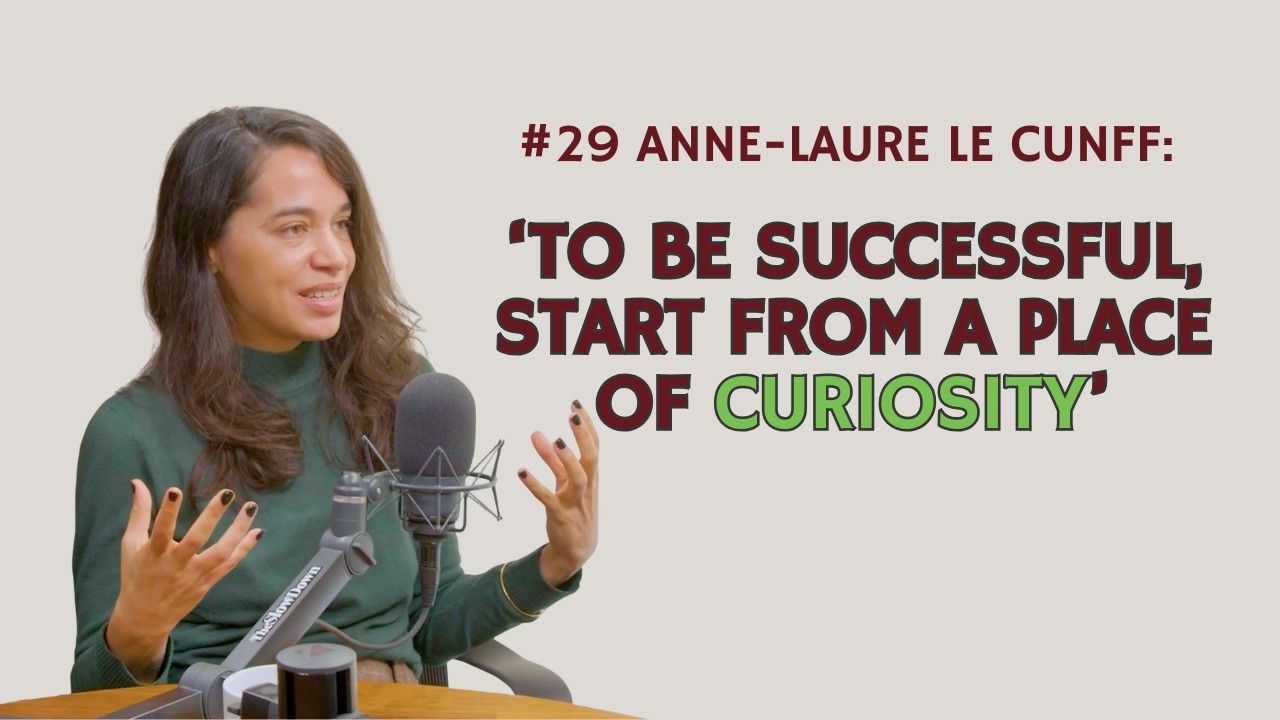
Enough Big Goals - Try Tiny Experiments with Neuroscientist Anne-Laure Le Cunff