Stop Setting Goals. Try This Instead | Tiny Experiments with Anne-Laure Le Cunff

Anne-Laure Le Cunff, founder of Ness Labs and a cognitive neuroscientist, explains how tiny experiments replace traditional goal-setting. Instead of big targets, run small tests on procrastination, routines, and habits to see what actually works for you.
Chapters
Well, some of us get up in the morning and feel a little bit overwhelmed with what's awaiting, the tasks, the achievements that we're supposed to achieve, etc., etc. But it seems that no need to get too overwhelmed because my guest Anne-Laure Le Cunff has an alternative. Hello and welcome to Latest TV, Anne-Laure.
Thanks so much for having me.
You're coming to Louis Speakers Festival and you're coming to talk specifically about your recent book, Tiny Experiments. Tiny Experiments sounds like something quite reassuring, something that perhaps we might buy into if it is an alternative for the bigger achievements that we all expected to aim for. Tell me a little bit about the idea behind the book and the method.
Absolutely. The book was inspired by the fact that I spent most of the, I would say the first chapter of my career trying to be successful in a very traditional way in the sense of climbing the ladder, getting the next promotion, working on the next big project, and having big goals. To me, that's what success was like. And when I went back to university to study neuroscience, I discovered a completely different approach to success. One that wasn't based on control, but based on curiosity. And, uh, this is the experimental mindset that scientists have. When scientists are faced with challenges, they don't try to come up with a big 5-year plan to know how to approach it. Instead, they start with small experiments. They have a bit of a hypothesis, they give it a try, they see what works and what doesn't. And the book Tiny Experiments is really an invitation to take this mindset and use it in our everyday life. Anytime we feel a bit stuck or we're faced with a challenge, to think like a scientist and to ask ourselves, okay, what can I try? What could work here? Again, with curiosity, not control.
Okay, and you're the founder of a global learning community. NesLabs, what you've described so far is perhaps quite simply, and maybe that's not a bad thing to say, don't, don't get overwhelmed, one step at a time. But you're obviously connecting it also to science, and you, you are a cognitive neuroscientist yourself. One step at a time is good, is healthy. But as a whole method that you are advocating, Could it replace bigger goals, the pursuit of bigger achievements? I mean, I know that scientists perhaps experiment with things, but behind scientific experiments, surely there's a grander ambition, no?
Yes, that's such a good question. And I do think that we can achieve really big things by conducting tiny experiments. It's just the way we go about it. When we have rigid goals, we're overly focused on the outcome, which means that when something doesn't work the way we want it to, when we fail, we see that as the end of the road. And we also tend to blame ourselves, which can negatively impact our mental health. When we have an experimental mindset, each experiment is just an iteration. So we can try something, and if it doesn't work, as long as we extract new knowledge from this, as long as we learn something from that experience, we can use that and we can try again. So we can still be very ambitious by conducting tiny experiments, but we are driven by our curiosity, not by this need of having perfect control over the outcomes.
Okay, so let's put this in practice. Um, at work my boss asks me to submit some report at the end of the day, somebody else wants me to research into something, another person says, you know, what happened to that deadline, I don't think it's going to go down too well if I say, well, I'm experimenting with tiny little experiments. How do you think we can actually put this very healthy, what I regard as a healthy approach, into practice, into, you know, our modern day-to-day life?
I'm really glad you're asking because a common misconception when people hear about developing an experimental mindset for the first time is that they think I'm saying you need to experiment with everything. And that's not what I'm saying. What I'm saying is that you need to make sure that you protect at least a little bit of space in your life for a little bit of experimentation. So not, not having your entire work driven by a to-do list, driven by these deadlines, making sure you can experiment. So you will still have projects, you will still have tasks, you will still have routines, you will still have habits, but you should also have experiments. And so what I invite people to do is to maybe try and make sure that if there's one challenge, one project where you've been a little bit stuck for a week or two, you're not really making progress, maybe try and take a more experimental approach here. Instead of using willpower and self-discipline and pushing through, and again, blaming yourself in the process, maybe take a little step back and ask yourself, how would a scientist approach this challenge? Is there something I can test that might open a new door and that might get me unstuck? And this is what having an experimental mindset is all about.
And, and the term that's been used to describe this method, mindful productivity, is that, is that what is meant by being mindful, um, about what we do as we go along in order to achieve better productivity? Am I getting this right?
Yes, absolutely. Mindful productivity is really about paying attention to all of the signals you get when you're making progress on your work. The issue is that in our schools and our society in general, we've all been taught how to pay attention to external signals of progress and success. So metrics, your grades in schools, your KPIs, performance indicators, all of those sorts of things that we can put in a dashboard. Anything you can put in a dashboard, we're pretty good at looking at. What we haven't been taught to look at is is the internal signals. How does it feel to make progress on this project? And what I argue is that if all of your external signals look good, so maybe you're making money, financial success, or maybe you're growing your audience, or you're getting that next promotion, and everything looks good externally speaking, but internally you're completely burned out, is that success? It's not, right? So mindful productivity is about being mindful of all of the signals, not just the external signals, also the internal signals, so you can be truly successful, not just successful externally.
Presumably this also applies to other areas, not just the workforce, right?
Oh, absolutely. You can use tiny experiments in any area of your life. And in fact, everything is interconnected. If you think about it, your mental health is going to have an impact on your productivity and your creativity.
Your—
the way you work, your productivity, creativity, your ability to communicate is going to have an impact on your relationships, which in turn is going to have an impact on your mental health again. So I really don't think you can think about having an experimental mindset in isolation. You can use it in any area of your life.
And you yourself, you said that you yourself found that this helped you with your career. I know that in the past you worked for Google. And how much in your own life do you think that that has had an effect?
Oh, I experiment all the time, and I really could not imagine doing any of my work these days or even navigating the many challenges that we face in our everyday lives without experimenting. Experimenting. So I sometimes experiment when I'm stuck creatively. It's interesting because in the book I have a chapter about procrastination, and I was actually procrastinating a lot while writing it. So I had to experiment with ways to make progress here that again were not based on purely self-discipline and willpower, that were a little bit more gentle and self-compassionate. I also experiment in my personal life especially for taking care of my mental health. So we're always told that you need to meditate and journal and sleep more and, and whatever intervention or strategy you're supposed to use to take care of your mental health. But the reality is that if you look at the research, it's always a bell curve. It will work for most people, but it doesn't mean it is exactly going to work for you. So you need to give it a try. And so that's what I do. I have experimented with with taking daily walks, with stretching, with yoga. And some of them I found worked really well for me, and I have then turned them into habits. Some others, although all of my friends were raving about them, not so much. And that's okay. Now I know because I've run the experiment. I collected my own data.
And I guess it's very important to realize that when we experiment, by definition, by nature, we can expect that the experiment does not work out, and that's okay.
Absolutely. Instead of having any kind of assumption with the outcome, you stay open to whatever result that you get. And again, whatever results you get, there's no reason to blame yourself or to feel like you have failed, because now you know. You didn't know before, and now you know.
Lovely. Well, I for one definitely am going to get the book. And you're coming to Lewes on the 8th of May for the Lewes Speakers Festival. Thank you so much for joining me today, Anne-Laure.
Thanks so much for having me. If you have a local news story you would like to share with our viewers, please email us at news@thelatest.co.uk. Thank you for watching.
More from Anne-Laure

How to Use Curiosity & Experimentation to Flourish, with Dr. Anne-Laure Le Cunff

Stop chasing goals and start running tiny experiments with Anne-Laure Le Cunff

Why You’re Still Waiting To Figure It All Out | Anne-Laure Le Cunff | EP. 391


Tiny Experiments: How to Learn, Grow, and Navigate Uncertainty — Anne-Laure Le Cunff





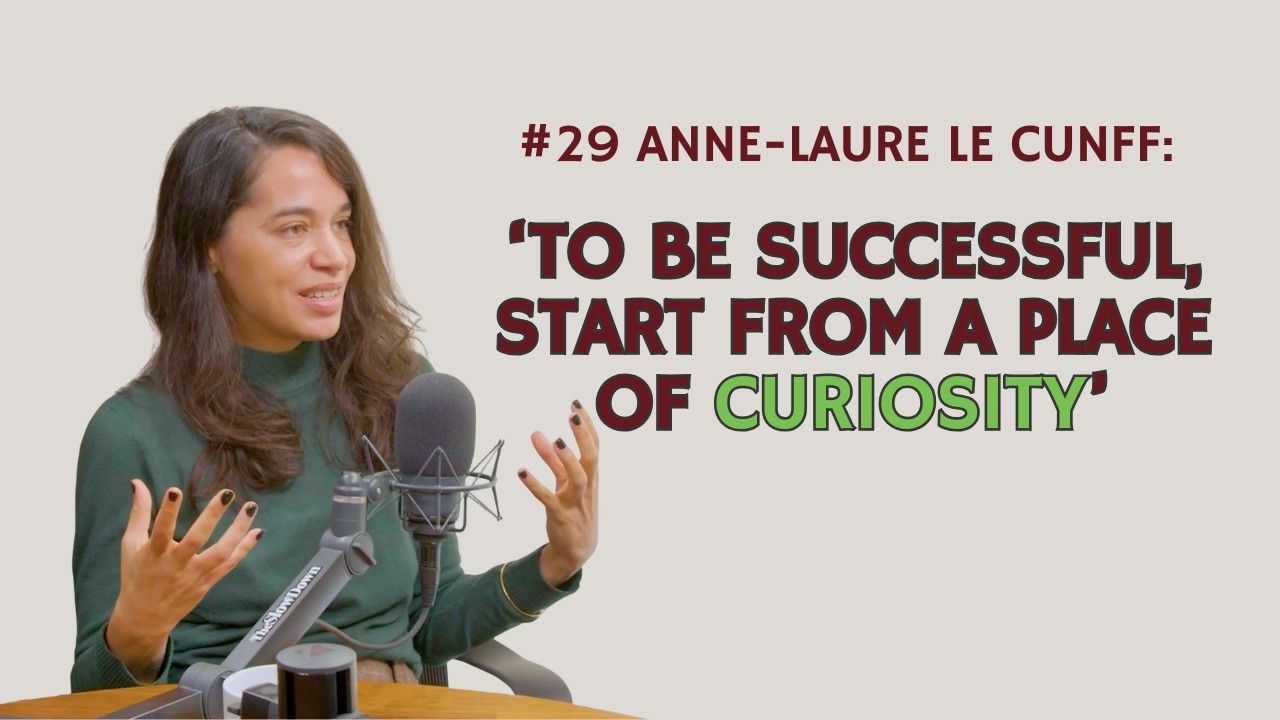
Enough Big Goals - Try Tiny Experiments with Neuroscientist Anne-Laure Le Cunff