Tiny Experiments | Interview with the author Anne-Laure Le Cunff

This content was created by Anne-Laure Le Cunff. This content was uploaded by Anne-Laure Le Cunff. This is a YouTube interview (published/created 2026-03-01) titled "Tiny Experiments | Interview with the author Anne-Laure Le Cunff." It’s a podcast-style conversation hosted by SPEAKER C (the host of Cosa Sposta) with introductory remarks from SPEAKER B and Anne-Laure Le Cunff as the featured guest. Anne-Laure (neuroscientist, writer and founder of Nest Labs) discusses her book Tiny Experiments and the experimental mindset: using small, time‑boxed experiments to navigate liminal identity, reduce fear of change, and learn about what work and life systems fit you. Topics include her writing, journaling and public‑speaking experiments; how the brain responds to uncertainty; practical examples and community stories from Nest Labs; reframing success (internal vs external signals); designing experiments (e.g., 5 hours/week writing, short podcast seasons); handling creative work and burnout; and why projects/experiments can replace rigid long‑term goals.
Chapters
When I left my job at Google, it was both liberating but also terrifying because I had really associated my sense of worth to that job title at Google. And all of a sudden, when people were asking me, "So what do you do?" I didn't have a good answer. My response to that uncertainty was to try and find as quickly as possible another title that would make sense for all of the wrong reasons, just to be able to say, "Here's my identity. Here's my contribution to the world. See, I'm productive.
I matter." We are here today in London to interview Anne-Laure Le Cunff, a famous blogger, writer, and neuroscientist, and we will talk about her latest book, Tiny Experiments. This is an interview which is perfect for you if you feel that you're a little bit stuck in life, that you are in between phases and you want to exit from this rut, and if you feel that you want to start doing things differently. It's an interview full of insight and a lot of points that you can start trying in your life. From today.
Anne-Laure, welcome to Cosa Sposta, a podcast that nobody can Google out of Italy. And thanks for joining me today. So we're talking about obviously your latest book, and I like to start with the content of the book, the experiments. What do you believe that are the 3 main experiments that define who you are today?
Oh, that's such a good question. I would say my writing experiment, my journaling experiment, and my public speaking experiment. Um, I'll start with my writing experiment. That was my first real experiment. It's when I committed to write 100 articles in 100 weekdays and to publish them online via my newsletter. That was the first time I really played with that, that idea of committing to something I was curious about for a specific period of time. Letting go of the outcome and seeing what happens. And this writing experiment has completely changed my life because that was the beginning of Nest Labs. That's what turned into Nest Labs, which is my business today. The second one would be my journaling experiment, which is still running. I journal every single morning, or at least I try to. It's not perfect. And this is really the way I stay aware of what's happening inside, not just paying attention to the external signals of success, but really checking in regularly with myself in terms of what I want and how aligned my work feels with what I want. And the last one, public speaking. Yeah, public speaking is something I used to be terrified of. And I designed a tiny experiment where I would put myself out there at first with short videos online, then online workshops, and then small stages. And this year I ended up speaking in front of more than 2,000 people. And, um, I would lie if I said that the fear is completely gone. It's not. But it's gotten to a point where it's quite manageable. And I sometimes even look forward to giving a talk now, all through experimentation.
Okay. So the pact, as you describe it in the book, is I will try to do these for a duration. And those are the things that really changed the course of how you look forward to things. So there is a lot of talking about the outcome, uh, and you were talking about that as well right now. One thing that really struck me was the feeling that you kind of like let go of identity in a way. Do you still feel that you are living like in between identities, like the liminal space that you were referring to in the book, from like, I don't know, Google employee or a wanderer going to Silicon Valley to now writer, neuroscientist? Like, do you still feel in between? Do you feel that right now Do you have kind of like a more stable image of yourself? How do you live that?
Yeah, I'm very much still in a liminal space. So as I explain in the book, when I left my job at Google, it was both liberating but also terrifying because I had really associated my sense of worth to that job title at Google. And all of a sudden when people were asking me, so what do you do? I didn't have a, a good answer. And, uh, my response to that uncertainty was to try and find as quickly as possible another title that would make sense. And in my case, it was starting a startup for all of the wrong reasons, just to be able to say, here's my identity, here's my contribution to the world. See, I'm productive. I matter. And, uh, what's changed now is that I'm still in a liminal space in the sense that I don't have a very clear idea of what my career is going to look like. Over the next few years, over the next decades. I'm not 100% sure in terms of what I want either, because that keeps on changing, that keeps on evolving. There are moments when I want to spend most of my time doing research, other times when I want to spend most of my time doing community building, and that's okay. There are lots of fluctuations, lots of uncertainty. What's changed is my relationship to that uncertainty. What I've managed to, I think, teach myself through all of these experiences and through this experimental mindset is how to be more comfortable in those liminal spaces, how to embrace them and how to see them as more like an opportunity for growth.
And so how do you introduce yourself right now?
First, I hope that people don't ask me, what do you do? And actually, you know what? It's actually, it's funny because I feel like something that maybe has changed too over the years is the kind of people I spend time with. And I feel like in a lot of networking events I go to now, conferences, people actually don't really ask, what do you do? Or who are you? But questions more like, what are you working on right now? What are you curious about right now? What is an idea that you can't stop thinking about right now? Those are the types of conversations I find myself in today versus maybe 10 years ago when I was in a more linear career. So I think that's been helpful. 'What do you do in general?' is not really a question that comes up in the sense of what is your job title. I have fewer people asking me that question, which is fantastic, I think. But if people ask, 'What do you do?' I tell them I'm a neuroscientist, an author, and an entrepreneur.
Which, I mean, is still a little bit impressive, but— Yes.
Yes. And you know what? Actually, when I find myself in those more traditional conferences where again, people are the first question they ask, they say, "Neuroscientist where?" And it's only when I say that I am actually working at a university that I see the nod of, "Oh, an actual neuroscientist," which is fascinating and something that I can't really judge or complain about because again, I was thinking exactly like that 10 years ago.
I think that a lot of what you're saying is linked to the need for certainty. Again, like having a job that has a title. So I'm I know who I am, what I want. And I guess that's why big changes, big swings in life look so attractive. From a neuroscientist perspective, what happens to our brain when we commit to smaller experiments? Like, what is the change? I mean, or even your personal experience, what's changed?
I think to answer that question, it's important to understand how the brain responds to uncertainty in general. Our brain was designed, is designed to reduce uncertainty as much as possible. And the reason why is because the more uncertainty there is, the less likely you are to survive. So think about our ancestral past. Our ancestors needed to know as much as they could about their environment. So where to find resources, who were their friends and enemies in the tribe, and trying to really predict the future. That would ensure their survival. And this is not— you hear a lot of people saying that this is a problem to be fixed. I don't think this is a problem to be fixed. I think your brain is working exactly as intended and it's trying to help you survive. The problem, the limitation here is if you want more than just surviving, if you actually wanna grow, you wanna thrive, you wanna push yourself, you want to get out of your comfort zone, then all of those survival mechanisms can get in the way. And this is why big changes are so scary. You're literally injecting uncertainty into your life. And so you're, you're putting your brain in alarm mode saying, whoa, wait a second. We felt like we knew what was going on. All of a sudden we're in a situation where we don't know what's going on. Tiny experiments are really a way, or small changes are really a way to inject change in your life without having all of those alarm bells go off, 'cause it doesn't feel as destabilizing as when you just have those big swings. Another reason why I think tiny experiments, and again, smaller changes work better, is that very often when we feel like we need to make a big change, we use that as an excuse to not make any change at all, because the change looks so big.
Ah.
That it feels like we need to do a lot of research, preparation. We need to feel ready to make that change. And very often, we don't make the change. We've all had those friends or colleagues that every time we see them, they keep on repeating the same thing. Oh yeah, next year, I'll quit my job. I'll start this startup. Next year, I'll do this. Next year, I'll move to that other city or that other country. Next year, I'll do this or that. I'll start writing a book. I'll do that. All of these really big changes. And because of that, they don't do them. Whereas if you say, uh, next week I will start writing one page every day, um, next, uh, year I will try to visit one new place in my city every week. And as you can see, there's still change, right? But it's more iterative and you can get started straight away.
So it's more like exposure therapy to gain confidence in trying things that you are kind of like scared to do, but you're still trying to see what happens without hitting the big swing or nothing.
That's such a good way to put it. And I think the other benefit is the, as you said, the exposure. So you better manage your fear through exposure. The other part is that you don't assume that this change is going to be good for you. You don't know. You actually don't know if quitting your job or moving to the this other city or, or writing a book is going to be good for you. And so tiny experiments are really an invitation to give it a try first.
Mm-hmm.
Just give it a try. Give it a try for a few weeks, for a few months. Only commit to that small change. So an example with podcasting that I really like is that instead of saying, I'm going to start a podcast.
Yeah.
Say, I will create, I will produce one podcast season. It will have 6 episodes. At the end of that, I can very gracefully say that I'll stop, that, that was just the, the, the only season I was planning on creating if it's not for me. And if I love it, I can keep on going. So that's the shift that you want to implement where you can try things, see if they work for you based on your own data that you're collecting about yourself, not based on what other people are saying, and make informed decisions in the process.
Yeah, so you can even stop if you don't like it. Just give it a try. Yeah. So you wrote, "It takes courage to be curious," because giving up a fixed plan can sound risky, especially because humans crave control and clear paths, right? So aside from all the, the pact that you described, the way of trying, iterating on tiny experiments, are there any other things that you recently discovered on how to work within uncertainty? Especially for people who loves planning, who are very strict with their planning and they try to have things figured out before starting.
Yes. And I'm part of these people who also feels like having a plan gives me this sense of control.
Yeah.
And I've come to realize that it's only the illusion of control that those plans are giving me. And very often things keep on changing, especially if you're in an industry or you're doing the kind of work where the environment keeps on changing, the players keep on changing, you're actually doing yourself a disservice by clinging to your plan because your plan becomes obsolete as soon as you're done writing it. Something that I would encourage people who are like that to do and who are naturally curious, because very often when I work with people, they are naturally, they're curious. It's not that they're not curious, it's more that they are repressing their own curiosity because they want to feel like they're in control. And curiosity will make you open a lot of doors, will give you a lot of possibilities, but is not necessarily always helping, at least when you're in that divergent exploration phase, not really helping giving you this very clear blueprint that you can copy and paste in order to be successful. So something that I would encourage people to do is that curiosity that you have and that you're quite often pretty good at directing externally. Doing research, looking at numbers, looking at frameworks, at models that you can copy and paste. Try and direct it internally. Ask yourself questions like, what feels right to me? What feels interesting to me? How do I wanna spend my time? How do I wanna spend my energy? How do I spend, I wanna spend my attention? These internal signals are also very rich in information that you can use to make decisions. And to adapt your path as you go without the illusion of control of creating this perfect plan. So instead of saying, here is a 1-year plan of everything I'm going to do, just tell, tell yourself, okay, here's what I'm going to try for the next couple of months. I'm going to try that and I'm going to pay attention to the signals, external signals. Is this thing working? Are we making more money? Do we have more readers, more subscribers, more listeners, et cetera? Internal signals. How do I feel doing this work? Because if all of the external signals are in the green, but you hate every second of working on this project.
Yeah.
Is that really success?
All right.
I would argue that it's not.
So it's more like, are you planning your own misery or?
Yes.
Are you actually doing something that you like?
Oh, it's, It sounds so absurd when you say it like this, but we do that all the time. We plan our own misery all the time.
Yeah. Instead of focusing on planning things in the right way, whatever that might be, try to focus on how you feel, which, what are the outcomes? And that's probably the end goal of the exploration and not just being in control the whole time. Yeah.
Yeah.
And coming back to your question, It does take courage to be in that state of curiosity because every time something feels a little bit unstable, wobbly, uncertain, we will want to go back to the plans. We will want to go back to control. And so being able to pause and say, actually, let me get really curious about what's going on here, about how I feel, about all of those signals. Let me get really curious. That does take courage.
So, and kind of like the opposite question. So instead of like restraining yourself into planning instead of doing things, all the times that we met throughout the years, you always were running a lot of different things, like a lot of different tracks. So I'm having this hugely successful newsletter. I was working at Google, now an entrepreneur. I wrote a book, I'm also doing a PhD. I was like always wondering like, how does she do that? Like how do you balance ambition with experiments that are the right size? Can you do too many tiny experiments?
Yes.
Therapy time.
You can absolutely be running way too many tiny experiments at the same time. It's a bit meta, but again, and this is why I talk so much about curiosity, it really takes being systematically curious about how you feel to figure out whether you are running the right number of experiments or whether this is too much. There is, especially with people who are quite resilient, a tendency to push yourself to do a lot more than you can do sustainably because it takes you longer to realize that something is wrong. We're very good at ignoring all of those signals. And you see that a lot in entrepreneurs, for example, the amount of the, the workloads that they can sustain, the amount of stress that they can sustain. And it's not because you're technically capable of sustaining all of that stress and that workload for a short period of time that you should. But still we do it. So it really requires paying attention. To me, this is journaling. This is my tool to have those conversations with myself where I can try and be as honest as possible and really asking myself, okay, how are we doing today? Sometimes just writing this and trying to really answer that question, the first words that come out are, I'm really tired. I'm exhausted.
I think that with the amount of stuff that you put out in the world, that is completely—
It's not correlated. You know, sometimes I can have a lot of projects going on and what comes out is I'm really energized. I'm so excited. I'm so looking forward to working on this. And so I have found that the burnout is not necessarily linked to the amount of work that I have. Yeah. It's linked to the quality of the work, the type of work that I have. Also, sometimes the environment in which I work, the kind of people I work with, the kind of expectations that they have. And for me, for example, if I have a lot of agency in my work, a lot of freedom to make decisions, a lot of space to be creative and to solve problems, I can actually have a pretty high workload and be completely okay. As soon as I feel like I have artificial constraints around the way I work, or that there is busy work that to me doesn't make sense that we could cut, I get really frustrated.
Mm-hmm.
And I can get overwhelmed with technically less work than in other situations. But because this is not something you can just track with numbers, you can't put that in a dashboard. I can't have indicators that tell me if I'm overworked in this way that has to do more with agency than the actual quantity of the work. It requires having some form of metacognitive practice. So, observing your own thoughts and your own emotions to be able to know what's going on.
Yeah, I was about to focus on that as well, because the feeling that I am having right now, and it might be useful going deeper on that, like the experiment part is kind of like the byproduct of the observing yourself part. That's the hard part, like understanding what you need, what you feel, who you are in the end. And the experimentation is a way to uncover that part. At least this is the sense I'm having right now, hearing you talking about this, while as a person who likes doing shit, I end up focusing on the experimentation part also because it's fun doing stuff. So yeah.
It's a good intuition that you have because the entire experimental method that I talk about in the book is inspired by the scientific method. And the scientific method always starts with observation. So you cannot design a good experiment just by being like, Oh, here's an idea. Let me randomly experiment with this thing. Scientists always observe the current situation. What is the current data telling us? And what is something we cannot infer from this data that would be worth exploring and where we need to collect more data? Based on that, you formulate a hypothesis and then you test it. And then you make decisions based on that. And so you're absolutely right that you need to start from observation. And also in order to close that loop, to close that experimental cycle, you need to also finish with observation. You need to observe what changed now that you completed the experiment.
Yeah.
And are those changes aligned with the hypothesis that you had, or maybe your hypothesis wasn't correct.
So I was wondering, since you also have a very active community, do you have some tiny experiments that you are aware of from the people that follow the book or your community that had a substantial life change from the experiment aside from the 3 that we started the interview with and how that process you feel that helped overcome procrastination and actually trying the whole experiment and just saying, "One day I will be the president of the United States," or something like that.
There are so many experiments in the Nest Labs community that I love. Some examples that I really liked over the past year, one of them was this person who had lost touch with his friends and who decided to design a tank tiny experiment saying, I will message one friend every Wednesday for, I don't remember how many weeks. But what I loved about that is that the experiment addressed the fear of rejection or judgment from his friends where he felt like he hadn't been in touch for such a long time that maybe they didn't wanna talk to him anymore. And so he removed himself from the equation by saying, I will send one message every week. If they reply, good. If they don't, I've done my job, right? I'm not judging the success of the experiment based on the outcome, but just based on showing up and doing it. I mean, the result of that experiment is that everybody was really happy to get a message from him. That's it. It sounds obvious now that it happened, but I think for him, it really helped him get over this fear and actually do it. There was also an artist in the community who had stopped painting for a while because she had surgery. And she had developed this fear that she lost some of her creative talent because she hadn't been able to practice for a long time. So she designed a tiny experiment where she said, I will go and sit in my studio for 1 hour every day and do nothing. And I love that because there was nothing about pressuring herself to actually produce anything. Just go and sit in her studio and do nothing. And what happened? After a while, she got so bored of sitting in her studio and doing nothing that she picked up the brushes again and started painting again.
Yeah.
Which I thought was beautiful. But so many different experiments. I've seen experiments from people who actually launched their community like this, where they said, I will host one Zoom call every week about this topic I'm curious about, and I'll invite people. And if there's only 2 people who show up, that's okay. It's an opportunity for me to talk about this thing that I'm curious about. I've seen people start newsletters, start coaching practices, start change their health routine. One of my favorite ones that I, when people are like, oh, to experiment you need to add something. And so it's a lot more work. I tell them, no, you can experiment with removing something. That can also be an experiment. And so one I really like is I will not bring my phone in my bedroom for 2 weeks. So you're removing something, you're only committing to it for a short duration, and you observe what happens. Every single person who tries this one reports back that they see positive downstream effects, better sleep, better productivity, better wellbeing in general. It's such a simple one, right? So yeah, so many examples. And to me, the most interesting ones are the ones that are so small, so tiny that you almost feel like, well, I might as well try it. There's no cost, right? I'll just try it. There's only, potential positive upside to running this experiment. Because worst case scenario, or maybe best case scenario, you figure out that this doesn't work for you. And now you know.
Building digital products can be very hard and sometimes frustrating, not just because the tech part is hard, but also because the efforts that you put into that sometimes goes to nothing. And that's why in Baica, after 10 years of working with startups, scaleups, and enterprises, we developed a methodology called Product Value Paths that help digital companies make the shape of their hypothesis more clear and help them validate and also sometimes build the experiment with them. We make digital product works, and if you need help with that, you can go to our website, www.daiqadigital.com, here in the description below, and you can contact us to get help with your digital product.
Even now that you wrote about this framework, you have all this community using this framework to try to change their life and experiment different things. Do you ever find yourself slipping back into old habits, like trying to put very rigid goals or thinking about like this grand plan or this fixed identity? How do you work with that?
100%. I can give you a very recent example.
Let's go.
It's this.
Oh no.
That's very meta. But when I signed my book deal for 10-Year Experiments, all of my old control freak habits came back, rushing. This needs to be a New York Times bestseller. We need to sell that many books and I need to get that blurb, that accolade for those people. And it was really interesting how I had to use all of the tools in the book in order to not fall back into this. And it's very common to fall back into those, automatic responses when we're faced with something that has a lot of pressure, a lot of stress, but also that is linked to our identity.
Yeah. I don't know about you, but for me, usually when things that are this big are also self-worth because like, what if the book comes out and it flops terribly? Nobody will buy it.
And it's impossible really to think about identity without thinking about self-worth. Right. And so for me, I had over the years writing the newsletter, I had developed an identity as a writer. And I had a lot of positive feedback telling me that my newsletter was great. People enjoy it and find it helpful. And all of a sudden I felt like I was putting that identity as a writer back on the table because now I was writing a book.
Yeah.
What if people said, actually, I'm not such a good writer, my work is not that helpful. And what if they regret buying the book? And what if, what if, what if, what if, what if? And all of that, as you said, tied to your sense of identity, which is tied to your sense of self-worth.
What are the experimentation that you run to, to write the book like that helped you not fixating on becoming a New York Times bestseller or nothing?
Yeah, two things. The first one was just in the way I wrote the book itself. At first I had read everywhere that ideally you want to spend a little bit of time on the book every day. And so I tried to apply that. And so I said every morning I will sit down and I will write for 1 hour.
Okay. How did it go?
Horrible. Absolutely horrible.
It sounds very hard.
So, yeah. And so not only was it hard, but I did try every morning. I would open my laptop, make myself a cup of coffee and go, ready, let's write. There were days where that went well and that was great. But there were also many days where I would sit in front of my computer, didn't feel inspired, didn't feel like I had done enough research on that particular section that I was trying to write. And then at the end of the hour, I had written nothing or crap. And then what I noticed is that I felt terrible for the rest of the day. So all of my other meetings, I was listening to people, but my mind was half there in the conversation, half over there with the book thinking that I hadn't written anything good that day. In the evening, having dinner with friends and also not really being able to fully be fully present. So I experimented instead with a slightly different format and instead of saying, I will write 1 hour every morning.
Yeah.
I said I will write 5 hours every week.
Okay.
And they can happen anytime, anywhere. It doesn't matter. That worked so much better for me because I could sometimes open my laptop and after 5 minutes I could tell not, not a good day.
Okay.
That's okay. Let, let me go and read something. I'll just read something. I'll take a walk. I'll listen to a podcast. I'll do something else. That's okay. I don't need to write today. That's fine. And then maybe on Thursday I would open my laptop, feel really inspired, and that would be a 2-hour writing session because I finally felt like something clicked. And sometimes I would not touch the book the entire week and then Sunday evening—
Like, let's go.
5 hours nonstop, just writing nonstop because I felt really inspired. So that was one experiment that worked really well for me afterwards, but I didn't find it straight away. I had to iterate until— it worked. And the other part was, and again, this is a theme that keeps on coming up in my work, but it's because it's really been important for me in terms of thinking about the way I show up and the way I think about my own success, really observing myself, observing those signals and noticing when I start caring about signals that are actually not that important to me. And so—
What do you mean?
So for example, anytime I would go to the US, and I went to an entrepreneur retreat or a conference, I would come back to Europe and feel like, oh, I can't believe I haven't thought of that. I haven't hired a launch team for my book. I don't have a PR agency. I don't have all of these things. And I would panic and feel like I'm not doing enough. It would usually spend, take a few days of observing this and asking myself, what signals do I care about? What are signals of success do I care about? I actually care about people reading the book and finding it helpful. That's what I care about. I don't actually care about being in the, you know, whatever magazine, like in the New York Times or whatever. And when I say I don't care, I don't mean that if it happened, I wouldn't be happy. Obviously I would be happy if that happened, but I'm not going to optimize for this specific signal because it doesn't actually really matter.
Okay.
And again, it's really about asking yourself, what are you optimizing for? And even if other very successful people are optimizing for other signals, it doesn't mean you need to copy paste those signals. You need to figure out what are your own signals of success.
Yeah, I can sense that every time I meet entrepreneurs that are more successful than me, I ended up trying to think, oh wow, they do this, why don't I do that as well? Like, yeah, it's easy to fall into the trap of How do you say that in English? Like keeping up with the Joneses?
Yes. Yes. It's mimetic desire, basically. Like psychologists call it mimetic desire and we want what other people want. And, you know, sometimes it can be good. I still feel like some of the things I see other people do are great sources of inspiration. I would have not thought about doing it this way. So I'm not even saying that it's bad to copy-paste something from someone else. It's more about copy-pasting intentionally, asking yourself, does that make sense? Do I actually want to implement this in my own system? Them in my own workflows. But like, because is my idea of success aligned with this person's idea of success?
I'm curious about one thing that you said before when you were saying, I sit down 5 minutes writing and I say, this is not today. How do you felt?
Once I had decided that I did not have to write for an hour every day, it felt good. It felt liberating. A lot of the suffering that we have is based on the artificial pressure that we create on ourselves. And so I almost felt like giving myself a little pat on the back of saying, cool, you've become really good now.
Okay.
At not pushing yourself for an hour. You know that this is not your day. Let's do something else. Let's actually do something else. So yeah, it's really about, again, listening to yourself. I know how woo and vague that sounds, But it's a muscle that you can build. It's really a muscle that you can build. And you will notice if you ignore those signals and you force yourself and you push through and you feel like crap at the end of the hour, you just need to pay attention to that and try to not do it again the day after. That's just how it works.
And what's your favorite not writing activity? So you sit down 5 minutes, you're like, not a good day. I tried. I can push through and feel miserable or do other things. What's your number one go-to activity that you pick in one of these days?
Dancing in my living room.
Yeah?
Yes, seriously. I'll get up, I'll put some music on, and I will dance like no one's watching for a few minutes.
What do you dance to? What's your go-to music?
Actually, I need to send it to you later, but there was this very specific Italian electro pop music song that for a while was my go-to song when I needed to do that. I don't remember the title, and I don't even know what what the lyrics mean because it's in Italian.
We will share these in the description of the episode.
Yes, 100%. And so that was— and I usually am quite obsessive with one song over a few weeks and it will be the song. And then I'll move on and it will be another song. But yeah, I'll get up, I'll dance. It just reminds me— being silly like this reminds me that ultimately it's okay, right? I'm not a neurosurgeon operating on someone who's going to die if I don't perfectly perform my job right now in this minute. And so I'm just being silly, I'm being playful, I'm having fun, I'm reconnecting with my sense of joy, reminding myself of how lucky I am to even be able to do this work and get up and dance whenever I want to, which is great. And then I just go and do something else depending on what else I have to do that day. And that can be a little bit of research writing, which doesn't require the exact same kind of spark of inspiration because usually you already have your data and you just need to write it up. And so that's a little bit easier in that sense, or a bit of reading or a little bit of community building, going in the NestLabs community or talking to my team and seeing what needs to be done. But I usually feel a lot better after a little boogie in front of my desk. Yeah.
Anyway, I really can relate that it's really hard to pace creative work. Sometimes I end up writing for hours straight and I feel unstoppable. Some other days, it feels the most miserable experience I ever had. And It's a mystery. Yeah. It's a mystery. Another thing that I really liked about your book is treating failure not as, "Oh no, I failed. This is a bad thing and I will regret it for my whole life," which I invite everyone who is listening to us right now to feel. But as a joke, sorry. But just as data, like, "All right, I tried this, it didn't work." Aside from the writing, do you have other examples from you, from your community to share? I think also to kind of like break the stigma things not going exactly as you hoped for.
Yeah, I have an example in the book that I share quite often because I think quite a lot of people can relate to that. And that's around creative work. For me was YouTube. So something that somehow kept on happening in the past couple of years was that everybody around me kept saying, you need a YouTube channel, you need a YouTube channel, you need to be on YouTube. If you're not on YouTube, You're not going to be able to grow your community. Your business is going to fail. YouTube is the future. So that got me curious and I said, okay, let's try.
Let me check this thing that everybody's talking about. Yes. This YouTube.
This YouTube. What is this YouTube? Like an old lady. But I said, okay, let me experiment with that. Let me give it a try. And so I designed a tiny experiment where I said I will publish one YouTube video every week until the end of the year. That was, I think, October or November.
Mm-hmm.
And, uh, let's see what happens. And I really didn't like it. I really didn't like it. The external signals were good in the sense that there were people watching, commenting, leaving good comments, pretty positive. The channel was growing. So if I had only paid to those external signals, the experiment was technically a success, but internal signals. I hated it. Every time I had to sit down in front of the camera and, and talk to myself, I felt so uncomfortable. It felt so forced. I was not looking forward to it. And so I decided to stop. And some people might say this is a failure in the sense that I did not manage to start and sustain and grow a YouTube channel. But to me, if you apply the experimental mindset, It is success because I didn't know before running the experiment and now I know. And now when people tell me you need a YouTube channel, I'm like, eh, no, been there, done that. This is not happening.
I don't need it.
Yeah. And so when you approach experiments with this mindset, when you, you, you really forget, you remove this binary definition of success and failure. So when you have a very specific goal, outcome in mind for your experiment, then you say, this is success if I get there, and if not, this is failure. When you let go of the outcome and the only goal you have is to learn something new, then as long as you know more about yourself, about your work, about what you want to do by the end of the experiment, this is success.
By the way, It's super cringe to talk to a camera. Like it's one of the most— I can totally relate to that. Every time I try to do that myself, if there is anyone not in the room, like in the building, I need reassurance from them. It's like, it's okay, you can do that.
Yes.
Yeah, but I don't know why it's so hard, but it's such an alien experience.
I actually looked at it because obviously the science— Oh, really?
Oh, cool.
I was really curious why, why is it that I can have a conversation like this and it's completely okay, but then talking to a camera is really hard. And so the reason why is because we use, we use real-time cues from the people we talk with to know how we're doing when we're talking. And so this is why here, you know, you're nodding, you're smiling. I'm like, oh, okay, I should keep going in that direction. And I'm not doing that in a calculating or manipulative way. It's a very natural thing to do. We're seeking approval. With the camera, you get none of these cues. You're delaying the feedback to after the video is going to be published. And so you're effectively talking to a wall. And it's very unnatural for us. And our brain is trying to get signals, to get feedback, and is not getting anything, which is very confusing. So that's one of the main reasons why we feel so awkward when talking to a camera.
How do you work with long-term goals now? From the book, it feels that a lot of what you're describing is useful for breaking inertia, breaking a moment where you are in a rut or you feel that you need planning. But what about like big goals? Like, I don't know, starting a family or buying a house? Like, how do you feel about that today? Even if it's not covered in the book, but just by yourself, like, what's your feeling of this now?
I don't really have goals, but I do have projects.
Okay.
And I think it's a bit different. With a goal, again, you're creating this pressure to be able to do this by this date and having this this particular outcome, whereas with a project, you're working on it and you can chip away at it a little bit every day or every week, depending on what you want to do. I've done that with buying a house, for example, where it's like, okay, what needs to be done this week? And you just do the thing that needs to be done this week. And I think really almost any big project can be broken down in this way. Once you remove the artificial goal out of that. I generally think that in most cases, goals are not helpful. They're not helpful. They're creating artificial pressure. You're going to make progress if you just show up and treat it like a project. So to me, they are tiny experiments that are a way to get started. And it is really designed to get started, to figure out your system. They're particularly helpful in times of uncertainty where you're not quite sure what the next steps should be.
Okay.
Once that's the case, you can upgrade your experiment to a habit or a project or whatever makes sense.
Or a bigger experiment.
Or a bigger, or a bigger experiment. But I would say, for example, that my Nest Labs newsletter is not really an experiment anymore. I have experiments within that newsletter where sometimes I try different formats or new things, but after 5 years of writing it every week, it's not a tiny experiment anymore. It started as a tiny experiment. You might be experimenting with your health routine. You're not quite sure if you'd rather run or do yoga and how you want to meal prep and all of that. So you can run tiny experiments. Once you found something that works for you, that can become part of your habits and routines. It doesn't have to be an experiment forever. But if you start noticing that things don't work anymore, maybe time to experiment again. And so that's why once you've run enough tiny experiments in an area and you feel like, you know what, I'm getting to something that Feels like it works pretty well for me.
Yeah.
Well, maybe upgrade that to, again, project to a habit, a routine. It can be a bigger experiment, obviously, but it doesn't have to stay at that experimental stage forever.
Yeah. Okay. So you can graduate to—
Yes. Graduate is a better word, actually. Graduate.
Yes. To habit or discarded if it doesn't feel like— Exactly. Right. We're closer to the end of our interview. And I was wondering, do you have like a practical first tiny experiment that you want to share with the viewers? Something that you maybe read from your community or you tried by yourself that you feel like, "This is a good start." Like if you want to try the framework, this is the thing.
So I never, ever, ever recommend a specific experiment because it would go against the entire idea. What I recommend doing to get started is I have an exercise in the book that I call self-anthropology. And that's really about spending 24 hours observing your own life. Pretend that you're an anthropologist for 24 hours.
Yeah.
Take little notes that can be in your notebook, that can be on your phone in a note-taking app, and ask yourself, what gives me energy? What drains my energy? When am I excited and enthusiastic? What are the meetings where I want to go and hide in a corner because I hate being here? Just asking yourself those questions without any assumption. So pretending that you're discovering this life that is yours for the very first time. I guarantee you that if you do that for 24 hours, you will notice things worth experimenting with. You will notice that there are things that you've been doing out of routine or habits that you never intentionally considered. They are just parts of your automatic patterns in your life, which means You can experiment with them.
Yeah.
You can try a different way to do that. And when you design your first experiment, I always tell people, please, please, please keep it tiny. Just one tiny experiment at the beginning so you can see what works. If you're experimenting with 1,000 different things at the same time, it's going to be really hard to know what variables are having an impact. So keep it simple, keep it very, very small, and then see if you wanna try a second tiny experiment or if you wanna go a little bit bigger with this one or As you said, just discard it if that doesn't work for you.
So instead of suggesting some kind of random experiment, you're suggesting start with observing, which is, by the way, the very first part of the book. So if anyone is looking for it, we will link it down below. And from there you can start wondering, "Oh, I might try this or might try that to change how I feel or how do I relate with some part of my daily routine." Is that so?
Absolutely.
All right. So the question that started this podcast is, it's an Italian question, which is "Cosa sposta?" We kind of like loosely translate to "What does move the needle?" Obviously, there is a lot of things that move the needle, but if you have to pick one in your life that significantly moved the needle in terms of getting what you wanted and getting closer to who you want to be, What is it?
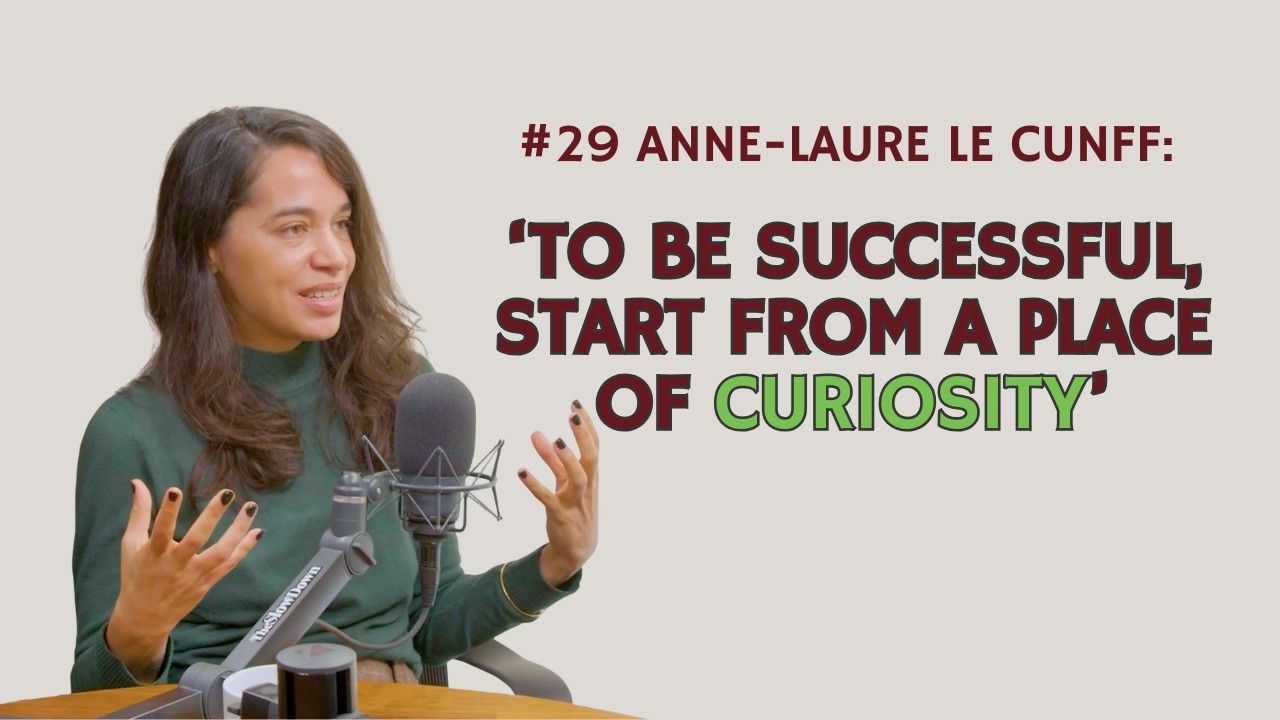
Curiosity. Curiosity is what moved the needle for me. Being curious about how I feel, being curious about how I spend my time, being curious about other people, being curious about ideas, and being really radically, courageously curious about everything.
Mm-hmm. All right. Thanks, Sol, for your time. You can find Tiny Experiments, I think, in Italy on Amazon. It's not in Italian yet, but we will get there. Yes, hopefully.
Yeah.
Thanks a lot for your time, Anne-Laure, and good luck with your next tiny experiments.
Thanks so much for having me.
If you like this interview, like the video, subscribe to the YouTube channel. We have a new interview every 2 weeks. If you're on Spotify right now, don't forget to leave 5-star evaluation on the podcast. It really helps me grow the channel. And see you in a couple of weeks to discover Cosa Sposta. Ciao!
More from Anne-Laure

How to Use Curiosity & Experimentation to Flourish, with Dr. Anne-Laure Le Cunff

Stop chasing goals and start running tiny experiments with Anne-Laure Le Cunff

Why You’re Still Waiting To Figure It All Out | Anne-Laure Le Cunff | EP. 391


Tiny Experiments: How to Learn, Grow, and Navigate Uncertainty — Anne-Laure Le Cunff



Stop Setting Goals. Try This Instead | Tiny Experiments with Anne-Laure Le Cunff


Enough Big Goals - Try Tiny Experiments with Neuroscientist Anne-Laure Le Cunff