Anne-Laure LeCunff: Overcoming Negativity Bias Through Tiny Experiments

Neuroscientist Anne-Laure Le Cunff explains how negativity bias keeps us stuck and how small, time-boxed experiments rewire our brains toward growth. She quit her Google job after a health scare, failed at a startup, and now teaches people to collect emotional data from tiny actions instead of chasing arrival at a goal.
Chapters
Welcome back to another episode of My Rejection Story. I am joined by Anne-Laure Le Cunff, the neuroscientist and author of Tiny Experiments, and I'm so excited for today's conversation. Welcome to the podcast, Anne.
Thank you so much for having me.
So in your book, you write about a lot of things that I love as someone who is a big believer in tiny experiments. And people who listen to this podcast know that I talk about doing rejection challenges all the time, which I think is A version of A Series of Tiny Experiments. There is something in your book called self-consistency fallacy, or self-consistency fallacy. And that's kind of that belief where you think, I've always acted this way, so I must continue. And I wonder what your thoughts are on the self-consistency fallacy when it comes to perhaps mindsets that people might have about rejection, like, I've always been told that I'm not good at sports, so I can't pursue the sport, or I've never been a good writer, so I can't take up writing. Do you see any trends there?
Oh, absolutely. Every time we experience rejection, we kind of save that experience in our mind. We record it, and it turns into a story about who we are. And that then in turn impacts our decisions in the future and what we think we're capable of doing. So having experienced rejection around the particular, particular area of your life, whether it's sports or arts or whatever it is really, will definitely in the future limit your ability to feel confident in terms of giving it a try.
You are listening to My Rejection Story hosted by Alice Draper. Yeah. Yeah. And as you were talking, it kind of made me think of negativity bias. Do you think negativity bias would play in here where we overassign, overly assign value to the rejections rather than things that did work or did go well?
Yes. Your brain is optimized for survival, right? So your brain is going to help you behave in ways that are going to keep you safe. And ensure that you stay alive. That's basically your brain's role. Everything is optimized for that. And so it makes sense that your brain will tend to, again, record experiences that feel negative, dangerous, threatening, and record them and label them as more important with more valence than positive experiences because it's important for your survival to know, ouch, don't do that again. Don't touch the fire again. Don't raise your hand. When someone asks a question. Don't put yourself in a situation where you might look like a fool because that means rejection. That means being kicked out of the tribe. That means death. Don't do that, right? So absolutely, we have a negativity bias because it's just your brain trying to do its job and protect you, right? The reason why you might want to try and figure out ways to overcome this negativity bias is that Sure, your brain is doing its job, and if you just want to survive, it's great. But if you want more than just surviving, if you want to explore, to learn, to grow, to evolve, to fulfill your potential, then those survival mechanisms are getting in the way. So it's important to first, don't blame yourself, understand that your brain is just doing its job, but also second, say, Thank you. I'm going to take it from there. And I'm still going to try the thing because I know that I'm actually not in any risk of dying if I try this thing. Yeah. Yeah.
Okay. So you explained this so beautifully. And I have spoken about like, you know, the survival elements in the sense that you might get kicked out of the tribe historically if you got rejected, and maybe that kind of still sticks around today. What you put into words that I've never heard put into words is sometimes we want to do more than just survive. We want to thrive. And that I haven't heard of it framed that way, which is like, we could not get rejected and go about our life surviving, or we could take risks and put ourselves in the space of rejection, because risks usually come with rejection, and potentially live a life that we thrive in or kind of is more meaningful. And I'm also thinking of, I think it's Robert Sapolsky who writes about reference to study in one of his books, which was that we are just as afraid when we're about to talk on a stage as we are if we're getting hunted by lions or something absurd. And I'm curious, like, with your research and your frame of view, We seem to overestimate the risks that certain rejections would give us, comparative to like, yes, of course, if you're going to get kicked out of your tribe, you would die, or if you're going to get hunted by a lion, you'll die. If some people don't like you, you might not die. You probably won't die.
Well, first, there's an automatic preconscious response here. When, if you think about it, thousands of years ago, if there were hundreds of eyes fixed in your direction, motion, not moving, it wasn't good news, right? So there's, that's the first part is just your brain registering something that if it used, when it used to happen in our ancestral environments was just really not good news for you and you were supposed to go and run as fast as possible. That being said, what's really interesting, especially with things like public speaking, is that if you go on stage and you tell yourself, I know those people are not lions trying to, who wants to make me their next snack. I know that at a rational level. And still, we still have the same cramps in our stomach. We still have sweaty palms. We still have our heart beating faster. And so, what it shows is that just talking yourself out of the anxiety is not going to work. The only thing that works for those situations where we've been wired to be scared is to practice, is to actually do it. And the first time you're going to do it, you're going to do it terrified. And that's completely normal. Who's been doing public speaking for a while will tell you, the first few times I did it, I was absolutely terrified. And then the second time, still terrified, but a little bit less. And then it became a little bit easier. And so it really shows that when you are against something that, again, your brain was designed to do in a very automatic way to ensure your survival, which includes avoiding rejection, which includes avoiding being judged by other people, there's almost never any point in trying to use your rational mind to convince yourself that it's fine. The only way to get over it is to actually do it.
Yes, thank you for sharing this. And I think this is so important because I think so many of us wait for the day we're gonna feel confident or think that we can, like, prepare our way into confidence. And it sounds like you kind of have to jump in and figure it out and then keep doing it. So a bit of exposure therapy. I'm curious, can you talk about, like, from a neuroscience lens, why exposure therapy, or yeah, exposing ourselves to these things, doing it terrified, and then over time becoming a little bit more accustomed to it, um, and finding it less scary— how does that work, like, in our brains? Like, what is happening?
Ultimately, this is just learning at the, at the brain level. You're just forming new connections between experiences and outcomes. And so you're really just teaching yourself and your brain that you do A and you survive. You do it again, you reinforce that connection. Public speaking, you survive. Rejection, you survive. Looking like a fool, you survive. And the more you do it and the more that connection becomes stronger, to the point where then it becomes something that you have internalized. If you think about it, there are many, many things that you do on an everyday basis where you don't even have to think about it. When you wake up in the morning and I don't know, maybe you make yourself some eggs, you're not thinking through each step. You're just doing it, right? And it's the same with those things. After a while, you've actually learned it. The connection exists in your brain. It's a strong connection. And you don't even have to think about it anymore. So this is what's happening, and this is why you do need to reinforce that connection by doing it. I love that.
I love that. So simple, but so hard. I mean, I guess most things in life that are difficult are actually simple. Make that connection, show your body that you can survive and keep doing that, and eventually it'll be less scary. I know that you had a bit of your own journey, Anne-Laure, where you were working at Google, and then you did something very scary. And your mom was terrified and you had to show yourself that you could survive. So, could you talk a little bit about, yeah, your own story?
Absolutely. So, I started my career at Google and I felt really, really lucky at the time. It was an amazing job, amazing team, amazing projects. And because I felt so lucky, I also thought that someone would discover that they had made a hiring mistake. And that I didn't belong in this company surrounded with all of these smart people working on these amazing projects. And so, as a result, I was saying yes to absolutely everything. You could tell me at 6:00 PM you needed help with something that needed to be done by 8:00 AM the day after, and I would say, "Yes, absolutely. I'm your girl. You can count on me." So, I was kind of the yes girl, and obviously it was completely unsustainable, but I didn't even realize it myself. Like is often the case in life, it takes a bit of an external trigger or a lifequake for us to realize that something is wrong. And in my case, it was a health scare. So one morning I realized that my entire arm had turned purple. So I went to the Google Infirmary because we had that on campus, and the nurse had one look at it, sent me to the hospital, and the doctors at the hospital said, we need to perform surgery as quickly as possible. You have a blood clot in your arm that is threatening to travel to your lungs. And in that moment, my response was, one second, I need to check my calendar. And I was so obsessed with doing my work properly, not having my team think that they could rely on me, that that was the first place where my mind went. When the doctors were telling me that it was a life or death situation, I thought about my tasks at work. So this is when I started questioning my entire priorities in work and life, and I ended up a few months later quitting my job at Google. You mentioned my mom. She was not happy about that decision. I grew up in an immigrant family where school and education had always been seen as the way to secure a safe spot in society where you would be, you would be okay. And my mom felt like she did a great job. I had a good job and we were done. She could now rest and relax. And all of a sudden I tell her I'm quitting this job. So that was, yeah, a little bit of a, a leap of, of faith of, kind of trusting that I could leave this job and figure out something better for myself.
Yeah, thank you. Thank you for sharing this. You know, I'm just going to share something quickly because it's really stuck with me. You were quite young when you went through this, and a lot of people I talk to go through this later in life where it's not necessarily a health scare. It can be a health scare, or it's a death in their family or something kind of shatters the way that they prioritize their life so far. And I had a guest on here, a psychologist, who framed these as psychosocial crises that often happen in midlife, but sometimes they happen a little bit earlier in our lives. And it kind of shifts our priorities from acceptance or inclusion, which sounds like you're asking everyone to say yes. I mean, sorry, you're saying yes to every request, to legacy, which is more like kind of what life do I want to live and what life do I want to leave behind. I know in your book, when you write about tiny experiments, you talk a lot about kind of leaning into curiosity and allowing for uncertainty. Uncertainty is kind of a theme there. And uncertainty is something that I struggled with, and I think many of the listeners struggled with, and many of us want to control. And it's why many people stay in the job that doesn't really let them thrive or fulfill them, but it's more certain than going out into the unknown and figuring your own path. Could you talk to us a little bit, yeah, kind of maybe uncertainty from the lens of your experience and maybe even how the brain deals with uncertainty?
Yeah, it is kind of connected to what we discussed earlier about that need for ensuring our survival. Uncertainty is not a good thing if you're just trying to survive. And again, in the past, the more information you had, or the more information you thought you had, the more safe you felt. And that could be, who are your friends and enemies in the tribe? Where are the resources? What's that weird noise over there? Knowing what was going on around you, being able to predict what would happen, this gave you a sense of safety. And our brains haven't changed that much over the past few thousands of years. So today in our current environment, we're still seeking that sense of certainty. We wanna feel like we know what's going to happen. And this is why a lot of us, when we find ourselves in situations of uncertainty, we cling to control, or rather to the illusion of control. We try to make plans, we do a lot of research. We love it when people tell us, here's a blueprint, here are 3 steps to success, just apply this, do it. And it will all work out. You will be fine. We love being told that things are going to be okay. And the problem is that in that process of seeking certainty, of clinging to that illusion of control, we close many doors to potential opportunities, exploration, and connections, and really opportunities for growth and self-discovery.
Yeah.
Yeah.
I, again, enjoy that you framed it as survival because I never really thought of it that way as well. But Yeah, it's easier to know kind of that we can survive if we know what's going to happen tomorrow and next week and next month, and harder. And when you made that decision to leave Google following your health scare and against your mother's advice, how were you able to manage just cognitively yourself that uncertainty when you know you can survive and pay all the paychecks and make sure everyone's happy if you stay in this job, and now you're going into this unknown space, how did you navigate that uncertainty?
I wish I could tell you that I managed it very well, but I didn't. I actually felt so uncomfortable with the uncertainty, with not knowing what I was, you know, my mission, my work, what I was contributing. I started my career working at the kind of company where it's so easy to introduce yourself. When people ask you, what do you do? You say, I work at Google. And people immediately assume that you might be doing something cool. They don't know what, but they'll assume that you're doing something cool. And all of a sudden, I didn't have that anymore. I didn't have that identity, and I realized that I didn't even know who I was and what I wanted. Instead of exploring that, exploring that uncertainty and trying to figure out what I actually wanted, what I actually was curious about, I went back. I went straight back to the exact same patterns that I had at Google, and so I kind of jumped into the first, the most socially sanctified kind of work that you can do when you're in Silicon Valley, which is I started a startup for all of the wrong reasons to be able to say, this is the mission, this is what I'm working on, this is my purpose, this is my contribution. And it's only when the startup failed, which I think is one of the best things that happened in my life, that I finally finally admitted to myself that I was lost and it was a very liberating thought.
Yeah. Yeah.
Why?
I mean, I feel like not a lot of people would admit that something failing is liberating. Or maybe I guess actually I'd reframe that. Not a lot of people would think that a startup failing is liberating. Why was it liberating, do you think?
All of a sudden, I felt like I didn't have a clear plan. I didn't have a ladder to climb, and it was scary. I think it's not incompatible for something to feel liberating and scary at the same time, and this is how I felt. I was a bit scared because I had had a very linear career up to this point. Study in school, have good grades, get a good job, quit your job at Google, and then start a startup. This is a very common path when you're in the tech industry. And all of a sudden, I didn't know what was the next rung on the ladder, what was the next thing I was supposed to climb, what was the next challenge. I didn't have that identity. And it gave me an immense sense of freedom because all of a sudden, I had all of these possibilities in front of me. And this time around, I decided to explore them.
Yeah. Thank you for sharing that. Would you say, because you write about the hero's journey in your book, would you say that, that your startup failing was your hero's journey or was it what came afterwards?
The startup failing was probably, if you look at the, the hero's journey, yes, that was probably the, the bottom point where then you start coming back up. Up after that, where the hero comes back being changed.
Yes. Can you describe what the hero's journey is for any listeners who don't know?
Picture a circle where you start, you start at the top and you go clockwise. The hero starts their journey at the top and they go on an adventure. At first they're very hopeful, but then usually something unexpected, sometimes terrible happens. You get to the bottom of the circle, 6 o'clock. There, they're in the valley of despair, and for a while they think that they will never make it back up, that this is the end, but they find a way to figure it out. And so they start coming back up. You're on the other side of the circle. What's really interesting is that in that hero's journey, although visually speaking, the hero comes back to the same point where you started at the top. It's not the same person. And so very often in novels and movies that use the hero's journey as a pattern and a mental model for the narrative behind the work, the, the hero doesn't always come back exactly to where they were. They don't come back to the village or they don't come back as the exact same person. They're too different now. And, uh, in some works, sometimes After a few years, the hero decides to go on another adventure and keeps going through these cycles, and this is how they grow and evolve.
Do you think as humans we go through multiple hero's journeys as well?
Absolutely.
Like, not necessarily, not as protagonist of a novel or a movie.
Yes. No, but I think, I think we do. I think we go through these cycles of growth and they all have those very similar patterns of going through phases of challenge when We don't know if we're going to make it back up, right? We sometimes feel stuck. It feels almost impossible to get out of a very complex situation we find ourselves in that we feel we haven't been trained for. And this is another characteristic of the hero's journey. The hero, when they start their journey, is always very naive, ill-equipped to face the, the dangers that they're going to face. And it's only through going through that adventure that they acquire the tools and the skills and the friendships that allow them to survive and, as you mentioned earlier, to thrive and to transform their lives.
Yeah, I love that. And from that 6 o'clock point you describe, which is when in your own story you shared, um, or at least in one of your hero's journey stories, when you— your startup failed, and then there's coming back up around Would you say that tiny experiments are a tool we can use to make us, like, get ourselves back up?
Absolutely. The first step of completing the hero's journey is believing that you are capable of figuring it out, even though if you don't know exactly what you're supposed to do. So it's really reconnecting with your sense of agency, and this is what having an experimental mindset is for. This is what tiny experiments are for. They're not telling you, here's the perfect plan, here's a step-by-step blueprint that you can copy paste. They're telling you, here is a way for you to put your curiosity to work. Here's a way for you to start from a hypothesis, to try something, not with the conviction, the certainty that this is going to work, but just with the curiosity to see whether this is going to work. And when you conduct tiny experiments, you try different things without any kind of self-blame or self-judgment if you don't get the outcome that you expected, you will inevitably complete that hero's journey in a way that maybe was hard to imagine or picture before you got started.
Yeah, I love that. And I love that I mentioned before, of course, I love the whole concept of your tiny experiments. And one thing of the many things that kind of sticks out to me is you're not measuring the outputs. So you're not saying, like, I need to reach partner level in my job by X date, or if it's fitness related, I need to reach the speed in this marathon by X days or whatever. It's more like these are actions that I'm going to take consistently and I'm going to do them for a set period of time, and then I'm going to assess my results and then decide from there. I am curious. My first question is, why do you think that conducting a series of experiments is more effective for us than committing to some arbitrary goal? Well, not necessarily arbitrary, but a goal that we think that we want to achieve.
Well, the first one is that very often we actually don't know what we want. We think we know what we want and we pick a goal and then we work really hard to get there. And then we experienced what psychologists call the arrival fallacy. We thought that once we would get to this milestone, to this goal, we would be happy. We realized that when we get there, happiness was not hiding just on the other side of that, that goal of that milestone. And we're still the same person struggling with the same challenges. And our achievements are very, very little correlation with how happy, confident we feel in our lives. So that's number one, just creating those external goals and attaching your self-concept of happiness to reaching this goal is actually quite dangerous when it comes to your mental health. We see that a lot actually with startup founders who attach their sense of self-worth to succeeding with their startup, and we see a very high rate of depression and anxiety in founders that don't succeed with those big goals. So that's number 1. Number 2, those kinds of goals encourage us to compare ourselves to each other. It creates a lot of social comparison. When you have those linear goals, those destinations, it becomes very easy to kind of look at life as if it was a giant leaderboard and to keep on asking yourself, oh, why is this person closer to this goal? Becoming a partner or like raising money or whatever that is that you're trying to, to do, or even a health goal, right? Why is that person there? Why am I here? It's only possible to compare yourself to others with these goals if we copy paste them from other people, which we tend to do. And, uh, the last one is that it limits you in terms of the things that you can explore. Usually when we have that one big goal, it almost becomes an obsession for us. And that comes at the expense of all of the wonderful things that we could discover in life if we were a little bit more open to experimentation. And so this is why I truly believe, and I've worked with thousands of people, that replacing those big, rigid, linear goals with tiny experiments instead is still going to help you achieve a lot. But by not clinging to that big milestone in the future, Well, first you'll probably start being happier in the moment, in the process of discovery. You'll start being happy in the messiness of becoming who you want to become rather than attaching your happiness to this point in the future. And you're also probably going to figure it out quicker in the sense that you're going to have more iterations. You're going to try things. You're going to see that this is not for you. You're going to try something else.. So all of those iterations are going to get you closer to designing the life you want quicker versus copy-pasting a big goal from another person.
Thank you for explaining this so beautifully. This is, I hope everyone's listening and taking notes. Because the arrival fallacy is something that I love the way you've coined it. I don't know if you coined it or if you took it from someone else.
I didn't coin it.
Whoever coined the arrival fallacy is a great term because I've seen it. I mean, a lot of guests on this podcast have spoken about how they kind of fall into the arrival fallacy and climb some kind of ladder or chase some kind of goals and need to find they arrived on the other side and were miserable or burnt out. And so being able to kind of have an awareness of what you're doing, I think, is quite powerful. And my own, which I didn't coin, is a tiny experiment, But how I got started doing what I do now, which is pitching people onto podcasts, running an agency that does that, is that I did a 100 rejection challenge many years ago where I aimed to get rejected 100 times from different publications. And along the way, I learned a lot about pitching, and that kind of also opened up a lot of doors and a lot of just random things because it got me into kind of experimental action mode instead of focusing on like some result that I couldn't control, but I could control what I was doing. And when I talk to people about kind of taking an approach like this, something that I often say is like, you need to assess the data. Like, that's why I like a rejection challenge is great because you tracked it in a spreadsheet. You can assess the data. You see like who's accepted me, who said a really nice thing, what trends are there, which sort of stories are landing, which ones are not landing, which ones always get rejected. And you write in your book that tiny experiments are meaningless without reflection. And I love that because it's kind of the same thing that, you know, you can't just go out and conduct a lot of experiments if you're not actually taking a step back and looking at how those experiments went. How did you feel and kind of what's the data there? So, could you talk to me a little bit about, yeah, the reflection side of tiny experiments?
Absolutely. In the book, I talk about what we call metacognition, which is a fancy word, which really only means thinking about thinking, observing your own thoughts, observing your own emotions, observing your inner world really, and trying to see what works and what doesn't. What I think is really important when you reflect on tiny experiments, but really when you reflect on anything in life, anything that you try, it could even be a project, it could be a habit, could be a routine, is making sure that you reflect on both the external signals and the internal signals of success. We're usually pretty good at looking at the external signals, anything that we can put in a spreadsheet, as you mentioned, where we can almost turn it into a metric that we can measure. Usually we're pretty good at tracking that, and we should track those things. They're important. But in addition to that, I really encourage people to track the internal signals of success. Because if, let's say you're experimenting with, um, a podcast, very meta, but let's say you experiment with a podcast, you say, I will publish 6 podcast episodes over the next 6 weeks, right? And that's your tiny experiment. You look at the external signals of success and it's great. People are listening, people love it, people are sharing it. Amazing. But every time you had to produce any of these, those episodes, you were dreading it. You were dreading having to have that conversation, having to do the research, having to sit in front of the camera. Is that success? I would argue it's not. Maybe podcasting is not something you wanna continue doing, but somehow very often we just look at the external signals of success and we make our decisions based on that. So in order to evaluate the success of an experiment, and again, really anything in life, it's really important to consider both external and internal signals of success.
Yes, I love that you touched on this. And I didn't know it at the time, but when I started this podcast, I decided I'm going to commit to releasing an episode a week for a year. And then I would decide after that what I was going to do, because I was like, I need to do it enough and get enough repetition and do it long enough to see kind of what comes out of it. Rather than, you know, as you write about in the book, you could get very demotivated one week because things are not going as well as you thought they would be going. What do you think about, yeah, that? Because I know in the book you write about committing enough to an action to, instead of being too focused on the extrinsic results.
Yeah, it's interesting because I think it's helpful to think about how a scientist designs an experiment. Number one, they design the experiment and they run the experiment because they don't know if it's going to work. If they already knew the results, there would be no point running the experiment. So you should start any experiment with the possibility in mind that this is not going to work out. Second, a scientist always waits until they're done collecting their data before making any kind of call or judgment. They don't poke at the data in the middle of the experiment and then say, eh, I don't, I like what I'm seeing here. Let's stop the experiment. They complete it. And it's the same with any of your tiny experiments. It's really important to commit to a specific duration. This is your trial period for your experiment, and then just do it. And there will be weeks that are really exciting and weeks that are a bit demotivating, and that's okay because you're just collecting data. You're just observing at this stage, and only at the end You do your data analysis, and this is when you reflect, and this is when with all of the data you collected, you can make decisions based on your actual experience, not based on predictions, not based on one week that didn't feel so good, or one week that was amazing. And this is a huge part of the experimental mindset, withholding judgment until you're done collecting your own data.
I love that. Thank you for breaking down the experimental mindset, and I think that A lot of meaningful projects require a long time. And so for people listening who are looking to grow their social media or build their business or write a book or something, whatever it is, it often takes a lot of repetition and a lot of reps. And you actually write in the book that a lot of scientists' best work comes through in their 40s, and that's through all the reps they've put in over the years. Tell me a bit about your own tiny experiments, because I know you committed to writing a lot of articles. And yeah, I'm curious kind of what your own journey of tiny experiments was.
One of my earliest tiny experiments was to write and publish one article every day for 100 weekdays. And I know it doesn't sound tiny, but I had already been writing for quite a long time and I needed more of a commitment device. And I also needed something to kind of explore whether I could maybe become comfortable writing in English, which is not my first language. That was one of my first formalized tiny experiments where I said, this is the action and this is the duration, and this turned into my newsletter, which then turned into a community, which then turned into a business. So that's been really amazing. And I've been really experimenting with lots of different areas of my life and work. I run YouTube experiments, I run experiments around meditation, walking, around journaling, really anything in my life or work where there's a little bit of doubt or the opportunity for growth, I always consider as something that can be turned into an experiment.
I love that. When you started, let's say, your tiny experiment of writing an article a day, which as you said, doesn't sound like a tiny experiment. Could you have ever anticipated what would have come out of that?
Absolutely not. And this is the entire point of experiments. Again, if I had known what would happen, there would be no point running the experiment. I did it because I didn't know what would happen. And I made sure to pay attention to both the external and internal signals of success. External signals were great in the sense that people started sharing the newsletter fairly early. And, uh, I got really good feedback on my articles, not all of them. Some of them honestly were a bit crap, but some of them were quite good and people loved them. And I kept on learning and iterating. And the internal signals were excellent as well in this case. They're not always, not with all of my experiments, but in that case, I was really looking forward to making myself a cup of coffee, sitting in front of my computer and trying to write a short essay for that day. So I kept on going and I don't really consider my newsletter an experiment anymore. It's become more of a project now. And tiny experiments can be a great way to discover projects you want to work on. You can also, if there's something you really love, you've been experimenting with, you can say, okay, now this is going to become a habit. So you can kind of upgrade those experiments to something that becomes a bit more of a permanent part of your life if you want to. But if you discover that this is not for you, this is not failure. You just learn something about yourself and this is great. You can move on and experiment with something else.
I love also the release of shame there where you can reframe this is not failure. I mean, that's also kind of part of the framing this whole project, well, for the experiments as tiny experiments, is that you are telling yourself, I'm trying this out, and if after the set amount of time I decide it no longer works, I will give it up, rather than, oh, I'm starting this YouTube channel because that's going to be my passion project. And then one year down the line, realizing that you resent it and it's not where you want it to be and you feel like a failure because you gave it up. I'm curious if you can talk about the parameters you set up for yourself when you embark on new tiny experiments in terms of maybe like length, like how long you're going to commit to it so you know you've got enough data.
So one of them is I try to only run one experiment at a time. And the only exception that I have is when the experiments are in completely different areas of my life. So I might have one experiment running at work and then one that is more around maybe my sleep or nutrition or something like that, where the variables are going to be so different that they're not going to clash or impact each other. Although everything is so connected that it's always hard to tell, but one experiment maximum, sometimes two. And this really allows me to see what's working and what's not working. It also allows me to actually stick to it because if I had a thousand experiments running at the same time, I would probably not finish them and it would be really hard to know if I didn't finish them because they were not for me or because I just got overwhelmed. And on the topic of being overwhelmed, I mean, this is why the book is called Tiny Experiments. I really make a conscious effort to keep them small. If I'm excited about a topic or an area or skill I wanna explore, there's a temptation to go big straight away. And you know, I think we've all done that, right? You see one video online and you buy all of the material and you sign up to all of the classes, and now this becomes your thing. I always try to ask myself, what is the tiny version of this? What is the smallest, easiest way I can explore whether this is something I would like to pursue and explore longer term? So I try to keep them tiny. And so for the duration, if I'm hesitating in between 5 months and 5 weeks, I will always go for 5 weeks. If I'm hesitating between 2 months and 2 weeks, I will try with 2 weeks first. And the reason why is because When you're done with one cycle of experimentation, you've done it for, let's say, 4 weeks and you loved it. Nothing is preventing you from then doing it again for 4 months. That's completely fine. Your first tiny experiment is just that, a first tiny experiment. And if you like it, you can scale it up, you can tweak it. It, it can be just the beginning of your journey of experimentation around that area of your life.
I love that. So thank you for sharing that in that way. And you touched on overwhelm and also not running too many experiments at the same time, which I'm guilty of, in the sense that when something's not working, I'm like, let me change a million things in my life. And my partner's like, you will never know what worked if you do that. So, yeah, I love that you touched on that. But leaning into overwhelm, you write a lot in your book about how we have limited executive function in our brains. Unfortunately, I wish we didn't. And that, yeah, if we commit 100%, if we try to commit 100% to everything, it's a recipe for burnout. Talk to me a little bit about overwhelm and how we can, I guess, know that we're putting our best foot forward in something we really care about, but we're not, you know, skating that path towards burnout because we're going too hard, pushing too hard on the accelerator.
I talk about in my work, I talk about intentional imperfection, and it's really the idea of embracing the fact that you cannot be at 100% of your performance across every single area of your life at any given time. So if you're giving 100% of your attention to work, you're probably not going to be able to be a fully present, helpful partner at home. If you are, for whatever reason, there's, you know, a lot of demands at home, uh, someone's sick or finances or whatever that is that you need to pay a lot of attention to, it is completely normal that you're not going to be able to be 100%. At work. The problem is that we usually completely ignore that. What I just said sounds obvious, right? It's one of those things. It sounds so obvious, but we completely ignore that and we push ourselves to try to maintain our performance levels, the way we show up at 100% across absolutely everything. And then, unsurprisingly, we burn out. What I recommend doing is first, just accepting the fact that you cannot be 100% everywhere at any given time. But second, communicating it to others, and this is where it changes everything. You can absolutely tell your partner, hey, I have this thing coming up at work. I need to be super focused on this. I know I'm not going to be the best, most present, most helpful partner for the next week, and I'm asking you two things. The first one is to be patient with me. The second one is if there's something really important that slips through the cracks, something I promised I would do, something that is important, that I'm not doing, just tell me. Don't get angry at me without telling me. Just tell me because I know I'm not going to be fully present and I might miss it and I don't want to have a stupid conflict for no reason whatsoever. I just want you to tell me. And when you do that, all of a sudden, that first allows yourself to fully focus on the important thing that's happening at work, to feel supported by your partner, but also for your partner to feel good about the situation. They know they're helping you. They know it's for this one week while you do your work. And they also know that in the future, when they are the ones in that situation, they can also communicate that they're only going to be able to be at 50% at home, for example. So that's really the key here. First, knowing that imperfection is the norm across the board. You're not going to be able to be fully perfect across the board. But second, and this is really the key, communicating it to the people around you.
Yeah, thanks for touching on that. I think as you're talking, I'm thinking like, you know, the communication piece, it demonstrates a level of self-awareness, which is assuring to your partner or whomever you're communicating to that you know that you're not going to be where you are normally for this week or this month or whatever. And I know when I'm on the receiving end of that, I'm kind of like, oh, that's reassuring to know that you know yourself that well. Do you think that some people struggle with maybe the self-awareness of knowing when, when to communicate these things?
I think unfortunately we've been told that we're supposed to be able to do it all. So it's not necessarily even a lack of self-awareness. I mean, this, yeah, the result might be a bit of, uh, self-awareness, but it's just that we don't even ask ourselves those questions. We just figured that We are supposed to be perfect in all of these roles and anything less than that is failure. So I think, yes, lack of self-awareness, but probably more of a lack of self-compassion, I think.
Yeah. Okay. I love that, lack of self-compassion. It's also making me think, you wrote in the book that the productivity, I think it was 1999, productivity of manual laborers had increased 50-fold over the last century. Peter Drucker wrote, I think you shared that in your book. And so there's this hyperfixation of productivity over curiosity. And would you say that tiny experiments are rewiring our brain to pursue curiosity over productivity?
Yes. And it can actually be very productive to be curious. So it's not even one or the other. They can work really well together. What I, I encourage people to do is to replace toxic productivity, the one that is really based on working as hard as possible and hustling very often at the expense of your physical and mental health, with mindful productivity. You still care about your work. You still want to have an impact. You still want to help others. But you know that in order to do that, you need to be mindful. You need to be present. You need to take care of your health. That's the only sustainable way to work. But then once you're convinced of that, how do you do it? What is sustainable for you? What is good for you? What works for your particular situation, for your, your health, for the, the current environment and your current ambitions? You can only discover that through experimentation. I genuinely Don't believe that you can just take what is working for another person, apply it to your life, and expect it to work. Everybody's different and your constraints are different. Your aspirations are different. So, once you're convinced that you don't want to have a toxic relationship to productivity, you wanna have a mindful relationship to productivity, how do you do that? Experiment to figure out what works for you.
Thank you so much for sharing this. It makes me think of what you wrote, I think, right at the beginning, which is to try be an anthropologist of your own life and conduct— yeah, kind of observe yourself and try build a life that works for you and not necessarily one that's built for someone else. For listeners who want to connect with Ness Labs, so read more of your work, find you where you're most active, do you mind sharing a little bit about where they should go and what they should do?
Yes, thanks for the opportunity to share. So my newsletter is called Nest Labs. It's at nestlabs.com where you can subscribe and I send it every Thursday and I talk about a lot of the topics we discussed today. I'm also on Instagram. You can just look up my name there. And my book, Tiny Experiments, is available anywhere books are sold.
And I highly recommend grabbing a copy, following everywhere, and yeah, reading the newsletter, Nest Labs. All big fan. Thank you so much for joining me. This was a wonderful conversation.
Thank you so much.
This was My Rejection Story hosted by me, Alice Draper.
More from Anne-Laure

How to Use Curiosity & Experimentation to Flourish, with Dr. Anne-Laure Le Cunff

Stop chasing goals and start running tiny experiments with Anne-Laure Le Cunff

Why You’re Still Waiting To Figure It All Out | Anne-Laure Le Cunff | EP. 391


Tiny Experiments: How to Learn, Grow, and Navigate Uncertainty — Anne-Laure Le Cunff



Stop Setting Goals. Try This Instead | Tiny Experiments with Anne-Laure Le Cunff


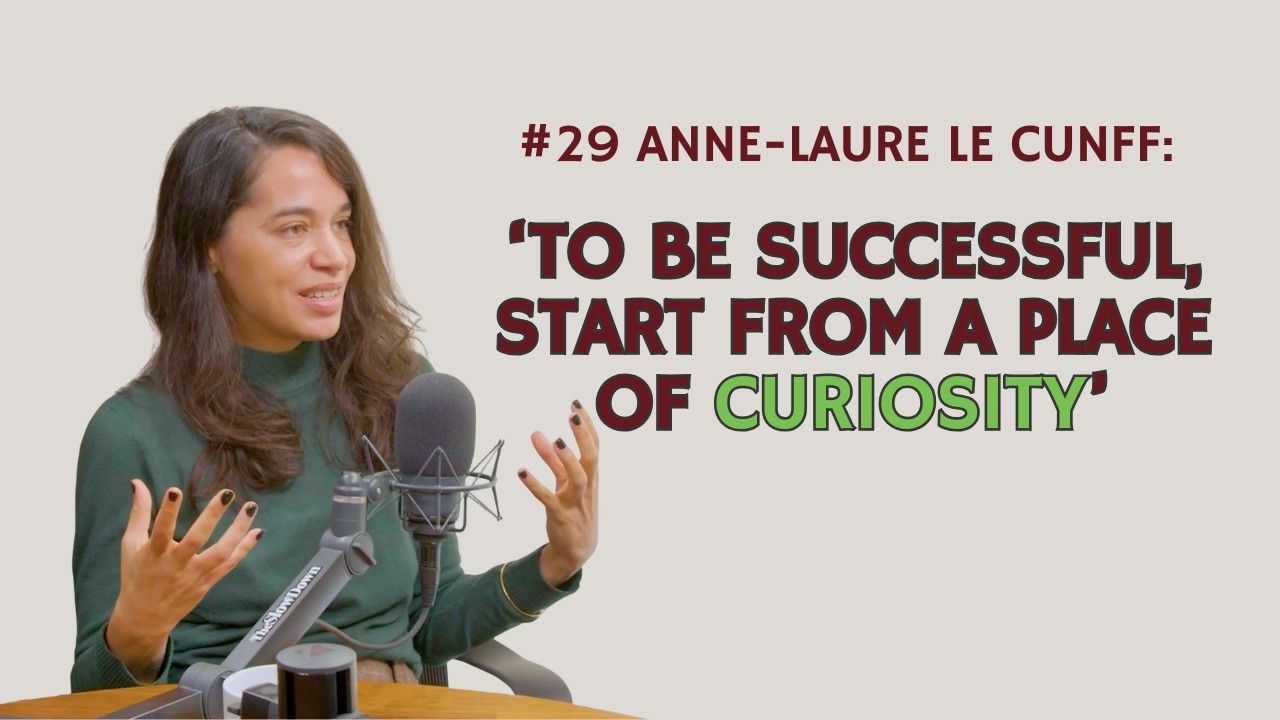
Enough Big Goals - Try Tiny Experiments with Neuroscientist Anne-Laure Le Cunff