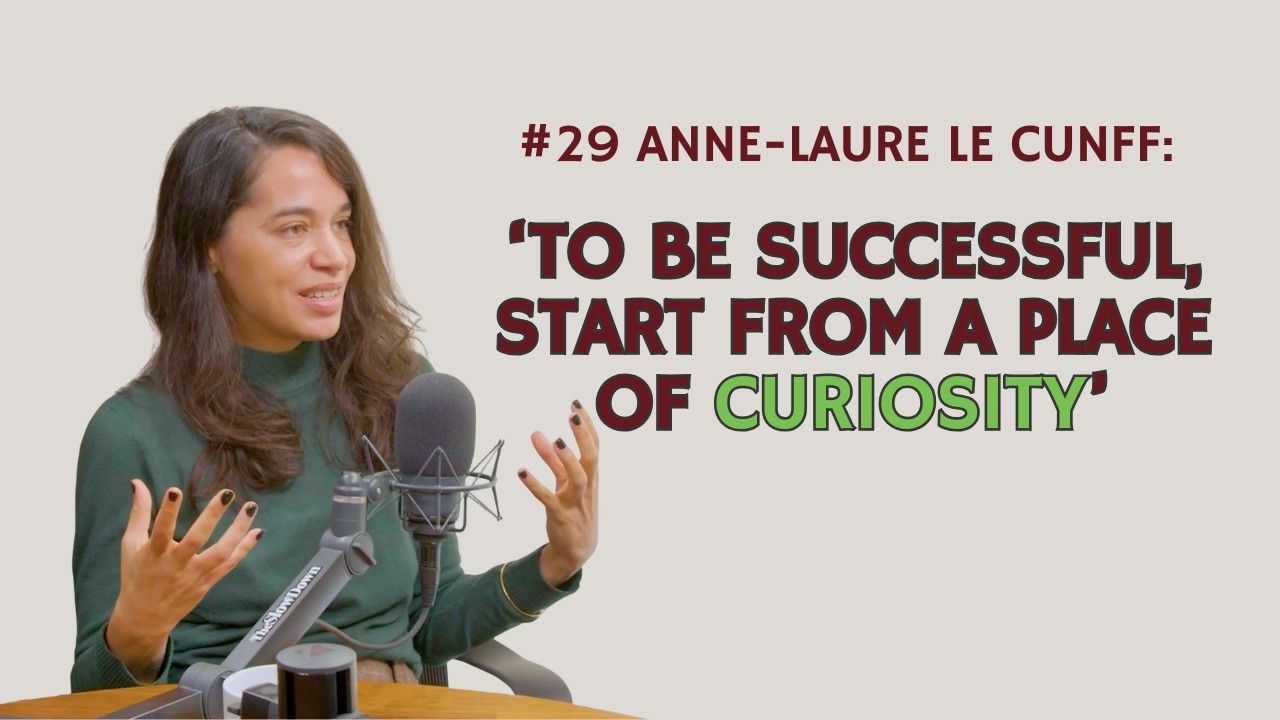
In this episode of The Roxanne Show, host Roxanne interviews Anne‑Laure Le Cunff about the limitations of the traditional linear life‑career blueprint and the benefits of adopting an experimental mindset. Anne‑Laure explains that the linear path—graduating, getting a first job, promotion, marriage, etc.—is a rigid, often unrealistic recipe for success, whereas an experimental approach treats life as a laboratory where one poses questions, forms hypotheses, tries new experiences, observes outcomes, and iterates. This mindset fosters agency, courage, and personal freedom. The conversation also explores how societal pressures (from parents, partners, friends) stem from worry rather than malice, and how making visible alternative, non‑linear models of success can empower people. Anne‑Laure notes a strong link between mental‑health spaciousness and willingness to experiment: anxiety or depression can trigger a desire for control and routine, hindering experimentation. Consequently, designing a fulfilling life requires a holistic view that integrates career, relationships, and emotional well‑being, supported by self‑leadership and metacognitive self‑awareness. The host emphasizes that self‑awareness is foundational for any life change, despite being an unpopular, “un‑sexy” concept in a fast‑paced culture.
Chapters
Real talk, real wisdom, all heart, all in. This is The Roxanne Show. I'd love for you to talk about the linear path versus the experimental mind or path and what, what, how the linear path actually can become more of a problem than, you know, helpful to an individual in life.
The linear path is basically the path we're told to follow if we want to be successful in life. The idea is that there are certain steps that you're supposed to go through in a certain order in order to be successful. So you have specific milestones, and that could be, um, you know, going to university, graduating, getting your first job, and then you apply for your first promotion. You work on your first, first big project. Maybe you meet someone, you fall in love, you get Get married, get a dog first, or maybe start with a plant, then a dog, then a kid, get a house, et cetera, et cetera. And so that's the linear path where you're really supposed to— it's a sequence of steps, almost like a blueprint where we're being told if you copy paste this recipe, you will be successful. And anyone who's been on this planet Earth for more than 5 minutes will know that this doesn't, it doesn't really work like that. Life is not linear. There is no perfect blueprint that you can copy paste. There are no perfect steps that are guaranteed to work if you apply them. Life is nonlinear. It's messy. It's chaotic. It keeps on surprising you in good and bad ways. And so I, what I really advocate for in the book and in, in all of my work really is to switch from that linear mindset clinging to this illusion of certainty and this this artificial recipe we're trying to apply, letting go of that and instead applying what I call an experimental mindset. And an experimental mindset is more akin to treating life not like a blueprint, but like a laboratory where you can experiment, you can try new things. Crucially, you have no idea what's going to work and what's not going to work, but that's part of the fun. That's part of the adventure. You don't try to be certain. You don't try to know the answer. You start from a question. You might have a bit of a hypothesis. You're wondering, hmm, might I maybe like that? Is that the kind of job that I would enjoy? Is that the kind of relationship that I would like? Is that the kind of city where I would like to live? And then you can experiment. You can try new things. You can observe the results. And then based on that, you can keep on iterating. And the promise here is that you don't know what your life is going to end up looking like. Nobody knows. Anyone who tells you they know is lying. You don't know, but you will end up being successful in your own completely unique way.
And this speaks to my heart so deeply in so many ways because first of all, I mean, it really allows for more— well, several, several values and attributes that matter to me. So agency, courage, trust. This is really how we can learn to trust ourselves. And all of that really allows you to be more free as an individual, to really create a life where, like you said, it's a life that truly belongs to you. It has your fucking name on it, not anybody else's. And my core value number 1 is freedom, right? And so it's so important to, for me to constantly be investigating, not from a place of judgment, but from like real curiosity. Does this next move, like, where is this coming from? Does this matter to me? Or is this something that I think will be good for X, whatever, you know, fill in the blank. You're, what's interesting, and I'm so curious to what you'll say about this, is when we think about how most all of us, society grooms us to, like, as we're being brought up, we're being brought up to first, the first question, what do you wanna be when you grow up? Okay.
Yeah.
Not even who, who, like your character, who, what? So we're already like, what's the label that's gonna define you? That's gonna put your value. Into like, and define your success. And then you go into that linear, that linear path, right? That you just beautifully laid out. And if you are someone who is going to lead with more curiosity, let's just say me, we're gonna use me. I, I, in fact, it's actually the perfect example. While I always had direction, I was always following what I felt was lighting me up and when I would do that, it didn't always look good on paper. It certainly didn't make sense in a lot of ways to, you know, maybe family or anybody, but it made sense to me in the moment. So I just went for it. You know, I've lived around the world, et cetera. But what I am curious to what you have to say about this is it, it really almost becomes a form of rebellion because we're not— it, it, it can almost seem, and in fact I would say, I think it does sort of equate to you're being irresponsible if you're not someone who is super specific, clear, following this path. Like, you know, I think times are changing and that's why I also believe that your voice is so important. All your work that you put out is so important, but it really is, it's, it's there, there's a contention with this idea of leading your life with more curiosity and more flexibility to, to be more discoverable versus no, you should be, you should know, you should go, and it's a done deal. And that's how we matter in life. Yeah.
And, uh, even in, in people, I've noticed even in people who are very curious, very adventurous, he, feel more comfortable with trying new things and keeping their options open and not really trying to cling on to the first answer. This is a conversation that keeps on happening where they tell me there's a lot of external pressure, and that pressure is not necessarily evil or, you know, people trying to make you conform or trying to fit into a box. It really doesn't come from that place. It really comes from a place of worry. Often it might be your parents, who really would feel better and would sleep better at night if they knew that you had a stable job with a salary at a well-known company and where they could feel like, okay, my job is done, my kid is going to be okay. It can be your spouse, your partner, it can be your friends. It doesn't come from a bad place. But again, it's because the only— and I think this is why it's so important. This is why I have these kinds of conversations. I have this conversation with you right now. This is why I I wrote a book and I'm writing a newsletter. I think it's very important to make those alternative models of success, those nonlinear experimental models of success visible. You need to have examples out there so people can see that it is actually possible to be happy, to be fulfilled, to be successful in a non-conventional way.
Totally. I so agree with that. Um, it's almost like you, and this is where almost the rebellion, it's like you have to kind of, it's not, let me prove it to you. But it is to say that you, well, you know, and this is another thing that I think your work does so beautifully or invites an individual into is self-leadership. You're really leading the way, right? So you're not following along, uh, which is not, you know, it, it's not this thing where you're just trying to disagree. It's really, you're trying to stay autonomous. You're trying to be a sovereign individual who's who came here to experience life and not just follow along, right? Yeah.
And I'm curious if this is something that happens to you too, but, um, with a lot of the people I've worked with, and I've noticed that in myself as well, I've noticed that there is almost a perfect correlation between my sense of spaciousness, my, my mental health, and how much I experiment. How comfortable I am trying new things. And if I'm anxious, depressed, stressed, or if there's something that's not going well in my personal life, there is often a temptation to then want to regain control in the rest of your life and wanting to stick to a routine, wanting to, to kind of be able to predict what's going to happen next, wanting to feel like you have a plan, that you know what you're doing. And so This is also why I think it's impossible to talk about how to design your life, how to design your career in isolation. You have to think about your relationships, you have to think about your mental health, you have to think about your emotional health, you have to make space for connecting with yourself, for listening to what's going on inside, for this sense of, you know, this self-curiosity, self-inquiry, really. Yeah, if you want to make sure that you give yourself that space to really, really explore, really experiment, and not go back to the default mode of making decisions, which can feel really reassuring, but yeah, which is not conducive to really designing the life you want.
Totally. Yeah. I mean, and I think it's, it's so easy to just stay in those loops and those patterns because it's, it's, it's like the safety mechanism. It's a survival tactic, right? For. Most all of us if we find ourselves in that space. But I think, um, I love this and I think that it, it brings to my mind, so metacognition, thinking about your thinking, self-awareness, which, you know, I, I often, I, I think it's really strong to share with you. I talk about self-awareness a lot cuz you can't do any, you can't make any changes in life without self-awareness, right? It's not the only part, but it is the foundational part, right? So if, if, but it's a, it's a hard sell, meaning we live in a society where, you know, more fast, better, like this is what most people want. And self-awareness is not this, it's not this sexy Instagram. I can hang it on my wall. I could put it in, you know, I could drive it, I could sleep with it, I could wear it. But it, it like, it impacts every fucking aspect of our life. And so, you know, when I love that you, when you mention, you know, you can't, you can't think about your whole career plan like in isolation. It's really this holistic approach. I think it, when I kind of, where I go from there is how do we become more self-aware? So that we can look at our life from more of this holistic sort of viewpoint to then be more discerning about, you know, what matters to us and what doesn't and what we want to explore more and what we want to maybe eliminate.
Yeah.
Yeah.
It's, um, I want to start with something that I would recommend for people because I think There is always an issue when you're someone who's used to practicing metacognition in your life, either through journaling, through any kind of self-awareness exercise, etc. There is a, you know, you can fall into the trap of giving advice to people that assumes that they're at the same level. When a lot of people, it's not necessarily that it's harder, but they just don't have the time, the mental space, they haven't, you know, really even tried journaling or anything like that in the past. So something that I like recommending to people who have never really created any kind of metacognitive practice in, in the past is to do something, a little exercise that I call self-anthropology. And, um, the reason why I call it like that is that it's an invitation to pretend just for 24 hours that you are an anthropologist with your own life. As your topic of study. And so it's not about going straight from journaling every morning or having a weekly review. All of those things are great, and I highly recommend actually building those habits long term. But if you're— you want to go from zero to one, just try something 24 hours. And again, pretend you're an anthropologist. Really picture it. What does an anthropologist do? They have their little notebook and they go in the field and they take field notes. And what's really important about the way an anthropologist does their job is that they don't judge. They just take little notes, they observe, and they ask questions like, why do these people do things like that? Why do they care so much about that? Why do they spend so much time and energy on that specific activity? Why do they do things in that specific order? And they just take notes, they observe, they ask those kind of questions again in a completely nonjudgmental way. And so you can do the very same thing with your life, 24 hours, and you can take your notes on your phone, in the little notebook, whatever works for you. You have a little Post-it note next to your computer and take notes. When do you get excited? When are you tired? When, what kind of meeting? Are there meetings where you finish the meeting and you're so full of energy, feeling so excited and you can't wait to keep on working on this project? Or Are there moments when all you want to do is go and hide and cry in the corner because you hate being here? All of this is really interesting data that you can use to better understand what works and what doesn't work in your life. And that can be a great starting point for someone who hasn't had really the space or the time to practice metacognition in the past.