The Experimental Mindset Every Leader Needs - Anne-Laure Le Cunff

Anne-Laure Le Cunff discusses her book Tiny Experiments, which teaches leaders how to design small experiments and pacts to combat procrastination, embrace uncertainty, and improve decision-making. She shares her path from Google to starting a startup to studying neuroscience, and explains how an experimental mindset builds psychological safety in teams.
Chapters
Today I'm joined by a guest who has helped me transform my life, and I truly believe this episode could have the same impact on you.
Anne-Laure Le Cunff, an award-winning neuroscientist, entrepreneur, and the author of Tiny Experiments.
Reading Tiny Experiments for me is what changed how I think about my work.
It gave me such a sense of freedom, a better relationship with uncertainty, and a whole new mindset of not trying to keep reaching all these goals but actually to find space in curiosity and possibilities.
It's a completely new way to make decisions, have a relationship with procrastination.
And if you're a leader listening to this who feels quite stuck at the moment, or is tired of keep trying to optimize yourself, or you feel like you're just pushing harder and harder but not seeing the results you want, this episode—
please, please stay to the end because Anne-Laure Le Cunff covers so many new ways in how we can approach how we lead our lives. So let's get started.
Anne-Laure, welcome to the show. I am so excited to be sitting opposite you today because as I mentioned already in your bio, you have influenced my life so much from your brilliant book, which I do need to touch and just show everybody this brilliant, brilliant book. So thank you for joining us today. Um, and for me, helping people find that courage to change is something I'm really got a strong passion for. And I'd love to start to find out what was your courage to change story?
Well, first, thank you so much for having me. And my courage to change story, I've had several, but I think the biggest one was when I decided to leave my job in tech at Google and try and figure out what I wanted to do next. So I used to work at Google, which was an amazing job, amazing team, amazing challenges. Absolutely loved it. But I also was suffering from what I didn't know it was called this way at the time, but imposter syndrome. I thought that someone at some point would realize that I did not belong in this company and I would get fired. So as a result, I was saying yes to absolutely everything. I was the yes girl in the office. Anything you needed last minute, even if I had to cancel plans with friends or anything like that, I would say yes, I'm your girl, I will do it. Obviously completely unsustainable. And I wish I could tell you that I had realized that on my own, but I didn't. As often in life, it takes an external trigger or a bit of a lifequake for you to realize that something is wrong with your priorities. And in my case, it was a health scare. One day I was getting ready to go to work, brushing my teeth in front of the mirror, and I realized that my entire arm had turned purple. Which obviously doesn't happen in one day. So it probably had been looking a bit odd for a while, but I had been ignoring it. And long story short, I ended up going to the infirmary at Google, then to the hospital in Stanford, and the doctor said, you need to get surgery straight away. You have a blood clot in your arm that is threatening to go to your lungs. And in that moment, What did I do? I said, one second, I need to check my calendar. Oh yeah, yeah. And I had this almost like out-of-body experience seeing myself have this absolutely absurd reaction. And this was the moment I realized my priorities were completely out of whack. And this is when I decided to quit my job.
With anything to go to or you just quit?
I initially left with nothing, nothing, no other role. I had a bit of savings. I trusted that I could freelance for a while if I needed to. And this is also where I wish I had this neat story where I could tell you I had the courage to leave my job at Google and then go and explore. But that's not what happened. It turns out I felt so uncomfortable after leaving my job at Google, not having that very clear identity, that way to introduce myself when people were asking, so what do you do? I started my career with a very neat answer where I could just say, I work at Google, and people would immediately assume that I was doing something interesting. Wow, great, a job at Google. All of a sudden, I didn't have that anymore, and I felt completely lost. So I ended up straight away going back to the exact same patterns and doing the one thing, the one socially sanctified thing that you can do when you work in Silicon Valley, which is starting a startup.
Brilliant. Because that doesn't take too much stress, does it? Exactly.
And I started that company for, which I know now, all of the wrong reasons. To have a sense of identity, to feel like I was working on something very clear, that I had a mission. And also to feel like I mattered, that I was contributing something to society, that I was being a productive member of society. So a lot of it was around external validation, really. Yeah.
It's mad, isn't it? Because I don't think I've met one person who's not had a similar thing of feeling I've got. You say when we meet people, what do you do? And the first thing is work, isn't it? We're so laboured by that identity of work. So how did then you find what it is you did want to do?
I was very, very fortunate that my startup failed, and that's probably one of the best things that happened in my career. Because of that, I finally found myself in a space where I had to admit that I was completely lost, that I had no idea what I wanted to do next. And so I had to ask myself, what do you want to do? What are you curious about? What would you like to explore? If nobody was watching, if external validation was out of the equation, how would you want to spend your days? What kind of work would you want to do? And for me, I had always been curious about the brain, why we think the way we think and feel the way we feel. And so I decided to go back to university to study neuroscience while still consulting on the side, and this time without any kind of goal without any kind of ladder to climb, really with just the idea of waking up in the morning and being excited about what I was exploring.
That just sounds completely joyful.
And it was, although it was challenging. I had no training in neuroscience before then. It was challenging, but in a good way. Not the kind of challenging when you're canceling plans with friends because you're working on a presentation. Not the kind of challenging where when you're worried about what people are going to think, where you're worried that people are going to see you fail. The kind of challenge that's more, as you say, joyful is the right word here. Joyful, intellectual, creative challenge. That's how it felt.
So it feels like to me, I'm sitting here going, for me going through that, you'd have had to have shed quite a lot, like let go of quite a lot. And I don't know why as human beings we try and hold on to all that stuff. So what was it like to let that all go? But to almost— because I know myself, I've let stuff go, but it creeps back in. How did you let it go and just allow yourself then to really truly stay on this path?
Okay, I'm a neuroscientist, so I kind of want to first, before talking about my personal experience here, I think it's actually quite interesting to understand what's going on in the brain when we do that. Um, so our brains really don't like uncertainty, which makes sense because if you think about our ancestral past from an evolutionary perspective, the more uncertainty you had, the less likely you were to survive. So, the more you felt like you had information that you knew what was going on, what was going to happen, whether it's, um, who are your friends and enemies in the tribe or where the resources are or what is this weird noise behind you, the more you felt like you understood the the world around you, the more you felt like you were safe and you were going to survive. And so our brain is always trying to recognize patterns and understand what's going to happen, making predictions, right? When there's uncertainty, when you don't know what you're going to do next, you panic. And the way you try to get back to a sense of safety is through control. Psychologists actually call that compensatory control. So the more uncertainty there is, the more we want to feel like we have a plan, we know what we're doing, and we just want to be told what to do and in what order. Yes. And that if you do that, you'll be fine.
It'll work out.
It will all work out. Right? And so what's interesting is that even when you tell yourself, okay, let me explore, let me try something new, let me maybe make mistakes, this compensatory control is always going to try and creep back in.
Yeah.
And tell you, you need to feel in control. You need to know what you're doing. I see that as a little dense. I don't ever pretend to, and I've never really been in a space where I can fully let go of this desire for control because it's completely natural. It's just my brain trying to protect me. Yeah. So what I do now is that I almost like listen to my brain and I just say, hey, I see you, I understand, I know why you're doing that. I know what you want, the plan. I know what you want, the blueprint. But let me, let me experiment. Let me see what happens. We're safe. I'm in no danger of dying. We're not in the jungle anymore.
Yeah.
So it's more about instead of trying to completely repress the desire for control, it's about noticing it. And then deciding to put it aside and to still experiment, to still try new things, to explore and to make mistakes.
And I think it's where your passion is around opening up curiosity. And I realize that it's, I do coaching leaders pretty much every single day. And the word I use the most is be more curious, be more curious. But it doesn't really, it was like we logically know that, but we don't emotionally see that through. We go to fix, we go to want to know.
Just a quick reminder, if you haven't already, to please hit the like button and subscribe to the channel. It's a small action that makes a big difference. You'll be the first to know when new episodes drop, and your support helps us create meaningful content for leaders like you. I'd also love to hear from you, so if you have any thoughts, questions, or ideas, pop them into the comments. And if you're curious about how my leadership coaching or training could support you or your team, just drop me a DM and we'll set up a call. Thanks so much. Now let's get back to the episode.
I'm kind of curious to know with people that say listening to this, leaders in senior roles, and they've maybe got a family and even some of that story of I'm, I am trapped, I do need to climb this ladder. I have maybe still got something to prove within myself, or I need to pay the bills, pay the mortgage. Have you come across people that are quite resistant to this because they're like, I have no choice?
Absolutely. And I think this is the, the biggest barrier to change is this belief that you're stuck, that you're trapped. And this is why I'm such a huge advocate for experimentation, not in the sense of change everything, experiment with everything, but in the sense of always having a little bit of space for experimentation in your life. And so if right now you are in a situation where you have small children or you're a caretaker or whatever it is that makes it that you need to stay in a certain role and have a certain salary, that's okay. It doesn't mean that you cannot experiment at all in your life and your career. And this is why in my work I talk about designing tiny experiments. It's really the idea that however stressful your life is right now, and especially if it feels really uncertain, almost like having a little laboratory in your life where you ask yourself, what is one thing I can experiment with? How can I reconnect with my sense of agency by asking myself almost like a research question? What would happen if I tried this? And it can be very low risk, it can be very small, and it can just be a way to reconnect with that sense that, yes, things can change.
Because I think you talk about in the book your meditation, wasn't it one where you're like, I just don't like meditation. You know, actually, what if I try it? Is that an example of a small one? Just a test?
Yes.
And it's actually a really good signal if you hear yourself say, that's impossible, I can't do it. I'm not that kind of person. I'm not wired this way. That's so juicy. This is great. If you hear yourself say those things.
Yeah.
Get curious about it. Why is it that you have internalized the belief that you cannot do these things? Because you can. You probably can.
Yeah.
And what is a tiny experiment you can design around that to actually confirm or disconfirm what is really just a hypothesis? This is not fact. It's just a hypothesis you have formulated about yourself.
Test it.
Try it.
Because something you made me think is I'm currently experimenting with getting fit. So I'm doing more weights and stuff. But I notice in the gym environment, if there's a weight machine or something that I haven't used before, everything in my brain wants to keep me safe. And I sit there and I use like, just go and experiment. Doesn't matter if you get it right or wrong. And I'm having to learn how to do band-assisted pull-ups and I've never even put the band on before. So I'm watching my Google video and I can feel people are looking at me and I can feel I'm doing it all wrong. I'm trying to get me leg in and it's all going wrong and I'm just going, oh my word. But because I had this attitude of, I'm just experimenting. Even if I don't get it to work, I'm experimenting what it's like to feel and try and do this. And I didn't do it, I couldn't figure it out. But the fact that I'd walked over and tried, I felt again that agency of I still gave it a go. I also was more comfortable that I'd made a, probably made a mistake or did it wrong. But that, as you say, that experimental mindset enabled me to have the courage to do it. And then next time I could say to my husband, like, can you help me next time? So I know I couldn't do it on my own. So it can be those, even those tiny moments of just trying to learn I had to do a pull-up.
You're really— you're touching on something fundamental about what it's like, what it is to have an experimental mindset. What you did when you went and tried and figured out how that machine works is really completely change your definition of success. Because when we have what I call linear goals, we have a very clear definition of what success should look like, and it's almost like a destination. And either we get there and that's success or we don't get there and that's failure. That's very binary. When you experiment, the only goal you have is to learn something new, including learning that you don't know how to do the thing.
Yeah.
That's actually— And that was okay.
Yes, exactly. And this is what allows you to iterate because you have one first try. In that case, couldn't figure it out on your own. And instead of reverting to, you know, self-judgment, self-blame. Just like a scientist, you observed that you cannot do it. Oh great, new data. Yeah, I can't do it. Next cycle of experimentation, next iteration, what do I do? I go and ask my husband, show me, how do you do it? And then maybe next iteration, I try to do it on my own. Let's see what happens. Does it work? Does it not work? Oh, clearly I didn't get it. Let me ask again. Yeah, you know, maybe that could happen. Or, oh, I can do it. It's a bit difficult, but I'm getting the hang of it. And so all of a sudden your definition of success is not binary anymore. And this is why I always talk about replacing ladders that are very linear with loops, where the idea is that every time you complete an experiment, you're just closing one loop, you're giving it one try, and all you want to do is learn something new about either yourself or your work or the, the world around you.
Love it. I never thought doing that one pull-up would It's amazing. It's amazing.
Can you help?
So I'm thinking of the people listening to this and some of them might be in their goal setting period, in their goal setting for their teams and all of that. How can you take this into the workplace? How come? Because I know you talk about the goal setting process is broken. Can you just expand on that a bit more in terms of the context of that work environment?
So the entire idea of experimenting more is inspired by the way scientists Work, and it's inspired by my own experience as a neuroscientist working in a lab. So really inherently, they are made for collaboration and for experimenting with others. It's very, very simple. The way I recommend doing it is really treating your team like a lab. And so what you can do is have a little kickoff meeting where you say, okay, we're going to start running some experiments. And you can ask people, you should really ask people to design their own experiments. The ownership is really important. So as a leader, instead of being very top-down and telling them, this is the experiment we're going to run, you can give them a little bit of time to brainstorm their own experiments. The format I recommend using to design experiments is to pick one action to experiment with for a specific duration. So there's no goal or success metric. The only thing you want to do is complete the experiment for that duration. So for example, if, um, I don't know, you're, you're leading a sales team. You could say the experiment is to reach out to one sales prospect completely, you know, outside of our existing clients every Monday for 6 weeks. And you spend the time you need to spend crafting that email, making it the best you can. And you do that and let's see what happens, right? So you're not telling them you need to close that many deals or you need to have that many meetings. No. The experiment is to just reach out and see what happens, right? So always, I will, action for duration. Very flexible. The duration ideally should be quite short. So again, you complete the experiment, you collect your data. So first step as a leader is just creating that space and saying, let's experiment. You all design an experiment. Let's do it. When you do it as a team, what can be quite fun is to all go for the same duration. So you say the action is whatever is relevant to your role, something you want to experiment with. The duration, we'll all do it for 6 weeks. And at the end of the 6 weeks, let's all come back together and we have a lab debrief meeting, just like we have at the lab where I work. Everybody shares the results of the experiments. And it's not about saying it was successful or not successful. It's about sharing what we learned and sometimes saying, hey everyone, I ran that experiment. It was awful.
Don't do it.
This is great. Now the entire team knows and we learn something collectively. So that's a really simple way to incorporate experiments in the way you work with your team.
And even I suppose on an individual level, instead of saying, right, what are your goals for this year? It's just like, what experiments do you want to take part in this year? So I remember you say it's about the outputs, not the outcome, isn't it? And I think the outcome can be quite overwhelming for people where the outputs is what I'm hearing from you feel like you can keep taking a step forward.
Yeah.
And the problem with outcomes is that it assumes you know what outcome you want. And in today's world, with the level of uncertainty that we have and with things changing all the time, sometimes you're not even quite sure what is the, the right outcome that you're going for. And this is why experiments as a mental model are so helpful, because for a scientist, if you already knew the result of the experiment, you would not need to run it.
Yeah, right.
You run experiments because there's, there's doubt. There's uncertainty. You're not quite sure what's going to happen and you wanna figure it out, so you experiment. This is a mental model that is a lot more helpful in today's workplace than saying, we know exactly what we're supposed to do, we know exactly what success looks like, and here is a 3-step recipe to get there. That never works. And then we blame ourselves when those plans don't work.
Yeah.
So, experimentation is really about embracing uncertainty instead of seeing it as something to get rid of. You see it as an opportunity to learn.
And already I'm just sitting here thinking of the pressure this takes off leaders. Because you go, if you've got a team that's got an experimental mindset and you've got this freedom to experiment, my gut feeling is telling me you're just going to have more innovation and more momentum, motivation, and growth rather than everyone feeling under pressure. You have to hit this number. You have to do that because you'd hope through these experiments you learn how to get to that. But as you said, this world now, what maybe what I knew as a leader when I was in corporate isn't how to do it now because the world has changed so much. But there's a risk that I will bring what I think you should do because that's what I did. But you said the world's changed so much and I suddenly really— I'm connecting some dots in my brain going, I think that's the fault of some leaders at the moment. We're so hung up on what we think is right versus letting go of that and allowing everyone to just find out other ways of doing things.
I have a lot of compassion though for leaders in that situation, because when you think about it, we are— and especially if you're in a senior role, you're hired to provide answers.
Yeah.
And so it does take a lot of courage and confidence to say, actually, I don't know what's going on here. What experimentation gives you is really a way to replace the illusion of certainty you're supposed to, to give to people with collective curiosity instead. And so instead of just saying, I don't know what's going on here, you can say, I don't know what's going on here, but let's figure it out together.
I like that. And is this what, is this what the pacts are? Is this the, so the action for a certain duration, is that then what you label we're making a pact?
Yes, I call it a pact because it is a commitment to curiosity. You're committing to collecting your own data You're committing to withhold judgment until you completed the experiment. So just like a scientist who doesn't poke at the data in the middle, and you don't go like, oh, I don't look, I don't like what I'm seeing. Let's stop the experiment. You finish collecting your data and only at the end you look at what happened and then you make a call in terms of what you want to do next. Should we iterate? Should we tweak anything? And that's why I call it a pact. You're really committing to being curious.
And seeing it through.
Yes.
You said a word there that I think is very strong, judgment. So I've just done some small psychology training where they were saying that the number one saboteur we all have is the judge. Can you give me a bit more understanding from your own experience and also as a neuroscientist of what is this judgment and how can we learn to maybe navigate it better, have a relationship with it better? What can we learn?
Well, I think it starts with a little bit of also self-compassion here, because you cannot talk about judgment without talking about belonging. And in essence, a lot of the self-judgment we experience is a desire to belong and the fear that if we don't do the right thing, if we don't make the correct decision, if we look like a fool, then we're going to be rejected by other people. So I think the first part is really just understanding that you're basically just being almost like a little child who just wants to belong, who just wants to make sure they have friends. And he's scared that they're going to be rejected by others. This is really where judgment comes from. That's the first part. And the second part is always— and this is always the recommendation I give— is that Do not try to repress those automatic responses. Again, your brain is trying to do its job. Being rejected from the tribe in the past meant death.
Okay.
And so that's why, that's also why we're so scared when we're on stage doing public speaking and all of that. We're putting ourselves in situations where in the past, if you had 100 pairs of eyes looking at you and waiting for you to say something, that was not good news. It was really scary. You probably did something wrong.
Yes, I get it.
Yeah.
So our brain is interpreting all of those signals as, ooh, risky. I could be kicked out. I could— from the tribe, I could be rejected. And, uh, feeling the feeling, knowing what it is, naming it, labeling it— psychologists call that affective labeling. Just putting a label on an emotion, on a feeling, allows you to process it better.
Kind of diffuses it, doesn't it? It just helps. Yeah. Yeah.
It's because it re-engages the prefrontal cortex. So it really helps you think about the feeling, which is really helpful in terms of processing it. So naming it, labelling it, processing it, and then deciding what you want to do from a place of alignment with what you actually want to do, not based on fear. It's not easy. And again, it's always a little It's a little dense that you need to practise.
It is.
'Cause I say I've been practising this for about 7 years and it does take practise. And I think a lot of people will read something or listen to a podcast and go, "Yeah, I know how to do that logically." But it is like you say, go to the gym to build muscle. You've got to keep going, like just keep learning and practising every day with your mind. And it, I think it becomes more autopilot eventually when you do it more. But yeah, it does take a bit of effort to start with. Does this link into, I loved one of the chapters in the book, "Procrastination is not the enemy." And I was like, Oh, okay. Looking forward to diving into this bit because I think so many of us think it is. Does this sort of link into our relationship then with procrastination?
Absolutely. Procrastination is fascinating in the sense that this is something we all experience, but we never talk about at a personal level. Everybody is happy to talk about procrastination at a conceptual level. Oh, procrastination. Oh yeah, this is hard when we procrastinate. You never walk to your boss saying, I'm sorry, I didn't finish the presentation because I was procrastinating. Nobody does that. And the reason why is because procrastination has been moralized in the sense that it's been associated with lack of willpower, lack of discipline, laziness. And so we don't want to say out loud, I procrastinate. We don't want to be associated with, with those— what we see as a moral failure, really. But procrastination is just a signal from your brain. That's just what it is.
Yeah.
It's your brain trying to tell you that something is not quite right with the task you're working on at the moment. That's it. And so if instead of repressing that signal, ignoring that signal, and very often blaming ourselves in the process, yeah, we just listen to it, we could learn a lot and we could find a way to get unstuck. So In the book, I share a little tool that is just a structured way to have a conversation with your procrastination.
Oh, let's go.
Yes. And it starts by welcoming your procrastination. I know it's going to sound silly, but really try it next time where you say, oh, welcome back.
Here you are again. Hi.
Here you are again. I believe you have a message for me. What are you trying to communicate? What are you trying to tell me? And this is the little tool now. Is the problem coming from the head, from the heart, or from the hand?
Okay.
If the problem is coming from the head, it means that at a rational level, you're not fully convinced you should be working on this task. So maybe someone put it on your to-do list and it doesn't make sense. Maybe you're not the right person to do it. Maybe AI should do it. Maybe someone else on the team should do it. Maybe the task is just not aligned with the general vision and mission of the company you're working for. Something at a rational level is off. And so you procrastinate. If the problem is coming from the heart, it means that at an emotional level, the task doesn't look like it's going to be fun, enjoyable. You're not feeling enthusiastic about it. And so you procrastinate. And if the problem is coming from the hand, it means that at a practical level, you don't believe that you have the right tools, the right skills, or the right support from your team in order to do the task. And so you procrastinate. What's really interesting is that when you have this conversation with your procrastination, when you treat it as a signal from your brain and you listen to it and you try to understand what's going on, it also gives you a systematic way to address the challenge, to address the resistance. So if the problem is coming from the head, then go back to the task. That can be with your team. And you can— yes, you can do that. I literally did it yesterday with my team in the lab. You can say, 'Hey, I've been procrastinating on this thing for 2 weeks now, and I think this is because it doesn't work. It's not aligned with what we said we were going to do. Can we take 15 minutes and have a quick chat?' Nice. 'And go back to the task and just make sure we're aligned here.' All of a sudden, procrastination is something you can share with other people as a tool to make better decisions.
Yeah.
If it's coming from the heart, then— so rationally, you're convinced you should be doing it, but emotionally there's a bit of resistance, make it fun. Grab your favorite colleague and do a little coworking session. Go to your favorite coffee shop. Give yourself a little reward. And if the problem is coming from the hand, then raise that hand. Ask for help instead of staying stuck and paralyzed. Ask for the resources that you need. And that can be coaching, mentoring, that can be financial resources. Sometimes if you don't have the budget to do the thing you're being asked to do, whatever resources you need, to get the job done.
Where does fear sit in those three? Fear, the heart, the emotional response. If you've got something you really want to do and you know it's your dream to do it, but just fear is getting in the way.
Yeah.
Is that the heart?
Fear can be sometimes emotional in the sense that it is more connected to your kind of self-belief, what you think, you know, like maybe fear of being judged, fear of failing, etc. It can also come from the practical level. Where you don't think you're able to do it. So you don't feel like you're equipped, you don't have the right knowledge to do it. At a practical level, it's usually a little bit easier to solve in the sense that you just need to get those resources.
Yeah.
So the training, the support and all of that. When the fear is really coming from purely an emotional level, it's a little bit harder. And this is where having psychological safety in the workplace is so important. Because very often this takes more of a coaching conversation with, you know, your manager or an external coach if you don't have that at work. But it takes a little bit of deeper work to go and untangle this.
It's interesting you mentioned psychological safety. That is coming up more in my conversations this year than ever before and actually seeing less of it. Are you noticing or aware of any patterns with the amount of uncertainty that's now rising, that psychological safety is going down? Because what I'm seeing is a lot of self-preservation self-protection, even teams closing in on themselves and not sharing as much anymore. Are you noticing any of that?
Absolutely. And this is just another instance of compensatory control. So we feel uncertain. We're scared of what's going to happen next. We don't feel like we have the right tools. We don't feel like we're equipped to deal with that uncertainty. And so we respond with this artificial control, trying to only work with people we know. Trying to only work with the systems we understand, things we've done in the past that worked. And although they don't work today, this is why I always talk about the illusion of certainty. It doesn't give you actual certainty, it just gives you the illusion of certainty. And it really prevents you from exploring better ways of solving those challenges.
My brain is dotting all over the place at the moment. It's so exciting talking to you because it's then jumped to a place in the book where you talk about The wonder that children have with curiosity and uncertainty. And something really hit me where you're saying like, as adults, we actually make our world smaller and we have a smaller sort of group of friends. We reduce our hobbies like crazy and probably reduce the type of films we go to and everything. Is that again, that thing of where does that curiosity go?
Yeah, well, at a developmental level, there's a part where obviously we have learned a lot of things, right, when we're an adult. And so you don't necessarily need to be learning at the same rate that you are as a kid. I think it's important to acknowledge, you know, when you're making an omelette in the morning, it's a good thing that you're not wondering every morning how to break an egg and how to—
I'm rubbish at making omelettes, but I get it. I get it.
But there are They are hopefully things that now you have internalized and, and this is what allows you to function as an adult, right? So there's part of that. That being said, we still— there are so many more things that we could learn and we become a little bit more uncomfortable exploring. And part of it is linked to the fact that it's kind of the, the other side of that coin that we're supposed to be an adult now. You're supposed to know what you're doing. And it's really, really hard to put ourselves in situations where we're a beginner again, where we have no idea what we're doing, where again, we could look like a fool.
Yeah.
In front of other people. And so this is why I hear a lot of people saying, oh, I wish I could learn to play this instrument. I wish I could learn this language. I wish I could do all of these things, but it's too late. And, and lastly, part of it is time anxiety. It's really this idea that you're supposed to make the most of your time.
Yeah.
And you feel like maybe you should keep on investing and getting better in things that you know already versus starting from scratch.
So true. Yeah.
And, and we limit ourselves again because what we don't think about— and so interesting when I hear people definitely having those signs of time anxiety and they're in their 50s. I said, you're still so young. You have decades.
Yeah, long time.
Yes. But you're acting as if you only had 5 years left. Right. And I'm guilty of time anxiety also. I don't know if guilty really is the right word here, but I do experience time anxiety quite often. There are so many things where I have to remind myself I have time. I can start now. It doesn't come naturally.
And I was sharing with you actually before we hit record that something for me and I'm what, say 47 now, going, I'd like to go back into education. I know that's one thing you did as well, but I definitely, I was sharing with you is I don't know where to start. I, I don't know, I don't feel I understand the academia world. I don't even know if I could do it as I've never done it. And you just so simply said to me, so easily, we'll see it as an experiment. Do you want to share in terms of like when I shared that to you, what happened in your brain and how you gave me that advice?
Yeah, when you shared this, I saw myself in you and so many other people in the sense that we somehow have decided that there are parts of our life or our career that are too big to experiment with. And it needs to be this very scary, overwhelming project, which means that we also never get started with it. And the reality is that almost absolutely anything can be turned into a tiny experiment. So even going back to university for a degree, a lot of people would say, oh wow, this is like a 2-year commitment. This is, something that I need to decide, am I going to have to overhaul my entire life to do this? And if you remove that belief that comes from absolutely nowhere, rather, we just think that that's the case, you can start doing a bit of research and you can discover that there are lots of degrees where you can do it module by module. And by doing 6 modules, you get a certain diploma. By doing 12 modules, you get another diploma. All of a sudden it becomes an experiment. Try one module. Do you like it? Keep going. And by the end of it, you'll have all of your modules and you'll have your diploma. But you're not going to discover that if you start from the belief that it's impossible. It has to be big. It has to be this huge—
I've got to find loads of time. I've got to— yeah.
Yes, exactly. And so I would really encourage anyone, and again, every single time I give people advice, it's also for me because— oh yeah, I generally still struggle with these things. I still have those automatic responses. Um, and so I always try to remind myself anytime I see I get this response where I say, oh, it has to be this big thing. It has to be this big project. Wait a second. What would be the tiny experiment version of this? Almost always there is a version of that.
So it feels like what we're getting better at as humans is being able to override the autopilot. And that's, I think, if we can get that skill to hang on autopilotly, my brain's going, this is big. You don't know where to start. You haven't got the qualifications or the proof that you can do it. But if I over— get the skill in overriding that to go, well, actually, if I see it as an experiment and if— because I said, I don't know if I want to do this or this or this. You went, well, just try one. If you don't like it, try the other. And I was like, oh yeah. I think because our brain probably tries to find reasons, as you said, to keep us safe.
Absolutely.
And on the certainty path. And that's why I think so many of us stayed stuck on the career ladder. We've got to get to the top and all of that. And I think this is where even as I'm talking, taking a breath of, you can give yourself so much freedom if you see it as an experiment.
Absolutely. It's, uh, it's been liberating for me, and I know it's been liberating for a lot of people to just have permission to try something without any specific outcome in mind and with the only outcome being self-discovery. And that's it.
Just a quick reminder, if you haven't already, to please hit the like button and subscribe to the channel. It's a small action that makes a big difference. You'll be the first to know when new episodes drop, and your support helps us create meaningful content for leaders like you. I'd also love to hear from you, so if you have any thoughts, questions, or ideas, pop them into the comments. And if you're curious about how my leadership coaching or training could support you or your team, just drop me a DM and we'll set up a call. Thanks so much. Now let's get back to the episode.
In your book, you say the secret of better decision-making. Could you expand on that? Because we are making— I don't even know, you probably know. How many decisions roughly do we make every single day as human beings?
I think it was 80,000 or something like this.
That's phenomenal. And some of those are really big decisions that can impact the lives of others as well. What is your thing of how we can start making better decisions?
The main framework that I share with people, the shift in terms of how to approach decisions is to incorporate both external and internal signals. So most leaders are very good at incorporating external signals in their decision-making process. By external signals, I mean anything you can put in a dashboard. If it can be turned into a number, a metric, something you can track, and you can put that in a spreadsheet and present it, ta-da! Great, we're making rational decisions. Internal signals are based on first intuition, but also emotions. How does it feel to work on this project? If all of the external signals are looking good, but your entire team is burned out, is that success? Is the project really successful? And I would argue that it isn't. And so to me, making better decisions is really about being able to, yes, the external signals are important, but also incorporate the internal signals of success and based on that, decide whether you want to persist with your current approach. That's one path. Whether you want to pivot. So just tweak some of the parameters of your experiment and see if it would help or pause. We're allowed to stop a project that is not working. And I'm saying pause. I'm not saying abandon forever. Because that same project might actually make sense in the future when the context is different, your team is different, you're different, you have different resources. So you can just put it on the shelf. Say, right now, based on the external and internal signals, this is not working. Let's pause. That is okay too.
It is, isn't it? It's just taking that moment to think. And I love when you said it, to think about your thinking. Yes. Which, if I'm correct, is obviously metacognitive.
Cognition.
Yes. Is to kind of go— and I'm thinking when I was listening to you, I think that's some of the gaps. We're thinking and reacting, but we're not thinking about our thinking to go, does this feel what we— where we want to go in this moment? Using the external and the internal and bringing them together as a relationship. I think there's a lot of people out there, and this is just from my experience as well in what I've come across, don't really know how to connect with their internal world or didn't even— don't even— some of you don't even know there's an internal world.
In your—
from your experience, how do you describe what an internal world is for people?
Your internal world is just another set of signals. And I always talk about signals because I think it helps people having language to actually explore this world that, as you said, can be a little bit more uncomfortable because we haven't been taught to listen to the signals. And so I really just tell people the same way you're turning your attention your curiosity outwards. You can do that inwards, and you can ask yourself questions. You can ask your body questions. You can ask, how does this feel? Um, am I energized by this idea? Am I excited? Or do I just want to, you know, sometimes during a meeting, you know, when you want to go and hide in the corner and you don't want to be here, you're like, why are we having this conversation? I don't want to be here. That is such an interesting signal. Don't ignore it. Ask yourself why. Why do I want— especially if you love your job in general and there are conversations that you're trying to avoid.
Yeah.
Look inside. Go and explore this inner world. There are so many interesting signals that you can learn from.
And I think even sometimes I'm not a big journaler, but trying to maybe write out your internal world can sometimes help make sense of it, isn't it? What's going on?
Yeah.
With, um, just curious, with burnout and listening to signals, not listening to signals, and obviously in your role, I've been there as well. My name was Go-to-Jo. You were the yes person.
Go-to-Jo, she'll sort it out.
That was me. And I kind of wore it. I did wear it as a bit of a badge of honor, to be honest with you. It's like, oh yes, I'm the one who could fix everything. There was, there was definitely ego attached to doing that as well as that fear of, am I enough, prove myself, lots of things going on. If anyone's in that sort of place at the moment where they're in that yes/no, they're that fixer, that one that can always be relied on, is checking their calendar when really they should be booking a doctor's appointment, what advice would you give them? And bearing in mind they're not probably in a great place right now.
Yeah.
What kind of, what are just 1 to 3 little small things that they could do to maybe just get some clarity on the choices that they have in where they're at right now?
It's really about first observing the current situation. We never do that. And so I always tell people, if you want to start experimenting, it starts with observation. So a simple exercise that you can do is pick a regular day, regular day at work, and I call this self-anthropology. The idea is to pretend for 24 hours that you are an anthropologist, but with your own life and work as the topic of study. And for 24 hours, just observe and take little notes. Again, without judgment, just observing. And you can ask yourself questions like, oh, why do I spend my time like this? Oh, I'm okay. I'm feeling more energized when I have this conversation. Every time I talk to this person in the office, I love it. I get excited. Every time I'm being asked about this project, I'm dragging my feet. No judgment again. Taking little notes. And only do it for 24 hours. It doesn't need, again, to be a big project. I guarantee you that if you do that, you will notice things that you've been doing in an automatic way without noticing, just because.
Mm.
That means those things can be things that can change if you decide to experiment.
Yeah.
Pick something, and especially if at the moment you're very overwhelmed, there's a lot of uncertainty, pick something so small. That it's almost impossible not to do. What's interesting is that people think that tiny experiments are always about adding something, trying something new. It can be about removing something and see what happens.
That's true, actually. To start with, I thought it was about adding.
Yeah. You can, you can remove something. And so I've had people, for example, experiment with no meetings for a week and they just try to work with their team through emails, seeing what happens. What happens when we remove meetings? After that experiment, they realized that there were a lot of meetings that were not necessary. And so they didn't go from— they didn't keep not having meetings, but they only kept the ones that they felt like they were missing during the experiment. A tiny experiment that is more personal but I love is I will not bring my phone in my bedroom for a week. Yeah, that's it. And just notice the impact on your sleep.
Yeah.
On your mental health, on your mood, on your productivity and creativity at work because everything is connected. So you can even experiment with things that don't seem like they're directly linked to your leadership or to your work and see the downstream effects of removing some things, simplifying some things. So that's what I would recommend. First, observation, a little bit of self-anthropology for 24 hours, and then picking something really small that could even be something you remove instead of trying something new.
Beautiful. I think that's absolutely brilliant. Thank you. This has been so fascinating and so, so helpful. So thank you. What I would love to know is what advice, if you were projecting into your future. What advice would your future self give you now? Or even what experiment would your future self love you to be starting now?
I would say don't forget to take care of your body. I have the kind of work that is, you know, a lot of writing and research, and it can be very easy for me to spend hours writing and maybe not drinking enough water or staying late on my computer in the evening because I really want to finish writing this research paper. And I think my future self will thank me if, despite the fact that I'm very excited about the work I do, I don't forget to take care of my body. And that's also why a lot of the experiments I do in my personal life at the moment are around walking, around eating better. They're really health-focused. And I think it is helpful. I do think it is helpful. They don't always work. There are things that I tried running as an experiment that was a disaster. Not for me. But walking has been great. So yeah, take care of your body.
I agree. I think the pact that I made from reading the book was to do at least 10 minutes of exercise every single day. And it normally ends up being a lot more than 10 minutes, but it's just to do— if I've got— if a day's tough, I'll just do like the lymph movements. And I'm like, well, I've done something, I've moved. So that's the pact. And it's interesting you say an action for a certain amount of time. It has just stayed. It has become a habit. I know it doesn't need to, but it's lovely. It actually has just become something that's part of my life now. Before we close, is there anything we've missed? Any advice? Anything you think we've missed?
I don't think we missed anything. Just the last thing you just mentioned. Tiny experiments can be a great way to discover new habits. I find it absolutely crazy that people just decide to start a new habit they've never tried before and they commit to it for the rest of their lives. So maybe try it for a couple of weeks first.
Yeah.
And then you can promote it to the rank of habit if it works for you.
It's so true. Like I've started playing golf. I was thinking, I'm not a golfer, golf is boring. So immediately I was like, I need to go and play golf then if I'm saying this. And but initially you're like, oh, go and buy all the kit and everything. It's like, no, let's just see how we get on with a few lessons. Let's see how we do. It is funny how we dive all in. Again, I suppose it gives us certainty. Got all the kit, know what to do. And then it's like, and then you don't wanna fail. Or there's, you go, I've gotta stick with it. And it's like, do you really want to? It is a minefield and fascinating how we work as human beings. And thank you for helping break it down and just give us some tips, um, in what we can do to honestly, it does give you more freedom. Um, you helped me breathe, breathe. Um, and you helped me really make some changes in my business last year. So I'm ever so grateful for that and grateful for your time today.
Thanks so much for having me.
Thank you so much. And thank you for everyone who's listening and watching. And we'll see you soon.
If you've been enjoying the Courageous Leaders Podcast, we'd love it if you'd subscribe to our YouTube channel. Your support helps us keep creating quality content and reaching more leaders like you who are ready to grow and make a real impact. We fund this podcast ourselves, so every subscription truly makes a difference and allows us to support courageous leaders like you. Thank you for being part of the journey.
More from Anne-Laure

How to Use Curiosity & Experimentation to Flourish, with Dr. Anne-Laure Le Cunff

Stop chasing goals and start running tiny experiments with Anne-Laure Le Cunff

Why You’re Still Waiting To Figure It All Out | Anne-Laure Le Cunff | EP. 391


Tiny Experiments: How to Learn, Grow, and Navigate Uncertainty — Anne-Laure Le Cunff



Stop Setting Goals. Try This Instead | Tiny Experiments with Anne-Laure Le Cunff


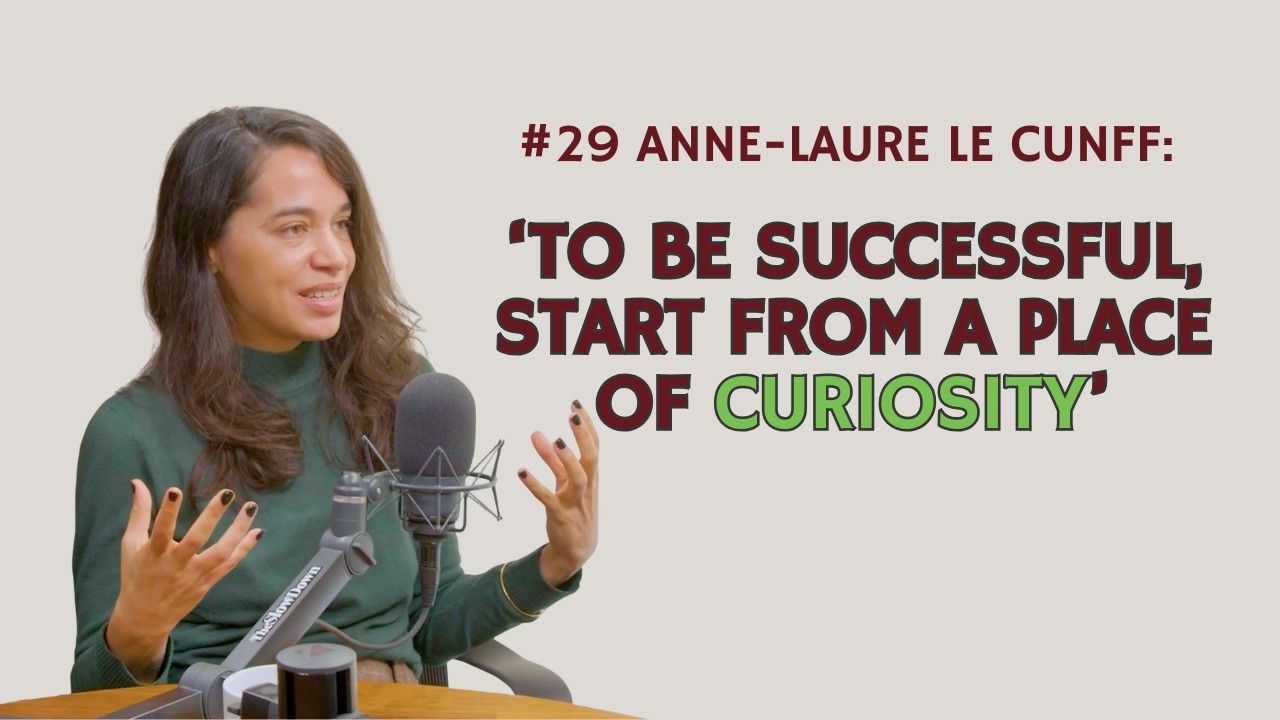
Enough Big Goals - Try Tiny Experiments with Neuroscientist Anne-Laure Le Cunff