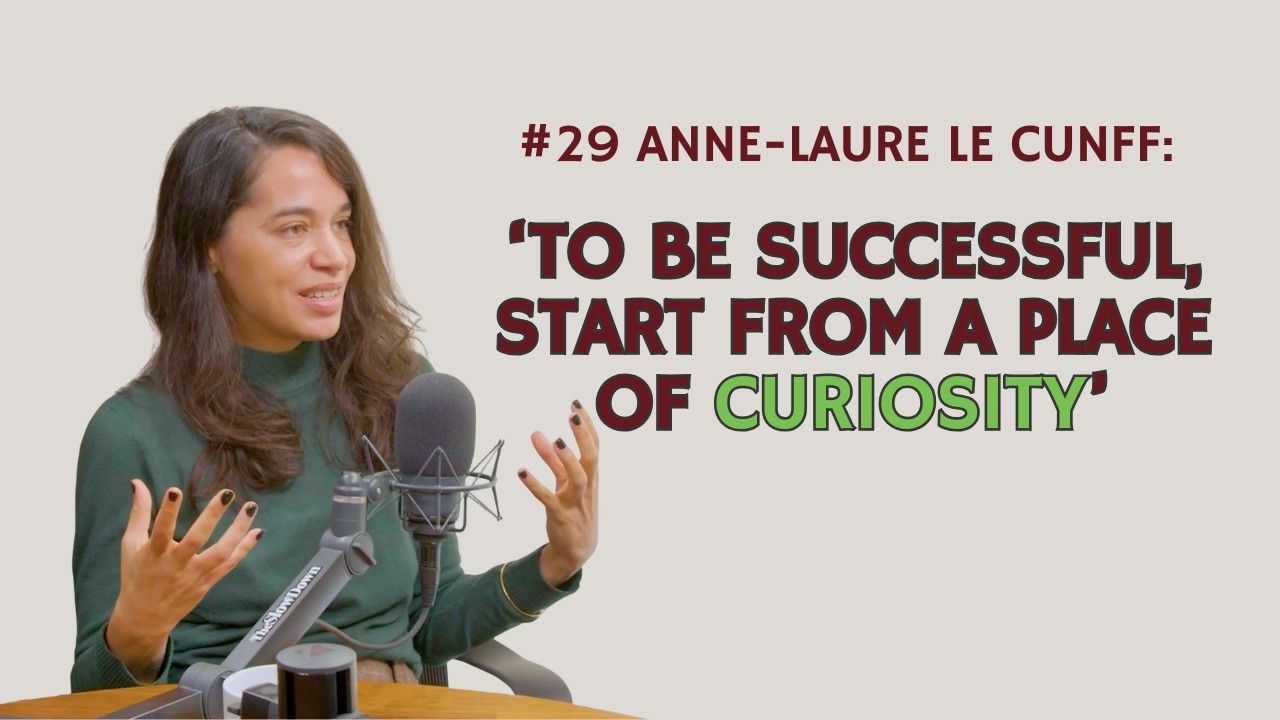
Anne-Laure Le Cunff on Why You Need to Experiment

Anne-Laure Le Cunff, a neuroscientist at King's College London, discusses why experimentation beats rigid planning. She introduces tiny experiments: purposeful, actionable, continuous, and trackable. Unlike New Year's resolutions, this approach reframes failure as data.
Chapters
Hello everyone. My name is Andrew and welcome back to Frames of Space. Today's episode is premised around a pretty simple idea, which is the idea that we talk about failure in the wrong way. Like, let's say that something in our lives doesn't work out. It could be a job, a project, any kind of plan. Usually we treat that as information that demonstrates our own inadequacy. It's because we were naive or underprepared, or we just, we just weren't good enough. But what we almost never say is that that failure was an experiment that taught me something useful. It helped me to learn something, and therefore it was an experiment worth running. My guest today thinks that that second framing, it isn't just healthier, it's more accurate. Anne-Laure Le Cunff is a neuroscientist at King's College London and the founder of a learning community called NessLabs, which is designed to help people experiment to harness their curiosity and creativity better. According to Anne-Laure, most of us are running our lives according to scripts that we never consciously chose, like the idea that We should do something because it fits our resume, it fits our work experience, it fits the way that we've acted in the past, or we should do something because it makes our parents proud of us and makes our friends pleased with us. And that's not a, that's not a terrible life per se, but it is often a life that you're performing rather than truly thriving or even fully living. Her latest book is titled Tiny Experiments, and on one level, It is about productivity and goal setting, but what it is actually about is something quieter. It's about the gap between the life you're performing and the life that you'd actually like to live, and what happens when you start treating that gap as a source of information rather than a source of shame. Now here's Anne-Laure Le Cunff. Anne-Laure Le Cunff, thank you so much for taking the time to come onto this podcast.
Thanks for having me.
Yeah, maybe let's, let's start with a little bit of table setting. When you grew up, like when you were growing up, was like working as like a chief, like a major employee at like Google, was that an example of a dream job for you or was that something that you didn't really imagine that you could attain?
I, yeah, I think both. It was not really something I had thought about doing in the sense that I grew up in France and working at Google was not really something that I thought was in the cards for me. And once I started working there, it definitely felt like a dream job, amazing colleagues, really interesting projects, big budgets to play with. And it was at the time one of the most exciting companies to work for.
Yeah. So did it feel like a dream come true or was it like stressful enough to land you in the hospital?
It felt like a dream come true and it ended up being a lot of pressure also, mostly pressure I was putting on myself in the sense that I thought that someone would realize that I didn't really belong there, which I didn't know the word at the time, but it was typical imposter syndrome. And because of that, I neglected my health. Yes, to the point of ending up in the hospital.
Yeah, maybe let's fill in the— I'm sure our audience is curious to understand what happened because Maybe you could talk about that a little bit and how it shaped some of your trajectory afterwards.
Yeah, absolutely. So I started working at Google, and as I mentioned, I was really worried that someone would realize that they had made a hiring mistake, that I did not belong among all of these super smart people. So as a result, I was the yes girl. I would say yes to absolutely everything. You could come and talk to me and say, hey, we have this presentation due tomorrow morning. Can you help tonight? And I would say, yes, absolutely, I'll cancel all of my plans with my friends and I'll work on this tonight. And obviously, if you do that a couple of times, that's okay, but it was constant for me. And until one day when I was getting ready to go to work, I was brushing my teeth in front of the mirror and I noticed that my entire arm had turned purple. So I went to the Google infirmary because we had that on campus. And the nurse had one look at my arm and said, you need to go to the hospital straight away. So I went to the hospital in Stanford and the doctor said that I needed to get surgery as quickly as possible because there was a blood clot in my arm that was threatening to travel to my lungs. And in that moment, instead of saying, oh yes, let's do the surgery, let's do it as soon as possible, I said, one second, I need to check my calendar. And this was for me the moment when it felt so absurd seeing myself think about my to-do list before thinking of my health, that that's when I really started questioning my sense of priorities.
I think there was a talk that you did at Big Think where you mentioned that you separate your life into two chapters where it's almost like a before and after. Was that like the defining moment that led you to where you are now that has caused you to change a lot of your approach?
Yes and no, in the sense that that was the first seed of change for me. And I wish I could tell you that I realized straight away what I had to change, what I had to do differently, and that I went straight to entering that second chapter in my life. But what happened after that is that I quit my job at Google because I realized that something was wrong. But after leaving that job at Google, I felt so uncomfortable with not having a clear label, not having the business card anymore, not being able to introduce myself in a way at parties where people would say, oh, you work at Google, you must be so smart. And not having this clear sense of where I was going with my career, that very quickly after leaving Google, I went back to doing the probably most socially sanctified thing that you can do when you're in Silicon Valley, which is starting a startup. So I started a startup after Google for what I realized today were all of the, the worst reasons. It was really just to give myself this artificial sense of purpose, feeling like I knew where I was going and how I was contributing and really restoring a sense of control. And I was really good at telling myself stories about how I was mission-driven and how, oh, my startup would change the world. But, but really deep down it was because I wanted to feel like I knew where I was going. Fortunately for me, my startup failed, which was probably one of the best things that happened to me in terms of my career. And for the very first time in my adult life, I admitted to myself that I was completely lost and that Once you removed all of those external markers of success, I actually had no idea what I wanted to do with my life.
Did those life experiences cause you to come up with the term libidinal space, or did that term exist beforehand?
I actually only fairly recently, just a few years ago, discovered that term, and it really made things click for me. And I think we've all had those experiences in life, you know, when you, you went through something and you had a really hard time describing what the experience was like, and then years later you discover a word and you feel like, ha, that's what it is. And for me, the word liminal, liminal spaces had that effect. So the word liminal comes from the Latin limen, which means the threshold, the transition, the in-between, in-between. So a liminal space is when you are on the doorstep of change. You, you're not quite where you used to be anymore, but you haven't arrived to your new identity, your new role, your new place in your life and in society. So you're in this very uncomfortable in-between. Examples include when you have graduated school, but you haven't started your first job, or when you are engaged to someone but not married yet, or when you have decided to quit your job, but you don't know yet what you're going to do next. And a lot of us, when we find ourselves in those liminal spaces, we find them so uncomfortable that we wanna get out of there as quickly as possible. What I have discovered more recently in my life through reading research is that those liminal spaces can actually be an amazing opportunity for growth and for self-discovery, but only if we allow ourselves to sit in the uncertainty.
Yeah, but maybe part of the reason why liminal spaces make us so uncomfortable is just how hard it is to sit with uncertainty. Like, I'm sure you've faced that, right? I'm sure you've— like, during the times when you were in liminal spaces, I'm sure that you felt tons and tons of anxiety over the fact that your future was uncertain and that you didn't have a set path.
Yes, it— what you're describing here Actually makes perfect sense from an evolutionary perspective. We were designed, our brains are really designed to reduce uncertainty as much as possible because if you think about our evolutionary past for our ancestors, more uncertainty meant that you were less likely to survive. So if you're optimizing for survival, reducing uncertainty is absolutely what you should be doing. And our brains haven't really changed that much in thousands of years. So that's what we are still doing, optimizing for survival, which means trying to reduce uncertainty as quickly as possible. The only problem is that a lot of the dangers that we used to face, or at least in most Western societies, do not exist anymore. You're not going to be eaten by a lion because you go off course and you start exploring, right? Um, but we still respond in the same ways. And so those survival mechanisms that work perfectly fine if you just want to survive can get in the way if what you want is more than surviving. If you wanna thrive, if you wanna grow, if you want to evolve and discover what works for you, this is where those mechanisms designed to protect you can actually get in the way.
Yeah, and it's, it is always like, there's always a time in our lives where we survive, but we do not thrive. And sometimes we don't even like really live life to like a sufficiently fulfilling way to us. And but it's because we're so hardwired to always see the risks that we want to take as like dangers that we need to avoid as much as possible. Okay, how about Hard pivot. What are cognitive scripts?
So cognitive scripts are patterns of behavior and decision making that we follow unconsciously and that we have internalized based on our education or expectations in the society and the culture that we live in. And in the book, in Tiny Experiments, I describe 3 main types of cognitive scripts that a lot of us follow in our lives and in our careers. The first one is the sequel script, and this, it's a script you follow when you make decisions based on the decisions that you made in the past. And so you think that whatever you decide to do today needs to make sense based on who you were before. This is the script that we follow when We graduate from school and we only apply to jobs that make sense based on what we studied. We don't look at anything else, for example. A second type of script is the crowd pleaser script. This is the script we follow when we make decisions based on what we think is going to please people around us. And those people could be your colleagues, your friends, partner, parents. And, uh, for example, let's say that you decide to become a doctor or a lawyer because your parents helped you with your studies and you feel like it would make them happy to do that. What's interesting with the crowd pleaser script is that it is based on what you think is going to make other people around you happy. That might not be true. Maybe they don't care, but you think that's the—
Maybe, you know, the concept of the spotlight effect?
Yes.
Maybe you could talk about that and like what that has to do with the crowd pleaser script and all of that.
Yeah, with the spotlight effect, we really think that we are the main character in our— we are in a way the main character in our own lives, but because of that, we think that we are more in the spotlight than what we actually are. Most people are very busy with their own decisions, their own lives, and they're not constantly looking at what you're doing. And this is really, this can really bias us in terms of the decisions that we're, we're making. So the crowd pleaser script is, can be a little bit of a combination of this, but more than that, it is really about the long-term expectations that we think people around us have for us. And so very often it is people pretty close in our life, parents, again, partners, et cetera, friends. And the last script is the epic script. The epic script is the script we follow when we make decisions based on the belief that anything we do has to be big, has to be impressive, has to be impactful, and anything less than that is failure. This is a script that a lot of startup founders follow where you feel like you need to save the world. You need to be on this big mission, but a lot of us follow it at another level where we feel like we always need to go for the, promotion, that we need to go for the big job. And, uh, we also limit ourselves in the sense that we might not explore opportunities where there's not clear status or success attached to them, or that don't feel like they're going to have a huge impact immediately. So those are the 3 main cognitive scripts that most people are following in their personal and professional lives.
The anxiety that you had when you were working at Google, or the anxiety that you had when you like tried to create a startup and all that, which cognitive, cognitive scripts do you think that you were internalizing throughout that process?
The main one was probably the crowd pleaser script for Google because I come from an immigrant background and my parents always thought that having a good stable job and a stable financial situation was incredibly important. And so I didn't want to disappoint them. I also didn't want to disappoint everybody around me. Back in France, when I was working in Mountain View in Silicon Valley, all of my friends back in France were really supporting me and cheering for me and saying, that is so cool that you ended up moving, you got a visa and you got to move to the US. And so everybody was so happy for me that I didn't want to disappoint them. That was one script. And the other one was when I left Google and I worked on my startup, that was the epic script. I really felt like I had to do something big in order to make my life and my career meaningful.
So what, what do you do to make your life meaningful these days? How have you switched from Cognitive Scripts to maybe like a different, a different approach to life? This is, this is where we finally get into the main topic of your book. Like this, that was all, think of that, that was all backstory. And now we've laid the groundwork so that you can talk about what you're actually here to talk about. How has all that anxiety, how has all that uncertainty paid off in the concept of Tiny Experiments?
Yeah, so all of the scripts we just described, they're based on a linear mindset. They're based on the idea that if you wanna live a happy life, if you wanna be successful in life, you need to have a clear vision, clear goals, a clear plan, and then you execute on them. And now I'm in that second chapter of my life, as you mentioned earlier in the conversation, I am trying to make decisions based not on the linear mindset, but based on an experimental mindset where instead of trying to start from a place of control and certainty, you start from a place of curiosity. After my startup failed, I decided to go back to university to study neuroscience, not because I wanted this to be my career, not to start a startup, not for anything like that. But just to make space for my curiosity and to let myself sit in this liminal space I was in, just to learn, just to be curious, just to explore. And I started experimenting with different ways to learn better. One of them was writing a newsletter. That was my first real experiment, and that experiment has since then turned into a business, turned into a book, turned into so many opportunities, which has been absolutely amazing. But the main change in my life and in my career is that I don't have a plan anymore. I actually have no idea where I'm going. And instead of optimizing for a sense of certainty, I'm optimizing for a sense of aliveness. So how excited I am to wake up in the morning. That is my barometer for success these days.
Yeah. Are there, are there ever times where you're, you're like, let's say that you're like freestyling, you don't have a clear plan about where you want to go in the future. Are there times where you subconsciously think, like you subconsciously act in ways that do follow those cognitive scripts and you have to like actively tell yourself to not follow the cognitive scripts that you like followed all of your life?
Oh, absolutely. Cognitive scripts are so deeply ingrained that I don't think you can ever completely free yourself from them. So it's really more about developing the sense of self-awareness and noticing when you're following a script and then questioning the script. So just to give you an actual example, when I started working on my book, I had so many people around me that were New York Times bestsellers. And so I thought, oh, I have to be a New York Times bestseller. And I really had to catch myself and say, actually, do you really want to do what it takes to be a New York Times bestseller? Do you wanna sacrifice your entire life for one year, be on a circuit and do keynote after keynote nonstop in order to achieve this? Or do you want to focus on the process of producing this book? But that being said, I still could hear the little voice in the back of my head say, oh, maybe you should go for it. Maybe you should go for it, you know? So yes, I still quite often hear the sirens of the cognitive scripts, and it takes a lot of practice, self-awareness, and honesty with yourself to notice when you're falling prey to those scripts and to make yourself rewrite them.
So one thing that we talked about is the idea that part of the reason why people might follow cognitive scripts, part of the reason why they might try to take a much more linear path to where they want to go in life is because it is so much more anxiety-inducing. It's so much more stressful to have that constant uncertainty about not knowing what your future portends for you. So now that you've started experimenting and you've started to engage in this experimental mindset, in general, would you say that your life has become more stressful or less stressful than it was back when you were following those cognitive scripts more closely?
My life has become a lot less stressful since I started experimenting more. And the reason why is because I actually don't try to convince myself that I am in control. A lot of the stress that I was experiencing before was coming from this belief that in order to be successful, I had to be in control. And so anytime something was not going to plan, anytime things were not happening in the right order, or at the right pace, when things were slower than what I expected, I would then feel like something was wrong and that I needed to fix it, uh, or that I was failing. Whereas now, because I know I'm not in control in any case, I'm only in control of my output, I can just show up, I can try new things, I can experiment, I can iterate and tweak and adapt based on what I'm learning, but I am not in control of the outcome, it removes an immense amount of pressure. So that's one part. And then the other part is that it also gives me a lot more freedom to try new things that might not work out because now I know that as long as I learn something new through the experience of trying the things, then that is success. Success is just learning something new.
Could you talk about the concept of like PACTs and how they've redefined success for you?
So what I call a PACT is in effect a mini protocol for designing tiny experiments. So those are mini protocols for personal experimentation. What I did is that I asked myself, if you stripped away anything that is not necessary from an experiment, if you went back to the core, the essence of an experiment, what is it? And in essence, an experiment is really is testing something for a trial period. That's it. You're testing something for a trial period. You have a hypothesis, you're going to try the thing, and for that trial period, you're withholding judgment. You're just collecting data, and at the end, you look at the data, you analyze it, and you see if your hypothesis was correct or not. That's what an experiment is. So a pact is just that, is saying what is the action that you're going to experiment with and for which trial period, for which duration. So you say, I will Insert action for, insert duration. I call them a pact because it is really a commitment to your curiosity. You're committed not to succeed in the traditional sense of the term. You're committed to find out. And it also spells out the only, I think, acronym in the entire book, because I didn't want to have too many of them, but I find it helpful. In this case, which is purposeful, actionable, continuous, and trackable, PACT, a PACT, which is in contrast to SMART goals that are kind of omnipresent in management and in the business world.
Yeah. Okay. What do you think about SMART goals? Do you think that they're flawed? And if so, what is the difference between a SMART goal and the type of PACT that you described?
Well, SMART goals are great. You know, they're, they're easy to define, they're measurable, and they're really, really good if you're in an environment where you know exactly what you want to do and how to do it, and you just need to decide on a timescale and then get to work. And this is a really good tracking tool for those kinds of environments where there is a lot of clarity in terms of the next steps. So it's not that they're bad. The problem is that I would argue that in today's world, those situations are pretty rare. Most of the time, we actually don't really know how to go about making progress. The, the environment keeps on changing. The technology keeps on changing. Our work keeps on changing. We keep on changing. And so I find working with people that whenever they try to apply SMART goals, Yes, they are very easy to define, but then they're not that helpful in terms of actually making progress in a way that is flexible enough that it can adapt to a situation that keeps on changing. So that's why I recommend switching from those rigid linear goals, those SMART goals, to tiny experiments instead, based on impact.
Yeah, I was, I was at the, maybe the right way to call it would be like an online conference hosted by your friend Ali Abdaal. Back at the beginning of 2026. And so he, he, he's done a lot of good work about why New Year's resolutions are kind of bad. But maybe, maybe this ties into that. Like, like, what would you say are the main problems with New Year's resolution?
Well, New Year resolution, so many things are wrong with them. The main problem with a lot of New Year resolutions is that people start them without even knowing if that action in the first place makes sense. So you kind of commit to this thing and say, from January 1st, I will do this huge overhaul, big transformation. I will commit to this thing for the rest of the year, and they've never tried it before. So that's one problem. And this is why I always recommend, even before starting a new habit, to first experiment with it, do it for a short duration, see if it works for you, and then, then only you can upgrade it to the level of habit. Another problem is that a lot of resolutions are copy-pasted on other people. So people actually don't really think deeply about what is the resolution that would make sense. So again, experimenting with something that makes sense for you would make more sense here. And, uh, it's just the, the timescale in general that is very vague for people. It's from January onwards. With the tiny experiment, you have a fixed duration. And what's great is that whatever happens at the end of this duration, as long as you learn from the experience, then the experiment is successful. Those New Year resolutions, I can't remember the exact number. I think I, I might have put it in the book or I might have cut it, but I think it's more than 80% of people who abandon their New Year resolutions by end of January or beginning of February. So, they don't work and somehow people keep on making them every single year.
Yeah. Are you ready for a question that's going to sound completely unrelated? Yeah.
I mean, I don't know, but let's give it a try.
Yeah, let's see. What would you say are some of the best decisions that you think you've made in your life?
Starting my newsletter was definitely a big one, and I didn't know it at the time because again, it was an experiment and I just say, let me try this. But looking back, This was one of the best decisions that I have made. Um, another one was, yeah, just going back to school to study just for, again, pure curiosity. That was really what opened the door to all of the thinking that I've done around these questions. And, um, maybe writing this book would also count as a, a good decision. That was not an easy one because when publishers contacted me, I was in the middle of my PhD and I felt like that might be a lot doing a PhD while writing a book. And I'm really glad I said yes. So that was a good decision too. But it's as always very easy to say in retrospect that those were good decisions. I had no idea at the time.
Yeah. And part of the reason why you have no idea at the time is because you're always working off of incomplete information. Like sometimes when you make a decision and it turns out to be amazing, there's no way to know how much of that is like a product of your own foresight, like the product, a product of the idea that like you knew exactly what the right thing to do. And like how much of that was just because of information that you didn't know about, like the extent to which you would succeed. Like it's entirely possible, like when you decide to write your book in the middle of your PhD, it's entirely possible that you would just burn out and then give up on the book, like very shortly after you started writing it.
So, and this is why it is so important when you make decisions to pay attention to both the external and internal signals of success. The reason why I knew these would not be terrible decisions, I didn't know if they were going to be good decisions, but I knew they were not going to be terrible decisions is because I checked in with myself and I asked myself about whether I would want to work on those projects, whatever the outcome. And for the book, for example, there's the amazing outcome of a lot of people love the book, a lot of people read the book, and this is great. And I finished the book, I finished the PhD, everything is great, right? And then there's the, the not so good outcome where I write the book, nobody cares. What happens in that situation? And I had that conversation with myself and I realized that the process of writing the book was something I was really excited about in and of itself. And so in that way, maybe it was not going to be a great decision, but it couldn't have been a terrible one. The problem is that very often we only look at our success based on external factors. So the recognition, the, you know, if you're on YouTube, the likes, the comments, the subscribers, the money. And we rarely stop to ask ourselves, okay, but how does it feel to work on this? If nobody was watching, would I want to keep on working on this thing or not? And I think this is such an important question to ask yourself if you want to make not perfect decisions, that doesn't exist, but better decisions.
And maybe this ties into the concept of PACTs because in the same way that PACTs help you experiment, the feedback that you're getting is not just external about how successful you seem to be about the, like, fulfilling the pact. It's also how much you enjoy it, how much it drains you as compared to, like, recharging your, your batteries. So are there ever, are there, like, in general, are there times where you've given the advice about experimentation to other people and they've implemented it in ways that are far more unique than you initially thought of?
So many times, um, we have a private community at Nest Labs with about 2,000 people in there where people share their tiny experiments. And so I see examples all the time that I think are fascinating. Um, two of my favorite ones are, have nothing to do with work actually, or work in the classical sense of the term, which is why I love them. One of them is someone in the community who mentioned that he had gotten so busy with work that he lost touch with many of his friends. And I don't know if that happened to you. That definitely has happened to me when, when we kind of stop messaging friends and then the longer you wait, the more awkward it becomes to reach out. And so we end up not doing it. So he was in that situation and he decided to design a tiny experiment where he said that he was going to send a message on WhatsApp to one friend every Wednesday. And that's it, and just say, hey, what's up? What's going on? How are you doing? And that's it. So not with a binary definition of success and failure where you're expecting an answer, but just saying, I'm sending the message and then we'll see what the, the friend says. But if they don't reply, that's fine. What happened, the result of the experiment, which is probably obvious but wasn't to him, is that all of his friends were really happy to hear from him., and we're really happy to reconnect. So that was a really nice tiny experiment. And another example that I love was this person, this artist in the Nest Labs community who had surgery and who hadn't been able to paint for a long time. She thought that she had lost something, her creative spark, that it was hard for her to get back into painting. So she designed a tiny experiment where she said, I will sit in my art studio for 1 hour every day and do nothing. Brilliant. So smart. Because by doing this, she removed the pressure of solving the problem. And she sat in her studio, and I don't remember after how many days, but first day nothing happened. Second day nothing happened. And I think around the third day she got so bored in her studio doing nothing that she ended up picking up the brushes and she started painting again. So those are two examples that I would have not been able to imagine or come up with. And I love that people are applying this framework to all sorts of different areas in their lives.
I wish that I could like sufficiently communicate the extent to which like your commentary about tiny experiments has helped me in my life. And I don't think I'll be able to communicate all of it. So I'll just try a little bit. I'll give like at least one or two examples. I think one thing that has massively helped me is the ability to focus more on inputs rather than outputs when it comes to whether or not a decision has succeeded. Like one example would be that I don't know if you know this, but I host a podcast and the podcast often features interviews with guests. Where one of the hardest things about my podcast is not even the process of coming up with questions or the process of editing or publishing. The hardest thing is just like trying to get high-profile guests that can consistently come on a regular basis. And the only way that I've been able to make that succeed a lot of the time is when I am trying to reach out to guests, I focus more on like the number of like emails or DMs or whatever that I've sent rather than the number of people that have said yes to me. Because inputs are something that I control and whether or not a certain percentage of people responds, which tends to be very variable, that is outside of my control. Another example would be at the beginning of 2026, that one session that Ali Abdaal hosted where you were part of it, you were, you were giving all of the attendees examples of pacts that they could fulfill. So I didn't, I didn't actually know that you had meditated beforehand. This was just like by complete coincidence, I came up with a pact to meditate every day for like a 2-week period, and it was incredibly helpful. By the way, do you, maybe as like advice from one meditator to another, do you have, do you have any advice about how someone could get better at meditating over time?
Oh, I am not an expert meditator at all. My tiny experiment around meditation allowed me to realize that I can meditate and that is now part of my toolkit. It is not my number one tool in my mental health toolkit. I prefer taking walks, journaling, and dancing. But with meditation, the only piece of advice that I would give to anyone listening to this and who, like me, like I used to think that meditation was just not for me, that I was just not wired for it. I discovered when I started experimenting that there are actually many different types of meditation. I thought meditation was just about emptying your head and I was really bad at this, but there are so many different ones and there are ones where you can use a mantra. There are meditation practices where you focus on your breath. There are even meditation practices where you move your body depending on what emotions you're feeling. And so I would really encourage people who have only tried the, I would say, most popular in Western culture type of meditation, who found that that did not work for them, to try and experiment with different approaches. There are so many different schools of meditation, and I'm pretty sure you will find one that works for you.
You know, I'm kind of curious, like, obviously you have tons and tons of advice about how people can experiment with many different aspects of your life. I'm sure that you've given this like advice to your friends or your family many times. When it comes to like the people that you've, that you know in your life, that you've given this advice to, who would you say, like, are there specific personalities that find it easier to experiment or harder to experiment? Like, what have you observed when it comes to the type of people that find it easier to experiment rather than harder?
It's interesting because I feel like everybody is facing different sets of challenges or parts that are easier for them. And in the book, I have this little graph where I map mindsets based on curiosity and ambition. And I think this is a really good way to think about it. So, people who are highly curious, they're already convinced that tiny experiments is a good approach to exploring and trying new things.
Wait, how about, let's elaborate, maybe talk about the X and the Y axis with the curiosity and ambition thing.
Yeah, so the, so you have two axes here. So curiosity and ambition. And what I explain is that if you are someone who is highly ambitious, but you, so, which means that you wanna have an impact, you wanna be successful, you wanna contribute, but you don't allow yourself to be curious. You don't allow yourself to explore. You don't allow yourself to try things that might fail or where you might look like a fool or make mistakes. That's the perfectionist mindset. A lot of us fall into that category. If you're someone who's highly curious, but you don't really apply yourself, commit to something for long enough, and so you have low ambition. So maybe you're someone who has a bit more of the shiny toy syndrome. You love trying new things, you do love experimenting, but then you have a really hard time picking one thing and sticking to it. That's what I call the Escapist mindset. If you're low in both curiosity and ambition, that's what I call the cynical mindset. What's interesting is that quite often these are actually protection mechanisms. Even the cynical mindset, saying, "I don't care about anything," is one of the easiest ways to feel safe. You can't fail if you're not even trying, right? And in contrast, the experimental mindset is when you're both highly ambitious and highly curious. So you want to explore, you, you wanna, you know, you have this adventurous kind of spirit and you want to try new things, but you also want to have an impact. And you know that in order to achieve your ambitions, you will need to try new things. You will need to make mistakes and you will need to fail in the process. To go back to your question about what challenges people face, what I have found is that people who are highly curious, they struggle to just commit to one tiny experiment at a time. And so I see a lot of people where I need to tell them, please, please, please, one experiment at a time, or maybe two max, but don't experiment with a thousand things. It's going to be really hard to know which variables are having an impact on your life, what's changing, what's working. So that's one challenge. And ambitious person, I see them keeping on tweaking and overthinking the parameters of their experiment, always feeling like, I don't know if that's the right experiment, and maybe I should actually do this. And they're kind of missing on the opportunities to actually do the thing. Just spend 5 days trying the experiment, see what works and what doesn't, and then, then you can tweak it instead of trying to plan your experiment perfectly in advance.
You know, you know the whole concept of how one of the easiest or one of the most useful ways to learn a certain topic is by teaching that topic to other people over and over again. And I'm sure that you have experience like giving instructional wisdom about your own book and the concept of experimental mindsets to people over and over again. So what are some lessons that you yourself have learned from your time teaching others about your own material?
So I think the— it's going to be very meta, but for my next book, I actually have decided that I'm going to ask a few friends who have podcasts to do fake podcasts with me before I finish writing the book. So not podcasts that are going to be published anywhere, but I have found the process of having those conversations so powerful when it comes to better articulating the ideas that are in the book, thinking about examples, thinking about how those ideas connect together. You would not believe the number of times I finish recording a podcast with someone and I feel like, oh gosh, I wish I had that conversation before the book went to print. Because we talked about something that I think would've been amazing in the book. And so a very meta as an answer, but that's one thing I learned is that that process of teaching to learn better, it doesn't need to happen after the book has been published. I can start doing this a little bit earlier. So that's one thing. And the second thing, which I knew at a conceptual level already, but now I know for sure, is that if anyone listening to this is considering writing a book at some point, You have to be prepared to then talk about your book nonstop for at least a year afterwards. And so please make sure to explore an idea you are truly curious about that you wanna keep on learning about for a long period of time. It's not like posting on social media where you just post it and you can forget about it.
Yeah, but the, the process of being forced to talk about it nonstop over and over again until you get sick of it and then you keep talking about it anyway. Maybe there are some, there are some facets of the concept of tiny experiments that just wasn't on your radar at all when you were writing the book, but just the process of like forcing yourself to talk about it over and over and over again, you sort of realized those facets in a way that you wouldn't have if you didn't talk about this issue nonstop. Are there any examples of this?
The main thing is probably the applications in the professional environment. I wrote the book mostly from a personal development standpoint. But I've talked since then with a lot of people who work in corporate environments and startups and who tell me, or who ask me, how does that work with the team? How do I run those experiments with the team? How do I run them as part of an organization? And I've become really clear about what that looks like now. And what that looks like is really inspired by the way we run experiments in the lab. When, when you are part of a lab at a university, we do that, right? We run experiments together. And this is something I touch upon in the book, but that I didn't dig into in the book as much as I've done afterwards through conversations.
Yeah, I guess we, we are, we're on the topic of all these lessons that you've been teaching other people. Have there been time, have there ever been times where other people have needed to remind you of your own lessons? Like you realize that you weren't living up to the experimental mindset as much as you could, and then other people who you taught realized that in your life and like basically taught you to, to, to learn your own lessons a little bit more.
Oh yeah, all the time. In the past year, I've been on the road doing keynotes, teaching workshops, lectures, and all of these kind of things. And I talk a lot about having a mindful approach to your own productivity in the book, experimenting with your, your sleep, with your diet, taking care of your health. There were so many times in the past year where that went completely out the window for me. And, uh, I almost felt like an imposter in the sense that I was talking about those tools while I knew I was going to bed in the evening so tired that I was scrolling on my phone and while I'm telling people don't do that. So there was definitely a tension and this is something I've been really open about in the sense that I do not claim that any of the tools in the book are going to make you a machine that is always going to be able to apply them perfectly at every single moment in your life. What I'm hoping, and that's what those tools have done for me, is to first help me notice when I am actually not living my life in a way that is aligned with the way I want to live it. And second, if people around me or, and people around you as a reader has also, have also read the book, that also gives you shared language to actually point it out to the people around you in your life when they're maybe struggling or not in touch with themselves. And so, uh, just one example was that very recently I almost said yes to a big project that I was invited to work on. And a friend of mine just looked at me and said, okay, you keep on talking about the external signals. Like if you do this project, uh, it's going to be, you know, X million of people who are going to view this and et cetera. And this is going to be great in terms of growing your community and having more people read the book. What about the internal signals? And I had completely ignored that while I was thinking about this project. And when I thought about the internal signals, I realized that I was dragging my feet a little bit, actually, that this project would take so much time and so much energy and also meant that I would have to be away from home for a long time and that I actually didn't want that right now. So that having that friend call me out on this and saying, you're not applying your own tools, was really helpful.
There have been, there are so many like fascinating ways that people can adopt the experimental mindsets in their lives. You gave one example about someone just like reaching out to friends that they hadn't talked to by just like shooting them like a message on WhatsApp every week or something like that. Do you, do you personally ever try experimenting when it comes to the ways that you communicate with others, either in public or in your personal life or anything else?
So yeah, absolutely. Something I've been experimenting with. Uh, is having a certain types of emails handled completely by my assistant now. And that was actually, that may sound simple, but I really value the way I communicate with others. And so for the longest time, I made it really a principles, uh, a principle, like a, almost like a point of honor for me that I would be the one replying to my emails. And so if you emailed me, I would reply to my emails. And for the past 2 months, we've been experimenting with my assistant where any kind of queries that are just general pick your brains queries, like especially I get a lot of founders who send me links to their product that might be a product around curiosity, learning, creativity, productivity. And they say, hey, I created this product. Here's a code. You can try it. Tell me what you you think? And I get maybe 3 or 5 of those every week, and I used to feel really bad about not replying to everyone. So now we have a template, and she replies, and it's something like, hey, Anne-Laure doesn't have the time to do that, but we have a monthly Q&A in the Nest Labs community. If you want, you can come and ask your question in there. At first, I was so uncomfortable with it, but now actually I'm really happy that that has freed up my time. So, That's an experiment I've been running, and I've noticed that in general, the parts of my work that I have a hard time letting go of are very often the parts of my work where it's worth experimenting and seeing what that could look like to do it in a different way.
All right. I have one final question, and it has to do with something we talked about earlier, the crowd pleaser script. Like you, you've mentioned quite a bit that when you were working at Google and like in different facets of your life, you often did what, like, you thought others expected of you, regardless of whether that was what they actually expected of you, like, as, like, as a way to, like, please other people. Maybe this question will be, like, something pretty intentional for you as a way for you to, like, be very, be very clear about what you would like to do in the future. How do you want others to remember you?
Oh, I actually haven't really thought about that. Seriously, I, I really, I just hope people remember me as a kind person, generally. I know how cheesy that sounds, but I don't think my work is going to be remembered for very long after I'm gone. I'm really hoping to have contributions, to really contribute here and now with the people around me, the readers of my book, but I'm not really pretending to working on the kind of stuff where in 100 years people will particularly remember what I've worked on. And some people might find that sad, but I find that really liberating because I don't really worry about it.
Yeah, like the fact that it's not going to be a concern frees you up in a weird paradoxical sort of way.
Yeah, it's not really something that I think about. It's also really not something I think would be good for me to think about. I have a chapter Anne-Laure at the end of the book about legacy versus generativity and how with legacy we are obsessed with how people are going to remember us, how future generations are going to remember us. Whereas with generativity, we're really focused on the kind of impact we can have here and now with the fellow human beings that are sharing our planet in the present moment. And I find it a lot healthier to focus on that rather than how I will be remembered when I'm gone.
Anne-Laure Le Cunff, thank you so much for taking the time to come onto this podcast.
Thanks for having me.
Thank you for listening. If you enjoyed this episode and would like to hear more, make sure to follow this podcast on Spotify, Apple Podcasts, or anywhere else that you get your podcasts from. Until next time. Goodbye.
More from Anne-Laure

How to Use Curiosity & Experimentation to Flourish, with Dr. Anne-Laure Le Cunff

Stop chasing goals and start running tiny experiments with Anne-Laure Le Cunff

Why You’re Still Waiting To Figure It All Out | Anne-Laure Le Cunff | EP. 391

Tiny Experiments: How to Learn, Grow, and Navigate Uncertainty — Anne-Laure Le Cunff



Stop Setting Goals. Try This Instead | Tiny Experiments with Anne-Laure Le Cunff



Enough Big Goals - Try Tiny Experiments with Neuroscientist Anne-Laure Le Cunff