Top Tech Voices | Work-Tech Life Balance

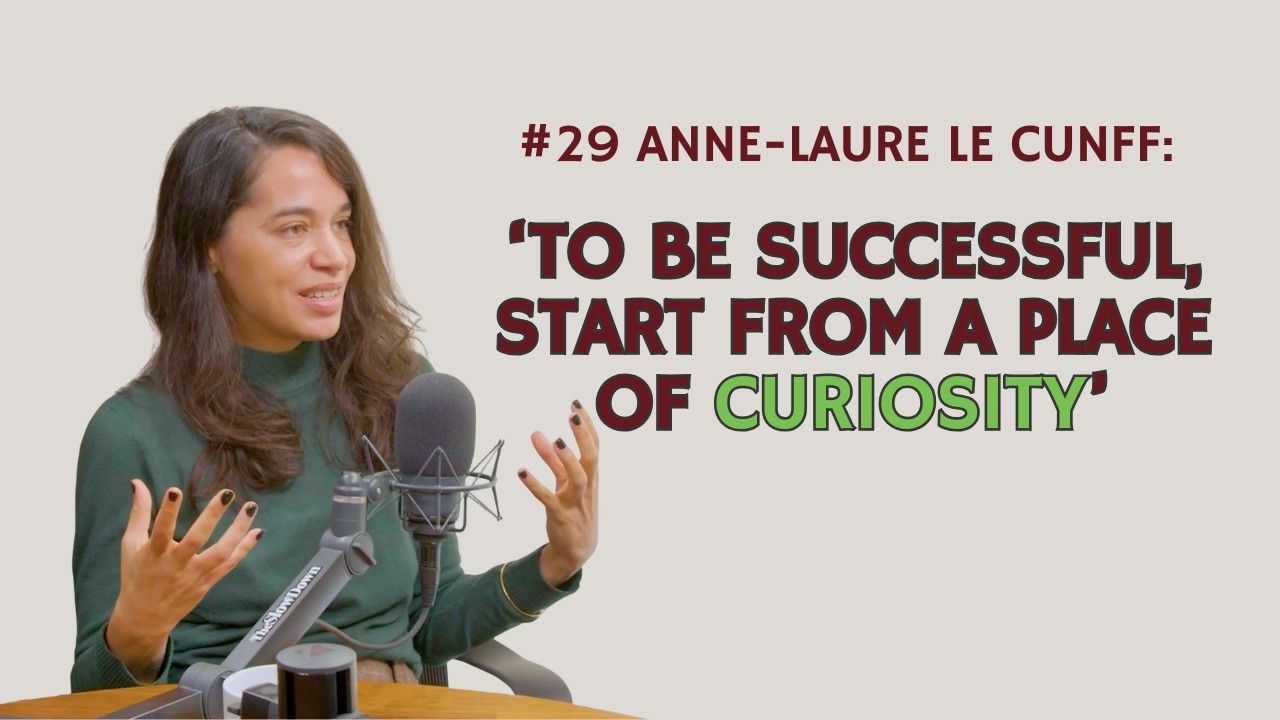
Neuroscientist Anne-Laure Le Cunff moved from chasing clear goals to embracing uncertainty as a learning opportunity. She uses tiny experiments, a weekly Plus/Minus/Next review to spot patterns, and AI tools like ChatGPT to surface hidden trends in her own data.
Chapters
We're back after an exciting and award-winning first season. Top Tech Voices returns with fresh perspectives, deeper conversations, and even more inspiring voices from across the industry. This time we're diving into how technology actually serves people, because innovation has the greatest value when it improves lives, protects what matters, and solves real human challenges, right? So whether you're tuning in from your desk, lab, or on the go, we're bringing thought-provoking insights, expert interviews, and behind-the-scenes stories that matter. So let's get into the latest season of discovery, dialogue, and inspiration. Ever wondered what might happen if you treated your curiosity like a muscle that you could actually train? Today I'm joined by a neuroscientist who frames curiosity as a mental workout for the brain and turns cutting-edge research into tools for everyday life. She's the founder of NessLabs, where her newsletter on mindful productivity and learning is read by over 100,000 people around the world. It's my pleasure to welcome Anne-Laure Le Cunff. Been very quote unquote successful. You worked at Google, one of the biggest technology companies in the world, then you had your own startup. How has your definition of success changed?
I used to have a very linear definition of success. So in my mind, in order to be successful, you had to have a very clear vision and a clear plan, and then if you execute on the plan, you'll be successful. In a way, that definition of success is not completely wrong if you are in an environment that is predictable. Where the rules are very clear, where there's very little uncertainty. My definition of success has completely changed since I've embraced the fact that I actually don't really know where the world is going. Things are changing so fast and there's a lot of uncertainty. I think what's changed the most for me is that I used to respond to that uncertainty with control, wanting to build frameworks and, uh, to have a very clear plan, which would inevitably break down as soon as it met reality. Now, like a scientist, I approach uncertainty with curiosity. So anytime there's something I don't understand, anytime the next steps are unclear, there's almost a sense of, of juiciness now. Ooh, interesting. What's going on here? And what can we learn from that situation?
Sounds like a fundamental attitude shift, and I don't think you are alone in wanting to control outcomes. I think we all are driven by that in so many ways. And why, what, first and foremost, why do you think that is? The phrase springs to mind, how to make God laugh, make a plan. You know, why do you think we're so obsessed with trying to control the outcomes?
I'm a neuroscientist, so I'll answer that question from a neuroscience standpoint. From an evolutionary perspective, that kind of response where we seek control and certainty makes complete sense. So if you think about our ancestral past, our ancestors, the more information you had, the more certainty you had, whether that was about where to find resources, who were your friends and your enemies in the tribe, or what was that weird noise in the bushes. If you had more certainty, you were more likely to survive. And because of that, and because our brains haven't evolved that much, they haven't changed that much in thousands and thousands of years, we still have that automatic response where when we see uncertainty, we see danger. And for us, the way to restore a sense of safety is to feel in control, is to feel like we have all of the information we need and we have the sense of certainty. Hmm.
Is it possible to feel safe in the knowing that we have no idea what's gonna happen?
Yes, it is possible. That's called a scientist.
Great.
A lot of my work is around helping people develop that experimental mindset, really taking that mindset that scientists have when it comes to the relationship to uncertainty out of the lab and into our daily lives and our daily work. When a scientist faces uncertainty, they see it as an opportunity to learn, and as an opportunity to grow. So by being by default curious whenever you're facing uncertainty, you can actually cultivate that sense of safety, even if you don't know where you're going or what's happening.
It's not easy for everyone though, is it?
Oh, it's not easy even for scientists. Even for scientists, there's always a temptation to fall back onto the kind of experiments or the kind of research and studies where you feel like you're a little bit more in control. You have a little bit more knowledge. You're a bit more comfortable. And I think our society is also designed in a way where the incentives are to sound like you're an expert. We're being hired to do jobs based on the answers we can provide, not based on the questions we can ask. And so because of that, it might be very scary to admit to yourself and to others that you actually don't really know what's going on. And to say, but you know what, let's figure it out.
Yeah, I talk about that a lot, actually, the idea of intellectual humility, admitting publicly that you don't know, but it's just not the way capitalism and business works, is it? So it's a real shift.
Yes, but long-term, we've seen that the businesses that succeed, and especially in the tech world, are the ones that have managed to design a culture where it's not only accepted, it's actually encouraged to be publicly curious, to admit that you don't know, to embrace uncertainty and to experiment together.
Do we have to, and we can get into more of the science, but do we have to rewire a part of our brain in that instance to override fear?
Yes, but it can only happen if you are in an environment that allows you to do that. I really struggle, I'm really against any kind of advice that puts it on the individual. To get rid of that fear and rewire and change their stress response, a lot of it has to do with the environment. A lot of it has to do with the work culture, with the culture in general that you're evolving in. And so I think it is our responsibility as a society to say, it's okay to not know. There is a lot of uncertainty, and that's going to be the only constant. We're not going to be able to get rid of the uncertainty. What we can do is, as a society, encourage and celebrate the people who say, hey, I don't know, and I'm going to explore this, and I'm then going to share with everyone what I've learned.
And societies and cultures in general, you know, it feels like in America they're a lot more pro you kind of failing in public, and in Britain they're like, ooh, aren't you a bit scared about trying that? So, so do you think being French has contributed to your confidence to experiment and be curious in public?
I think being French wasn't really necessarily what helped here, but what helped was to really work in different environments. So I've worked in France, I've worked in the UK, I've worked in the US, I've lived for a little bit in Japan. And so really understanding that what I thought was the one way to be successful, the one way to solve problems was not the only way. And as soon as you start, you open this door where you realize that there's not one way to go about things, then you can start experiment with different ways of doing things. And so I think that might be actually a bit of a challenge in some companies or industries where there's not a lot of mobility or openness to explore different cultures, where there's no change when it comes to how we relate to uncertainty, not because people don't want to grow, but because they don't even think that there might be another way to go about it.
And it sounds so cool, you know, lived in all these countries and you've had these great experiences. I hear a courage that comes through of, like, being brave enough so you realize there's not only one way to do something. And then you're brave enough to try it. But what about people who are watching and listening, and we'll get more into the technology of it, but who have a feeling there's a different way to do things but aren't quite sure that they've got the kahunas.
I think it's very easy when you listen to someone's story, like I just shared it, where I'm just sharing everything that I did over the course of several decades and say, oh wow, so brave. So courageous. But in reality, any kind of change starts very small. And so for anyone who wants to start experimenting more, who wants to start exploring more, who wants to start playing with uncertainty a little bit more, I always tell them, just start with a tiny experiment. It doesn't have to be big. It doesn't have to be scary. It doesn't have to be overwhelming. You don't have to change everything in your life or the way you work to start experimenting. You can just pick one thing, one project, one area of curiosity, something you've been meaning to try or to explore and start experimenting with that. So you can keep it very, very tiny. And then there is a compounding effect where, yes, when you will look back in 5 or 10 years, you will feel like, oh, there was no way I could have predicted that that's where I would end up. But now I'm here because I decided to start experimenting.
Yeah, and that's what you've become renowned for, the tiny experiments. How did that begin and what's one tiny change that's made a big difference for you?
For me, it all began when I decided to go back to university to study neuroscience, and they taught us the scientific method. It was completely different from the way I was working before, where I had very clear goals, very clear objectives. At Google, we called them OKRs, and, uh, you had to document them and try to hit them. They had to be ambitious enough that you didn't hit all of them, It was this entire like performance of success that we were all doing collectively. And again, it was very helpful when we had a very clear vision in terms of what we wanted to do. When I went back to university to study neuroscience, the scientific method I discovered there was completely different. It's really based on starting not from a clear goal, but starting from a hypothesis. So you're not starting from a place of certainty, You're starting from a place of curiosity and you ask a little bit like a research question. You ask, what might happen if I try this? And the very big important difference here is your relationship to success and failure. When you have those very clear goals, you have a binary definition of success and failure. So either you get to the result you want and that's success, or you don't and that's failure. For a scientist, there is no such binary definition because whatever the outcome, if you learn from it, that's success. And so what you do is, again, you ask a question, try something, collect your data, reflect on it, and whatever the outcome, you incorporate what you learn into your next cycle of experimentation, into your next iteration. To me, changing that mindset, going from this linear goal-based mindset to an experimental mindset has completely changed the way I work.
Mm-hmm. My next question was gonna be like, how do you know if you're running a good experiment? But from your answer, would you say it is using the data you collect to inform the next experiment?
I would say the only aspect that differentiates a good from a bad experiment is whether you are actually curious. To find out the answer. To me, a bad experiment is one that is copy-pasted from other people because you've heard that everybody's doing something, that you're supposed to do this, and so then you do it for all of the wrong reasons. If you design your experiments based on something you've noticed, an observation, a real actual area of curiosity where there's the potential for growth, then you can't go wrong.
Mm. You talk about curiosity and experimentation a lot. And to me, it brought up the idea of a sense of play. Do you think that's why it's such a successful framework?
That's such a good question. I feel like play is definitely part of it, but not all experiments have to be playful. I've run experiments that didn't feel playful at all, and that was actually interesting data to see how not fun it was. So I would say that the sense of playfulness can be a positive signal. And this is great and you should listen to it and maybe do more of that if this is how it feels. But if you notice that you're conducting an experiment and maybe you're getting external results that look pretty good, but every time you have to do the thing or work on the project, you dread it, you don't actually want to do it. That's also an interesting signal.
Hmm. But, and how can we override that? Is there a way we can use our brain chemistry? Because You know, we all need to do things that we don't want to do at times that don't feel playful, that are very, very necessary. You know, the idea of discipline and then having compassionate discipline has been something that I've been thinking about loads. I mean, is there a simple hack?
I know a lot of scientists would disagree with me, but I personally don't think we should be relying on discipline or willpower to achieve any of our goals. And some of the more traditional or older research is all based on that. It really says that it's about the, this kind of almost toxic resilience of saying you have to be strong, you have to show up, you have to be resilient, you have to be disciplined. To me, this is not sustainable long-term. And we do actually see that in the research where short-term, where you push through, you might be able to stick to your goal for a little while, but long-term it doesn't work. And one of the best examples of that is New Year resolutions.
Mm-hmm.
We know that almost nobody can actually stick to them, and it's because they're designed around willpower and discipline. Instead, I think we should base our, our ambitions on this sense of curiosity, this sense of self-mastery, self-development, wanting to grow, wanting to evolve, and not with the idea of being, becoming this ideal person, this perfect person, but with the idea of discovering ourselves, discovering what we might like or not like, discovering what we might be good at, discovering that Venn diagram of what you're good at and what other people appreciate from you and want more of you. And I don't think you can do that through sheer willpower and discipline.
Mm-hmm. Yeah, that is a good point. And also just the words themselves carry so much weight and sound so harsh, and it already makes you not wanna do the thing when you're just telling yourself that you're trying to be disciplined. I think we're in this age where we are collectively having a lot more of a holistic approach to business, wellness, capitalism, things like that. But I did wanna ask you, you know, you speak a lot about curiosity and how that's informed your career, and yet you are a neuroscientist, you know, you are at King's College, you used to work at Google, and I know that never leaves you, that drive of achievement and being surrounded by those people. How do you, kind of stop a curious project always becoming a business, and how do you differentiate between the two?
Yes, it's interesting because I define the type of people I work with and the type of people who find my tools helpful as both highly ambitious and highly curious. And I think that's what's really important, maintaining that balance between ambition and curiosity. The problem you have in some careers and in some industries is when there's only ambition and no curiosity. You almost see curiosity as a distraction. And so doing something, a hobby, a project just for the sake of it because it's fun, almost feels like it's distracting you from making progress on the actual ambitious goal, right? But equally, only being curious without ambition is escapism. If you keep on trying the new, the latest shiny new toy, or starting a new project without finishing anything, and you're just having fun, but you never actually apply your ambition to actually launching something, building something, contributing something, this is also not a really good combination. So you need both. And in order to maintain that balance, you need to pay attention. To the signals. There are a lot of people who are very good at their jobs that just, you know, we've all done that, right? You finish a project and then you move on to the next one, next one, next one, next one, and you keep on working and executing, right? Just giving yourself the space to reflect on the experience. How did that feel? Did that feel good? Do I want more of that kind of work or not? Do I want to keep working on more of those kind of projects? And Is there a good balance between my sense of curiosity and my sense of ambition?
Mm. Yeah, cuz I was gonna ask, well, if curiosity without ambition is dangerous, but discipline isn't the answer, how do we get there? And would you say it's with observation and naming the emotions, or is there any other way?
Yes. The, the term you're looking for here is metacognition, uh, which just means thinking about thinking, which means observing your own thoughts, your own emotions. Especially in tech, I feel like we're all quite good at paying attention to the external signals. So anything you can put in a dashboard that you can track with numbers, we're very good at that. Something that we haven't really been trained to do is paying attention to the internal signals. And I know the word intuition has been kind of connotated with a woo-woo sense of, you know, kind of like a vague thing you don't know how to use. But very often as a professional, when you've been working in an industry for a while, you have actually developed an intuition for something that feels right or wrong. You can't immediately put your finger on it because your brain has started noticing patterns that just don't quite click in the way that you would expect them to, and it's worth paying attention to that. And so whenever you have this intuition that something's wrong, and that can be an emotion, that can be a sense of resistance, that can be procrastinating on a project that you think is important. That can be feeling a little bit of anxiety before going into a specific meeting. All of these, those internal signals are equally important, and as a professional, you should pay attention to them.
Hmm. As a neuroscientist, is there any quantitative way to sharpen our intuition?
Just the repetition. Of actually capturing data. I wouldn't say it's purely quantitative, but one of the most powerful metacognitive tools that you can implement in your daily work, in your daily life, is having some form of weekly review, and it can take just 5 minutes. A tool I use, and this is one of the most popular tools that we use at Nest Labs, is called Plus/Minus/Next. It's very simple. It has 3 columns or 3 bullet points. Plus, minus, next. In the plus column, you write everything that went well and felt good.
Mm-hmm.
In the second column, minus, everything that didn't go so well or didn't feel so good. And in the last column, and this is what makes it so powerful, it's not about having just this static snapshot. It's about closing that experimental loop by taking what you learn and decide, okay, based on everything I learned here, based on all of those signals, what am I going to try next? How am I going to tweak my approach with the next iteration? And if you do this every week, what's great about it is that you'll grow and you'll evolve and you'll learn more without knowing exactly where you're going, without the need for a quarterly plan or a 1-year plan. So it's not purely quantitative, but it is pattern matching. It is noticing those patterns. It is collecting your own data and noticing when things keep on happening and then keeping on iterating based on that data.
Would you call that emotional data?
It can include emotional data, but it doesn't only have to be emotional data. I think what makes it really powerful is actually that you take any kind of data, and that data can include how you felt. So if someone mentioned a project you worked on and maybe they said something a little bit harsh and you had an instinctive reaction here, or again, if you think about a particular deadline or, um, particular outcome that one of the stakeholders is expecting from you and you feel anxiety, all of those emotional signals are really important, but equally the external signals I mentioned earlier, they're important too. So if there's something you're having a lot of fun working on, but the external signals are telling you that nobody else cares, nobody's using it, that little side project you build or that tool you build, none of your colleagues find useful, that's worth listening to., as well. So both internal and external signals, both emotional and more logical, rational kind of data, factual kind of data, they're all useful.
Yeah, it's really interesting to think about how we can build systems to incorporate our emotional or feelings data along with the kind of harder— I actually hate that word productivity, but whatever you wanna call it, achieving your goals. You know, we live in this capitalist world and I, I know you've talked about the different kinds of time. We are bound by certain timeframes and having to achieve things by a certain deadline. So, it sounds like you've got that one brilliant framework that you talked about with Nest Labs, but what can people who are listening and watching, like, how can they really employ those systems into their lives?
To me, productivity, I don't like the word productivity on its own as well, but I have used it as more of a Trojan horse to have those conversations. And I specifically talk about mindful productivity, which are 2 words that you would not expect to see together, but I think they actually make sense because when you think about what mindfulness is, it's really about paying attention to your current state, to your current state of being without any kind of judgment. And this is something you can apply to your work, paying attention to all of those signals and really protecting your mind, protecting your mind from all of the chaos, the external chaos, the deadlines, et cetera. As you said, We live in a, a world and we do the kind of work where it's unavoidable, right? And you actually need time and deadlines. And, uh, you know, we would not be having this conversation if we didn't put it in our calendar and say, let's meet at this time and have this conversation. So I'm not saying to get rid of all of those productivity tools that can be really helpful. What's very important though, is to really protect some of your time outside of this productivity-driven kind of environment and all of those targets. For some people, that might look like blocking a little bit of time, um, every week to work on strategic thinking projects where they can actually deeply focus. That can look like using automation tools or actually like filtering their inbox or using AI to actually do some of the, the work of deciding what to even look at. In the first place, because you don't need to look at every incoming piece of information in your inbox. Or that can also look like creating a calm environment. And so what does that look like? Working in an environment that is not stressful, that is designed in a way that is conducive to productivity and creativity. Again, I think it's important to experiment and to figure out what works for you in terms of, of routines, in terms of systems, and in terms of designing your environment.
Yeah, because I guess there's two kind of systems that you were kind of alluding to there. One is a system to help you, I suppose, prioritise. You know, at Google, you have a really clear way to prioritise, like P0, like the building is burning and you have to do that and somebody does it for you. But when you are working on your own projects and perhaps you're curious, you're in an— also when you're an engineer or you're working in tech, like a new discovery always leads to something and it kind of sometimes feel like you can just go on and on and on. So what I'm hearing from you, if I'm right, is like, like time blocking some time to design a system just to help you decide how to think. Is that right?
Yes. It's, uh, something we rarely give ourselves space for, but that is worth the investment. So again, practicing metacognition. Reflecting on your own thinking and your own emotions, how you feel throughout the week, noticing the patterns. And so, for example, let's say that you notice that every morning you open your inbox and then you can, you get sucked into all of those different emails and queries from people. And then it's the end of the day and you feel like you had zero time to actually think about more long-term projects, strategic projects. A very simple, tiny experiment would be to say, for the next 10 days, I will not check my emails for the first hour of the day. Very simple system. And during that hour, I'll, I'll, this is going to be an hour for deep work, deep focus, where I'm not getting distracted by all of those incoming questions and, and queries. What's great about this approach is that at the end of your experiment, you can decide whether it worked or not. And it's okay if it didn't work. If it didn't work, then you can try something else until you have a perfect system that works for you.
When it comes to systems to organize your thinking and productivity, do you think they are always schedule-based? And how long should we run a tiny experiment before we decide if it's worked or not?
The basic way to think about productivity is in terms of time as the main unit. It's a good place to start, but I think some of the most powerful systems are based on energy levels. Unfortunately, the workplace is usually not designed in a way that is conducive to adapting your workflows to your energy levels. So this is usually something people can do if they have, they're in quite an innovative work environment where they're the, the leadership team and everyone, or even the way the building is designed. Allows them to, to actually kind of base their work schedules and workflows based on their energy levels and having this kind of flexibility as well. Um, obviously this is also why a lot of entrepreneurs and freelancers have a lot more freedom when it comes to that. So yes, time is a very important unit here to use in, in terms of adapting your productivity systems, but if you can, if you have the freedom to do so, or if you are yourself in a position of leadership where you can do that for your team, taking into account energy levels and designing systems where maybe someone who's more of an early bird has their best creative ideas in the morning, can start a little bit earlier and have this time protected and then not have meetings until later in the day. Like that kind of thing is not very complicated to put in place, but does require a little bit of forward thinking.
Yeah, because I was going to ask you, how do you measure yourself and your team's energy levels? I've actually been thinking about this a lot. I've been thinking about designing— again, I hate that word— productivity and scheduling, first of all, around the seasons, and then second of all, you know, from a female perspective, around your monthly cycle. But when you say it, how can a team leader or a manager design a system for their team around their energy levels? Like, what do we need to measure first?
So, literally measuring your levels of energy, and there are two main ways to, to do this. The first one is completely automatic. Um, if you have any kind of smartwatch with sensors nowadays, there are lots of apps that allow you to do this. And I'm not saying the managers should have direct access to this, right? I'm saying that each employee can actually track that. And then in, as a way to report it, a very nice exercise I recommend anyone does, even if you don't work as part of a team, just for yourself, is go back to the— look at your last week in your calendar, and for each meeting, change the color of that meeting as red, very low energy, yellow, I felt pretty good, and green, I felt really energized. I had a lot of energy in that meeting. You can only do that for the past week because usually you have a little bit of a recency bias and our memory is not that good. And so it's going to be really hard to remember that. For the past month. But just do that for a couple of weeks where at the end of each day or at the end of each week, you color code your calendar based on your energy levels, and then you'll have a little map that emerges and that tells you when you tend to have more energy and when you tend to have less energy.
So interesting. Do you think though, sometimes it'll be how the meeting made you feel and sometimes it'll be your own energy? So like how, how do you differentiate between those?
You're already thinking like a scientist. This is why you, you have to do it for several weeks. So you need repeated trials. Repeated trials. Okay. And this is how you start seeing patterns. If you do it only for one week, exactly, you're not going to know if it's the meeting itself or if it's your energy levels.
Yeah.
But if you do that for 3 or 4 weeks, then you'll start seeing patterns.
Yeah.
So yes, you do need repeated trials.
Because we've all had those meetings when we're really tired and then we meet someone incredible and we're like, I'm gonna change the world, and suddenly you feel great. Or we've all had a great meeting at a certain time, and you're like, I, I wish I had more energy for it.
So, um, and that being said, I think you're pointing at something that's really important is that feeling excited about a conversation regardless of the time of the day is actually really important signal as well because it can give you a sense of direction as to what you might want to explore next. If every time you go in a meeting that's about AI and you leave the meeting feeling incredibly energized and excited, regardless of the time of the day, that's important. Maybe that means that you need to talk to people on your team or in your company that are working on AI a little bit more. Maybe you can spend some of your time helping them with a project. So, this is actually also a really good signal.
I think about that all the time, and sometimes I'm like, is my brain and body lying to me? Because I'm like, I'm exhausted, and then I have a meeting, and even though, you know, I sometimes I think I'm an introvert, I get so energized from somebody else, and it's so, yeah, it's really interesting what it does to your brain, the certain situations.
And isn't that what you want more of in your work and in your life? So instead of seeing it as a bug, I would see it as a feature. So if you notice that you're normally quite tired at that time of the day, but those kinds of conversations are giving you a lot of energy, that is actually a way to think about your career long-term because those are the kind of conversations you want more of.
And as we're thinking, because I'm definitely going to do this now, go back over the week, think about how meetings made me feel. And then it's so good 'cause then you can layer it on top of so many things. You know, you can take your emotional data and your cycle and everything. But obviously I'm like, cool, I'm gonna integrate AI into this. And I just wondered if you've thought much about AI in your own work 'cause I know you are a big fan of people processing their own emotional data, right? Writing things. And there's a lot of arguments against AI that it's gonna do the thinking for us. And I'd love to know what you think about that nuance.
It really needs to be a conversation with AI. And this is why I highly recommend by first collecting your own data. And by collecting your own data, as I mentioned, having a metacognitive practice where you're going to actually write in your own words how you felt, what worked, what didn't, what you're thinking of doing next. Where AI is really, really good is at seeing patterns in a lot of data. So before all of these AI tools came out, I used to, at the end of the year, go through all of my plus/minus/next metacognitive reviews that I had. And manually trying to see if there were any interesting patterns. And I would catch some. I would definitely notice some, and it was really helpful already. But since I have access now to those AI tools, I can upload all of those reports, all of those reviews into AI and ask it very pointed questions. And so, I can ask questions like, do you notice any patterns in terms of topics I'm particularly excited about? Do you notice any patterns in terms of projects where maybe I sounded a little bit more burned out the way I was talking about it? Do you notice dot, dot, dot? And it's not that I would've not been able to notice those patterns if I treated my data as a historian and spent 3 months looking through it, which I have no time for, right? So it doesn't happen. With AI, I can actually do this. So you will get a lot more value out of your own metacognitive practices if you use AI, but you can't have AI do the job for you, and if you don't provide it with actually really good data, it's not going to give you any interesting questions to think about.
That's really interesting. So, how exactly are you using AI in your own sort of professional and personal life?
So, for the personal, and the lines are so blurred between the—
I know, I know.
Yeah, the personal and the professional. I just mentioned for my weekly reviews, I do upload them. So, I do an annual review every year. I use AI now to help me Sip through these and see patterns. So this is really helpful at a purely professional level. I use it a lot for grant proposals, for example. It's really helpful when I'm working on an externally facing document and I do a first draft of it, and then I just ask it, what am I missing? What are my blind spots? And again, this is the sort of thing I used to do with a supervisor or a teammate where we would sit down. And do it together. It was a lot more time-consuming. Sometimes it couldn't even happen before the deadline because we were both really busy working on different things. And so it's really having this kind of thinking partner at my fingertip where I can actually ask for feedback. I never, ever, ever use it to actually write from scratch for me. It's always terrible when you do that. It's always going to be derivative. There's not going to be any creative thinking. In there. So if you are a student, you spend less time partying too much and you have 5 minutes to turn in a paper. Yes, sure, do that. You're not going to have a good grade, but at least there's something that you turned in. And I'm not, I'm not even sure you're allowed to do that. But if you're a professional who's actually trying to think about real-world problems and come up with innovative solutions, you need to input your own thinking, your, your own thoughts. You need to do a little bit of the work and then you can use AI to augment that thinking.
Yeah, I talk about AI as a cognitive prosthetic quite a lot. So filling in the blanks of your own, yeah, your own blank spots, basically. And that's the way, you know, we should be using it, like we hire someone, you know, like when we hire someone to do a job that we can't, basically. So I think that's interesting. And I wonder, you know, when you say that you are using these AI tools to go back and look at the data that you have about how you felt about things, What exact AI tools are you using? Is it a customized GPT? Is it something that you made yourself? Is it a different large language model?
I use both ChatGPT and Claude. I feel like they're good at slightly different things. And usually if I'm at the stage where it's quite broad and I'm still exploring, ChatGPT is just faster, gives me a better overview of all of the different parts that I might have missed in my first pass. When it's It's the time to refine things, and especially if there's any kind of code going on or anything like that, I switch to Claude. And it's interesting, see, that's a really good example, I think, of what I mean by intuition. I don't have anywhere written when I should be using ChatGPT and when I should be using Claude. I just know I've developed that knowledge, that embodied intuition based on a lot of iterations, a lot of trying, and that's what I mean when I talk about intuition in our work.
And I guess you've built that up because you have ring-fenced the time to experiment, right? And you wouldn't know otherwise. And I think especially in this, you know, we are in this age of tech overwhelm, especially with AI and everything. You know, everyone, people are like reticent to learn something new. How can you change people's minds about stuff? Like how, what's an easy way for one or anyone watching, listening to feel excited about upskilling rather than overwhelmed about it?
I think a big misconception, uh, around being more experimental, developing that experimental mindset that people might have when they first hear about my work is that it needs to be a big change. Uh, it needs to be about experimenting with everything. And that's really not what I mean. What I mean when I say to develop an experimental mindset and be more experimental is really carving out a little bit of space for experimentation. And so that's what I would tell people if they're experiencing this tech overwhelm. Experimenting doesn't have to be about adding more things. It can be about removing things and it can be about doing things differently. So one of my favorite tiny experiments that I give to people when they say, I don't know where to start, I don't know how to do a tiny experiment, I say, Okay, so something we didn't discuss yet is the format of a tiny experiment. And I always tell people it has to be a specific action for a specific trial period. And again, we talked about the repeated trials, very important. So you say, I will do this thing, I will try this thing for this specific duration. And, uh, one of my favorite ones is I will not bring my phone in my bedroom Mm. In the evening for 5 days, for a week, for 10 days. The duration doesn't matter. Keep it short. Keep it tiny. As you can see, I'm not adding more stuff. I'm not making things more complicated. I'm not building another system, right? I'm just experimenting with a slightly different way of doing things, and I'm going to pay attention to how I feel, and I'm going to see if this is something that's helpful that I wanna keep on doing. Or maybe it's not. And then, or maybe I wanna stack something on top of that. Maybe I wanna slightly change my environment in my bedroom. Maybe I want— so that's what I mean by running tiny experiments and being more experimental. And it can be really, really helpful in managing tech overload in the sense that you can start tweaking little things in your routines and in your environment without changing everything in one go.
Why are humans so against change? Like even when we're setting up for this podcast, we almost swapped seats and then we didn't because this is how we've always done it. And there is something, we just love routine. I find it, I travel for work and I'm in one place for 2 or 3 days and suddenly I've already got the way that I do things there, even though I only just got there. You know, like what is that about us?
Our brains are trying to conserve energy and anytime you change your routine, you add more cognitive load. So that's why we love finding patterns. So I'm just going to give you maybe a silly example, but every time you're in front of a door, you're not asking yourself, ooh, how does that work? How do I open this door? Right? It's completely automatic. And that saves your brain a lot of energy. You don't have to think about every single decision throughout your day. And this is great in the sense that it's really helping you function as part of society, go through your day and do whatever you need to do. Without being completely tired at the end of the day. When it gets a little bit dangerous is when those cognitive scripts become so automatic that you start applying them in areas of your life where maybe you don't want to go for the automatic decision. And so that's also why metacognition is so important. From time to time, asking yourself, wait a second, why am I doing things this way? Is that because I want to, that's my decision in a very intentional way, or is that because it's become an automatic routine? When you start questioning your scripts, you can decide to do things slightly differently if you want to.
It reminds me of the kind of difference between, you know, it's basically keeping a record of things, and one might see journaling as kind of a woo-woo practice, but actually what I'm hearing is it's, you're giving data that can help you understand yourself more. So yeah. Also, you know, we've talked about both sides of the coin here with technology. We touched upon AI and how helpful it can be to process I guess, the data from your own feelings and behaviors. But you also mentioned trying an experiment of keeping your phone outside of your room because we are so overwhelmed with technology. We just, you know, offline is the new luxury. Do you think that more technology can help us get out of the bind that we're in with the overwhelm right now?
Not necessarily more technology, but better technology. One of the simplest swaps that you can make, you see people who actually decide to not bring their phone in the bedroom, and then they have a dedicated alarm clock. Clock in the bedroom that's doing its job, which is supposed to help you wake up in the morning. That's what it's supposed to do. And so I think better technology and also really technology that's designed to achieve a specific goal and that you use just for that purpose. A lot, I think, of the kind of the challenges that we're facing today are because we have so much multipurpose technology and the lines are starting to get blurred and it's getting really, really hard to know when to use specific piece of tech for a specific goal that you have. And so being intentional and designing your tech environment in a way that is serving you instead of having this automatic, again, cognitive script-based approach where you say, oh yeah, obviously my phone is really good at sending texts and doing phone calls, but it's also, it has an alarm, right? So by default, why not? I'll just use it as an alarm. You can start questioning this. So really questioning the way you use your technology and using each each piece of tech for the best purpose possible, the most aligned purpose possible.
I think, you know, a lot of people that work in technology are very good at using that technology at work, but then sometimes they won't bring those same systems into their home life, yeah, to optimize. So maybe starting with a tiny experiment, I guess, is the way to go.
Yes. And again, starting from a place of curiosity. Observing the way you do things and the decisions that you make on a daily basis and not considering that because that's the way you've been doing things, it has to be the way you keep on doing things. You can actually change your approach. You can experiment with different ways of doing things and you don't have to copy paste what's working for other people.
I know it's a whole conversation in itself and I'm not gonna get into it because it demands a lot more honor. But I just wanted to touch upon some of your work in the ADHD Curiosity Research and just, which is a whole thing in of itself, but are there any lessons that you've learned from looking into the different ways that people's brains work? We're a lot more aware about that now, that you think engineers can apply to product design.
Really, for me, the, the main lesson the past few years working at the ADHD Research Lab is that a lot of the products in our everyday lives are designed with only one neurotype in mind. And I think any engineer, just by doing a little bit of research around the different neurotypes, the impact that it has on their sensory experiences, on the way they think, on the way they navigate the world, could be extremely helpful. And I know it would require a lot of extra resources to make every single piece of tech we design absolutely perfectly accessible to every single neurotype, but I would love to see just a little bit more awareness, a little bit more research. And for that, I think that at a leadership level, we also need to give space for product designers to do that research, to go and read papers and try and understand how they can design products that are actually inclusive and accessible to everyone.
Yes, because I would be interested to know in terms of the percentage of people who work in technology product design, whose brains work like what, because you might find actually it's disproportionate percentage Right?
Absolutely.
Yeah. What tiny experiments are you running in your life right now?
My current tiny experiment is all about spending less time on my screen. So I'm trying to take a daily walk and it doesn't have to be long and it doesn't have to be anything fancy. Sometimes it's just around the block and I just listen to music or I listen to a podcast, but I do something where I'm not staring at a screen. And yeah, it's become actually really fun now. I check my number of steps at the end of each day, and I've noticed that it is actually a really good indicator of how I feel. Usually when I went on a longer walk, I notice a positive impact on my mental health. And I don't know if it's like, you know, it's kind of a correlation, not causation thing. Is it because I feel better that I go for longer walks or not? I don't know, but there's definitely something going on here. And so I think when I'm done with this current iteration and I'm probably going to keep on going.
And do you find you still get the benefits even if you're like stomping around the city versus the countryside?
It would probably be a little bit better if I was outside in nature, but this is really part of the philosophy of running tiny experiments. It's really the idea of experimenting with what you can do right now, what's actionable right now with your current resources, whether that's your environment, your time, the— your energy levels, really designing something that is feasible. Because if you wait until you have the perfect conditions, you're never going to start experimenting.
And what's next for you? What are you excited about? What— have you got some tiny experiments up your sleeve or things that you really want to do next?
I'm currently very, very focused on my ADHD research, and we're currently collecting data in the lab, which is very exciting. And I'm starting to think about my next book. I think it will be about ADHD.
Oh, I can't wait. Thank you so much for joining us.
Thanks for having me.
More from Anne-Laure

How to Use Curiosity & Experimentation to Flourish, with Dr. Anne-Laure Le Cunff

Stop chasing goals and start running tiny experiments with Anne-Laure Le Cunff

Why You’re Still Waiting To Figure It All Out | Anne-Laure Le Cunff | EP. 391


Tiny Experiments: How to Learn, Grow, and Navigate Uncertainty — Anne-Laure Le Cunff


Stop Setting Goals. Try This Instead | Tiny Experiments with Anne-Laure Le Cunff



Enough Big Goals - Try Tiny Experiments with Neuroscientist Anne-Laure Le Cunff