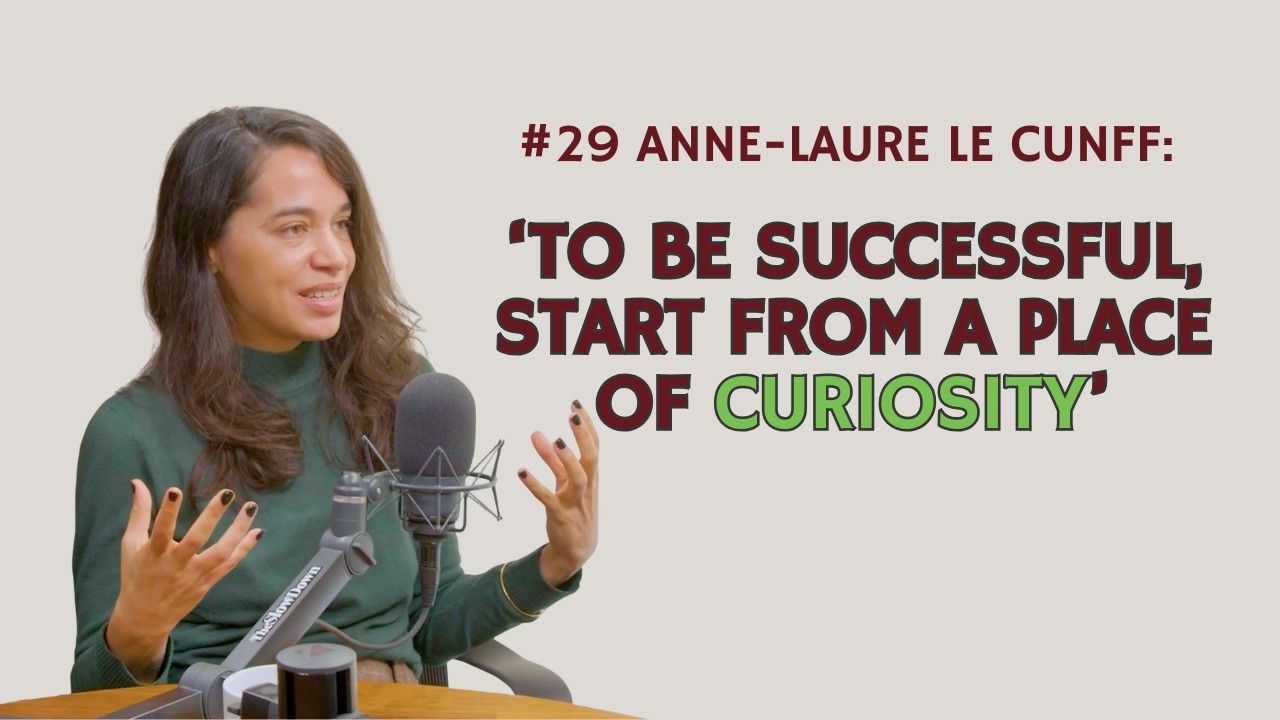
Tiny Experiments: How to Learn, Grow, and Navigate Uncertainty — Anne-Laure Le Cunff

Anne-Laure Le Cunff discusses her book Tiny Experiments and the PACT framework: Purposeful, Actionable, Continuous, Trackable. She explains how to design short trials to learn and grow amid uncertainty, convert experiments into habits, and how AI and predictive processing shape the way we think and respond.
Chapters
Anne-Laure, welcome to the show. Great to have you here.
Thanks so much for having me.
Can you tell me about the illusion of clarity?
So the illusion of clarity is something we have all experienced, even though you might not have heard the term. It's really when we think we understand something clearly, but when comes the time to actually explain it to someone, we realize that there are a lot of gaps in our knowledge. And it's only when we sit down to either communicate that idea to someone in a conversation or maybe writing about it, or maybe trying to give a presentation about it, that we realize that that thing we thought we understood deeply, we don't understand as well as we thought.
It's such an interesting phenomenon. And what can we do to reduce the illusion and increase our real clarity?
Well, I mean, just putting yourself in situations where you are confronted with the fact that you don't understand those ideas as deeply as you thought, and doing that repeatedly is a great way to tackle that illusion of clarity. So that means that anytime there is something that you're deeply interested in, something you're curious about, you shouldn't do that with everything because that would take over your life, right? But if there are topics you really care about. Taking the time to try and explain them. And that could be just explaining them to yourself. So an exercise that I really like doing is really just grabbing a piece of paper or notebook. And the reason why you want to do this is that you don't wanna go and start looking things up. You wanna be fully offline and only relying on what is currently stored in your brain and just try and explain that concept. Try and explain that idea in your own words. You will very quickly see when there is something that you don't really understand and when there are gaps. So that's one way of doing it. That's really quick. I have a friend who keeps Post-it notes next to their computer just for that, just grabbing a Post-it note, trying to explain the concept. And then if there are topics that you really, really, really care about, you can take it to the next stage, which is really trying to explain it to other people. And again, just thinking about the level of safety, the level of risk that you wanna take here, you could start in a very simple way. Explaining it to a friend over coffee in a more casual conversation, and whenever you feel ready, taking it to the next stage where maybe you start explaining it to a larger crowd of people. That could be recording a quick 1-minute video reel that you put on your social media about the concept. That could be, if you're someone who has a newsletter or a podcast or any kind of platform where you explore ideas, you could start try and explain it here, or again, that could be as part of a presentation. So you can see there's a, a gradient almost of ways that you could do that. So some of them that might feel really safe, just you with your notebook, some of them that might feel a little bit riskier. But when you get to the point where anyone could put you on the spot and ask you a question about this topic and you feel comfortable explaining it without hiding behind jargon, this is where you know that when it comes to that specific idea, you have tackled that illusion of clarity.
Makes so much sense. I know personally, as someone who teaches audiences, I sometimes get asked to present topics that I don't feel that I'm an expert in. And one of the best exercises I've found is in creating the slides and really thinking about the topic and doing the research, you get much more confident. Creating slides for me has always been a process of learning because you have to distill the concept into a diagram or into 3 bullet points. And And that is perhaps one of the hardest things to do. But one of the risks is we live in an age of AI. There is what I know you've called the Google, or now the ChatGPT effect. Someone can go on Claude and generate a presentation in seconds, and then there's this feeling of inauthenticity. I suppose you've got your slide notes, so you could potentially read them, but what happens afterwards if you get a question?
Yes, absolutely. Beyond the fact that As you said, there's first the inauthenticity aspect where, where to me, it's almost dishonest, right, to stand on stage and give a presentation about something you haven't really taken the time to understand. And that's different from being an expert because I truly believe that it is okay and it is actually great to stand on stage before you feel like you understand everything. That's completely fine, but It is about standing on stage and saying, I have done some of the work. Here's where I'm at right now with what I understand, and I'm sharing it with you, and hopefully the conversation that will follow will also help me learn more. So you can stand on stage without being an expert. I think that's great, but I don't think you should stand on stage pretending to be an expert when you actually haven't done any of the work. And there is, as you said, a temptation with the tools that we have at our disposal today. You just click on a button and get that presentation generated for you, maybe even have the notes, the actual things to say, the voiceover generated for you, and then stand on stage and, and read from a prompter. And, uh, I, I don't think that's helpful for the audience. I don't think that's helpful for you either. So I just talked about a little bit about the authenticity, the problem with authenticity that you mentioned, but another problem is just around learning and personal and professional growth, creating your own version of something that you're interested in is one of the best ways to learn. It really forces you to make those connections. It forces you to make sure that you actually understand those ideas. And when you skip that work, you're not actually learning anything. You're not actually integrating anything. It's just surface level. Knowledge that is going to first crumble anytime someone actually asks you a question, but also that you're not going to be able to remember whenever that knowledge could be helpful in any of your other projects. The term Google Effect was coined by researchers quite a while ago. I can't remember, but I think it was maybe 2008 or 2010, so quite a long time ago. And what researchers found is that when we know that we can access information later somewhere, that could be on the internet, that could be because we saved it in a folder on our computer, we remember better where to find that information than the actual information. So participants remembered better the name of the folder where the information was stored than the actual information. And so if you think about that effect today with ChatGPT, knowing that we could find any kind of information on ChatGPT at any point could also have an effect where instead of remembering the information, we will just trust that it will be available for us to access at any point in the future. So less authenticity, as you mentioned, but also less learning and less growth as a result.
Overreliance on the fact that I don't need to remember anything anymore. I can just access it with a few clicks and it will be there. But maybe there's another layer, which is, is that information even the right information? Because perhaps you haven't even gone deep enough to verify.
Yes, absolutely. We're fortunately past really bad AI hallucinations at this stage. I feel like if you know how to use those tools, most of the time the information is, let's say, factually correct, but as you said, is this the right information? And is this all of the information that you need? I know personally that when I have searched for topics around my own research, so things I'm pretty knowledgeable about, and I used ChatGPT more as a quick Google search, right? I wanted to find maybe a paper I knew that I read in the past and couldn't quite remember what it was called or who wrote it, or I wanted a quick summary of something that I already knew about. I could write it and spend half an hour doing it, or I could ask ChatGPT to do it. Most of the time it would give me only the kind of broad consensus in the scientific community around this topic, and it would consistently— Mm-hmm. Miss the finer, more nuanced points if I didn't prompt it to. So I would have to go one layer deeper and say, can you also mention those 2 or 3 other theories that I know are not the main ones, but that are also important? I could do that. I could do the deeper prompting because I already knew what I was looking for. But if you're prompting an AI to explore a topic that you don't know much about, then you just trust that it's going to give you the full picture, you're actually going to have a lot of blind spots and you're not even going to, you know, you don't know what you don't know, right? So you're not even going to realize all of these gaps in the map that the AI is giving you.
Yeah, I've experienced the same thing recently. I was doing some research into values. I wrote a book about values, And so I was using Claude and I was asking, but what about this and this and this? And it was saying, oh, great idea. And then expanding the context. Oh, great idea. It, as you said, is full of blind spots. It would've been way less rich. And I think a lot of communication nowadays between people is in that layer 1 level. You know, we're not getting the nuance and the subtlety and all of the options, but that is a challenge for people to work out. And maybe we'll learn ways of better prompting. As we progress. But what I'm really interested to talk to you about is tiny experiments and the PACT. What is a tiny experiment?
So let's start with what is an experiment? Let's start with that. So an experiment, once you remove all of the maybe unnecessary layers or the things that a scientist does. So as a scientist, I have to write grants. There's a lot of admin work. I have to write those very long protocols. Protocols and register them and all of that. But if you go back to the essence of what an experiment is, an experiment is when you choose something to test for a trial period. That's it. That's what an experiment is. So you start from a place of curiosity. You might have a little bit of a hypothesis, bit of an intuition in terms of what might happen. You're not quite sure. And so you say, Let me actually try it out. I'm going to test this. And you know, when you run an experiment that if you do something only once, it could mean anything. It could be a coincidence. There's no pattern if you try the thing once, which is why you have a trial period or a number of trials, a number of repetitions where you do the thing enough times that you can start seeing patterns and you can see whether your hypothesis was correct or not. So That's an experiment. So in my book, Tiny Experiments, I explain that if you want to design your own experiments, you can just choose one action and one specific duration during which you're going to perform that action. So for example, you could say, I will meditate every morning for 10 days. Action, duration. I will reach out to an expert in my area every Monday. For 6 weeks. I will cancel all of my team meetings over the next 3 weeks. See what happens. And so this is a tiny experiment. I will action for duration. You mentioned the pact, and I call that a pact because it is really a commitment to your curiosity. What you say is, I will collect my own data for that specific period of time, for that trial period, and I will withhold judgment until I'm done collecting that data. An experiment is not a goal in the sense that you don't have that one destination you're trying to get to, this very binary definition of success and failure. It's not a habit. A habit doesn't have a specific duration. You say, I will drink I will drink, you know, this amount of water for the rest of my life, every day for the rest of my life, or I will run 3 times a week for the rest of my life, which is kind of crazy when you think about it, because a lot of people have never tried these things before and they just say, let me, you know, build that habit for the rest of my life. An experiment is again, a specific action for a specific duration and the tiny part. So that's an experiment. The tiny part is because I really, really want to encourage people to start small. When you hear about experiments, you might get excited and you might say, okay, let me use this to overhaul my entire life, or let me run this experiment for the next 12 months or 18 months. And it's really important that you complete your experiment in order to know whether it works or not. So that's why it's better to start with something quite short. Try the experiment for a week, for, for a couple of weeks, for 3 weeks, something quite short. See if it works, or if it doesn't, see what you can tweak, and you can always then run another tiny experiment afterwards.
Makes a lot of sense. It takes the pressure off habit formation where you're saying to yourself, if I miss 2 days in a row, I'm no longer attached to that identity, and then I'm a failure. Should you be measuring your progress as you experiment?
So I recommend, so PACT, you mentioned PACT. PACT is also an acronym and it stands for Purposeful, actionable, continuous, and trackable. And, uh, the trackable part is really important. It's not like the M in SMART goals where it's about measuring and where you imagine having those different dashboards and you measure all of those different metrics. With a PACT, you only track whether you've done the action or not, and that's it. So you could use any kind of tracker where you say yes, no, did I do it today or not? And that's it. You can also track how you feel, the internal and external signals. You can do that in your journal. You can do that in your weekly review, but it, it is really at this stage about tracking things, not really measuring in the sense of measuring progress. You do that at the very, very end. The analysis should always come at the very end when you're done collecting your data. The reason why is because scientists also, Don't start poking at the data while they're in the middle of the experiment. The, the best way to get a biased result would be to do that. So this is why we have the trial period and we say, let me do the thing. And during the duration of your experiment, there are going to be times where it feels harder, times where it feels easier, times where you just wanna quit. But this is why you keep it tiny. And you finish it, and at the end you look back and you analyze the result. Okay, what worked? What didn't? Do I want to do it again? Do I want to tweak some of the parameters of the experiment? But again, you only do that at the end.
What are some examples of tiny experiments that you've heard people try, or perhaps some from your own life?
Yeah, I, um, so I run a community called Nest Labs where we have a section where people can post their tiny experiments and they they can post their mini protocol and people can support each other. So I've seen thousands and thousands of examples of tiny experiments. I'm going to share a couple that I really, really like, which I think really capture how flexible this approach is. So one of them is more personal and the other one is more professional. The personal one was someone in the Nest Labs community who had realized that because they had been so busy with work, they had lost touch with friends. So they designed a tiny experiment where they said, I will send a message to a friend every Wednesday for, I don't remember how many weeks that was, and that's it. And again, you're not measuring success by seeing how many of your friends reply or anything like that. You're just tracking whether you did it or not. So every Wednesday he would sit down and write a little message and send it to a friend. The result, which I know is going to sound obvious, but didn't to him at the time, was that all of his friends were really happy to hear from him. And, uh, that helped him restart those conversations and catch up with them and really also helped to, to your point, right? Removing some of that fear because it was just a tiny experiment. It really allowed him to start reaching out again to his friends, even though he felt like maybe they would be angry at him for not giving any news for so long. So that's one I really, really liked because I, they didn't really think of that application at all, and someone came up with it. And another one that is more professional is also someone in the NessLabs community, an artist who had surgery in her arm, and because of that, couldn't paint for quite a long time and had developed that fear around painting that maybe she had lost some of her creativity because of all of this time without being able to practice. So she also designed a tiny experiment and she said, I will sit in my art studio for 1 hour every day. Uh, and again, I can't remember how long that was, but I will sit in my art studio for 1 hour every day and I will do nothing. That was the tiny experiment. I will just sit there and do nothing. Wow. Okay. And what was great is that the first few times that she did that, well, she was just like sitting there and waiting and waiting. And after a while she got so bored of sitting in her studio and doing nothing that she ended up picking up the brushes again and painting again. And so that experiment really helped her reconnect with her creativity in a way that felt very light with very little pressure, which was really amazing. So again, that's another example from my community that I really enjoyed.
Yeah. Yeah. That's, uh, such an amazing example of an experiment that leads to an unexpected outcome. And was so worthwhile, should you remind yourself using, like, lock it into your calendar, for example? How would you recommend someone ensures that they complete what they've committed to?
So, I know this is going to sound very meta, but I recommend to actually experiment with that because I have found that it doesn't really work in the same way for everyone. Some people, some people find it really helpful to block time in their calendar, and so they can actually stick with the experiment for its entire duration. Some people find that it adds pressure. And, uh, I'm going to give you a personal example, something that actually happened to me that I think illustrates this quite well. When I signed my book deal for Tiny Experiments, I had never written a book before, and so I didn't really know how to go about it, and I actually had to experiment a lot. There is a lot of advice for writers out there, but obviously everybody's different and everybody's creativity works in slightly different ways. So the advice that I had seen at the time that was, that's pretty common. And that's what a lot of people will tell you actually is block time in your calendar and ideally start writing first thing in the morning. And so every morning block 1 hour or 2 hours and work on your book. And that's the way to do it. So I thought, okay, let me experiment with that. What I found is that in my case, it didn't work at all. What happened in that is that there were many days where I would sit down in the morning to write, and by the end of the, the block, the 1-hour block, I hadn't written anything good and I felt terrible about it. And then it would have all of those downstream effects throughout the rest of the day. I would be sitting in meetings and think in the back of my head, I didn't write anything good today. Maybe I shouldn't have signed that book deal. Maybe I'm not really built to, wired to be an author. I've been writing short-form content for so long, but a book is a different beast, blah, blah, blah, all of that, right? All of this self-doubt. So I changed the experiment and instead of saying, I will write 1 hour every morning, first thing, I said, I will write for 5 hours every week. And it doesn't matter when those hours happen. It could be anytime. That ended up working so much better for me. And there were mornings where I would actually sit down and then write because there was less pressure. There were also weeks where I didn't touch the manuscripts at all the entire week. And then on Sunday afternoon, I would spend 5 hours hyperfocused, deeply, you know, inspired by the book, and I would write nonstop for 5 hours. And all in all, I probably ended up writing roughly the same number of hours over the course of producing this manuscript, but there was way less pressure when I didn't block time in my calendar every morning. But there was no way I could have figured that out if I didn't really experiment with the approach, right? So this is why I would say, Go with one iteration, run one tiny experiment where you block time in your calendar, see if that works for you. Based on that, you might want to take a slightly different approach where you have bigger blocks, shorter blocks, fewer blocks, no blocks, and you can keep on iterating until you have a system that is as unique as you are.
And you could create a tiny experiment about anything, right? It could be as simple as walking on the beach every morning and seeing what the result of that might be, all the way through to launching a startup. I mean, I remember Tim Ferriss saying he treats his life as a series of experiments, and I think he gives them 3 months. And he says he starts something new, tests it, and if it doesn't work, he's willing to give up because it was just an experiment. So actually, you don't feel like a failure.
Yeah, it really completely rewires your relationship to success and failure. Again, if you think about scientists, they don't run an experiment because they know what the result is going to be. If they already knew that this would succeed, quote unquote, as in getting to a very specific destination, there would be no point running the experiment in the first place, right? So you run an experiment because it is very possible that this is going to fail in the traditional sense of the term, but scientists don't really see that as failure. What they see is that they had a hypothesis, that hypothesis was incorrect, and this is great because now they know. Now they know that this is not the right approach. They have more knowledge than they had before running the experiment, and they can use the new knowledge that was generated to run their next experiment. So all of a sudden, failure is not something that you want to avoid, it really becomes an opportunity to learn and an opportunity to grow.
And a tiny experiment could become a habit if it really suits you and it benefits you and you love it.
Absolutely. An experiment can either turn into a habit if it is something that maybe you've run it for a couple of weeks and, uh, and you really like it, it works for you. You're seeing all of those benefits and you can say, okay, you know what, let me almost like promote it to the rank of, of habit and say, this is something that I wanna stick to now for the foreseeable future. You can also turn an experiment into a project. So if this is something that you feel like you wanna keep on building on and you see yourself keeping on working on over the long term, that can become a project. So that's what happened with my newsletter. It started as an experiment where I said, I will write one short article every weekday for the next 100 days. And I know it sounds like a big experiment, but the articles were quite short and I already loved writing at the time, so that was my preferred medium, something I was quite comfortable with already. And at the end of the 100 weekdays, it was very clear to me that I loved it. I absolutely loved sitting down at my computer, not being quite sure yet what I would write about, reading papers about this topic and turning it into something I could share with people. And so I wouldn't really say now that the Nest Labs newsletter is an experiment. I still have lots of tiny experiments running as part of this project, but the Nest Labs newsletter I've been writing for 5 years now, it's not a tiny experiment anymore. So absolutely tiny experiments can turn into habits and they can also turn into projects.
What about your story at Google? Can you tell us a little bit about what got you interested in neuroscience and the transition that you made?
Yes, absolutely. I really think about my career, my life in general, I think about it as if it was two chapters. And Google for me was very much the first chapter of my career. At the time, I had a very linear, traditional definition of success. So, to be successful was to have a clear goal and to get a good job and then climb the ladder, get the next promotion. And that's what I did really at Google. I was very focused on being as successful as possible. That was probably mixed in with, I didn't know the term at the time, but probably mixed in with a little bit of imposter syndrome as well, where I felt like maybe someone would discover that I didn't belong there. All of this put together, the traditional definition of success plus the little bit of imposter syndrome meant that I was basically the yes girl at work. You could come and ask me to work on anything at any time of the day, and I would say, yes, yes, you can count on me. So colleagues would come to me at 7:00 PM and say, can you create that presentation for the meeting tomorrow at 9:00 AM? Yes, yes, absolutely. I'm your girl. I will do it. Even if that meant canceling plans with friends or maybe sleeping fewer hours that night. I would say yes to everything. That was obviously unsustainable. And I wish I could tell you that I had realized, I realized on my own that something was wrong. But for me, and I know it's the case for a lot of people, unfortunately, it took a bit of a trigger outside of my control for me to realize that something was wrong. So what happened was that one morning I was getting ready to go to work, and while brushing my teeth, I realized that my entire arm had turned purple. So I went to the Google infirmary. We had that on campus, and the nurse had one look and said, you need to go to the hospital. So I went to the hospital in Stanford where the doctor said, we need to perform surgery as quickly as possible. You have a blood clot in your arm that is threatening to travel to your lungs. And in that moment, Instead of saying, yes, absolutely, let's do the surgery as soon as possible. I said, one second, I need to check my calendar. And it was almost like, it was almost like this out-of-body experience of seeing me, seeing myself doing this thing that was so absurd, right? Didn't make any sense that. It made me realize that my priorities were completely out of whack. And for me, that was the beginning of that second chapter I'm now in, where I have a much less linear approach to success, fewer goal-based kind of success and this kind of linear progression, and where I'm a lot more experimental and also trying to pay a lot more attention to all of the signals that my brain and body are trying to give me instead of ignoring them and pushing through.
Wow, that's so interesting. And it leads me to ask you about response 1 versus response 2, because there is a very real, of course, when something like that happens to you and across the scope of our lives, uncertainty is going to hit us. And we talk increasingly about living through VUCA, volatile, uncertain, complex, ambiguous times. What does response 1 versus response 2 actually look like in the face of uncertainty?
So response 1 is our automatic answer in the face of uncertainty. I think it's useful to understand why we respond like that when we're faced with uncertainty. So our brain, essentially, if really you go back to what your brain is trying to do, what its job, your brain is designed for survival. That's it. And everything else is bells and whistles. Really, your brain is designed to help you survive. And because of that, it does make sense that your brain is also designed to try and reduce uncertainty as quickly as possible. So whenever you find yourself in a situation where you're not quite sure what's going to happen next, where you're not quite sure what the risks are, who are your friends and your enemies in the tribe? Where are the resources? What is that weird noise behind you? All of these kind of things that create uncertainty, your brain is going to try and attend to them. And try and find an answer as quickly as possible. This is not anything wrong with the brain, the way your brain is designed. And I would argue that if what you want in life is just to survive, then great. Your brain is doing a great job and you can actually rely on those automatic responses. But if you want more from life than just surviving, if you wanna grow, if you wanna thrive, if you wanna figure out what really is the way you wanna spend your time and your energy, then those automatic survival mechanisms can get in the way of that personal and professional growth. And this is where you wanna be able to say, and I know it's going to sound a little bit silly, but really, thank you, brain. I know what you're trying to do here. I really appreciate it, but I am in no immediate, you know, risk, danger of death here. And I actually want to go and try that thing. I actually wanna go and experiment. I wanna see what happens here. And this is response 2. This is a response that is autonomous rather than being automatic. That is a response that is based on curiosity rather than control. It's really a response where you reconnect with your sense of agency and you trust yourself to figure it out as you go, even and especially if uncertainty is really high right now in your life and in the general environment.
So developing some tools that interrupt that default state, perhaps those predictions of, you know, this is going to go badly, here we go again, and gratitude, actually thanking the brain. So that sounds like a great first step, just saying, oh, thank you, I understand that you're doing your job. However, right now I want to give myself some more options.
Yes, absolutely. I think Really remembering that whatever you're experiencing is just a signal from your brain and that those signals come from a place of protection, wanting to protect you, is really important. And so some of those signals can be quite uncomfortable and there might be resistance around them. But as you said, if you just have this little pattern interrupt and where you say, oh, thank you, I see what you're doing here and I am grateful. That you're trying to protect me, but let me take over now. So being curious, being grateful, just sometimes, you know, taking a deep breath, that can also be a great way to interrupt the pattern or reframing the signal in the way that is more useful to you. So something a friend recommended to me and that I've since heard many times is for public speakers, for example, when you're about to go on stage and you notice that your heart is starting to beat faster and maybe your hands are a little bit sweaty, reframing this from I'm anxious to I'm excited because the signals actually look very similar. So there are lots of different ways you can interrupt that pattern and you can in that way completely change your experience.
And do you think we are reacting to the world or predicting the world as per the predictive processing model or something in between? What's your thoughts?
Well, I mean, we know that the brain is really a prediction machine and the way the The way this works is that, so if you look at the prediction-action cycle in the brain, which is one of the models of the brain, and I'm not saying we know for sure this is how the brain works, right? But it is a model that a lot of scientists believe is a good representation of how the brain works and how we navigate the world. So first, the brain is going to make a prediction based on the information, the data available in the environment, and then we're going to take an action based on that prediction. Then the brain is going to look at how how the situation changed, basically the new information in the environment based on this action we took, and is going to notice the, the error, the, the gap in between the prediction and what actually happened. This is how we learn. This is how we grow. This is how we evolve, even when the path forward is unclear. So we make predictions, we take action, and then we see if, again, very similar to how tiny experiments work, we see if the hypothesis that we formulated was correct. And this happens at a micro level every single time you take an action. Even when you go and open the door, you're making a prediction where you're almost 100% sure that by the time your hand gets there, that handle is still going to be there, right? So it's all predictions.
It's fascinating. And it's interesting that the greater the prediction error, the higher the likelihood that you're learning and growing, which seems unintuitive, but it makes a lot of sense.
Absolutely. You want to put yourself in situations where there is an actual gap between your prediction and what might actually happen. So again, using the example of the door handle, once you're done learning this, there's no learning anymore, right? You're, you're just actually going to the door handle, which actually, by the way, is really funny because you'll notice that in some countries, the door handle is the other way around and you can almost feel it in your brain, this, this little friction, the resistance of, oh, Oh, I made a prediction and actually it's not— what's happening is not what I had predicted. And so you have to relearn something new here, right? But so, yeah, if you only predict things that go exactly as you predicted them, then there's no learning anymore. So I completely agree with you, and I think it's one of the best things you can do if you want to keep on growing is making those kind of risky predictions. And by risky, I don't mean putting yourself in a situation of danger. I just mean that you could be wrong.
We're kind of almost living in our own personal simulations and trying to maintain stability. And people wonder, why am I not growing? Why am I not achieving the goals that I've set for myself? But it's because you are aligned with low prediction error with your own version of reality and not actually challenging yourself. And I think that's where Tiny Experiments comes in. Anne-Laure Le Cunff.
Absolutely. Tiny experiments are a very simple way for you to inject more predictions and more of those errors. So more trials, more errors in your life, and in that way to keep on learning in ways that are very easy to implement. And actually, something I hear quite a lot sometimes is people saying, oh, I don't know if I have space for experimentation. You know, I have so much going on in my life right now. This is another reason why my book is called Tiny Experiments and not Big, Massive, Huge Experiments. It's because you, you can actually experiment with very small things in your life and you don't need money, resources, or any kind of special tools to experiment. One of my favorite experiments is I will not bring my phone in my bedroom for one week. That doesn't require any money, any extra time, anything like that, any extra energy, and it can actually have very positive consequences in, in your life. So experiments can be very, very tiny, and they are a way to make more predictions, to take more actions, and to learn from the gap in between your hypothesis and the actual outcome.
Are there ever any times when the experimental mindset might be the wrong tool?
There are situations where you know exactly what you're supposed to do. They're quite rare, but if you are in a situation where it is really a matter of just doing the thing, then maybe you don't need to experiment. They're quite rare. We know, for example, that if you want to lose weight, you need to be in a calorie deficit. So there's, there's, there's no way around that, right? Like that's not something you're going to experiment with. You know that, oh, by eating more calories than I spend, am I going to, to lose or gain weight? We know the answer to this, right? But within that, within that, you can experiment, right? What is a way for you to maintain that calorie deficit if you want to lose weight? Is that maybe more veggies, more protein, or maybe you want to exercise a little bit more, adding more steps throughout your day? So you can experiment with ways to create that deficit. So I would argue that there are very, very few situations where you cannot experiment at all.
Thank you so much, Anne-Laure. If someone is interested in reading the book, connecting with you, joining your community, where would you like them to go?
Thank you so much for having me. So I write a weekly newsletter called Nest Labs. You can go to nestlabs.com and subscribe there. And I write about a lot of the topics we discussed together today. And the book again is called Tiny Experiments and it's available anywhere books are sold.
Amazing. And a final thought for those who stuck with us all the way to the end.
A question, maybe. I'll just ask them, what will be your first tiny experiment?
I like that very much. Anne-Laure, thank you again, and thank you all for tuning in. Do check out the links in the show notes. We'll see you next time.
More from Anne-Laure

How to Use Curiosity & Experimentation to Flourish, with Dr. Anne-Laure Le Cunff

Stop chasing goals and start running tiny experiments with Anne-Laure Le Cunff

Why You’re Still Waiting To Figure It All Out | Anne-Laure Le Cunff | EP. 391




Stop Setting Goals. Try This Instead | Tiny Experiments with Anne-Laure Le Cunff



Enough Big Goals - Try Tiny Experiments with Neuroscientist Anne-Laure Le Cunff