Anne-Laure Le Cunff: How to Navigate Uncertainty With Tiny Experiments
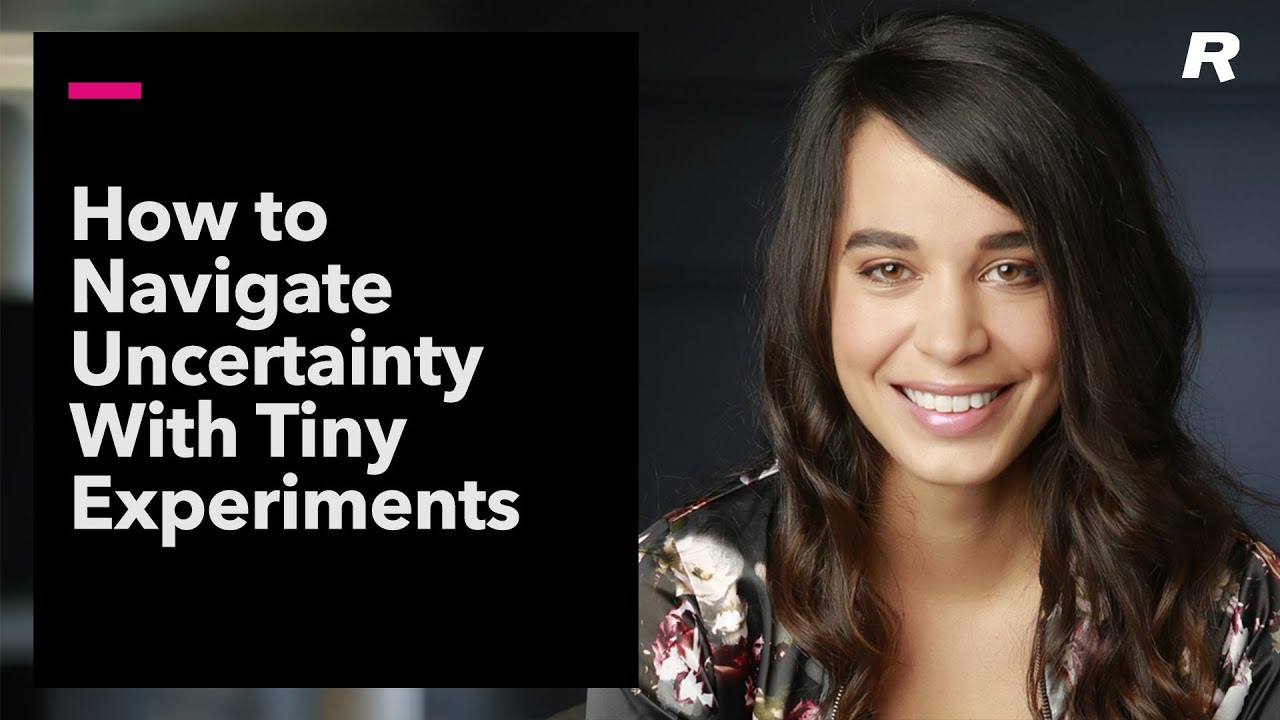
Neuroscientist Anne-Laure Le Cunff argues that linear goals don't work in today's fast-changing world. Instead, she proposes tiny experiments: pick one action, run it for a set time, track metrics and how you feel, then persist, pivot, or pause. This experimental mindset replaces burnout with curiosity.
Chapters
My name is Anne-Laure Le Cunff. I'm a neuroscientist at King's College London and the founder of Nest Labs, an online platform for curious people who want to achieve more without sacrificing their mental health. There's an interesting paradox when you think about modern work. Modern work is all about finding solutions to complex problems and knowledge workers, which I like to define as people whose brain is their most important tool in order to do their work, are really good at solving complex problems. However, when it comes to the way they manage their own work and their own workload, a lot of them report feeling overwhelmed, stressed, anxious, and burned out. So why is it that so many smart people torture themselves in the way they manage their own work life? To understand this paradox, we need to go back to the very definition of success. Success is something that seemingly everybody wants to have. We praise it, we admire it, we spend a lot of time measuring it with OKRs, KPIs, performance reviews. So what is the success that everybody wants so ardently? If you open a dictionary, the most likely definition of success you're going to find here is something like this. Reaching a desired outcome. So there's the idea of movement, of progress towards a specific result, something we desire. And that definition of success seems so simple, so obvious that it seems like it's the only possible definition of success, but it's not. This definition of success is based on something I call linear goals. Linear goals are the idea that in order to be successful, you need to have a clear vision and a clear plan. You need to know exactly how to go from point A to point B, and this is how you become successful. And this is not new. We've been using linear goals to talk about success for thousands of years. 2,000 years ago already, Epictetus said that in order to be successful, First, say to yourself what you would be, and then step 2, do what you have to do. And don't get me wrong, Epictetus had a lot of very smart things to say, but he wasn't living in the same world we live in today. We don't live in a linear world. We live in a nonlinear world. There are market trends that keep on changing and industries that keep on shifting and global events that can change everything overnight. And so when we try to stick to linear goals, to have this clear vision and this clear plan, the only thing that can happen is frustration, overwhelm, and burnout. Worse, what happens when we try to, to stick to those perfect plans and it don't work out? We blame ourselves. We feel like if that blueprint worked for other people and didn't work for us, something must be wrong with the way we applied the plan. Now, do you know who has a completely different definition of success? Not one that is based on linear goals, not one that is based on having a perfect plan to execute on. People with an experimental mindset, and more specifically, scientists. What I define as, as an experimental mindset is having both high ambition and high curiosity. The ambition to commit to exploring something new, to taking risks, but also the curiosity to open new doors, even when we're not quite sure what we're going to find on the other side. So what does that look like to have this experimental mindset, to approach uncertainty with high curiosity and high ambition? Well, first we need to really believe that failure is an inherent part of learning. When a scientist doesn't get the results that they expected, they don't blame themselves. They ask, huh, interesting, what can we learn from this? Second, knowing that curiosity always, always beats certainty. There's something really interesting about how the brain works. It's based on something neuroscientists call perception-action cycle. So instead of making decisions based on complete certainty, the brain observes the current situation in the environment, makes a prediction, and then based on that, decides on the next best course of action. And then whatever the outcome, as long as the result is not so bad that you're dead, your brain is going to take that new information in the environment and make a new prediction. That's Prediction Action Cycle, and this is based on curiosity and iteration. The reason why scientists are so good at applying the cycle is not because they're smarter than everybody else. It's because they've been trained to do so. They apply something called the Experimental Cycle. It starts with observation, where you see what the current situation is and where then you formulate a hypothesis asking, What could be different? You then collect your own data to see how you can test this hypothesis, and you analyze data to see what the result of the experiment is. And to close the loop, to close that experimental cycle, you then observe what changed in the environment. This cycle is based on pairing action and reflection, reflection and action. You do something, you reflect on it, and then you use that reflection to decide on next course of action. Knowing that failure is an inherent part of learning, believing that curiosity always, always beats certainty, and always pairing action with reflection and reflection with action. Those 3 principles together are a little bit like an operating system. They're a way for you to develop an experimental mindset and to approach uncertainty with more curiosity. And the good news is that you do not need to have a lab in order to apply this experimental mindset. All you need to do is replace linear goals with tiny experiments. Let me show you how. So you can apply tiny experiments in any area of your life and in your work, and that can be through communication, parenting, healthy habits, management, developing new skills, building a new productivity routine. Even the way you dress at work. Anything you're curious about can be turned into a tiny experiment. And I know when you discover this concept, you might want to start experimenting straight away, but a good experiment, as we've seen in the experimental cycle, always, always, always starts with observation. You need to first ask what is the current situation so you can imagine what could be different. I like to call this exercise self-anthropology because the idea is to pretend for just a short amount of time that you are an anthropologist, but with, but with your own work and life as your topic of study. You want to observe your day-to-day and ask yourself, what is working? What is not working? What is giving me energy? What is draining my energy? What are ideas I'm excited to explore at work? And what are the ideas I feel like I've worked on for long enough and I'm ready to move on. Observe your day-to-day. Do that for 24 hours and take little notes throughout the day, just like a scientist. Once you know the current situation, you can formulate a hypothesis and you can start experimenting. To do that, I invite you to design a mini protocol for experimentation. And the way it works is exactly like a scientist. Who decides what they're going to try and the trial period. You're going to pick one action to experiment with for a specific duration. It's very important that you pick a duration that gives you enough time for you to have repeated trials. When you look at research papers, you will see that scientists say, we tried this experiment with 500 participants, or or over the course of 5 weeks. And the reason why you want repeated trials is because you wanna make sure that what you're seeing is an actual pattern rather than a coincidence. So this is why you design a tiny experiment saying, I will try this action for 2 weeks, for 1 month, for 1 quarter, for 6 weeks, whatever the duration is. You always pair an action with a specific duration instead of just doing the thing for one time and not knowing if you have a coincidence or a pattern. I want you to see how flexible this approach is. You can use that in purely work aspects, professional aspects of your life. So you could use a tiny experiment to say, I will reach out to one industry leader every Monday for 2 months, or I will host a lunch and learn every last Friday of the month for 3 months. But you can also use tiny experiments in your personal life, so you can use experiments to better manage your health, which is going to have downstream effects on your productivity and creativity at work. So for example, I will meditate every morning for 15 minutes for 15 days. Um, or you could also do it for your personal relationships. One of my favorite ones is I will call my mom every Sunday for 4 weeks. Very importantly, tiny experiments can be not only about adding something, experimenting with something new, they can be about subtracting something. So if you are time poor and you feel like, I don't have space to add a new experiment, think about something you could remove. I will not bring my phone in the bedroom for 1 month, or I will not check my email for the first 30 minutes of the day when I get to work. I will not do this action for the specific duration. Once you're done completing your experiment for that specific duration, you want to analyze the data. That's the last part of the experimental cycle. And for that, it's very important that you consider both the external and internal signals. External signals are anything you can put in a dashboard. We're usually very good at looking at these. And so any kind of number, success metrics, and all of these kinds of performance-based ways of seeing if the experiment worked are great to look at, but you also want to look at the internal signals. How did it feel to complete the experiment? Because if all the external signals look good, but at an internal level, it felt terrible to complete the experiment, then something needs to change. Based on both those external and internal signals, you can decide whether you want to persist. Keep going with the experiment exactly in the same way if it's working for you. Maybe you want to pivot, just tweak something, do it in a slightly different way, change the time of the day, change the kind of people you're doing the experiment with, change the amount of the, of work, change your creative approach to that project. Or if the experiment just didn't work for you, you can pause it. And I don't call this one abandon forever, because you might come back to it in the future. But it is completely okay if an experiment doesn't feel aligned with whatever your priorities are at the moment or whatever your capacity is at, at the moment, to pause it, maybe come back to it later. I invite you to start a year of experimentation. Instead of linear goals, ask yourself, what is something I'm incredibly curious about that I would like to experiment with? That could be something at work, that could be around a topic that you're interested in, that could be AI, that could be your health, that could be the way you introduce yourself at the beginning of a conversation. Anything you're curious about, again, can be turned into a tiny experiment by picking an action and a duration. Whatever you discover, always default to curiosity. When there is something new that happens or new data we uncover in our personal and professional life, there might be a temptation to freeze, to try to be in control, to make a plan, and to go back to linear goals. Instead, ask yourself, huh, interesting, what can I learn? Tiny experiments can lead to big changes. Imagine a world and a workplace where it's completely normal to walk around and ask people, what have you been experimenting with? What have you learned? What was your latest failure? Not only would that be a world where there would be more imagination and more innovation, but it would be the kind of world where we value people not based on the quantity of answers they provide, but based on the quality of the questions they ask. Thank you.
More from Anne-Laure

How to Use Curiosity & Experimentation to Flourish, with Dr. Anne-Laure Le Cunff

Stop chasing goals and start running tiny experiments with Anne-Laure Le Cunff

Why You’re Still Waiting To Figure It All Out | Anne-Laure Le Cunff | EP. 391


Tiny Experiments: How to Learn, Grow, and Navigate Uncertainty — Anne-Laure Le Cunff



Stop Setting Goals. Try This Instead | Tiny Experiments with Anne-Laure Le Cunff


