Branching your brand beyond newsletters with Anne-Laure Le Cunff, creator of Ness Labs.
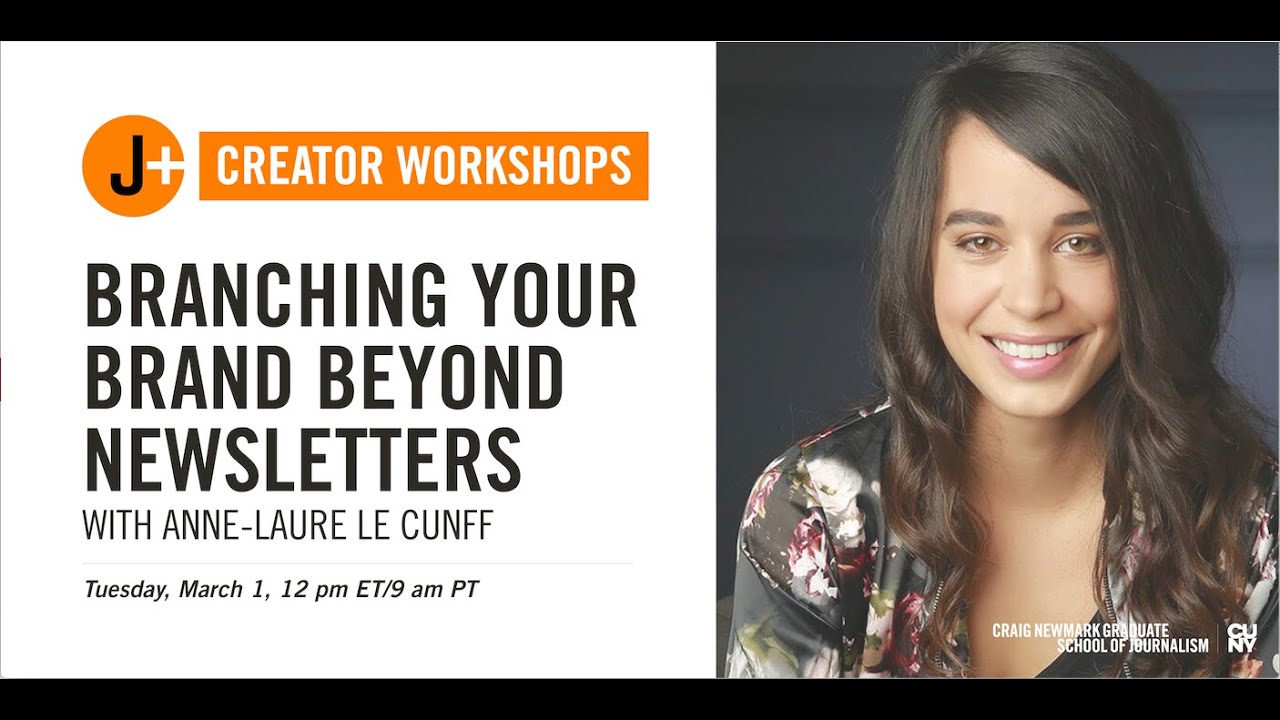
This content was created by Anne-Laure Le Cunff. This content was uploaded by Anne-Laure Le Cunff. This is a YouTube recording (Creator Workshop at CUNY Newmark J-School) titled "Branching your brand beyond newsletters with Anne-Laure Le Cunff, creator of Ness Labs." Recorded March 9, 2022, it is a hosted interview by Yvonne Liao with guest Anne-Laure Le Cunff (founder of Ness/Nest Labs) plus contributions from other speakers/audience members. The session (40-minute interview + Q&A) covers branding, building in public, newsletter growth, community-building and monetization (using Circle), content strategy, pricing, hiring, product/tool choices, lessons learned and audience questions. Participants include Yvonne Liao (host), Anne-Laure Le Cunff (primary speaker), occasional commenters labeled "Speaker C," and attending audience members. The excerpt is in English and is a practical, tactical conversation about growing a creator business around evidence-based mental health content.
Chapters
I will kick things off here. Welcome to the 5th event in our Creator Workshop series at CUNY's Newmark J-School. My name is Yvonne Liao. I'm one of the creator-in-residencies with Newmark J+ and the founder of Bewilder, which is an outdoor recreation company based in California. So I'm proud to be having this talk today, and one of the reasons is because we also, Bewilder, just rebranded, relaunched our website, and know firsthand what, how detailed and thoughtful the branding aspect of your initiative or your project can be. So in the spirit of these talks, we are also trying again to cultivate a creator community, feeling like we can support one another. Please keep the chat alive, introduce yourself, share the projects that you're working on, and know that we will be having an opportunity at the very end of this talk to also network and break out into different sessions so you can actually meet other creators around the world. So without further ado, our speaker today is Anne-Laure Le Cunff, the brainchild of Nest Labs, a media company designed for your mind. Every week, Nest Labs produces a newsletter with neuroscience-based content and conversations, and it has now grown to more than 40,000 subscribers. This morning. Initially, we had been 30, and now there's 40,000 subscribers. That's part of the Nest Labs community. Congratulations, Anne-Laure. We're super excited to hear from you and how you've grown it to where it is today. So just a quick reminder, the format is going to be a 40-minute interview, um, 3 minutes now, and then we will have Q&A for audience questions. Feel free to either ask your questions in the chat, or we will select someone and you ask in person. So with that, I will kick off our first question. Branding can have kind of a negative connotation. I think sometimes people feel like, oh, you know, you're just working on your personal brand. It feels kind of influency. How do you navigate that? And how did you think about what branding means to you?
First, thanks so much for having me. It's great to be here. I think people feel this way about brands when it feels inauthentic and they can tell that this is just an artifice that's used by brands to sell more of a product or a service. To me as a creator, having a brand is more about having values that you stick to, whatever happens, and that you communicate through whether it's the content you're creating, whether it's the business decisions that you're making. The rules you're applying in your community, the values that you infuse in every single aspect of your business as a creator. I think this is what really creates an authentic brand than putting a style guide together and saying like, this is going to be our tone of voice, which most people are savvy enough to read through now.
And how would you describe Is Nest Labs' brand and what was really important for you to capture in that branding?
If you look at the website for NAS Labs, you'll see that it's very minimalistic. It's black and white and that's it. And it started from a functional standpoint at the beginning, just because it was just me and I didn't have the money to hire a designer, but it's come to become also something that's part of the brand in the sense that it's very simple, no bullshit, no bells and whistles. We're not trying to kind of make things look shinier than they are. And because our website is all about sharing evidence-based strategies to take care of your mental health, I think this is actually a really good match to say that we're not going to have flashy colors or anything like this. It's really all about the quality of the content. And then another aspect that's important is that it's not because it's minimalistic that it has to be cold. And from the community side of things, we're really trying to cultivate a community that's warm, kind, and very human. So generosity, it's also something that's really important. And this is something that we try to infuse in the community in terms of everyone sharing together, learning from each other, supporting each other, but also in terms of content for Nest Labs where like 90% of the content, if not more, is free for anyone to read. And for people who want to engage more, there's the private community that's paid, but you can get a lot of value just by browsing the website for free. So this generosity is also really important to us.
That's really resonating with a lot of journalists as we obviously want our content to be as widely read as possible. But before I jump into that topic, I'd love to know like how much of what you just described is Nest Lab's brand identity as part of your personality? Like how much did you connect with that, especially being a creator And so many of us are here, actually, according to the poll, about 60% of the attendees here are creators. And so, yeah, how did you— your personality, what would feel authentic to you while also, I think, balancing out the audience that you were trying to reach?
I would say that the Venn diagram of Nest Labs and my brand was basically like this, just the same. And everyone knew that because it was just me.
And I've always been a fan of learning in public and working in public.
So I've documented extensively my journey building NestLabs on Twitter. I've been sharing the good and bad. Like, you know, once I was like, look at it, I just changed the design. It's so pretty. I spent so much time building it. And 3 days later, I posted another screenshot saying I just went back to the cheap default design because my conversion rates went down. And sharing screenshots of revenue, the growth, the audience, the number of page views, etc. All of that is available on my Twitter. And so I think because of this, because as a creator I've been building Nest Labs openly, people have associated with me. That being said, since last year I have employees now who are helping me because Nest Labs has grown so much. So I'm really trying now to detach myself a little bit more in the sense that I really want the business to work even when I'm not working on it. And one of my big objectives for this year is that I want to be able to take a 2-week holiday without checking my emails, without— and for the business, and since my employees are learning so fast, fingers crossed, but I do think that I'm going to be able to reach this goal.
I believe it. I believe it. And you kind of talked about building in public. That's definitely a motto, especially within the tech community, but it can be really anxiety-inducing for those who haven't really developed that that muscle. Was that terrifying at any point? Did you receive any kind of like vitriol online? What was your experience as you were building Nest Labs in the early days, especially out in the open?
I think the first time you hit publish on anything online is anxiety-inducing. And as you said, like 60% of people listening to this are creators. So I think everyone has experienced this. It's very scary. As human beings, we are social animals. We're designed to want to be judged in a positive light by other people because this means being accepted in society, being protected, etc. So we are always very scared of being judged. And this is why public speaking, for example, is one of the biggest fears that people have. There was a survey showing that some people were more scared of public speaking than death. Just, it shows how scared we are of being judged, right? So yes, it was very anxiety-inducing at the beginning, but I think, as you mentioned, it's like a muscle. The more you do it, the more comfortable you come with it. And I've been very lucky that I don't have, I didn't receive any very negative reactions to anything that I've done. I think the nature of what I do makes it a bit difficult because I write about evidence-based strategies and I link to all of the research papers of what I'm claiming. So, I mean, if you're not happy, go and attack the research scientists that have done the research, not me. I'm just a messenger. And also, as I mentioned, the fact that I've designed the Naslabs brand around kindness and generosity and being human, I think has attracted attracted the right kind of audience as well. And in general, the people that I have in my community and in my audience on Twitter are people who are all about learning in public, making mistakes, having a growth mindset. And so whenever there's something that's wrong, it's all about being constructive and learning from it rather than pointing fingers and being basically bullying people online, which my community doesn't do and my audience doesn't do.
That's incredible and incredibly inspiring. And so Anne-Laure is actually very qualified side. This is not her first rodeo. You built health and wellness companies before. Can you tell us a little bit about what the differences have been when it comes to kind of going off as a creator versus being like a CEO or founder? What was the different approaches and what did you learn?
I think, I don't know about necessarily the difference between being a founder or creator because I see them in a very similar light. It's still your project and your baby that you're building, but I would say that I learned a lot between my first company and what I'm doing now. The first one, which failed, because I would still be working on it if it didn't, I tried to apply the perfect playbook of how to build a company. So I was spending a lot of time reading online about how to start a company. I got a co-founder, even though I didn't know them before, because everyone was telling me, and on, in TechCrunch and Wired, they were all saying, you need a co-founder to start a company. So I did a lot of things wrong just because I was trying to apply these guidelines that were so generic that they didn't like to make sure that it's beautiful. Whereas as a creator now and working on Nest Labs, I'm much more comfortable being experimental and just trying things out and just having those little trials. I'm a big fan of the expression failing like a scientist because scientists design experiments not for them to succeed. If they knew that it would succeed, they wouldn't need the experiment in the first place. So they design experiments to learn something new. And I'm trying to apply that mindset to my business. Every week I try something new, I tweak it, and if it doesn't work out, I'm just learning something from it and then trying to be 1% better the week after. So I think having this more experimental and incremental approach to growing the business has been something that's been quite different in my approach today versus my first—
I genuinely love that. I think that's something I'm going to have to keep in mind too, and I hope everyone else does as well. There is a lot of ideas about how to build a company, build initiative, and it sounds like with Nest Labs you found something where you can create a sandbox and experiment on your own. And speaking of on your own, though, how did you differentiate between your personal brand, who you are on Twitter versus Nest Labs? And we've seen a lot of different speakers, you know, really converge. Like those are one and the same. What's your approach to that question?
I don't think they're the same anymore. But talking about that Venn diagram again, which is completely a perfect overlap before, there's still a lot of overlap.
Today.
And I'm completely comfortable with it because actually you mentioned the sandbox, but the reason why Nest Labs is called Nest Labs, the labs bit is about having a sandbox for myself to be able to play and experiment and grow. So I'm very comfortable with the fact that there's a big overlap between my personal brand and my company brand. That being said, I think compared to— I know other creators that are— the name of their business is their name, right? Like if you look at James Clear, jamesclear.com, for example. And that's the reason why I decided to have a separate brand. For my business is that even though right now there's a big overlap, I wanted to have the option in the future if I wanted to separate myself from the business of branding to be able to do this. And so right now I'm very comfortable having a big overlap, but I really like the idea that I'm not stuck. This is a choice and this is something that can change in the future because that brand exists separately as from my—
Such an intentional decision that you made. What were some of the other intentional decisions that you made about what you wanted to build before you launched it? So take us to like day zero or even negative one. What were some of the thoughts and strategies that you were starting to form, or did you really just kind of like throw Nest Labs on the wall and start creating? What was your approach?
I think the only strategic decision I did at the beginning was to commit to being consistent with producing content. I genuinely can't remember what the stat is, but it's something like 98% of blogs die in the first year or something like this after their launch. I can't remember, but it's really bad. And I didn't want to join the graveyard. So I decided that I would at least give myself a year and I would publish my newsletter every week.
For a year.
And it's so interesting how much of the success that you see for online creators is just based on being able to stick to it for long enough to be able to see that success. A lot of people quit before they get there. And the, the, the first few months can be pretty slow, which can be a little bit demoralizing. And I understand why people quit, but if you stick to it long enough, then you're going to start seeing success. So that was the only strategic thing that I've applied and that I keep I'm sending newsletter every week, I'm not missing any. And if you look at the way the newsletter has grown, it hasn't been a smooth curve. There were weeks where nothing happened, it's flat, right? It's just crickets. I send a newsletter and apparently this is not a great one. It happens, right? And then maybe one week another creator bigger than me in terms of audience will share my work and say that they love the newsletter and boom, 2,000 subscribers. But this would not happen if I didn't keep on showing up, right?
Right.
So it's really all about showing up and then just let the magic happen.
Well said. And did you feel like you had to do any type of competitive research or was this a space— I mean, you have history working in wellness and health, but is this a space that you just wanted to take another stab at or were you really kind of debating other types of areas or other industries to explore?
Um, so the, the way I started Nestlabs is very different from what I did for my previous companies because I initially started it as a blog for me to write about my studies. I, uh, I, I study neuroscience, so I wanted to have a space where I could write about everything that I was learning in order to use something called the generation effect that shows that by writing your own version of what you're learning, you're going to both understand it and remember it better. So just that I created that blog and I didn't expect so many people to like it and to subscribe and I didn't expect it to be a business.
But because of this, once I—
once people were, okay, I'd actually love to pay for a book, do you want to write something, do you want to do that? And I felt like when people ask you if they can give you money, there's probably a business somewhere. I did what I would call more of inspiration research than competitive research because I don't think in the creator space it makes sense to think about competition. The pie is big enough and it keeps on growing that you're not really competing against another business. It's more likely actually that if you, and that's the case I've seen that, if you become friends with fellow creators in the same space, you're going to end up sharing your audience and growing it together. And I've been very lucky from the pretty early in my journey as a creator to connect over Twitter with creators who were also interested in mental health and mindful productivity, creativity, and neuroscience, and I've benefited so much from either the mentorship or them promoting my content or sometimes collaborating together on projects.
So I really don't think about it in terms of competition.
That actually segues really nicely into my next question, which is gonna be about mentors and advisors. So yeah, and did you seek these other creators out? It sounds like they kind of either found you or you found them. Actually tell us how those relationships formed and how helpful it's been.
I never proactively looked for mentors, or I never proactively tried to create those friendships. But as I said, I've been consistent in creating content and putting myself out there, sharing it online, sharing it in platforms where I knew people who were interested in the same topics were hanging out. So you kind of end up finding each other. And as also just a virtue of me creating content and researching it, I would stumble upon sometimes repeatedly over the content of the same creator. So I would like their content often on Twitter. Then I would be like, okay, that's a lot of content they create. That's really good. I'm going to follow them. They would follow me back. After a while, one of us may DM the other one and say, you know what, hi, I just wanted to say, I love your work. You end up connecting. And now I have a few friends like this. Some of them, most of them I've never met in person, but once a month or once a month and a half, we do some quick calls where we catch up, we share any tool that we've discovered that we found helpful or any strategies that we've applied, whether it's for the business or productivity, et cetera. Sometimes it's just a mental health check-in, but it has happened very organically. But the one thing, again, it wouldn't have happened if I wasn't regularly creating content and sharing it online.
When did you give yourself a break? Now that I've heard that is your core piece of advice is just steady content production. As someone who's also been wrapped up in the steady content production, it is exhausting, especially on a weekly cadence. So, well, one, did it ever feel exhausting to you? And then two, after that year mark, how did you evolve?
Yeah, I think It helps, it may not apply to every single type of creator business, but it helps that for me, I'm in the mindfulness and mental health space. So whenever I feel like I'm about to burn out in the newsletter the week before, I'll say, hi, I'm taking a break, see you in 2 weeks or see you in 3 weeks. So I do take breaks. I just try to make them very intentional and just say, this is what's happening. I'm not going to send a newsletter for X weeks. The only time I didn't send the newsletter, even though I was supposed to send it, was on a Thursday. I was typing it up and I got a phone call learning that my grandma passed away. And obviously I was like, I'm not sending this. But except for that day, every other time I'm just listening to myself, listening to how I feel. And if I feel like burnout is looming in or that I need a break, I will just tell people no newsletter next week. I will see you in 2 weeks. So I do take breaks. I think it also helps being a creator to not have a boss or other people telling you that you have those targets to hit, those deadlines, etc. So you can have a little bit more control over your schedule.
Totally. But you also have to have a lot of self-discipline to keep that schedule too. I'm really sorry to hear about your grandma, but yeah, thank you for sharing a little bit of that journey with us. And now just kind of segueing to more of the technology and some of the products you use. What did you really just like launch Nest Labs with? How thoughtful were you in terms of like getting all the social media handles or, you know, some of like the more logistical aspects of making sure that you're ready to go public?
So I started Nest Labs with just a Mailchimp newsletter. I didn't have a website, nothing. Just that after a while, when more and more people were signing up, that I figured that I needed to be a bit more intentional about it. And so this is why when I changed the name, I can't remember even what the newsletter was called at the time. It was something like Creator Spark or Creator— I don't know. I like hadn't put a lot of thought into it because again, it was just a place for me to write every week. That's right. But once I figured that it could maybe be something a little bit more serious, and then that just registered the domain, I registered the Twitter handle, the Instagram handle, and I think that was it at the beginning because it was still just me. Again, consistency, but I think you have to make it sustainable and realistic, right? A lot of creators probably burn out because they try to do too many things at the same time. So I'm doing more things now with Nestlabs and I have more channels, but it's because I have a team helping me now. At the beginning, I think the only reason why I managed to stick to it is because I was only doing— I registered the Instagram handle just so it would be parked for later, but I didn't start posting on the Instagram account until I hired a social media manager. So there was a year and a half of that dead Instagram account, and I was completely okay with it because I just didn't have the time and full energy to take care of it. So I put all of my energy on Twitter and the newsletter. For me, it really paid off to just be laser-focused on those two channels.
Yeah.
Was that hard or is that something that felt pretty intuitive and obvious to you at the time?
I think based on— because of the kind of content that I have, it actually made sense because people on Twitter, they like reading things and I was writing. So it was just a perfect combo. And also it helped that I'm addicted to Twitter. So in any case, even if it wasn't for work, I spend way too much time on it. So it really didn't feel like work, whereas Instagram for me feels like work to promote stuff on. I'm much more of a passive consumer on Instagram, whereas on Twitter I'm just talking about whatever crosses my mind. I'm much more comfortable there. So it wasn't hard, but for very specific reasons, very specific to me, I think.
That's very cool. And for those who are not familiar with your journey, how— yeah, what year are we at in terms of Nest Labs, you know, story. And then also at what point did you finally start monetizing your newsletter?
So I sent the first newsletter at the end of July 2019. And then I had, by the end of 2019, I think I had 3,000 or 4,000 subscribers. And then I was not, I was monetizing, monetizing is a really big word. I got a few messages from people who asked, can I sponsor the next edition? Commission, and that was a few hundred dollars here and there. And I was okay. And I think by the end of 2019, I had made a grand total of $300 or $400. So definitely not enough to pay the rent. And I always had at the time, at the end of my newsletter, I always had a little note saying, just hit reply and tell me how you're feeling. Just say hello. And in March 2020, when the pandemic started, I got so many replies to this, way more than I used to get every week from people saying, I feel lonely. I don't think my mental health is doing great right now. I feel isolated, etc. And this is when I decided to launch the private community, which was the first paid product that I had. I really wanted to help them, but at the same time, I needed to make it sustainable. And I felt like if I launched a free community, I would just stop working on it in 2 months because I wouldn't have had the time and the mental energy. So I really wanted it to be sustainable. And at the end of 2021, the community was generating around $10K a month, which was why it was enough to start hiring people and building a team, et cetera. So that's the beginning of 2022.
And have you been bootstrapping this entire time? Just no outside capital or investment?
Yeah, I've been, I've been contacted several times, either to invest or buy the business. But the level of freedom that I have and even the opportunities to just connect with people, make new friends, work on what I love. And I'm doing a PhD at the same time. So having this kind of freedom to have a regular source of revenue while also doing my studies is too precious for me. And getting investors means basically getting a boss and a new manager, and I don't want that for myself. So it's all bootstrapped.
Very cool. Very cool. And when did you pick Circle as your platform for kind of cultivating and why?
So in March 2020, I basically, between the idea of launching the community and actually launching it, I think there was a week or two max. I really wanted to do that very quickly and be helpful as quickly as possible with members. So I started researching different platforms and as always, because As I said, I build in public. I posted on Twitter saying, I wanna launch a community, which platforms do you recommend? And someone tagged one of the co-founders of Circle in the answer saying, hey, Anne-Laure wants to do this, you wanna talk to her? So we did a call with the co-founders of Circle. I was, I think, customer number 5. And we liked the, yeah, I liked the vision. I also really liked that they were building an asynchronous community platform. I find personally Slack very stressful. I don't like the watercooler approach that creates FOMO Whenever I'm not looking, there's a conversation happening that I'm missing. And because again, all about mental health and mindfulness, I wanted something slow, thoughtful, and intentional. And I really feel like that's what Circle was building. So I joined straight away as one of the first customers and launched the community there. And I've been a beta tester giving them feedback from almost day one.
Awesome.
Wow. That's such a serendipitous partnership. Do you feel like there's a lot of serendipity that emerges when you are putting yourself out there operating in public?
Yes, absolutely. I'm friends now with the kind of creators that before I started creating my own content, I would have thought there's absolutely no way we can connect or anything like that. I also have a network of people around the world now where I know I can I show up tomorrow in New York, in San Francisco, in Tokyo, in Shanghai, or wherever, there's at least going one person that I can meet up with for coffee or dinner. And all of that, I think, is because I keep on putting myself out there and I work in public.
I'm an open book.
I am very comfortable being vulnerable and it makes it much easier to connect with people authentically. So yes. I definitely think that all of this is because of everything I'm creating and the fact that I'm doing it in the open. Cool.
Very cool. And more of like a tactical question again, how did you decide on that pricing for access to that community in March 2020? Did you do a lot of research prior to that? Kind of just take us through your thought process there.
No research. I just figured that I probably wanted something that was cheaper than Netflix because people think that Netflix is a non-essential, but it is an essential for most people. And it is still at a price where some people think it's a little bit too expensive. And I knew that Nas Labs was always going to be— and this is what I hope it to be— something that will enhance people's life and add a lot of value to their lives. But to pretend that this is something essential would be absolutely ridiculous. So I wanted to be affordable, but I also wanted to be at a price where it makes sense for me to offer support. So I started initially with $5 a month and $50 a year, which I thought was a good price and which I'm still happy about, except the lower one, the $5 a month, I've switched to $9 a month now because I had too many people who were requiring a lot of my time, asking lots of questions and requiring a lot of support. And who had only paid $5. And when at the time it was just me, I didn't have a team, I just kind of had to make sure that— yes, exactly. So I changed the price and now the vast majority of people go for the yearly membership, which I think makes more sense and makes it way more sustainable even for me as a creator and for the team.
What kind of questions were they asking?
Just like random things like, oh, I don't understand, how do I find this? Or I tried to download this and it doesn't work. I can't find the recording. Of that event that you did. Lots of random things, which I think if you're a big company with a proper support team is fine. But if it's just you and it's a one-woman show writing the content for the newsletter, managing the community, even coding the website, fixing the technical issues, doing the social media, you're doing all of that on your own. So I'm okay. I was okay answering those super questions, but I was okay doing it for people who were going to be in the community in the long term, at least a year, because it made sense. To spend all of that work onboarding them for someone who paid $5 and may just cancel their membership the month after. It just didn't make sense.
Right. No, I think that balancing act is really hard to do. So I'm really glad that you kind of like drew the line. How quickly did you kind of realize like, oh, this is not working? From the moment you like launched the pricing model to like, okay, we need to increase the price.
I think it was around the 3 or 4 month mark when the community started getting big enough that that was actually hard. At the beginning, when we only had 200 members, the proportion of people asking all of these questions was so small that it was fine, you know, a few more minutes during my day just answering these questions.
It was okay.
When it became— it came to a point where I felt frustrated. I also felt like this was taking time away from more strategic things that I had to work on, this is when I decided to raise the prices.
Yeah.
And kind of explain the psychology because you mentioned that 90% of your content is free. So as journalists, it's a little, you know, anxiety-inducing to be like, okay, I'm going to start charging now. And many of us haven't actually started charging for fear that people will— one, what should we charge for? Like, what is the access that we're actually exchanging? For? And then two, is everyone gonna like leave because they don't want to pay anymore? So at least I can speak for myself, that is like my own paranoia. But how did you— how do you feel like when you are stepping into your readers, um, what they're actually most interested in, or what do they find most valuable from your community? Is it supporting you? Is it, you know, circle? What would you describe?
I think it's helpful to think about the classic funnel. So if you think about the funnel for Nest Labs, there are people who just stumble on the website because they look up something on Google and then they stumble upon these articles. And these people, they may read one article and then they disappear, and that's fine. They got the value they wanted and they disappear. Some people find it interesting and they scroll down and there's a box where they can enter their email address. Telling, did you like this? You can get more information. So you're already at a level of engagement that is a little bit higher. And again, here, the vast majority of people are going to stay at that level of receiving every week, opening it, reading it, and that's it. And if you go a little bit deeper, a subset of people are going to feel like, okay, that was great, but now I have questions. I'm gonna talk about it. I wanna dig deeper. How do I apply this to my specific situation? Are there other people who are feeling the same way, who are experiencing the same things? Are there any tools that I can use? All of those sort of questions that are a bit more interactive and that I could not address in just a static article that I'm publishing on the website. So these people are the ones at the bottom of each newsletter here, and I have a box saying, did you like this? Do you want to have more of an interactive relationship with people? Like basically going from me broadcasting information to being able to change that relationship to something where we exchange information, support each other, learn from each other, learn together, etc. And so here, a small subset of people who read the newsletter are going to convert and join the community. So I think a good way to think about it is just the level of engagement that people want to have with those topics. And it's probably similar to the levels of engagement on the internet in general. Most people are lurkers and they're happy to just passively consume content, whereas some of them, a very small subset, are going to want to actually engage and comment on YouTube and join communities, etc. So I think this is what the community is providing.
Very well said. You make that sound so easy. How do you balance then producing content for that, you know, top of the funnel versus, you know, spending a lot of your time and energy for that community? How did you really allocate it? Because because that is more work for one woman. I don't know when you hired your first social media manager or what your first hires were, but yeah, I think that is like a different challenge and I'd love to hear how you tackled it.
So it helps that I am not writing all of the articles anymore. So I have a team of writers now. So this is great because now I only write about things that I really want to write about. And it's interesting because sometimes I look at the content calendar and I'm like, "Ooh, no, no, give that one to me. I'm going to take that one. I want to read this one." But it means also that if I don't want to write for a month or if I have too much work with my PhD and I don't have time to write for NestLabs, it's fine. Things are ticking along with the newsletter and I don't have to worry about this. So in terms of things that I do try to do regularly though, even if I'm busy and I always try to have time for this, is at least show up in the community from time to time. And I try to think of ways of doing this in a scalable way. So in the very early days, I would try to reply to every single message. Not possible anymore. So what I do is that once every 2 weeks or so, I do a call just like this one, except that it's not a presentation, it's not an interview or anything like this. It's literally 1 hour of all of us talking together. And we just chat. We have a topic that could be mental health at work, that could be burnout, that could be productivity tools. We just pick one topic and I'm more of a moderator. Where I just talk with people. I'm trying to help them have conversations together. And yeah, I'm more facilitator of conversations, which means that I get to connect with everyone. I get to see their faces, get to have a deeper connection, but also it requires zero prep from me because these are all topics that I'm comfortable with. So even if I'm very busy, I can find an hour to just show these and have a conversation with people in the community. So that's my current setup, which has been working and that I haven't found too complicated to sustain.
How long have you been doing those, like, I don't know, monthly or gatherings with your community where you are facilitating?
Since the very beginning. So since—
Oh, wow.
Okay, cool. So since you created the community, essentially the community aspect of it. Okay. And the response has been from your community?
Really good.
I would not do them.
I would not still do them 2 years after if they didn't like them. I do, I do listen to feedback.
So no, they like them.
This is actually one of the favorite aspects of lots of people. Lots of people don't actually even post in the forums. They just show up to these. That's their favorite bit. They just like every 2 weeks having a little conversation, talking with people from all around the world. Another way we connect people is that we have something called MindMatch, which is one-to-one matching for people. So they fill a form, they they say what their interests are, and then we connect them for virtual coffee with someone else in the community.
So it's really cool because we have lots of people making friends.
We even have people starting businesses together. We have people who have newsletters that they launch together. Someone is working on a course with another member of the community. So it's just really nice to see all of this collaboration happening because they've joined Nest Labs and joined the community.
Beautiful. And It sounds like you've done everything right. So can you tell us a little bit of the mistakes you've made? Because I'm sure they happened along the way and it's very much part of like our growth story as well.
Yeah, so many things. I already mentioned how once I tried to make the website really pretty and I spent so much time and it was so nice, so shiny. I loved it. 3 days later— that was so much work, right? I'm talking weeks of really working on little details, creating illustrations, etc. And 3 days after, the impact on all of my engagement numbers from the website was so bad that I just reverted back to the old one, which was a default template I've been using since day 1. So it's just this weird thing where you're trying to do the right thing and you're trying to improve, but actually you're hurting the experience for your audience. So that was a big one. Another one is that I launched a cohort-based course and I announced it and I didn't expect it, but 600 people joined basically. And then 2 weeks later it started and I thought it would be a small thing. I'm all about experimenting, as I said. So for me, this was a trial, but my trial ended up with being with 600 people and I hadn't created any of the content, absolutely nothing. And it was starting in 2 weeks. I did manage to do it. We were very happy about the course, but to say that I was close to burning out is an understatement. Completely not. I was completely burned out by the end of that month, and I almost didn't touch the business for like 3 weeks because I just could not even open anything that had to do with my business, my baby that I loved so much, but I had almost destroyed that kind of like, you know, passion that I had for it by pushing myself too hard. So I'm now trying to be a little bit more intentional, still experimenting, but I do a little bit more research and I should have known looking at what my friends were doing, the fact that many of them had done cohort-based courses and had similar audience size. I should have known that those are the kind of numbers that I would have had, but I just went, yay, sign up. And And I was like, I'll figure it out later. I did figure it out, but that, yeah, at a big cost to my mental health at the time.
We are starting to get some audience questions, which actually segues really nicely. And I would encourage everyone that we are close to the hour mark, so please submit your questions either through chat or raise your hand and you can ask Anne-Laure your questions yourself. But Preeti asked, What is the importance of the website versus the newsletter?
The website is very important because our SEO search engine, I don't know how familiar people are, but basically we rank pretty high on Google and other search engines for a lot of the topics that we write about. And that's because the website is pretty well optimized. It's not shiny anymore, but behind the scenes, it's actually pretty well optimized. And also because a lot of the topics we write about are pretty niche it's quite easy if you create good content to rank pretty high. So a lot of our traffic, we have more than 1 million page views a year, and so a lot of that traffic is coming from the website, which then converts to these letters. So if you think again about that funnel, a lot of the members that end up in the community first engaged with Nest Labs because they looked up something that is relevant to what we write about sign up and then sign up to the community. So very important.
Yeah, sounds like it's a great marketing tool as well. And Glenn asks, how did you build your audience at the very beginning? Did you have like friends and family? How many subscribers did you kind of launch Nest Labs with?
The very first version before it was called Nest Labs was just a newsletter that I had created when I left my first job to stay in touch with colleagues and I didn't have anyone in my family on it because nobody speaks English in my family and the newsletter was in English, so I couldn't even send it to my mom. Everyone says like, yeah, my mom was my first subscriber. My mom doesn't speak English.
She was still not a subscriber.
So it was very small. It was, you know, maybe like, I don't know, 50 people or something like this. And it was weirdly even scarier than it is today because it's more anonymous now to send it, whereas before I knew exactly who I was getting it and the fear of being judged was even higher. And in terms of how I built my audience, a lot by hanging out where other people who are into the same things that I am are hanging out. I was very involved on Product Hunt at the time. I was commenting a lot, participating a lot in conversations and posting little products and ebooks that I was doing there. I was part of many Telegram groups, one called Women Make, that's for female entrepreneurs, another one for bootstrap founders, and the one for people who wanted to learn how to code. And I was posting a lot there. So, and Twitter as well. So basically I was active enough where whenever I needed to prompt something, I was not considered a spammer because I had already helped a lot and brought value and helped people with different things. So if once in a while you're like, hey, by the way, my turn, this is this is the thing that I'm launching today, people are way more supportive. So yeah, I guess to answer the question, by being active in different places where people who cared about the same things were also active.
And I'm starting to get some questions from Jeremy, who has been watching our chat while we were talking, and from Matt and Maya. It sounds like they're really curious to hear about some of your engagement strategies to kind of keep members active in the Circle discussions, which is true sometimes even in Slack or wherever whatever platform you pick, it's hard to get people to like continuously engage. So, and that's also something you're mindful of is like the intensity of engagement. So how did you approach that?
I tell them that I don't want them to post if they don't want to, and I'm not optimizing for it. I'd rather have a forum that's dead than having a lot of noise Again, this is because of the vertical that I'm in. So the conversations in the forums are actually very slow. Some people reply to conversations sometimes 2 weeks after because they just, they're scrolling. Oh, this is very relevant to the things I'm interested in. So the answer is that I don't try to optimize for having more conversations. This is also why I love the Zoom calls that we're doing, because this is where most of the action happens and the forums are more of a planning tool for, for these. And then one way though, that we do keep engagement high in the forums, again, not trying to foster conversations or anything, is that we do love learning together. So I try once every 3 months to have some sort of group learning project. So that could be a course, that could be a 1-month challenge where we learn about blogging or building a newsletter or practicing mindful productivity or reshaping the way we manage our mental health at work. But those things really work in terms of engagement because it has a start date and an end date and it creates this little sense of community where we're all in it together, we're all learning together and we can support each other throughout that journey. So having those little seasonal activities, I would say, has been really helpful.
That's a great idea. Speaking of those activities as well as the virtual coffees that you mentioned, Shauna had a question of like, how do you manage that and those connections? I think maybe in reference to some of the tools and products that you might use in order to enable those programs.
So there's a tool called Covalent, I think, which I don't use. They literally just contacted me 2 days ago. The tool is my amazing assistant. She's absolutely wonderful. And we have a— we just have a form and a spreadsheet and it takes 5 minutes every morning, but she just goes through the people who signed up in the past day and she connects them using one of the email templates that we have. So it's not automated. At the beginning, I was doing it myself and I actually really liked it because it meant that every morning I got to see— because people to fill the form had to tell us what they're interested in. It's also a really good way to kind of like keep a hand on the pulse of what people are interested in in the community. So I always thought that that was interesting. And also, and I haven't tried that Covalent tool that's automated. There's really something about having a human who's looking at both your profiles and thinking, ooh, I think this could be a really good match. So for now we're just happy. You know, I told the folks at Covalent, I was like, your tool looks amazing, but we're very happy to do it manually actually.
Oh, cool. And how many matches are you manually doing?
Oh, I think every day. It's, if you let it go, like you don't wait for a while, like it's difficult, but every day it's probably 6 or 7. So it's, you know, it's just something you block a little bit of time in the morning, you do that before doing your emails. It's not, yeah, you just have to do it regularly and it's fine.
That's fascinating. Mariana also had a question in terms of like, what kind of marketing did you do to get from 0 to 3? 3,000 to 4,000 subscribers, that initial growth spurt?
Yeah, two channels that I used at the time, Product Hunt and Hacker News. So Product Hunt, I launched a newsletter, got 2,000 subscribers in one day. So that's a big bump, obviously. It was really scary. The next newsletter that I sent being like, hi, you know, literally, 80% of my newsletter is new people. So it's like, that was a lot. And then once I created the website, it made it much easier to share the articles on social media, which I couldn't do when I only had the newsletter because that lives in people's inboxes, obviously. And I had a few articles, I would systematically post them on Hacker News because again, of the topics that I write about, and I had 3 or 4 that were number 1 or number 2 on the front page of Hacker News. And that also brought in a few thousand subscribers. So that was very interesting actually, because as I said, it's all about creating content consistently and I was consistently posting it on Hacker News. But out of all of the articles that I posted, the maybe, you know, it's like the 80/20, like Pareto rule, right? I think 80% of my subscribers came from 20% of the articles I created. And I would be completely lying if I told you that I know what the recipe is today. I still don't know to this day which articles are going to work or not, which is why I just publish regularly. But sometimes there's this article where I poured like tears and blood and I spent days researching and like, this is such a gem, people are going to love it, and crickets. And sometimes I'm tired and I'm just like, oh, I don't have the energy, I'll just write about these things that I find interesting and I post it and then lots of likes and retweets and I never know why. So that's why I just keep on posting. But yeah, to answer that question, Hacker News and Product Hunt was where most of my subscribers came from in the early days.
It sounds like you have a very good handle of who your members are or who you're trying to reach, because like the people who read Hacker News is, it's a specific mold. One, you're mostly in tech. Two, you're pretty entrepreneurial or you're interested in it because Hacker News is associated with YC, Y Combinator, and Product Hunt. Same thing, you're really interested in building products. You're a bit of a creator, you're a bit of a maker, and you're also working in tech. So yeah, why did you really target those people and what else did you know about your, you know, your target audience in the early days?
My target audience is knowledge workers. So it's not necessarily being in tech, but basically any manual worker, their most important tool is their hands. A knowledge worker, the most important tool is their brain. So, and I write about content about, I create content that's all about making the most of your mind, taking care of your brain, taking care of your mental health. So actually that's where the overlap happens. It's interesting, you would mention that Hacker News is very techie, that's all about tech, but my number one article on Hacker News that brought me so many subscribers is one that is about time anxiety, the fear of wasting your time and of not doing anything meaningful with your life. So more of an existential one, which was is interesting. And so I think that you look at these platforms at a surface level, it may look like they're interested in what's the latest framework to build that kind of app and how do I make this thing kind of work on mobile or anything like that? When really they face a lot of the same questions that someone would face if they work in marketing or in another area. And the thing is that I'm a bit less familiar with other areas, but if I could have also probably promoted my content, which is again about all mental health at work on any other platform that was targeting knowledge workers, whether they were, if I had known of a platform for journalists, for example, that would actually would have been a good place also. So yeah, I don't necessarily think in terms of audience and verticals in terms of being in tech, et cetera. I just think in terms of what kind of value I want to deliver and who can benefit can benefit from it. And I think anyone who needs to use their brain a lot at work can benefit from my content. So that's, this is the audience I'm targeting.
Fascinating. Super fascinating. Jeremy has a question. What have been the benefits of you sharing more videos on YouTube and what are a couple of tips you have about creating videos efficiently for those in the room who aren't pros?
I stopped doing YouTube videos because they were taking so much time. They were creating so much anxiety for me. I am not, as you can tell, I'm not a native speaker, right? So I'm pretty comfortable just having a free flow conversation like this, but anything scripted, I start stumbling on my words. I start being stressed. Also being regular, being consistent with it was very difficult because I ended up traveling quite a bit last year for personal reasons. It's very different carrying your laptop, opening it and just writing something versus having to have your tripod, your camera with you, spending then 2 hours editing the video. And so my answer, sorry if it's disappointing, is that personally putting everything in the balance, I didn't see enough benefits to keep going. And I am friends with creators who have millions of subscribers on YouTube. So I know that it can work. I know it can be amazing. It has changed their lives. And so I do believe YouTube is an amazing platform. I personally haven't cracked the code. I also don't think that I gave it my 100% to try to make it happen because of everything that was happening last year. But yeah, I think same as with everything else, I would recommend probably just experimenting and see if it's for you. And also if that's not for you, if your form of expression is something else, if you'd rather do Reels on Instagram or TikTok, or you're more someone who's comfortable on Twitter or writing a newsletter, It's not because YouTube is a great platform that everyone needs to do YouTube. So personally, not doing it anymore.
Cool. No, I love the decisiveness in your approach to figuring out what works best for you and company. We just have a few more minutes left, and I did want to just mention this because we kind of talked about it behind the scenes. It's just like everything that's going on in the world today, war in Ukraine, global pandemic, how much of it do you speak to directly and respond to? Because I know it sounds like you have a content calendar, but when these things start percolating up, which obviously affects everyone, ourselves included, do you tackle it? Do you take on, do you respond, or do you kind of stick to what you're known for, what the plan was?
I do speak to it. Today I posted on Twitter to say that we would donate 10% of all of our revenue this week week for charities that are helping people in Ukraine. You know, I just, I get like almost I think any major event I felt connected to. I'm not forcing it and I'm not trying to, I don't want to jump on the bandwagon, that would be kind of disgusting actually. So, but anytime there's something that I do personally feel disturbing but also has been impacting my mental health and I know has been impacting the mental health of our readers. I do acknowledge, I think it's a balance. It would be very weird, I think, not to acknowledge it. I know some creators have a rule of just sticking to what they do. I personally don't care if I lose subscribers because they're like, that's not what I signed up for, because I think it's very important to talk about these things and to acknowledge the suffering that people are going through at the moment. And at the same time, as I said, it's a balance. I think it would also be very, very bad to just use whatever world event almost as a marketing strategy. So I just, I do speak to these things when it feels right. And when it's something that has been on my mind for the week, it just feels weird to end the newsletter and not at least mention it. Yeah.
Have you received pushback?
Never. No, I think if I get pushback for something like this, I would myself manually unsubscribe the person and just tell them to go read another newsletter because it's, you know, I think when you're a creator, it's a two-way relationship, right? So it's a bit like a wedding. And if you're not happy, it's fine. You can— there are many other people creating content online. So if you're not really happy, you don't like my values or you don't agree that's okay. There are plenty of fish in the sea. You can read other content somewhere else.
Bravo. Thank you so much, Anne-Laure. I really appreciate your time. We are so grateful to have you. You dropped so many tidbits, advice, words of wisdom that I will be internalizing, applying to Bewildered. I'm sure many of us will be doing the same as well. We're gonna let you go, so I hope you have a wonderful day and And for everyone else who wants to stick around, yes, I see some people clapping on video, so thank you. We are now going to do into breakout sessions and allow everyone to kind of just say hi to one another, talk about what we just discussed, and yeah, hopefully stay in touch. Thank you so much. Have an awesome week. All right, take care.
Bye.
Cool. Charlotte's going to be working some magic for everyone who's still in the room. I know it looks like we still have a lot of people. 12:20, and we're just going to be breaking out. Just a 10-minute quick— Yes, um, just 10 minutes. Say hi, say bye. Thank you.
More from Anne-Laure

How to Use Curiosity & Experimentation to Flourish, with Dr. Anne-Laure Le Cunff

Stop chasing goals and start running tiny experiments with Anne-Laure Le Cunff

Why You’re Still Waiting To Figure It All Out | Anne-Laure Le Cunff | EP. 391


Tiny Experiments: How to Learn, Grow, and Navigate Uncertainty — Anne-Laure Le Cunff



Stop Setting Goals. Try This Instead | Tiny Experiments with Anne-Laure Le Cunff


