Community Growth w/ Anne-Laure Le Cunff & Rosie Sherry
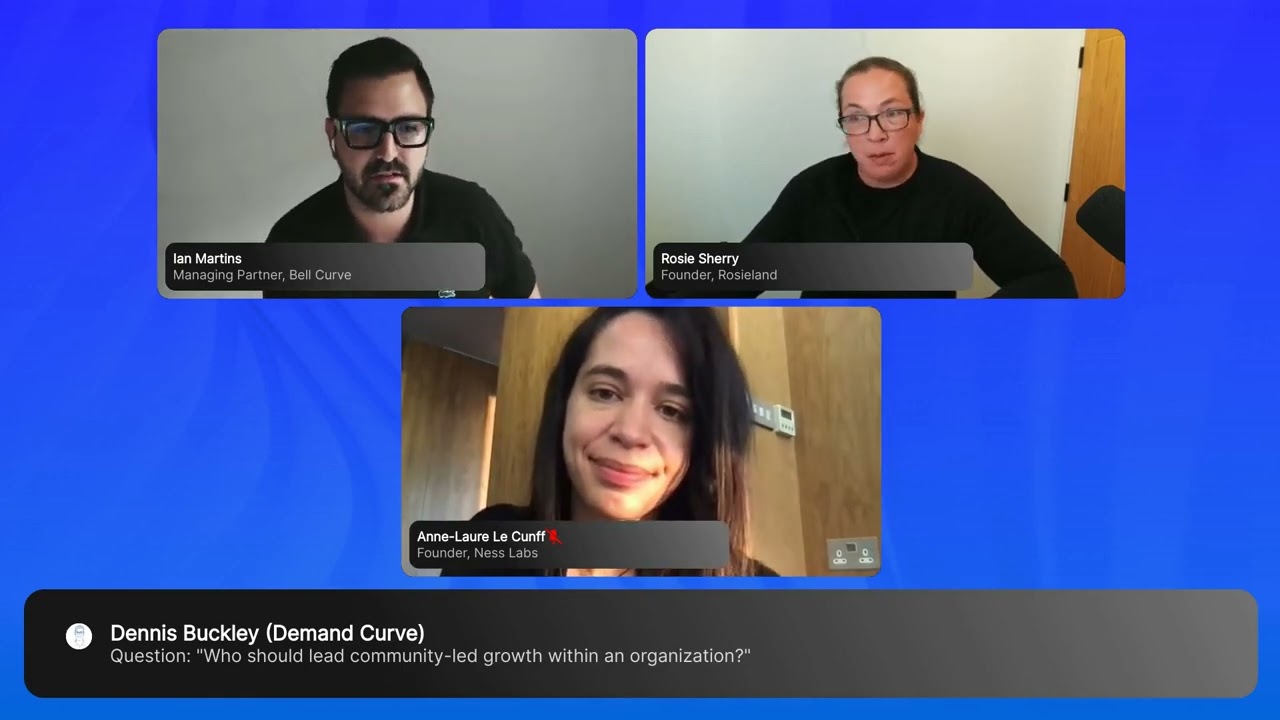
In this YouTube interview, Anne‑Laure Le Cunff (founder of Nest Labs) and Rosie Sherry (founder of Rosieland and former IndieHackers community manager) discuss the concept of community‑led growth and how it differs from traditional audience‑based growth. They define community‑led growth as a many‑to‑many, research‑driven approach where the product and business are shaped by deep listening to community members rather than one‑way broadcasting. The conversation covers who should own community‑led growth (often a cross‑functional role or a community‑focused executive), the importance of authentic, resilient networks, and the need for founders to truly believe in community value. They contrast audiences (one‑directional, speaker‑centric) with communities (collaborative, outcome‑oriented) and share personal stories of moving from newsletter audiences to co‑designing a community. Practical tactics for seeding the first members are explored, emphasizing manual, high‑engagement invitations, co‑design, and leveraging existing engaged newsletter subscribers. They discuss hiring from within the community, fostering long‑term engagement through shared learning outcomes, and avoiding vanity metrics. Moderation strategies are linked to community values, with examples of self‑promotion channels and gated access to reduce spam. Platform selection is guided by desired conversation speed, ownership of data, and exportability, with preferences for slower, thoughtful spaces like Circle or Discourse versus real‑time tools like Slack. Growth tactics are framed as a community flywheel: minimal viable community, opportunistic outreach, multi‑channel promotion (LinkedIn groups, Twitter, email), and leveraging learning cohorts to drive both acquisition and stickiness. Risks of inauthentic, sales‑first communities are highlighted, as are the benefits of supporting existing external communities when building a new one. The interview ends with contact information for both guests.
Chapters
So Anne-Laure Le Cunff is an entrepreneur at Nest Labs and a PhD researcher at Kingsland PPN with a newsletter of almost 50,000 subscribers and a paid community of 2,000 members. She regularly writes about mindful productivity, creativity, and mental health. And Rosie Sherry is the founder of Rosieland, a 3,000+ member community for community builders. Previously, she was the first community manager at IndieHackers, which I'm I'm sure a lot of you are familiar with. Thank you both for taking some time to join us today.
Thanks for having us.
Thank you for having me.
Mm-hmm. So I think to, to kick things off, I'd love to talk about, you know, what is community-led growth from, from your perspective, right? I think it's one of the, probably the newer approaches to, to, to growth, or at least one that's gaining a lot of popularity and a lot of steam and a lot of attention right now. So I'd love to get from each of you what your POV is on what community-led growth is. And maybe we'll start with you, Rosie.
Okay. I think I like to describe things in simplistic ways. And I think community-led growth for me is just like working with your people, but like truly working with your people and listening to them and figuring out their needs. It's almost like Instead of like product discovery, you have community discovery. So you're kind of like wanting to take a deep research-driven approach, but really focusing on your people and not jump into assumptions as to what people need or want. And it's hard. I think it's hard. I don't think anyone's quite figured it out yet, personally, but it's definitely kind of a growing niche or specialism.
And how about you, Anne-Laure?
I'd say that it's, in addition to what Rosie said, it's a more resilient way of growing your business and your company in the sense that if you look at audience-based based growth. It's, it's very much a one-way communication channel where you have this kind of like central node, whether it's the community lead or a marketer, a founder, a thought leader, influencer, whoever is that central node that's basically broadcasting their, their thoughts and their ideas and their products to other people. Whereas with community-led growth, you have a network where instead of being this one-to-many communication, where it's this many-to-many kind of network, which means that even if you remove one of the nodes, you're still going to have value that's being organically generated by just by the fact that you're not just broadcasting, but you're fostering the community where there's this many-to-many communication. So, um, it's, yeah, a resilient approach to growth in my mind.
And in your mind, um, who should be leading community-led growth for, for an organization? You know, like, it's not, um, an obvious role, at least as of yet, right? Is it a community manager that should be kind of stepping into that, that seat? Is Is it somebody from the marketing department? Like, who should be kind of taking ownership of that approach to growth in your mind? And if you want to add to that too, like, what kinds of skill sets do you think that person should have?
I don't know about, like, you know, smaller companies like mine in the sense that it's just the founder doing everything. But I remember that when I was working at Google, I used to do community management there too. And it was incredibly difficult. It was 10 years ago because it was considered a separate role. You were doing community management and that's it. And so someone who was head of marketing was not doing community management. Someone who was doing PR was not doing that. People who were working on product were certainly not touching the community, even though a lot of, you amazing and useful feedback was in there if they had looked. So it was very interesting how community was living in a silo at the time. And I think things have changed for the better. We're not there yet. But if I— when I talk to friends of mine who are still working at bigger companies in roles that entail managing communities, I think there is an understanding now that you cannot have this one person community. It has to be something where everyone contributes and everyone knows what's going on and everyone learns from what the community has to say in order to improve the product and the whole business.
Rose, anything to add to that?
Yeah, I can add to that. Everyone we talk to, especially like in all my kind of Rosaline work, everyone has like a different opinion of where community should sit. And I think, you know, it's at the end of the day, it's like it should sit where you can have most impact to some extent and perhaps not get too carried away with having like a VP or like a chief community officer. It's definitely been a trend in the past couple of years, like more roles coming up for VP of community and chief community officers. There's also a trend of just like community having touch points with all the departments. So it kind of sits on its own, but like with the recognition that community impacts product, it impacts marketing, it impacts product research and sales, it impacts so much and it can provide so much to the company and to the products as a whole. If we're talking like small startups, quite often you can't like have your own community person, but I've kind of started calling myself a community executive officer. So it's like I'm the founder, but I'm the community-minded founder, right? And I kind of had that role in my previous business that I founded. And I kind of think it's important, like, instead of like, if you really want to be community-led, you have to have it, in my opinion, a deep understanding of someone really leading with community and being able to make decisions about community and not being like disregarded. Because when you're disregarded about the work you want to do, it's really hard to make an impact. So having I guess, like, community executive officers. Like, in my previous role, I was the community-minded person. I was making all the decisions, but I made all of the decisions with community in mind. That was always, like, top of mind. And I'm not sure, like, all CEOs at the moment who run community-led companies think like that. They often think, thinking, like, too transactionally or not really giving back to the community. And so yeah, I'd love to see more community executive officers. Pretty cool.
Yeah, I'd love to double-click on that. And, you know, speaking from a founder's perspective in particular, you know, community-led growth is a bit of a hot topic right now, right? And so it would be easy for someone to say, hey, maybe that's our growth channel. You know, maybe we can just go into community-led growth. But to your point, it, you know, you believe that it should be led by somebody who truly understands community, right? And so it's not just kind of like, like paid media, like let's just turn on paid ads. It's not that kind of function, right? There is a certain orientation your whole business needs to have in order to truly take advantage of community-led growth. So how do you think a founder should evaluate whether this might be the right approach for them or not, whether it might be right for their business? What kind of, of What kind of things should they be asking themselves?
I think if it's right, they need to believe in it to start with. They need to believe in the power of community. I think a lot of people don't, and I think that's perhaps the biggest problem. And I think partly to believe, we need more good examples of how community can impact companies as well. And I think that will come in time. There are some examples out there, but not enough. And I kind of hope the next kind of, I guess, 5 years will kind of show us some more examples. I'm hoping some companies can really dive into the power of community because it's special. It can be really special.
What have been some of those reasons believe be? And then I'd love to get your take on this, Anne, as well.
The belief that it could bring change, a belief that community is more powerful than marketing and growth, the belief that just like working with your people, they can give you 10x, 100x more value if you treat them well. Really trying to tap into those kind of things. Like with my previous company, Ministry of Testing, that I founded, is that I'd never had a salesperson. I never had a marketing person. It was all just community-focused. It was slightly scrappy. We were never good at sales pages, but we've made sales. And like a bunch of the sales are now like to really big companies and corporate companies. And it's all bottom-up from the community. It was the community people going to their to their training departments, their HR departments, and asking for budget to come to conferences without a salesperson, without SEO, without proper marketing, so to speak. But we still did a lot of marketing type things. We did a lot of social, we did a lot of emails. And yeah, I guess that's the power is like you can save so much money, right? But it's like I just think we need more examples. Perhaps it goes back to that.
I would add to this that you need to believe it and it needs to be honest because I feel like they are— community-led growth is kind of a hot topic at the moment. And so I feel like because of that, a lot of companies just figure out like, oh, we need to do community. The reality is that, as you said, it's not just like doing paid ads, it's actual people that you have in your community and they're not stupid. So they can tell when you don't really have an interest in really building a community, when you're really just using that to sell a product. So you do need to have value, to be honest about what you're doing here and and for the community to bring something more than just selling them the product. I think it's also completely okay. Like we just talked about why you would want to have a community. It's also completely okay to sometimes, again, being honest and knowing that your product doesn't need a community. Not every product needs a community. There's lots of things that I love and that I buy every day or every month and I don't, need, you know, community. I, you know, I don't need a community for my toothbrush. I don't need a community for even, you know, I love candles. And even if I really love them and there's big affinity to the product, I don't need to join a Slack that is telling me all about the candles and how they're made and talking about it with other customers. So I think those are two very important things is to, yeah, asking yourself, do my product actually, does my product actually need a community? And if it does, what it is exactly that I'm trying to achieve here. Am I really trying to bring more value to my customers, or am I trying to use this as a scrappy way to save money? And in that case, the community members are going to be able to tell, and you're likely to hurt your brand more than help it, I think.
So they ask, there could be some risk in doing it poorly?
Yes. Yeah. And for the wrong reasons.
I could add one more thing to that. Sorry. In the idea that like the candles and the toothbrush, right? You might not want to start your own community around it, but there might be some communities that exist for those things, like people who love candles and I guess love toothbrushes, right? But if you're keen to like invest in community, why not go and support those communities that already exist? And that's a great way to just give back, right? It's like support them unconditionally or, you know, however it is you support them. And that, I think that's what more companies should do, or it might even be like the first step into their community building efforts. It's like, let's get a feel for things, let's build trust with our people, people who like candles and toothbrushes, and see where that goes. Because I guess like in community as well, it's like quite often you don't know where it's going to end up, you don't know how it's going to grow because it's so kind of people-led. It's really hard to like, for me, it's really hard to plan 6 months ahead, even 3 months ahead. I find it's really hard.
Yeah, yeah, no, I think that that's a really great call out in terms of supporting existing communities if you want to be community-led but don't necessarily either have the resources, you know, the time, the knowledge, the expertise to build your own, or the need to build your own, frankly. And it's often I think that is an often overlooked angle to community growth. I'd love to get both of your POVs, because I think that this can sometimes be misunderstood, but the nuance and the differences between growing an audience and growing a community, right? Like, audience versus community. What's an audience and what's a community?
I'll go first. Audience is generally like For me, it's more kind of like one-directional. So typically it's a company or an influencer kind of having power over the conversation. Quite often there's a comparison, it's like the audience is the seats facing forward and the community is like chairs facing inwards. But I kind of think that is true, but it also goes deeper than that. It's about the culture, it's about working with people, it's about collaboration and all of those things. Audiences don't generally do that, but perhaps like the biggest thing for me is community gives back to the people. And I think this is perhaps the hardest thing for companies to realize is like quite often when people build communities, they try to bring in influencers and grow their community and their audience and all these things. But they're not necessarily investing in the people within the community. And I believe in doing that, and in my experience is that people who show up, that's who you should focus on in community, the people who are contributing. And there's loads of ways to kind of support them on their journey.
I'll add to that, going back to what I was mentioning earlier about the resilience of the network. I personally went from audience to community, so I saw that change and I lived through that change myself. And so I had this newsletter and I don't remember how many subscribers I had at the time, but there was very much, as Rosie said, this seats facing the person on stage basically broadcasting content and sending a weekly newsletter. And at the beginning of the pandemic, I started having a lot of people replying back to my newsletter saying that they were feeling very lonely, that they were missing the human connections that they had before, um, and that it was very hard on them. And so that's when I decided to start my community. The reason why I decided to do that is because I felt like as the writer of this newsletter, I was becoming a bottleneck when it came to delivering value to people in my audience. There was no way I could help everyone. There was also no way I had more knowledge than all of the combined knowledge that everyone had in my audience. And so I decided to remove myself from that equation to become a facilitator rather than trying to be the person delivering all of the value. And that was a really good— I didn't know it at the time because as Rosie was saying, it's really hard to plan 6 months in advance. You have no idea what's going to work and what's not going to work out. So I didn't know it at the time, but it was a really good decision because what happened is that people kept complaining, asking questions, saying that they were struggling, but not just to me, to everyone in the community. And so there was always someone, at least one person, who said, oh, you know, I've been through something similar. "Here's what I did, maybe it will work for you." In terms of also helping people grow in the community, instead of just me giving workshops and giving talks, etc., I encouraged everyone in the community to give their own talks, to give their own workshops. A lot of them used the Nest Labs community as the very first time ever they gave a talk. They never did that before because they were not necessarily in a role in their company where they had the opportunity to do this. That was for them a little bit of a springboard. So I think, you know, going from audience to community is really all about that. It's about becoming a facilitator and helping people help each other.
You know, you're touching on something really interesting about, I think, the, you know, pros and just some of the considerations with the product-led— or sorry, community-led approach, which is that you don't necessarily control everything. There is a bit of like, you've kind of created this child and you've sent them out into the world and now they're going to kind of exist and grow and evolve. And you can be there to, to your point, facilitate perhaps and maybe steer it. But there is a degree of evolution that occurs on its own. Do you want to maybe touch on some other examples of that? I don't know if Rosie or Anne-Laure, do you have any examples of kind of communities taking on a life of their own that you've witnessed?
Yes, um, God, uh, Ministry of Testing that I ran, um, we, we did, we did one, one conference, uh, every year. And then I'm not sure if it was the right decision, but we did it anyways. Over the course of a few years, we ended up with like 9 conferences in, in one year. Just because this was literally across the globe and before the pandemic, and it was all community-led. We worked with the community. It was not my plan. And in fact, it kind of led me to kind of stepping back a bit. It's like, well, if this is kind of what the community wants, I'm not sure if— I can't travel that much. It's very hard for me to manage. So I kind of changed my role a bit because of that. Another example is what we ended up with, with 100 meetups across the globe, again pre-pandemic, it was all community-led. It started with me just starting one because we were organizing conferences and I just started a meetup in a location because of the conference and when people started seeing that they were like saying, I want to organize my own meetup, Within the space of 2 or 3 years, we had like 100 meetups happening. The current CEO of Ministry of Testing grew up through Ministry of Testing. He had his first speaking gig there. We collaborated for a bit. And it's just like, you know, it's like, yes, I was looking for someone to take over, But the fact that it's like it all kind of ended up happening kind of naturally. And when I went to hand over the business or like step down from like the CEO role, it was actually a really smooth transition because like, you know, he had already been doing it for 2 or 3 years in different capacities. But like the community knew him, the community trusted him. And it just kind of worked out really well. And to me, it felt right to hand it over for someone else to run who was also committed to the industry that we were serving rather than trying to hire someone externally who already had the CEO experience. He didn't have that, but he just had the love for the community.
Yeah, it was similar for NestLabs in the sense that I, as I said, I launched NestLabs at the beginning of the pandemic, so I don't have any pre-pandemic numbers because it didn't exist at the time. But very similarly, you know, at its height, we had like probably like 3 or 4 online meetups every day, all community-led as well. And we even had a member who suggested training other members to be good hosts basically for those virtual meetups. Because it is an art actually to host those meetups, to keep it engaging and fun and to make sure that everyone feels safe to participate and to share. All of this was the same, led by community members. All of the community managers that we had for the community also came from the community. I never posted a job advert. For that. And I always have people applying, uh, just saying, hey, I love the community and I'd love to, to help in a more official manner. Which, as Rosie said, I think is one of the best things that you can do, to recruit someone on your team that's already been a community member, an active community member for, for a while, and to just, you know, give them more support to so they can keep on doing this. It's a lot better than— I did have a very quick stint at trying hiring someone who was not in the community, and that lasted for a couple of weeks. So I would not recommend it. I think if you can, if your community already exists and has members who are very active, it's really good if you can hire someone from the community itself.
So let's say that you've established that you want to go in a community-led direction with your business. What have you found to be some of the most effective ways to get that first group of people on board and to get them really engaged in your community? Right. I feel like that 0 to 1 or 0 to 10 hurdle can seem like a huge mountain as you're going into this. Maybe talk to me about some of your experiences at that stage.
I can, I can go first on, on this one. Yeah, I think when you're, when you're getting started, this is actually the most important thing. Who are going to be the first members in your community? There's lots of other things that you need to work on afterwards, but at the beginning, this is the only thing that you should care about. Because everything else, the values that you're going to have, the tone, how welcome people feel when they join, all of that is going to be derived from the very first few members that you're going to have in your community. It's not as simple as you writing down a code of conduct and then inviting random people into it and then hoping for the best to happen. So I think it's incredibly important. And in my case, what I did is that I manually invited one by one, the first few hundred people, like the first 300 people, I think, in the community.
300, wow.
Yes, I, what I did is that I went into my newsletter and I filtered members by engagement. So you can see who opens every single newsletter, who clicks on the links, who replies to the newsletters. And I exported that as a CSV file and I messaged every single person. And for the ones who I actually had talked to, over the past year, the ones that had replied to my newsletter already. I also, you know, mentioned something that we talked about. It was a very, as much as I could, a very personal invitation. And for the first few members, I made it very clear that the idea was to co-design the community together. So I told them that this is the idea in general, but at this stage, I really would love to have your feedback and for you to tell me what you think, what works, what doesn't, what would make this a great experience for you. And I think it's been absolutely essential in the success of the community, the fact that the first few members were the, you know, already very engaged in terms of mission, in terms of values, in terms of the kind of content that they wanted to have. But also they were very invested because it was also their baby. They helped me design it from the get-go, and I knew that moving forward, whatever challenges that I would face, I would have this kind of, you know, advisory board almost where I could turn to and tell them, look, I'm struggling with this, or, you know, I'm struggling with engagement, or I started those new kind of events but nobody's showing up. What do you think? What is wrong? What would you change, etc.? So, so yeah, it may be a little bit extreme for the first 300 members, maybe not that many, but I do think that the very first ones you do need to choose very carefully and invite manually, and if possible, make them co-designers of the community rather than just community members.
Rosie, anything you want to add there?
Yeah, well, one of the things I was going to say is like, it's okay to build an audience first and then build a community, which is exactly what Anne-Laure has done, right? So that, you know, there is still a value in building an audience before you build a community. And you can use that audience to your advantage. You can use that audience to organize events, have one-to-one conversations. You know, it's a way to kind of do a bit of like community discovery, to do your research, so to speak. One other thing I'd add on to there is perhaps like really understanding your market is like, where do you fit into the scheme of things? Where do you fit within the ecosystem? Why would people even want to join your community? Is there already one out there? How is it different? Do you have trust built up? Have you built an audience which has therefore built up trust in who you are or who your brand is? And those kind of things will help kind of form your vision, your goals, whatever you want to call it, you know, whatever you want to like, whatever you want that community to be. And it can kind of just like help you communicate better to your community members about what it is you're trying to build. But definitely having a really good understanding of the ecosystem when you're trying to build. With Ministry of Testing, I had a really clear goal in the fact that I was kind of frustrated with the software testing world at the time, where it was all very corporate-y stuff going on, very corporate events, very expensive events, very like you're supposed to go in suits to them. There was like a couple of online forums and they were just terrible. My whole goal became to be the opposite of that. I could see that there was a need for something different, and that stood with the community even today. It's like, we want to be different, we want to be ethical, we don't want to be that, so we want to be the opposite. Anytime the team's thinking of, well, what are we going to do next? How are we going to do it? It's like that's always at the forefront of of their minds is like, this is who, this is who we are, or this is who we want to be, and this is what we want to do for the community.
Um, it seems that you both touched on, you know, having an audience and then building a, a community, you know, from that audience, or at least some initial seed members, seems to be a fairly good strategy to have in place. Um, that means content tends to be a great way to to build audiences, right? Producing content. And so it seems that there's a direct relationship between content, content marketing and creating content and building a community and doing community-led growth. I'm wondering if you can maybe talk about that relationship and specifically if there's any nuance or thing you should be thinking about in your content creation if your aim is to build a community.
I can, I can go first. I would say that you just need to make sure that your content is as aligned as possible with the kind of conversations that you want to foster in your community. And at the beginning, you're going to be doing that on your own or just internally, but just with your internal team. But moving forward, what I found is that it's also really nice once you have the community to start informing the content strategy based on what the community finds the most interesting, based on their questions. You know, I've seen a lot of people with quite a bit of success on marketing teams turn Q&A sections in their forums into content for their blog that's doing really, really well. Because who needs, you know, SEO kind of like software thing when you know the questions that people are asking? You just look in your community and you You know, every single week there's a person asking the exact same question. So why not create an article that is answering this? So I think what's really interesting when you think about the synergy that you have in between your content marketing and your community is that it becomes this virtuous cycle where your content is helping your community and then the conversations that the community has about the content or sometimes the lack of content because they can't find the answer to their question is informing your content strategy.
Yeah, I totally agree with that. I take, I think, a very similar approach. Listen to your people, right? But like properly listen. And if you listen to them and have conversations with them and all those kind of things, you can't help but know what they care about or what they don't like or what they do like and what their frustrations are. And the more you dive into that, it becomes obvious what you should talk about. And I get the comment quite often, it's like, Rosie, it's like you can read my mind. And I think that's a great quote in the fact that I can't really read your mind, but it's just that I've been listening and I've been asking questions and I've not been trying to have the answers. I put questions out like on Twitter literally like every day, and those educate me about what people think about community. And so I do the questions partly for myself, but I also do it for people sometimes. Like the The biggest way people learn is not necessarily from a really good article or a really good podcast. Sometimes they just need to hear the question that they should have been asking themselves. And just by seeing that question, they're like, oh yes, I should be thinking about this. But then they can go and see what everyone else is talking about that and come up with their own kind of solutions to it. So, but yeah, it's like, listen to your people. It sounds really obvious, right? But it's like, when people exist everywhere, when your community's on social, when it's on perhaps a Slack or a forum or YouTube, you know, there's so many places that your community exists. It's definitely worth kind of creating a strategy of taking down notes of all those things. And it's hard, it's hard to keep up.
Yeah, that's a good— those are great points. There's a couple questions here I'm seeing, and I'm curious about myself too when it comes to community growth. So I imagine, you know, as the community is a bit smaller and you can, you know, invite 300 people manually and have these relationships, you know, that are a little bit more organic, and maybe these folks are a little more committed to the cause because they're co-designing this community with you, you have some fairly high engagement particularly early on, you know, people are excited about this and they're working on it. I'm not sure how common this is, but I imagine it could get to a point perhaps where that excitement or that energy slows or dies down, or the relationships— the community grows so big that the relationships feel a lot further away than when the community was smaller and more tight-knit, right? How do you foster engagement and maybe stoke that energy to facilitate it? What are some tactics that you use to keep that momentum and that energy high?
I'm personally a massive fan of learning communities. I feel like communities where people are gathered around a common outcome work a lot better than communities that are gathered around a common topic. If there's a shared outcome, then people do have a reason to keep on showing up. And obviously it works a lot better if this outcome is the kind of outcome that you're going to reach a lot faster and in an easier manner if you do it with other people. So there are probably other ways to figure out what's a shared outcome that you can have for your community, but in my case, learning something together has been really, really good in terms of maintaining engagement because that means that You know, you can, you can have events where you're like, let's learn about this thing together. You can have meetups where it's like, let's discuss this topic together. But again, with the goal of learning. It also means that people are going to naturally seek support and connect with each other to help each other learn together. It means that people are going to come back to the community to find inspiration, to find mentors, maybe to learn from people who are a little bit further along the way in their learning journey. So if there's some sort of personal growth embedded in the value that you're providing in the community, this is a really good organic way to maintain engagement over the long term.
Yeah, I would add to not be worried kind of about the vanity metrics of things. It's like kind of be, you know, don't worry like if there's like a dip in conversations happening or, you know, don't worry about the comments that are appearing. And it's almost like better to be focused on helping people as something to measure or a goal to have. And really what that comes down to is like figuring out how you can help people. So, if we go back to, like, Ministry of Testing, which is like an industry, it's a community of practice, they're all testers pretty much, right? Or they all work in tech and they all want to advance in their careers. So, like, the best way to engage them is to figure out how to help them advance in their careers. That might be a job board. It might be training, which we did. It's conferences, which we did. It's also like finding new talent and getting more speakers on board and helping people level up their game from that aspect. So it's not necessarily all about kind of showing up in the forum and worrying about those kind of vanity metrics. Maybe it's more about, are people growing or are we kind of like generating new ideas for our industry or are we just talking about the same thing over and over again. And to me, that's what gets me excited. And it overlaps a lot with the learning aspect, right? But it's, you know, focus on the people rather than the— the people and the outcomes, I would say, rather than the day-to-day activity.
Moderating. And trolls, that's, that's, uh, one of the questions that was— I had, um, because I'm very curious how you both think about this and deal with it. And, um, you know, the— you know, that you can push your— all the guidelines out that you want, but, you know, at some point there, there might be some moderation— moderating required. And so I'm curious as to how you both approach that, that side of a community.
All right, uh, yeah, interesting. So I've had like my experience at IndieHackers and my experience at Ministry of Testing was very different. So like IndieHackers had a lot of, um, actual spam. They, they got spammed a whole bunch because it's like an open, open platform and anyone could sign up that they just seem to get hammered. But I think moderating, to be honest, comes down to your values. It's like you have to know kind of like what community you want and be willing to stick to those values, right? So if a conversation is happening and it's out of place, you have to be willing to, you know, actually delete it or contact the person and say, actually, this is not allowed, we're going to remove it. I think a lot of communities kind of fail from that aspect. And it almost gives community a bad name because people join communities and there's no actual value because people come in to, you know, post about their latest blog post or their latest product. And it just totally kills the community vibe, right? Who, you know, no one really wants that. And I think Lenny's newsletter, he does it quite well in his Slack. He moderates it quite well. And with Rosieland, I have a policy, it's like you can't share your own things. These are the rules unless it's part of a conversation. But if you're going to come in here and just drop a link to your own thing, I'm going to remove it because I know it's not what people want. And the other communities out there, they all have that and no one actually wants it. And it doesn't actually provide any value to people. But yeah, like Ministry of Testing, we rarely had to moderate stuff. I mean, occasionally, you know, there were a couple of big long-timers that, like, you know, got really difficult. I think that's probably what I struggle with the most is, like, Sometimes you get these, I don't know, white tech bros who feel very above their authority. They feel like they can run the whole show. And it's hard to come down on that, or it's hard to balance when conversations are getting out of place. But I had to pull the line at times because the community members were just getting so fed up of some people just coming in all the time and overtaking the conversations every single time. So, you know, is that spam? Is that, you know, it's really hard to deal with those, um, those situations that aren't spam but they are impacting the community vibe. I hate it. I absolutely hate it.
I remember I had a kid in one of my classes in college that just like tried to dominate every conversation and becomes exhausting for everybody, right? So yeah, it's like, it's not really spam because they're engaging, but it really killed the vibe for everybody for sure.
It does help to have some form of control over who joins the community. I think a lot of problems arise when anyone can join. So for some companies, it's very easy because it's only customers. You can join, for example. And so there is something about, which is kind of sad that you need this, but somehow taking your credit card out that makes you kind of like a patron of the community and you're like, I'm paying for this service. And so I want the place to look nice. So I'm probably going to be a little bit more careful about what I say, even though you obviously always have the 0.1% of people who are going to feel entitled because they paid for the product. But in my case, Nest Labs is a paid private community. And there's definitely this feeling that because everyone has decided to pay to join this community, it's everyone's house. And so everyone cares a lot about making sure that this is a nice place to hang out. So I also had very little moderation to do and we never had any trolls. And my strategy as an alternative to the one Rosie has of saying you can't post that in the community is that we have a specific section for self-promotion. And so it's not you can't, it's you, if you want to, if you really need to, it's there. It's just, it's that you have to go there and you can share it there. And we do have a bit of engagement in that section because people give feedback. Uh, we also really encourage people to not just drop the link. They can drop a link to a landing page to their product, but ask specific questions. I ask people to critique it, say that, you know, maybe they're struggling with low conversion rates, and so they want to understand what's wrong, etc. So we're really encouraging people to do that, and we tell them that you cannot post these kind of things elsewhere in the community. So for us, it's been working really well rather than telling them not to post it, to say that's the corner of the community where you can do it. I think both can work, can work really well. So yeah, I would say, yeah, tell people what they can and cannot do and be very, very, very clear about that. And it does help a lot if you have some sort of control over who is joining your community.
Correct. I wanna switch gears a little bit and talk about community growth. So not just about how that community's gonna help you grow whatever business it is that you might have, but how do you actually grow the community itself? You know, what are some tactics that, that you've seen that have helped you grow, right? Like, you know, of course there's organic growth and perhaps There can be some virality built into that, but I'd love to know what you've seen work effectively, maybe what channels, paid media, that work in actually growing the size of the community.
I'll go first. I generally think about growth kind of in a kind of community flywheel perspective. And that kind of ties into what I call minimal viable community, which is just start small and see if something works. And as you're kind of maybe starting in the tiniest ways that you're having a conversation with someone, always be looking for opportunities for growth as you're talking to people. So if you're talking to someone, you could say, 'Oh, we could do something together.' 'Oh, you should write something about that.' 'Oh, we should do a podcast on that.' And I think just by naturally looking for opportunities all around you, at least for me, it's kind of hard not to see opportunities to grow. But on top of that, I've always used the kind of multi-channel angle to grow community as well. And perhaps that ties into the building the audience kind of aspect, but LinkedIn groups, for example, was a really big growth driver for Ministry of Testing in the early days, as still is today. They've got thousands, 40, 50, 60,000 in their LinkedIn group, but that brought in a lot of members. It really raised awareness in the early days. And later when LinkedIn launched Pages, I kind of jumped on it in the early days and it just kind of grew from there. And again, it has loads of engagement through, through questions, um, mostly, but it's got like 60,000, 70,000 people there as well. Um, and we've done Twitter as well. And so it's like, you know, it's like, but we have our own, they have their own website or platform. So it's all about kind of, yes, we'll go to other places and have conversations where people are. We're not always trying to pull them back to our community, but we're kind of like ensuring people know that we exist and engaging with them, having conversations with them. And that feeds into like our strategy of trying to figure out, well, what do we do next? Or what are people talking about? Or what do people care about?
And I personally see it as, you know, and it's like anyone who's worked on growing a product will recognize it, it's very basic, but just a classic funnel, except that I'm looking at the level of engagement that people want to put in, basically. And so, you know, it starts with Twitter, uh, most of the, the growth that we have nowadays either from SEO or from Twitter. And so you have people, they just want to lurk basically. So they'll read a tweet, they'll read an article and that's it. And they're happy. And that's great. We've delivered value. Some of them, they really liked what they saw either on Twitter or on the website and they want more. They want regular content. So they sign up to the newsletter. And in each edition of the newsletter, we promote the community. We say, this is what's going on in the community this week. We have these learning opportunities, we have this online course in the community, we have this coworking session with everyone in the community. This is what's happening. And if you want to join, if you want more, if you want to engage with fellow community members rather than being in this kind of like broadcasting relationship where you just receive the newsletter, then you can, you can join the community. And as you can see, again, I know I I never shut up about learning communities, but it's because I'm a big fan of them and I do think that they work. It is an amazing way of growing a community as well. Every time we launch a new course that's hosted in the community, we see a massive influx of new members. And because they go through this learning experience together, they actually connect with each other. They know each other. It creates a stickiness. That is a lot stronger than if people were just randomly joining whenever they needed to get a question answered. So it almost creates little cohorts of people joining at the same time and who are at the same stage in terms of engagement in the community and who know each other, recognize each other, and help each other. So it's really helped both in terms of growth, but also in terms of kind of like nurturing the community over the long term.
Great. I really love the effort-based funnel. I think that that's a really great way to think through things. I think that's a wonderful, wonderful takeaway from this. LinkedIn, I know LinkedIn is an incredibly powerful tactic or channel rather that sometimes gets because it can get a bad name recently in the paid media world. It can sometimes feel like that doesn't work. But from a community standpoint, I can see that as being an incredibly valuable channel to play on. I've seen some questions in the polls and what have you around, or the chat rather, around platforms, right? Where should you build your community, right? Should you Slack, Discord, LinkedIn groups, like what's, what's a good place to put a community and maybe what might, what should you be thinking about when choosing one of these platforms?
I have two main thoughts on this. The first one, again, it's kind of linked to the kind of level of engagement that you want, but how do you want people to engage? How fast do you want the conversations to be? How real-time do you want that to be? To be, and that's going to have a massive impact in terms of platform. So for example, I hate Slack. I hate it because I have massive FOMO every time it's not open. I feel like there's so much going on that I'm missing things that it's like, you know, and I know it's supposed to be a water cooler. That's what people tell you, dip in, dip out. But I'm just, when I'm interested in something, I get obsessed. And so if I can't read everything, I feel like I'm missing the important information. So Slack is stressful for me. And because my, you know, all of the content that I create, my newsletter, the website, etc., is about mindful productivity and mental health at work, it made sense for me to go for a platform that is more, that is slower and more thoughtful in terms of the conversation. So, you know, you can reply to a message that was posted 3 days ago. That's completely fine. You can take your time, you can write a very long message, and then it becomes a repository that people can go back to read conversations that have happened maybe 2 months ago, but they are still very valuable. So in my case, that's why I chose Circle, but there are also lots of other options that are forums like this, they're a little bit slower, more long form. And then the second thing that I would take into account is, are you actually owning your community or not? And this is the same thing as with social media where you're renting versus your newsletter where you're actually owning the list. So the— it's a very easy way to check that. Are you renting or owning your audience or your community? Is how easy would it be or how hard would it be to export that community and move it to another platform? And you'll see that if you're, for example, building your community on Facebook, it can be a nightmare to export that community elsewhere. And people have done it, but you need to reinvite people, they need to sign up again, etc. Whereas there are other platforms where it's as easy as exporting it, importing it into another platform, and you do own that list and those members. So those would be the two things. And I'm not saying that it means that you shouldn't do Facebook. It's just that those are the things that I think you should consider and you shouldn't make that decision blindly.
Yeah, I agree. I'm a fan of forums. I don't think enough people spend time kind of investing into forums. I kind of feel like they're coming back, or I'm trying to help to make them come back a bit. I use Discourse. It's got great wiki-like features and moderation, and it's you know, generally kind of like a platform that's been around a long time. They've recently released chat as well on it. So it's in beta, but you can have like a forum and a chat within it. We'll see how that goes. Yeah, I still like Slack. I actually, for Roliland, I have a Slack and a forum, and the Slack is just quick-firing conversations. You know, it is a water cooler. We drop audio notes to each other. That's something that we started recently, which adds like a cool, interesting vibe to what we're doing. But I always go back to like, I think a lot of people, like when they think of community, they naturally jump to forums and chat kind of setups. But I don't think that's what community tools necessarily are. It's only part of your community effort, right? And my current vibe is that community platforms focus too much on the conversations, and it does get overwhelming, especially like after the pandemic. Everyone's a bit overwhelmed. And like, I look at email and I think that's a community tool. It's like, sure, it's an email tool, but you can use it to your advantage to build community. You know, every time I send an email out about an event, people sign up. If you post that same event in your community, people won't see it, right? So, you know, it's really, to me, it really is about choosing the best tool to get the job done, not necessarily about having a place to converse. Because yes, communities converse, but also, like we touched upon before, communities need outcomes. They need people want to achieve certain things. So it's, you know, quite often it's, you know, a big messy solution to bring that all together, which is why I also think there's lots, still lots of room for innovation for community to help members kind of thrive in these spaces.
Perfect. Well, we're getting real close to the end of our session. I want to thank you both for sharing all of your wisdom with us here and with the audience today. Rosie, where can folks find you online? And I mean, here's your plug away, all the places people can check you out.
Yeah, I'm @RosieSherry on Twitter, or rosie.land is kind of where I write and create and have community around community.
Wonderful. And Anne-Laure, where can people find you as well?
I created my Twitter handle when I was a teenager, so I'll just not share it. You can find it online, but if you want to stay in touch with me, the best way is to go to newsletter.nestlabs.com. You can sign up here, and I send a newsletter every week.
Perfect. Well, thank you everyone for tuning in. I hope you enjoyed this session. Next up, we have How to Visualize Value with with Jack Butcher, and I'm sure you all enjoy that session as well. So yeah, thank you everyone for all your time today. Really appreciate it.
Thank you.
More from Anne-Laure

How to Use Curiosity & Experimentation to Flourish, with Dr. Anne-Laure Le Cunff

Stop chasing goals and start running tiny experiments with Anne-Laure Le Cunff

Why You’re Still Waiting To Figure It All Out | Anne-Laure Le Cunff | EP. 391


Tiny Experiments: How to Learn, Grow, and Navigate Uncertainty — Anne-Laure Le Cunff



Stop Setting Goals. Try This Instead | Tiny Experiments with Anne-Laure Le Cunff


