FranklinCovey On Leadership with Scott Miller: #446 Anne-Laure Le Cunff
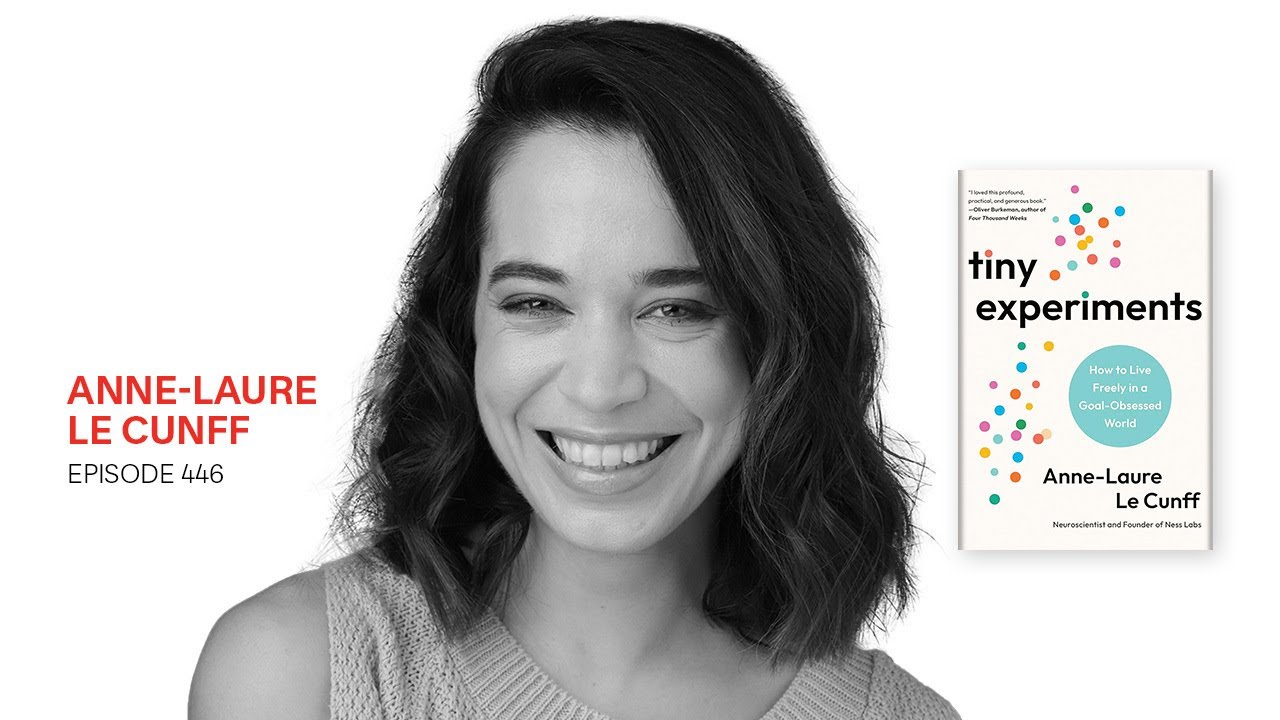
In this episode of Franklin Covey’s "On Leadership" podcast, host Scott Miller interviews neuroscientist and author Anne‑Laure Le Cunff about her new book Tiny Experiments: How to Live Freely in a Goal‑Obsessed World. The conversation traces Anne‑Laure’s personal shift from a linear, purpose‑driven career to an experimental mindset that embraces uncertainty. She explains the book’s opening chapter, “Escaping the Tyranny of Purpose,” using the story of Ron Finley, the Guerrilla Gardener, to illustrate how clinging to a fixed purpose can blind us to emergent opportunities. The interview then moves to the concept of intentional imperfection—balancing high standards with purposeful trade‑offs—and to a two‑step “dance with disruption” framework that first labels emotions (affective labeling) and then addresses objective consequences. Anne‑Laure shares the Chinese horse parable to model equanimity toward unpredictable outcomes. She introduces the notion of social flow and its three effects—pooling, ripple, and safety—showing how collective focus amplifies learning, impact, and psychological safety. Throughout, she offers concrete tiny experiments (e.g., weekly cold‑email outreach, tweaking routine meeting formats) that listeners can try to build adaptive habits, especially in today’s volatile economic climate. The dialogue blends personal anecdotes, neuroscience research (self‑complexity), and practical leadership advice, concluding with a call to experiment publicly and iteratively.
Chapters
Hello and welcome back to Franklin Covey's twice-weekly podcast, On Leadership with Scott Miller. Gosh, close to 7 years of phenomenal interviews, 475 conversations with some of the most influential thought leaders in the world. They come known as CEOs and founders and entrepreneurs and intrapreneurs, physicians, scientists, researchers, people that may or may not have some celebrity or household name recognition. They're all dedicated to the same thing, which is to help you become a better leader, to be more disciplined, to be more fulfilled, to actually create better habits. Franklin Covey, of course, known as the world's most trusted leadership firm, founded in part by the iconic author, Dr. Stephen R. Covey, who wrote the book amongst many titled The 7 Habits of Highly Effective People. Each week, twice weekly on audio and video, I try as the host to tease out some insights from our guests in the hopes to make you more fulfilled and a better leader, whatever that means in your life. Our guest today is Anne-Laure Le Cunff. She is a neuroscientist. She is a well-educated researcher. And author of the newly released book, Tiny Experiments: How to Live Freely in a Goal-Obsessed World. You're welcome, even before the interview starts. What a great title for today's topic. Anne-Laure, welcome to On Leadership.
Thank you so much for having me. I'm very excited to be here with you today.
Well, you live and travel around the world. You have worked and researched from many different continents, and today you're joining us from Austin, Texas, which is currently where you are residing. Looking forward to diving into some of the maybe counterintuitive aspects of your research and your books. You are a well-known researcher and neuroscientist. I believe you are right now— is it true— finishing your PhD, or have you already completed that?
I finished my PhD last year, and I finished writing the book a few months ago, and I'm very much focused now on getting those ideas into the world.
Well, Doctor, welcome to the house. We're delighted that you're here. I know I have some sense what that takes and I'm in awe of your discipline and I'm sure you are delighted as are your family for your success. So let's rewind a couple of years 'cause people aren't gonna be able to exactly pinpoint your accent because you've had a broad life around the world. Give us a little bit of backstory, who you are, what you've been doing, where you've been living and why this particular topic became such a passion for you.
Yeah, absolutely. I am half French, half Algerian. I grew up in Paris and I think about my life and my work into two very different chapters. The first one was very linear, very focused on trying to feel like I had it all figured out. So I wanted to have a clear plan, a clear vision, and then clear steps to get there. And the second part of my life, which is the part that has inspired this work and this book, is all about having a more experimental approach, really embracing the idea of uncertainty, as something you can learn from rather than something to be scared of. And that's been basically my life in the past few years, studying the neuroscience of adaptability, curiosity, and uncertainty, and learning how to make the most of it.
So I detect some French. Give us a sense for what your travels and your nationality has been.
Yeah, so I grew up in Paris, and then I worked at Google in San Francisco for a few years. I am currently based in London, and we're currently doing this interview while I'm in Austin, so I'm traveling through the US and trying to meet as many people as possible.
Well, we're delighted that you landed with us for some time today. The book is titled Tiny Experiments. I mean, really, it's kind of a— it's a manual for how to consider ways in which to live your life and to maybe even challenge some conventional wisdom, right? Some assumptions that all of us thought were the right path for us. One of your opening chapters is titled Escaping the Tyranny of Purpose. Like, there's a screech on that one because so much time and energy in books are about finding your purpose and discovering it, uncovering it, naming it, leaning into it, connecting it to your activities, when in fact you have a little bit of a counter-type to that prototype, if you will, including a great story about a guy named Ron. Ron Finley. Slow down and take your time to discuss what does it mean to escape the tyranny of purpose, and maybe tell the story about Ron Finley.
Yes, so purpose is something that we are all searching for, and in fact, it has become something we're increasingly searching for. In my book, I share this staggering statistic which shows that the number of mentions for the phrase Finding your purpose has increased by 700% in the past two decades only. So there is really this obsession with finding your purpose. And for the book, I interviewed Ron Finley, who you might have heard about as the Guerrilla Gardener. He did a really big TED Talk where he was sharing his experience trying to grow vegetables on his sidewalk when he realized that it was really hard for him to try and access any kind of supermarket and fresh produce in his neighborhood. So instead of staying in that situation where he would just eat junk food because that's what was available, he decided to start growing his own vegetables in the only spot that was free around his house, which was the sidewalk, and to invite everybody else in his neighborhood to actually take and use some of that produce. He was attacked by the local council legally because you're not supposed to do that. The sidewalk is not a place where you're supposed to grow vegetables. And the fact that the local council was more interested in preventing someone from growing their own vegetables rather than investing in having local supermarkets with fresh produce made him reconsider his current career. At the time, Ron was not a gardener. He was working in fashion and the gardening was just something he wanted to do on the side. But what happened here made him change his career and really focus on spreading that message that anyone should be allowed to grow their own produce and to have access to fresh produce around their house. The reason why I shared this story in the book is because if Ron had been overly focused on having a linear career and being successful in his current path, where he did have a sense of purpose, he loved fashion, he might have ignored that other path, that other avenue for exploration and for impact that happened in a more emergent way in his life.
In fact, he was a very successful fashion designer. He wasn't just, you know, selling clothes on Etsy. I mean, he had his clothes produced in many fashion stores or department stores, if you will, and made a major pivot. What do you want the learning to be from that for all the people that are listening and watching today that are thinking, oh, isn't that lovely? A successful fashion designer from LA decided to use the space between his sidewalk and the curb that was actually city property to build vegetables. That's lovely. Great for him. What do you want people to internalize that about their own life right now?
I want to encourage people to experiment more with their path, with their creative projects, with their relationships, with their leadership, with their communication. What I want them to start thinking about is that even if things seem like they're working for you at the moment, it doesn't mean that you have to keep on sticking to what works. Life is long. There are lots of possibilities, and we can, we can become something that we haven't even imagined in the first place. But that only happens if we make space for experimentation.
I'm just internalizing that because I know a lot of people that right now with a sort of unstable economy are either sticking with their job because they're kind of, you know, back to being trapped, if you will. Trapped not always in a bad way, but secured. And others, I have 3 friends that have lost their jobs in the last week. 3 very professional people that, you know, for whatever it was, some of the changes happening in Washington about defunding projects. I mean, there's gonna be millions of people that lose their jobs in the coming months because of a change in administration and a reprioritization of that leader's funding. What would you say are some mindsets or some calming techniques that people could start experimenting when that seems very scary to a lot of people right now?
I think the changing your mindset and having an experimental mindset also means understanding that even though it sounds paradoxical, injecting experimentation in your daily life and work creates more stability. This is what psychologists called self-complexity. It's really the idea of not putting all of your eggs in the same basket. So even if you decide in your day job to be quite stable and to kind of stick to what works, you can make space for experimentation outside of that in other areas. And that means that when things are going to change, because things keep on changing, the world keeps on changing and evolving, you will have different options that you are— have already started experimenting with. So I think even before the calming techniques and those type of different perspectives, just understanding internalizing this mindset that it is a good thing to experiment and it is going to create more stability. That's number 1. And number 2 is really also not necessarily trying to experiment on your own. A lot of people try to experiment with something and they only share what they've learned once they feel like they have developed a certain level of expertise. And unfortunately, they're missing on lots of opportunities to grow and to connect and to evolve in that process. So I would also encourage people to start learning in public, to start experimenting, and to share their projects with coworkers, with their friends, with people around us, with their family, and say, hey, here's one thing I'm experimenting with at the moment. Here's what I'm hoping to learn, and I will share my journey with you as I go, not when I feel like I'm done and I know everything.
Your English is extraordinary. I wish my Spanish was half as good as your English is, having it not necessarily be your first language. It's a compliment to you. Let's talk about the power of intentional imperfection. I don't know that I resonate with the idea of being a perfectionist. A lot of things I do aren't perfect. I've been accused of being a perfectionist. I mean, I'm like, have you seen a lot of my work? It's not perfect. I have a high standard, but nothing I've ever done has come close to being perfect. I don't even resonate with that term. Educate us on what it means to embrace the power of intentional imperfection?
I really like how you just said, I have high standards, but I am not aiming for perfection because I know that is impossible. And this is really what intentional imperfection is about. It's about accepting the fact that it is impossible to be absolutely perfect across the board all the time. And it's about becoming intentional with that knowledge in mind. So for example, you might say, this week I have this big presentation coming up on Thursday, and that's going to be my main focus. I'm going to direct all of my energy and attention towards making that presentation a success. But that means that I might not be as present as I would like to be as a spouse back at home. And so when I know that, I can tell my partner, hey, I have this thing coming up and I might not be as present as usual. So please bear with me. If I don't notice some of the things that I'm supposed to do, if I'm forgetful, and please do tell me and nudge me if there's anything you need because I'm going to be very focused on that other thing. When you do that, you actually raise your standards across the board because you're being intentional and you communicate better what those standards are going to be in the moment.
That was good marriage advice you just gave there, by the way. That was really good marriage advice. You know, this phrase, "Change is the new normal," has kind of become a cliché in two decades, right? But it's safe to say that disruption is going to be the way of life in America, at least, with this new administration. That's not a political statement. That's just, I think, a fact. Whether people voted for that leader or against that leader, everybody would agree, "Oh, there's a whole lot of disruption." that is happening, not to mention the first few weeks. And I think it's rippling around the world, right? I think all of America's allies and enemies are disrupting themselves to be prepared for what is happening, whether it is the renaming of the Gulf of Mexico or it's an attempt to regain control— I can't say it with a straight face— over the Panama Canal or the purchase of Greenland or whatever sane or insane thing that's going on. There is the elimination of decades-old departments and cabinets and pennies and you name it. And some of it will be good and some of it will be not so good and hopefully we'll all still be here. However, disruption is the new normal, not just change. And you write a lot about learning to dance with disruption, whether it is the tsunami coming with machine learning and AI, which is going to change the professional landscape like we don't even imagine. I know this. A, I'm a podcast host and B, I'm a literary agent and have probably 25 AI manuscripts sitting on my desk with authors wanting me to represent them, some of them hyperbole, some of them doom and gloom, and some of them quite insightful. Educate us on what it means to dance with disruption and maybe try to bring it as close to our real lives as possible. I'm not sure I care if the penny is here or not, but I definitely know that my life is full of disruption. Bring it home.
Absolutely. So I call it dancing with disruption because it is a little dance and it has 2 steps. The first step is to decouple the actual consequences from the subjective experience. So you can deal with the subjective experience of experiencing a disruption. And that very often means some fear, worry, tensing up, anxiety about the future, which might cloud your judgment and make it more difficult to make a rational decision. So before you make any decision about the disruption, You just have to first process the emotion. So that's processing the subjective experience. So let's say, for example, that you have a very important client that might be canceling. You feel like they're getting cold feet and that contract might not happen. You will feel fear. You will start worrying about what is my manager going to think? What does that mean for other clients that were kind of waiting to see a case study from this client? So don't think about that yet. Just process the emotion. And I share a tool in the book that is called affective labeling. And that really just means putting words on the feelings, naming the feelings, taking a few minutes to just say, oh, that's fear, that's anxiety, that is the worry of being judged. Cool, let's name it. There's research showing that just by naming the emotion, you will have processed most of it and you can move past it. Once that's done, you can go to the second step of the dance, which is to actually deal with the objective consequences of the disruption. And this is when you go into thinking rational mode, where you start brainstorming with your team and figuring out how you want to address the challenge that you're facing. And you're going to be a lot more effective doing this if you've done the job first of managing the subjective experience and the underlying emotions that are caused by the disruption.
Anne-Laure, here in the US, you may be aware there's a couple of adages. For example, you know, when one door closes, another door opens. You know, sometimes a disappointment turns into an appointment. We hear this phrase, "Try to find the silver lining," and that may or may not be something that's always good. Sometimes you just need to dwell and own whatever the opposite of a silver lining is, right? You share a great Chinese story in the book. About the horse and the sun. Will you just take your time and slowly retell that story? Because I think it has such relevance in our lives, especially those of us who are not yet aware of, but that a disruption is coming our way.
It's a beautiful Chinese story, Chinese parable. So what happens is that this farmer has a horse and the horse runs away. All of his neighbors come and say, "We're so sorry, you must be so sad." And the farmer says, "Ah, I don't know, maybe." Then the horse comes back the day after with several more wild horses, and all of the neighbors come and say, "You're so lucky, this is amazing." And the farmer says, "Ah, maybe." Then his son decides to take one of the horses, the wild ones, and to go and break the horse and train it, but his son falls and breaks his leg. The neighbors come again and say, "We're so sorry, such misfortune." We're very sorry to hear about your son. And the farmer says, "Ah, maybe." And the day after, the military comes because war has started and asks to enlist his son, but his son has a broken leg, so has to stay on the farm. And again, his neighbors come and say, "That is such great luck." And the farmer says, "Maybe." And what this parable is really teaching us is that We cannot know in advance what a disruption is going to cause and whether any event today is going to have positive or negative consequences over the long term. So it is really about kind of like keeping the sense of equanimity and staying calm and resilient in the face of disruption because you never know what might come out of it.
It is a great story. I mean, I'm tempted to post it on my social media, for all my friends that are trying to determine what's happening. Is it good? Is it bad? You know, maybe. We'll see, right? It helps you also bring a little bit of calm to an otherwise sort of frenetic life in the world right now. Let's end talking about social flow. And specifically, you talk about 3 effects: the pooling effect, the ripple effect, and the safety effect. First, what is social flow? And why does a non-intellectual like me care? And let's talk about the 3 different types of effects. I'll pitch them back to you.
You might have heard about the concept of flow, which is just the idea that we can put ourselves in a mental state where we're highly focused and concentrated on our job, and we can be much more creative when we're in the state where we kind of forget about anything else, right? Only the work matters, and we lose track of time. It's a great feeling for lots of people who want to do some deep work. What's very interesting is that there's research showing now that there's also social flow, and social flow happens when we get into a deeper sense of flow when we're surrounded with other people who are in the same state. And the way you can leverage this is by really taking your team together and instead of trying to solve a problem on your own, getting everyone in the same room and getting everyone to work on the problem, not by brainstorming, but individually, and just knowing that having this effect, this sense of flow collectively, the social flow, is going to make you all at a team level reflect in a better way about the problem.
Okay, now with that foundation, drill into what the pooling effect means.
So the pooling effect is the effect that shows that By pooling resources and information together, we're going to learn faster, better, and more efficiently. Again, that connects to social flow in the sense that instead of trying to figure out all of the information you need to find a solution to a problem, create space for pooling information. And for some people at a very practical level, that can be creating an internal spreadsheet, an internal database, and just saying, hey, let's all copy paste what we found about this. And pool our resources in a way where we can be more effective together.
Next, go to the ripple effect.
The ripple effect is also knowing that some of the actions that you're going to take individually can ripple and then have positive effects around you in your business, in your community. But for that, you need to work in a way where you actually share your work. If you make progress and don't tell anyone what you learn, you're not going to have any ripple effect. So to create a ripple effect in your organization, once you've spent that time working on something, make sure that you also share what you learned with everybody around you.
So I mean, these seem pretty common sense. Did you write about these in Social Flow because your research showed that common practice or common knowledge isn't common practice, that there tends to be a dearth of these in organizations?
Oh yeah, absolutely. And a lot of things that are common sense have actually been backed by research in a way where there's actually strong evidence, but people don't necessarily apply them. So my objective with this chapter where I put them all together is to connect them in a way where even if you don't remember the exact tools and the exact effects, which not everyone might remember, just having this change in mindset where you start thinking a little bit more at the group level when you're trying to get into a state of flow and when you start thinking a little bit more at the collective ripple effects, pulling effects that you might have in the way you work. So thinking about your work in a more collective way.
Leanne, this is talking about the safety effect.
Finally, the safety effect is showing that we tend to be more comfortable taking risks and experimenting if we know that we can count on the group to kind of have our back, having this type of safety net when we experiment. So that's also where you want as a leader to try to create that sense of psychological safety where people know that they can try new things, they can experiment. Again, sharing their journey, letting everybody know, hey, that's the thing I'm experimenting with. And as a leader telling them, cool, you do that. You collect that data, you tell us how it goes, and if it doesn't work out, we got your back.
Let's end riffing a bit on this concept of the nonlinear path. You know, I think it changes in ebbs and flows with generations. You know, I'm old enough, probably twice your age, when I was raised out of college in the workforce, the providing or the prevailing principle was a linear path, right? First you do this and then you do that and here is the path and millions and millions of people had very successful careers with a linear path and still many millions do, right? People's values are different. Some value safety, some value title, some value 401 contribution or equity. Not everybody has the same personal professional values. I do, however, think it's safe to say that in the emerging generation that a nonlinear path is becoming more and more standard, more and more likely than a linear path. Riff on that and we'll end our conversation.
Absolutely. So we used to have, as you mentioned, this very linear path with very clear rules and a step-by-step in terms of what success should look like. And that was the beginning of my career. When I worked at Google, we had a rubric that was telling us, do these things in this order, work on these kinds of projects, and you will get promoted and you will be successful. In today's world, where there is a lot more change and instability and uncertainty, that doesn't really work this way. And the new generation has noticed and is changing the way that they work and they design their careers. So instead of having this very linear approach that is based on a more predictable world, they are starting to experiment more, to have a more experimental approach. And that means that instead of trying to have this 5-year plan where you feel like you know where you're going, where you have this this certainty, this control, you say, okay, what is something I'm curious about? What is something I would like to learn about? What do I want to experiment with? And based on that, designing just the next steps in your career, not the 5, 10-year plan, just the next steps in your career to explore a direction. Because of that, when you look back, it might give you a career path that looks a little bit wiggly, but that's completely okay. It can still be very, very fulfilling to have all of this space for exploration and reinvention.
Anne, obviously you've done a tremendous amount of research on this book. Let's end on an extremely practical note. You've inspired me today, right, to think about maybe— I love that concept, it's like my new mantra— maybe in terms of interpreting and receiving how some outside action may or may not be benefiting us or a horse or our son, perhaps saved from the military. Who knows, the next day maybe the house was gonna catch on fire. I mean, who knows, right, what's gonna happen? I love that story, especially as I tell it to so many friends who are in turmoil right now, emotional, financial, professional. It's such a great story to kind of calm down. If there was a tiny experiment that you would hope all of our listeners and viewers might consider partaking in when they hang up from this podcast, do you hang up from a podcast? When they end listening from this podcast, Give us some examples of some tiny experiments that you've seen people partake in that have changed their paradigm, changed their mindset, maybe even changed their trajectory.
Yeah, I'll give you a couple that I absolutely love from my community. One of them is a person who decided to grow their professional network by experimenting. So they say that every Monday they send one cold email to someone they admire, someone they read a book from, or someone they saw at a conference, and they send that one email. And because of that, they've had amazing opportunities. So, that's one tiny experiment. And another one that you can just do on your own, that's maybe a little bit less scary, is just looking at your calendar and noticing something you've been doing in exactly the same way over the past years. So, maybe you always start your morning with emails, or maybe you have your team meeting exactly in the same spot with the same format. And asking yourself again, maybe, maybe we could do things differently and design an experiment around that and say, for the next month, let's try this differently. Let's just tweak a little bit our parameters and see what happens.
Neuroscientist on the rise, Anne-Laure Le Cunff. Your new book is called Tiny Experiments: How to Live Freely in a Goal-Obsessed World. My favorite chapter was escaping The Tyranny of Purpose, and I'll be telling lots of people the story about the Chinese horses and farmers. Thanks for your time today. Best of success to you.
Thanks for having me.
And we'll see you back here next week for a new conversation on leadership.
More from Anne-Laure

How to Use Curiosity & Experimentation to Flourish, with Dr. Anne-Laure Le Cunff

Stop chasing goals and start running tiny experiments with Anne-Laure Le Cunff

Why You’re Still Waiting To Figure It All Out | Anne-Laure Le Cunff | EP. 391


Tiny Experiments: How to Learn, Grow, and Navigate Uncertainty — Anne-Laure Le Cunff



Stop Setting Goals. Try This Instead | Tiny Experiments with Anne-Laure Le Cunff


