NessLabs CEO Anne-Laure Le Cunff: Hits 1,500 members paying $75k, software next?
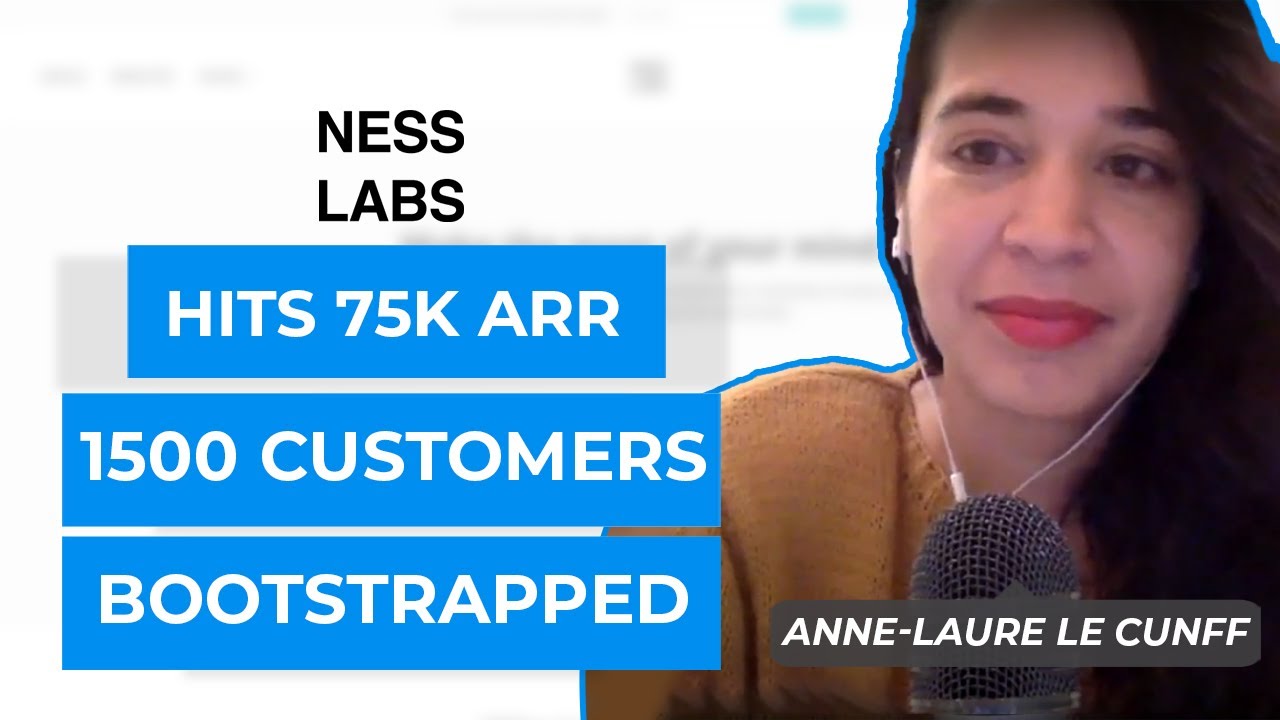
This content was created by Anne-Laure Le Cunff. This content was uploaded by Anne-Laure Le Cunff. This is a YouTube interview (published December 19, 2020) titled "NessLabs CEO Anne-Laure Le Cunff: Hits 1,500 members paying $75k, software next?" — a recorded founder interview / podcast-style conversation hosted by Nathan Latka with Anne-Laure Le Cunff, founder of NessLabs. They discuss NessLabs' business model (content + community membership), tech stack (WordPress, Memberful, Circle, Zapier, Mailchimp), growth and acquisition channels (Twitter, SEO), monetization and metrics (membership priced at $50/year, ~1,500 paid members ≈ $75k ARR, 25k email subscribers, recent course launch generating ~$30k), product strategy, and marketing tactics (working in public, email cadence, SEO approach). The excerpt includes practical details about operations, customer acquisition, revenue breakdown, and Anne-Laure’s background and future plans for educational products and collaborations.
Chapters
Hello everyone, my guest today is Anne-Laure Le Cunff. She's the founder of NessLabs, an online platform offering neuroscience-based content and coaching to thousands of entrepreneurs and knowledge workers. Prior to NessLabs, she led marketing for digital health products at Google. She holds an MSc in Applied Neuroscience from King's College in London. All right, Anne-Laure, you ready to take us to the top?
Absolutely.
Okay, so what is NessLabs? Is it a SaaS company? Is there software behind this, or is it really a pure content sort of membership site play?
Pure content and community. There is no code behind it.
Okay, so the challenge with any membership site is stickiness. How do you make sure you create new content every month that keeps people paying your monthly fee?
I block time every week to write content. I've never missed a newsletter, and I think people stick around because they know that they can count on me to show up every week with new content. And the community helps a lot too, because people form relationships and make new friends, so they keep on coming back to chat together.
And what does the average member pay you month for all this great content you're putting out?
It's very affordable. It's only $50 per year.
5-0?
Yes.
Okay, got it. So call it $4 or $5 per month. That's great. And when did you launch the company?
So the company was launched last summer and the membership was launched in March this year. So this is only when I really started to make money.
Okay, got it. So 2018 is really when you got soft launch and then really got going last year.
2019 is the soft launch.
Okay.
This year is when I launched the paid membership.
And how many folks over the past, call it 4 or 5 months, have you signed up to the paid membership?
So we just turned 1,500 members yesterday, actually.
That's incredible. Nice work.
Thank you.
So 1,500 folks. I mean, can we do the math? 1,500 folks at $50 per year, that's about $75,000 in ARR right now.
Yes, and it's just me, so it's mostly profit.
We love that. What takes the most of your time? I mean, you obviously have to create the content. Where do you spend money? Where are there costs associated with business?
It's mostly using— because the platform is completely no-code, most of the money goes to using SaaS platforms actually that I'm paying for and that are helping me manage everything, especially as a solo founder. It's really good to have, like, you know, I use Memberful, I use Circle for the forums. I try all the time to not do anything manually myself.
Tell me more about that. No-code is hot right now. So walk me through your tech stack. Circle for forums, what else?
Memberful for managing the memberships, any cancellations, renewals, people who want to upgrade or downgrade, that all happens there. I don't need to touch it. The website is on WordPress, which is integrated with Memberful and Circle using Zapier. I think Zapier is probably the glue for everything, and I would not be able to have the platform I have today if I didn't have it. And finally, the newsletter is using Mailchimp.
Okay, Mailchimp. How many zaps do you have set up?
Probably 10 or something.
Oh, okay, not a ton. I was expecting you to say like hundreds. Okay, just 10, that's great.
Yeah, I try to keep it simple because again, solo founder, I don't want it to be too complicated and break.
Yeah, no, I love this. Okay, so membership site, 1,500 customers. How did you get the first 10? That's the hardest.
So the very first few ones were friends that I knew were very interested in the same topics. And then my main acquisition channel so far has been Twitter. I've been very public working there in public, posting articles, sharing my progress. I even share screenshots of my Memberful dashboard with the monthly recurring revenue. And that has also attracted lots of people who kind of want to follow my success and be a part of the community.
How many folks do you think are paying for Nest Labs specifically to just watch how you build a membership site?
I would say 5%.
Okay.
Something like that. I have people who explicitly told me, "I joined the community just because I want to see how you're doing it." Yeah, yeah.
You're not quite sure how to take that, right? You're like, "Okay, well, I want people paying me for my neuroscience-led content, but I also don't mind people paying me if they're just learning from how I'm building a membership site.
Absolutely. In my mind, they're subsidizing my work, so I don't really mind if it's just because they want to see how I'm doing it.
Yep. Now, this is great. I just see you posted on Twitter yesterday, 1,503 active members. You had 9 new orders and 4 new renewals just yesterday. Revenue over the last 30 days was about $33,800. Translating that to MRR, you've grown, call it, 60-70% over just the past 30 days. Obviously, going from $1 to $2 is 100% growth rate. As you get bigger, it's harder to get the growth rate higher, but where are you getting most of your customers now today? Is it still Twitter?
Yes, it is still Twitter, and I am actively growing acquisition from SEO and Google. It's growing really, really fast. At this point, it's still Twitter. That's my main acquisition channel, but in terms of growth, I'm really hoping that in the next few months, search engine traffic is going to overcome Twitter. And the reason why I'm excited about this is because it's more passive. For Twitter, I need to actively post all the time to get traffic, whereas if it comes from search engines, literally people are coming to my website in my sleep.
Okay, one of the top keywords that you rank for, you get 50 organic clicks per month from this keyword. I have— I'm going to read this. I have no idea what this is. Stygian blue, stygian blue. What is that?
Wow, this is one of my most random articles. I don't know how you end up on this. It's basically a type of color that lots of people can't see. So this is an article I wrote about impossible colors, and they are colors that only some people can see, and you can force yourself to see them by looking at two colors consequently very, very quickly. So that's what it is about. I had no idea I was ranking this high for this word.
Yeah, that's— I'm using Ahrefs to look at this, right? I'm looking at some of your top keywords. You also rank really high for the term life lessons. You get about 50 clicks per month from that. Now are these, I guess I'm asking this because I'm curious, are these intentional? Do you look up the keyword you want to rank for and then write for it? Or do you just write it and you happen to start ranking for something you want?
I'm absolutely terrible at choosing topics based on this. The only SEO optimization that I do is inside of WordPress. I write an article first and then I just make sure that I'm not doing any newbie mistakes. So I just make sure the links are all right, the titles are okay, the URL is fine. So it's basic optimization, but so far I have never written an article based on the traffic I would get from it.
Really, really interesting. Now you've managed, according to your popup on the website powered by MailMunch, it looks like you've grown your email list to about 20,000 folks. Is that accurate?
I should update it. I'm at 25,000 now.
That's great. Okay, so, and again, that's all coming really from Twitter.
Mostly, yes.
Wow, okay. So talk to me about your email frequency. You mentioned MailChimp as part of your tech stack. How frequently do you send out emails, and what's the open rate typically?
I send an email every week and the open rate is between 45% and 50%.
That's huge. That's a really big open rate. So tell me the last email you sent out, what was the subject line?
The last one was, I think it was altered states of consciousness where I was looking at psychedelics.
Fascinating. Okay. See, I know nothing about this world, so I can't even ask any scientific questions about it unfortunately. I wish I was more educated, but I can't. So you send that email out to 24,000, 25,000. Call it 10, 11,000 open it. What do you promote in that thing? Do you send them back into your content or what?
I have several sections. The first section is all of the new articles that I've written on the website, which are free. The second section are links from all around the internet, interesting stuff that I found that I haven't created. And the last section links to content that is in the community and the paid membership. And this is also one of my acquisition channels where I tell people, hey, do you like the free content? Well, there's even more. Behind that paywall, so if you want to support the newsletter and be part of the community, you can join the paid membership here.
I mean, you probably know every week when you send that newsletter, you're going to get X amount paid converting to a $50 a year plan. How many do you typically get, like 5, 10, 20 new paid signups per email send?
Yeah, that's about it.
Yeah, so maybe 10 new at $50 each, so every time you send an email, you make $500 basically.
Which is great, yes. And compared to the model that I had before where I was relying on sponsorships, this is so much better. It's way less work and it's way more reliable.
Tell me about that. What was the, the, you know, the sponsor that paid you the most? How big was the sponsor deal?
I think $1,500 was the highest I got, but that was a one-time thing. Most of the time it was $200 or $300. I completely stopped doing them now because I tried to figure out how much money I was making per hour, and that didn't make sense for all of the time I was spending back and forth working on the copy, etc. It makes much more sense for me to just craft really good emails every week and to link to the membership.
That's so smart. And you're building a real asset here, right? That's the main thing. I'm curious what's going through your head. I mean, in my opinion, you know, you know, social capital today is what comes before right, like financial capital. It used to maybe be the other way around. You could raise financial capital to buy attention. You can't do that anymore. So you're doing it, I would argue, like the trendy way, the right way, the higher leverage way. What's next for you? I mean, really, when you build a big audience like what you've built, your only bottleneck is you need more stuff to sell. You gotta create more great product.
Yeah, so I recently launched an online course. The $30,000 I made in the last 30 days are from the course that I launched. And so you're very right that building an audience First is a really good way to go about it because I announced the course, I launched it, it was only available for 2 weeks to buy and I made $30,000 a month, which is half of what I did since March, since I launched the membership. So that was really good. And in terms of plans for the future, I want to keep on building an educational platform. So I want to launch more products for people to teach themselves the content that I write about. I want to make it more interactive and I want to grow the community.
Mm-hmm. I mean, I can imagine all these big B2B SaaS brands or even B2C brands like Calm, for example. They're always looking for somebody like you who can be like their celebrity spokesperson who also brings like a distribution channel with them. Now, the way for you to do that and keep all that work for yourself is to build a neuroscience-based version of Calm with all of your beautiful personality and tactics built in. Which way do you think you're going to end up going?
It's so interesting you're mentioning Calm because I was on their podcast a few months ago and my website crashed actually. They did think the same thing, that I would be a good guest on their podcast. And yeah, I, I see it more as something where we would collaborate together because everything I write about is at the intersection of lots of different areas of research. So I'm not really trying to own a specific space. And I think it's much better both in terms of growing my audience and providing value to people to collaborate with other people who are working in adjacent spaces.
And, and Name some of those adjacent spaces for me.
So there's productivity, there's creativity, there's just mental wellness in general, personal mental wellness, but also wellness in the workplace. These are some of the areas that I talk about a lot.
Anne-Laure, there's a lot of people that want to be famous on Twitter, right? But they just don't understand how to do it. Talk to me back, like your first couple tweets when nobody tweeted it, and then you start getting 1 or 2, and now you get like 100 when you post your Memberful screenshot. What's the secret to Twitter?
To not be shy about what you post and to not always share only the product, the final product of your work. I try to work in public. I think lots of people enjoy following my timeline because I share the work in progress, I share the questions, I share the mistakes, and it's a much more authentic experience and relationship with people on Twitter versus just broadcasting content without ever engaging with people. And without ever having the vulnerability to show the actual process.
Mm-hmm, yeah, this is, I'm just scrolling through your feed right now and it's all sort of like, look at the process of me doing this. Here's my Rome research mobile site, like the improvements, the sketches, like your notes, what books you're reading, all this sort of stuff, your refrigerator.
Yes, I made pickles recently, so I shared a picture of that.
This is so funny, you got 81 likes. This is really interesting. I mean, I know a lot of folks that they don't get Twitter, and when I watch them try and use Twitter, it's because they try and perfect every tweet. They spend like a day trying to write like the perfect tweet, when really stream of consciousness tends to do better.
Yeah, absolutely. And also, if you post a tweet and no one engages with it, that's completely fine. It's probably one of the very few platforms where you don't really get punished by the algorithm for sharing tweets that don't perform that well. So you should feel comfortable just keeping on tweeting. This is also the best way to understand what your audience enjoys in terms of content.
Yeah, I mean, it's fascinating to me when you post, "I don't know who needs to hear this, but you only need to know 20% of the features of Roam to get 80% of the benefits." By far one of your most popular tweets over the past 30 days. No picture, just text. You just wonder why something like that does so well.
Yeah, because I've been sharing so freely and openly that I kind of know what's going to be interesting to people who follow me. If you post once every 2 weeks with something, as you say, that you spend a full day crafting and it doesn't perform, well, first, it doesn't perform. Second, you didn't learn anything. You need to repeat the process more often to know what works and what doesn't.
Mm-hmm. Yeah, I love this. Okay. What else should I know about the business that I haven't asked about?
I used to make most of my money with NestLab through consulting, and this has been a slow process of transitioning away from that to focus more on recurring revenue. And this is a piece of advice I've been telling to people who've been trying to emulate what I've been doing with my website is it takes time. It takes a lot of time to get to a point where you have thousands of email subscribers and thousands of people in your community that are trusting you enough to give you money for being part of this journey. So it's really good to have another source of revenue, whether you keep your full-time job while you're building this on the side, or whether you're able to freelance or do consulting. But I would say that it's very dangerous to believe the success stories of people who say they just woke up and they launched a community and 2 weeks later they had thousands of people in it. So that's the one thing I would say about NestLabs. I'm very, very proud of my success, but it hasn't been an overnight success at all.
Yeah, I mean, it's very much like you could have launched your recent course and then put out screenshots on how you sent one email blast and got $1 million in revenue. But because you've built in public, people have watched you over years hustle and build and build, and they know that you earned the right to send one email and get $30,000 in sales. It wasn't overnight success.
Absolutely.
Anne-Laure Le Cunff, let's wrap up here with the Famous Five. Number 1, what's your favorite business book?
I don't really read business books.
Any book.
Any book. How to Change Your Mind by Michael Pollan.
Number 2, is there a CEO or a leader you're following or studying?
Uh, there's, um, leader, leader, leader. I'm so bad at these questions.
That's okay, you can pass. You can say no.
Okay, can I pass this one?
Yes. Number 3, you can't say Roam Research. What's your favorite online tool for building your community besides one you've already mentioned?
Besides Circle, I can't say Twitter either.
No Twitter, Circle, Memberful, or Roam.
Wow, you're being really tough. Or Zapier. Just email.
Okay, perfect. Number 3, how many hours of sleep, or 4, how many hours of sleep are you getting every night?
Between 5 and 10.
5 and 10, okay, fair enough. And situation, married, single, kids?
With a partner, not married, living together.
I love that. Any kids?
No.
None. Okay. And can I ask how old you are?
30.
30. Last question. Take us back 10 years. What's something you wish you knew when you were 20?
Mm, that I didn't know I didn't need to follow the career path that my mom wanted me to follow and that I could take more risks and things would be all right.
Don't follow mom's career advice. You guys heard it here first from Anne-Laure with Nest Labs. Maybe the perfect example of how to build social proof first, a great community first, launch products on top of it. She went from sponsors to consulting to now membership course. Now she's got over 1,500 paying customers paying $50 per year, about to break $100,000 in terms of true ARR. We're rooting for you, Anne-Laure. Thanks for coming on The Top and taking us to the top.
Thanks so much, Nathan.
One more thing before you go. We have a brand new show every Thursday at 1 PM Central. It's called Shark Tank for SaaS. We call it Deal or Bust. Bust. One founder comes on, 3 hungry buyers. They try and do a deal live and the founder shares backend dashboards, their expenses, their revenue, ARPU, CAC, LTV, you name it, they share it. And the buyers try and make a deal live. It is fun to watch every Thursday, 1:00 PM Central. Additionally, remember these recorded founder interviews go live. We release them here on YouTube every day at 2:00 PM Central. To make sure you don't miss any of that, make sure you click the subscribe button below, here on YouTube, the big red button, and then click the little bell notification to make sure you get notifications when we do go live. I wouldn't want you to miss breaking news in the SaaS world, whether it's an acquisition, a big fundraise, a big sale, a big profitability statement, or something else. I don't want you to miss it. Additionally, if you wanna take this conversation deeper and further, we have by far the largest private Slack community for B2B SaaS founders. You wanna get in there. We've probably talked about your tool if you're running a company, or your firm if you're investing.. You can go in there and quickly search and see what people are saying. Sign up for that at nathanlatka.com/slack. In the meantime, I'm hanging out with you here on YouTube. I'll be in the comments for the next 30 minutes. Feel free to let me know what you thought about this episode, and if you enjoyed it, click the thumbs up. We get a lot of haters that are mad at how aggressive I am on these shows, but I do it so that we can all learn. We have to counter those people. We gotta push 'em away. Click the thumbs up below to counter them and know that I appreciate your guys' support. All right, I'll be in the comments. See ya.
More from Anne-Laure

How to Use Curiosity & Experimentation to Flourish, with Dr. Anne-Laure Le Cunff

Stop chasing goals and start running tiny experiments with Anne-Laure Le Cunff

Why You’re Still Waiting To Figure It All Out | Anne-Laure Le Cunff | EP. 391


Tiny Experiments: How to Learn, Grow, and Navigate Uncertainty — Anne-Laure Le Cunff



Stop Setting Goals. Try This Instead | Tiny Experiments with Anne-Laure Le Cunff


