Redefining Success with Tiny Experiments | Anne-Laure Le Cunff | Thought Echoes Podcast
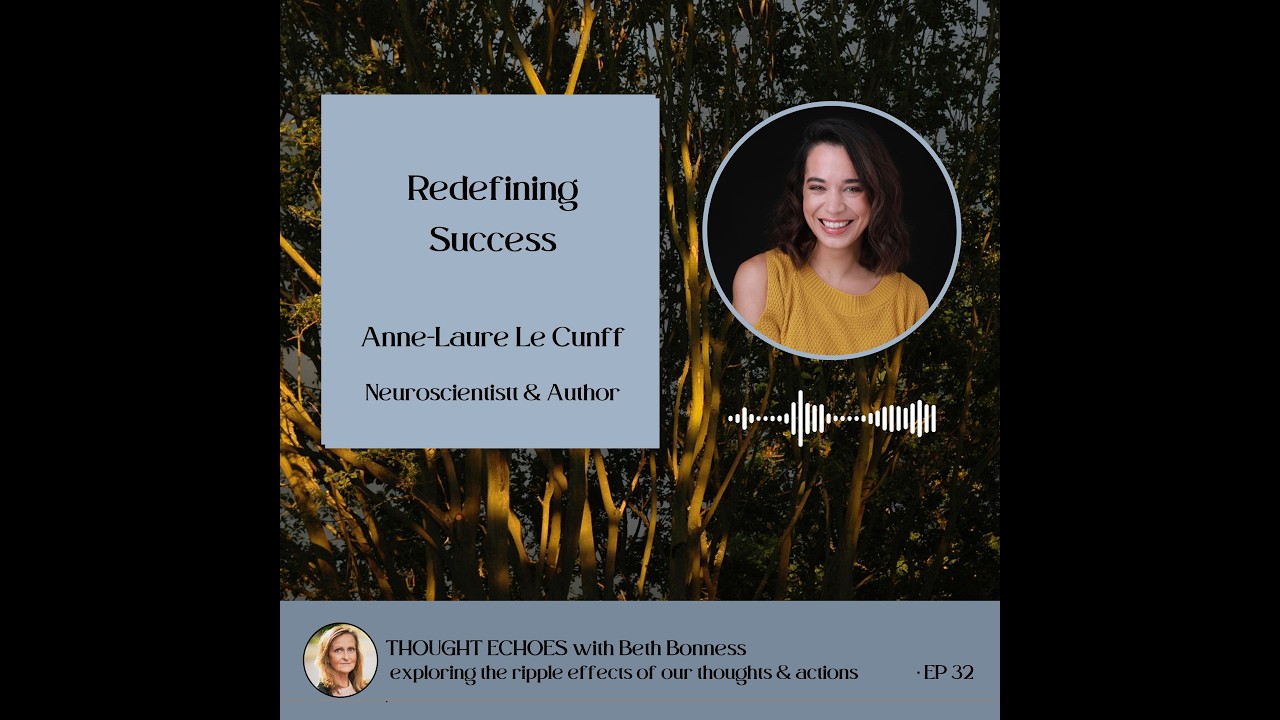
Anne-Laure Le Cunff left Google to study neuroscience and now teaches people to define success through tiny experiments instead of rigid goals. She identifies three cognitive scripts that trap us: the Sequel (repeating past success), the Crowd-Pleaser, and the Epic. Her method: make a short-term pact, collect data, reflect, iterate.
Chapters
In this fast-paced world where everything moves quickly and we're on to the next thing before we finish what we're doing, we might stop a moment and reflect on our thoughts and how they echo through time. They are not a one-and-done phenomenon. They linger and hang around in our subconscious, waiting to surface again. Hi, I'm Beth Boness, host of the Thought Echoes podcast. In this episode, I talk with Anne-Laure Le Cunff neuroscientist, founder of Ness Labs, and author of her book Tiny Experiments: How to Live Freely in a Goal-Obsessed World. Listen as we explore redefining success not by outcomes but through curiosity and experimentation, and how her work invites us to notice the scripts we live by and gently rewrite them one tiny experiment At a Time. I hope you enjoy this episode.
Hello, I'm Anne-Laure Le Cunff, and I'm a neuroscientist and the founder of Nest Labs, a platform to help people achieve their ambitions without sacrificing their mental health.
And can you tell us a little bit about what got you to write this book? Because it wasn't something you came up with, you know, in a summer and then you decided the next year you were going to write it. So this was, this was, uh, had been a long process before you actually came up with the book. Talk to a little bit about that.
Oh, absolutely. It was a long process. The book was inspired both by my personal journey and by the research I've been reading and conducting at King's College London. In terms of my personal journey, I kind of think about my life in terms of two chapters. The first chapter was very linear in the sense that I had a very clear idea of what success was supposed to look like. And I thought that if you had a goal and you worked hard and you got there, then you'd be happy. And I thought that was really what success was all about. I, because of that, I ended up working really hard, really overworking myself, saying yes to any kind of project. I was working at Google at the time, very focused on climbing the ladder, the next project. The next rung on the ladder of success. And I not only burned out, but found myself feeling completely lost. And I ended up quitting my job at Google. I worked on a startup for a little while. I'm going through things quickly, quite quickly. We can go back to these things if you want to. But the, the second chapter in my life, the one I'm currently in, started when I let go of this idea of having a fixed goal that you need to get to, of having a rigid definition of success. I went back to school to study neuroscience. I completed my master's degree and my PhD. I started writing online, the Nest Labs newsletter, which is how we connected. And, um, my life now is not linear anymore. It's very experimental. I, uh, decide what I'm going to work on not based on, on an external definition of success, but based on what I'm curious about, what I'm excited about. And because of that, I have no idea where I'm going, but I tend to wake up in the morning pretty excited to find out what the day is going to bring.
That's wonderful. And one of the things I loved about the book I mean, the concept got me, you know, right off the bat. But there was a— I'm a little wee bit older than you are. And so the climbing the ladder certainly was very much— I had the whole working parent, you know, kind of in the mix too. But the book provided a language for some of the things that I'll say I had tried to tease out but didn't have it with as systemic a way, systematic way that you had. And so it gave a language plus kind of a framework to experiment with that was was just delightful, just delightful. So since the— this podcast is about the nature of thoughts and their ripple effects, one of the things that I wanted to ask you was that how do you see our relationship with our thoughts? And it was hard for me not to think of the cognitive scripts that you talked about that we have a tendency culturally, familiarly, you know, to fall into.
Yeah, so cognitive scripts are absolutely fascinating. Um, so the scientists started researching them in the late '70s, and there was a seminal study that was published in, in 1979 where— I love those kinds of very simple, elegant studies where the, the protocol is very easy to understand. In this case, what they did is just ask people, if you're in this given situation, how would you act? How would you behave? They gave them different scenarios, different situations, and what they found is that most people If you put them in a similar situation, they will actually behave in very similar ways. And in some situations it's completely fine. It can be really helpful when you go to the restaurant or you go to the doctor and you kind of know how you're supposed to behave. You're following a script and, and that's all right. That helps us as a society know what we're supposed to do and in what order we're supposed to, to talk and how to be polite and connect with each other. That's, That's all fine. What's interesting though is that when researchers started looking at those kind of scripts in different areas of our lives, they found that not only we use those scripts in those kind of like, you know, everyday decision-making, but we use them for much bigger decisions in our lives as well. And in fact, you have, you follow, we tend to follow cognitive scripts almost in any area of our lives, whether that is Choosing our careers, deciding on how to dress, our relationships, our hobbies, literally anything that is important, we tend to follow some form of script. And in the book, I talk about 3 of the big scripts. There are many types of scripts, but those are the 3 big ones that a lot of us tend to follow at some point or another in our lives. The first one is the SQL script. That's the idea that whatever you do today needs to make sense based on what you did in the past. So it needs to have a nice narrative. It needs to make sense. And this is the script we follow when we limit ourselves in our choices because, for example, we might say, I'm only going to look at those kinds of jobs because that's what I studied in school, or I started in this industry, so I'm going to look for jobs in this industry, and we limit ourselves in this way. This is also why, by the way, we rewrite our CVs so they make sense retrospectively when we apply for jobs, because we like a good story that makes sense. So that's the sequel script. The second cognitive script that a lot of us follow, I call the crowd pleaser script. And this is when we write a story that we think is going to make everybody around us happy, that everybody could be our spouse, our colleagues, our friends. We're writing a script for— we want to get the kind of reactions when people say, oh wow, I can't believe you got this job, or I can't believe you're working on this, so impressive, so fun. And we don't really consider what would make us happy. So that's the second one, crowd pleaser script. And the last one is the most insidious one because that's the script that we celebrate as a society. And this one I call the epic script. It's inspired by the Hollywood movies. It's, uh, the idea that whatever you do, it needs to be big. It needs to have an impact. It needs to be ambitious. And anything less than that is failure. And because of that, not only we tend to put all of our eggs in the same basket, but if we haven't found our passion yet, we feel miserable. We look around at all of these other people who seem to have it all figured out, who wake up every morning excited to work on this thing, that mission, the passion, and we think, oh, I haven't found my passion yet. Something's wrong with the way I'm living my life right now. So those are the 3 main cognitive scripts that a lot of us fall prey to.
And you, you give some advice in terms of, I guess the first thing is to be aware of them, and that can be a whole different, just pause a moment, let me take a break and kind of look at, use that framework against decisions I've made and kind of go, yep, yep, yep. Oh, that explains it. But are there, are there ways that you recommend for people to kind of, if they're stuck in one of those scripts as a way to kind of open a little window over here to, and maybe a tiny experiment kind of as a way to do that, but, um, to just be aware of it, but then do some, that you have the power to do something about it.
Exactly. And that's the entire premise of the book really, is that you can use tiny experiments to figure out what you want in life. And so instead of having those big goals, instead of climbing those ladders, instead of copy-pasting a script, from someone else and try and reproduce whatever story of success you've been told you're supposed to follow, you can start from a place of curiosity. And so instead of starting from an outcome saying, I want to get there, you just ask yourself, just like a scientist, you, you ask yourself almost like a research question and you ask, mm, might I enjoy this? Or would that be something I would be good at? Would that be something I would like to spend more time on? Would that give me joy? And instead of committing to it for the rest of your life, like we do with a habit, for example, you can instead say, I'm committing to this just for a specific amount of time. And success is not getting to a specific destination. Success is just collecting the data, conducting the experiment, and learning something new. About yourself, about the kind of work that you might want to do. And that's really the definition of a tiny experiment. It's deciding on an action, a test that you want to, to do and decide on a duration for how long you're going to do it and withholding judgment until you're done. So if you say, I'm going to try this thing, I'm going to try writing a weekly newsletter for 5 weeks. Or I'm going to try journaling every morning for one month. You finish the experiment and only when you're done, you look back and then you can analyze the data. How was that? Did I like it? Was there maybe a messy middle, but then I started liking it again? And that's exactly how a scientist approaches an experiment. They collect the data first and then they analyze it.
It was really interesting because there was a question that came up in the workshop that you gave for people who had bought the books, which was delightful. And they said, how many can you do at a time? And it's true. When I went through the book, I picked one about the writing group that was going to be for the rest of the year that I'd kind of done, but it gave me a language and a way to kind of check in with your, you know, the plus minus next, which was very helpful. And then you talked about, well, you could do two if you did one in your personal life and then one at work. But then I found the ones that I did at work were too big. In terms of they were too long. And so I tried to reframe them to be shorter just so I could get in the practice of doing the process all the way through. But that not looking at the data doesn't mean that you don't ask the questions about what worked, what didn't, what will I do next, but that you refrain from making the final decision, you know, exactly a little longer. And another, a little one that I did was about transcripting journal notes. And I had an which was totally wrong, which was delightful because it, it reinforced the fact that just because you think something's going to work out some way, it doesn't. And that's not bad. It just was different than I thought it was. So, um, I, I love the premise.
I love so much that you're, you're pointing this out because, uh, two things. First, as you said, that's the great thing about an experiment is that if you find out that you were wrong, That is success also, because you didn't know. And sometimes I've had that too, where I started from a place of almost like the null hypothesis, where I started from a place of saying, I think this is not going to work, but you know what, let's, let's just, let's just run a tiny experiment over the next couple of weeks. I'm, I'm almost 99% sure this is not going to work. And then it does work. And so this is, this is what I love about this approach is that whenever you're proven wrong, it's actually delightful. So it makes it a lot more fun to make mistakes and learn from them.
Yeah, there's no pressure. There's no right, there's no wrong. There's just doing it. The other thing that the book really reinforced was the reflection time. I'm very much into, you know, getting stuff done and I try to factor some of that in. But there's a difference between saying, okay, now you're going to sit down and you're going to analyze what you did and having white space on your calendar to go do something totally unrelated so that your subconscious can kind of do what it's going to do and contribute to what your analysis is. But that white space, rather than tiny experiment on top of tiny experiment on top of tiny experiment, and then we're, you know, we're so excited, but we don't give ourselves any time to kind of learn from what we did. So the metacognition that you talked about, again, was giving language to something that was missing enough of. So I really appreciated that. Can you talk about how the ripple effects when somebody starts doing it? Because you've been doing this for a while and you've— the Nest Labs has a whole community doing it. Can you speak to kind of a higher level of what you see as the ripple effects in kind of the before and after with people before they were doing the experiments, just in general, in terms of using that as a process and what kind of ripple effect the tiny experiments have had people's lives?
Yeah, from what I'm seeing in the community, I think the, the main downstream effects of running tiny experiments is really just a, a sense of joyful experimentation in life and, um, this, uh, a new relationship to uncertainty, really. This is what I hear a lot. When people have this experimental mindset, whenever they're faced with a challenge or where they're not sure or they feel a little bit lost, they, when they used to in those situations, maybe to freeze and to feel anxious and to want to escape that space of uncertainty, that liminal space as quickly as possible. Now it's almost as if someone just gave them a little piece of candy and they're like, ooh, wait, I actually have no idea. I'm completely lost right now. And it becomes a space for experimentation, a space for possibilities and opportunities. So this is the main change that I'm noticing with people where now whenever they're in, in doubt that they don't know, it's not so scary anymore. It's potentially, it's potentially fun.
When in the decision one, which is looking at head and heart and hand kind of, and I'm probably mixing up because procrastination was about looking at those three, but the decision when you're looking at the data or whatever and how you're feeling is to separate the feeling from kind of the, the doing something about it so that you really get a chance to be in that uncomfortable, I don't know, I feel anxious. Why do I feel anxious? I don't know why I feel anxious, you know. So to spend more time in that versus trying to quickly go to your phone or do something that gets you out of that space, it's still there. You buried it. It's going to come up some way. So giving yourself permission and encouraging people to kind of let that come out and help inform how they're going to make the decision was, again, another really, really great tool.
Yeah, and that's the thing is that like a lot of, um, self-help tools unfortunately are all about getting rid of the uncomfortable emotions that might come up when we're struggling with a project or we're in, we're in a place in our lives where things are a little bit difficult, whereas in the book, I really encourage people to become friends with those emotions, to welcome them and to process them, not in a way where you wanna just get rid of them, but to fully feel them. And then you can go onto the more higher level cognitive process of dealing with the actual consequences of whatever problem you're facing. But first, feel your emotions. As you said, if you don't do that, they will come back at some point and it won't be so pleasant. So it's just better to deal with them as they come and to really treat them as useful signals from your brain rather than something you want to get rid of.
Yeah, that's very good advice. Um, and these tiny experiments give you a chance to practice that, which is great. When you think of how entangled all of us are, and the part that I had not finished before the workshop that you had was the kind of the social element, you know, growing in public and learning in public and all that. So can you talk about how with the social flow, you know, in terms of the ripple effect? So this is all wonderful and there's a ripple effect that each of us have, even if we think we're only in our, you know, little bubble of whatever we're doing, whatever we put out into the world, there's a ripple effect with that. But this is a more active, on purpose, going to be out in community with people. So can you talk about that and what maybe were the biggest surprises in working with groups?
Really working with groups and sharing what you learn, so learning in public, what's amazing is that— so this research on social flow that I talk about in the book, which I think is absolutely fascinating, There is a lot of research on flow where most of us are aware of what a flow state is when you get in the zone and you're fully focused on the task at hand. But more recently, they discovered the concept of social flow. The fact that when you put several people in the same space and they're all in the flow, they actually get in the flow quicker and stay there longer. There's a social effect that is tied to it, and you can make the most of that. By putting yourself in spaces where you are with other fellow curious minds who also love to experiment, and you can learn together. You can learn faster and better. Um, something that I find amazing about conducting experiments together as a group is that after the, the first discomfort at the beginning of sharing your mistakes and your failures and what didn't work, there's something almost magical that starts happening where people become more and more comfortable actually sharing the process. And there's almost a sense of pride in having tried something that they weren't quite sure was going to work and actually didn't work, but they can raise their hand and say, hey, I tried this thing. Don't do it. It doesn't work, but I can share with you what I learned. And it's really beautiful to see that happening. It's the opposite of how traditional schools work, where you're supposed to raise your hand when you have the correct answer. Here, when everybody collaborates together and experiments together and learns in public, you raise your hand whenever you learn something new. And if you learn that through failure, it's even better because it means you actually tried the thing and it comes from practical experience, not just something, some theory that you read, somewhere. So that's one of the effects, is really creating this shared sense of psychological safety where everyone feels like they can share the messiness of the process and what they're learning right now without feeling like they need to wait until they're the expert to share what they're learning. And the other one is that people tend to become a lot more playful with the different experiments that they run in their lives. I've noticed this in workshops and groups that I run, and especially the longer cohorts over a few weeks where people start at the beginning thinking about experiments for work only. So they say, I'm going to do this experiment in terms of time management. Maybe I'm going to block time and work in this way, or maybe I'm going to use a new way to manage my to-do list. But because everybody is sharing their experiments with each other, you get inspired by people running those weird experiments you would have never thought about. And you, before you know it, you're running an experiment about painting or, or doing collages or cooking or gardening or whatever it is that you might not have thought about experimenting with in the first place. So seeing other people experiment in different areas of their lives can also give you inspiration. In terms of areas of your life you would have not necessarily considered changing or experimenting with.
Well, I think too that again, by doing an experiment versus I'm, I want to learn about gardening, so I want to become a Master Gardener, or I want to learn about, I want to write a book, so I'm going to take this course and get, you know, where it's this huge commitment to this epic project and doing some experiments along the line, you may find out that you don't like gardening or you like some other aspect of it or whatnot before you go and, you know, kind of work your way into that. One question I have is when I heard about the learning in public, I'm an extrovert, it seems, but really I reduce as an introvert. And I've got a daughter and a husband. Her husband are totally different in terms of how they refuel. So how is the introvert extrovert element of being in public? I mean, obviously you raise your hand, but how have you experienced the type of person being comfortable with basically sharing in public?
Yeah, I, in the book, I explained that there are different levels of learning in public. And, uh, and I think this is a misconception that people might have if they just hear the phrase learning in public and they don't have the opportunity to read more about it. Learning in public doesn't have to be very public. It doesn't have to be sharing on social media, building a big newsletter. Or doing public speaking. Learning in public is anytime you share something you're learning with one other human being that is not yourself. If there's at least one other person who's aware of the process you're in right now with all of its messiness and all you're trying to do and the mistakes and the failures, you're learning in public. And so this is why you can actually just grab a friend or a colleague and say, hey, let's experiment together. I've seen people do it with very small WhatsApp groups where it's just 3 or 4 people in there running the experiments, and every week they do the little plus minus next together and they review their progress, what went well, what didn't go so well, what they want to tweak next. And sometimes you just stay at that level of learning in public, and that's great. Sometimes you feel kind of cold to share with more people, maybe because you're very excited about the experiment, you're learning so much, you feel like other people might benefit from learning about your journey. And then you can decide to maybe start a newsletter, a blog, or whatever it is, but that is completely optional. You will get most of the benefits of learning in public by just sharing with a few people. The benefits of having to articulate what your experiment is, the benefits of getting out of your comfort zone and having to share the things that didn't go so well. Even if you do that with 1 or 2 people, that's great. And then the other benefits you get from learning in public with a larger public, a larger audience, are largely interesting if the kind of experiment you're running would benefit from this larger audience. And that's the case sometimes. That can be the case, but not always. So learning in public can be learning in front of a very small audience. That's completely fine.
Yeah, with people you'd be comfortable with. Can you give some words of wisdom for somebody who hasn't gotten your book yet in terms of how they would tiptoe into— I mean, buy your book would be one tiptoe in, but a way to, um, advice in terms of how to get started in this and what would be, um, from all the people that you've worked with, what would be the most success— the way to set them up for success in terms of trying the technique?
The cornerstone of the entire book is what I call a pact, and I call it that because it's a commitment to exploration, to being curious. And a pact is a mini protocol for experimentation. If you never read the book, if you, or if you forget everything about what you read, this is the one tool that I think can really change the way you approach challenges or that you can use whenever you feel a little bit lost. The way it works is you say, I will insert an action for insert a duration. And so that could be, I will write a weekly newsletter for 5 weeks. I will meditate every morning for 10 minutes for 10 days. I will action for duration. You can use that to experiment with any areas of your life or work, with your health, with your relationship, with your creativity, with your productivity. And this is what a tiny experiment is. It's committing to exploring a hypothesis, something you're interested in, but you're not quite sure is going to work for a specific duration. And at the end of the experiment, deciding whether you wanna keep going, or maybe you wanna tweak it, do it slightly differently, or stop. Maybe you hated it, and that's great. Now you know, and you can try and experiment with something else. So That is the one tool to get started that I share in the book, and everything else in the book is really about supporting you in developing that experimental mindset.
One thing that I found very beneficial, and I resisted at first, was to for 24 hours just take— it, it's not like, uh, documenting everything you've done, but just take note when you're feeling kind of a tweak in a good way or a bad way that got your attention to just write down how, what happened, how you're feeling at that time. I journal every morning, so it's like the reason I resisted was like, all I have to do is go look in my journals in terms of that. And it captures how I was feeling at that moment in the morning when I was doing it. But I'm relaying stuff that happened at other times. And so I thought, okay, I'll go do it even though I've got this list of things I want to do all my tiny experiments on. I'm going to use the the field notes. And it was interesting. Some of the stuff is like, yep, that's recurring, that's recurring, that's recurring. It's like, oh, what if I took this one and made it really tiny? So I would add that to the observation on yourself versus things you—
Absolutely.
It was really, that was very helpful as a kind of precursor, you know, before you picked your first tiny experiment. Tell us about what you're going to be doing and then you're going to take a break for a little bit. Well, this is—
Yeah, I'm going to take a little break and, uh, actually apply a lot of the tools in the book to try and figure out what I want to experiment with next. So I'm going to be taking field notes, observing how I feel, looking back on the past few months and try to reflect on what gave me energy, what drained my energy, what I want more of, what I want less of, and then try and figure out my next experiment. Um, and, and this is also something I, I talk about a lot and I think is really important is that I don't want to rush. I actually don't know what I'm going to do next. And this is part of having an experimental mindset is that although it is a little bit uncomfortable right now that I'm not quite sure what I'm going to do next, I'm going to enjoy that liminal space. I'm going to enjoy being a little bit lost right now. And I'm going to conduct a few tiny experiments to find out what it is I want to focus on next.
That sounds wonderful. Well, I wish you the best of luck, and we're going to be following you, even though we know you go— you'll go quiet for a little while, which is, you know, well deserved. So thank you so much, and I love your newsletter. I'll put all the information about the book and the newsletter and Nestlé's up there. So thank you very much for joining.
Thank you for having me.
Take care.
Amazing. Thank you so much. Bye-bye.
Thank you for listening. If you enjoyed this episode of the Thought Echoes podcast, please consider subscribing, leaving a review, or sharing with a friend. It helps get the word out. Until next time, keep exploring the echoes that shape your world.
More from Anne-Laure

How to Use Curiosity & Experimentation to Flourish, with Dr. Anne-Laure Le Cunff

Stop chasing goals and start running tiny experiments with Anne-Laure Le Cunff

Why You’re Still Waiting To Figure It All Out | Anne-Laure Le Cunff | EP. 391


Tiny Experiments: How to Learn, Grow, and Navigate Uncertainty — Anne-Laure Le Cunff



Stop Setting Goals. Try This Instead | Tiny Experiments with Anne-Laure Le Cunff


