Remote Daily #232 - with Anne-Laure Le Cunff
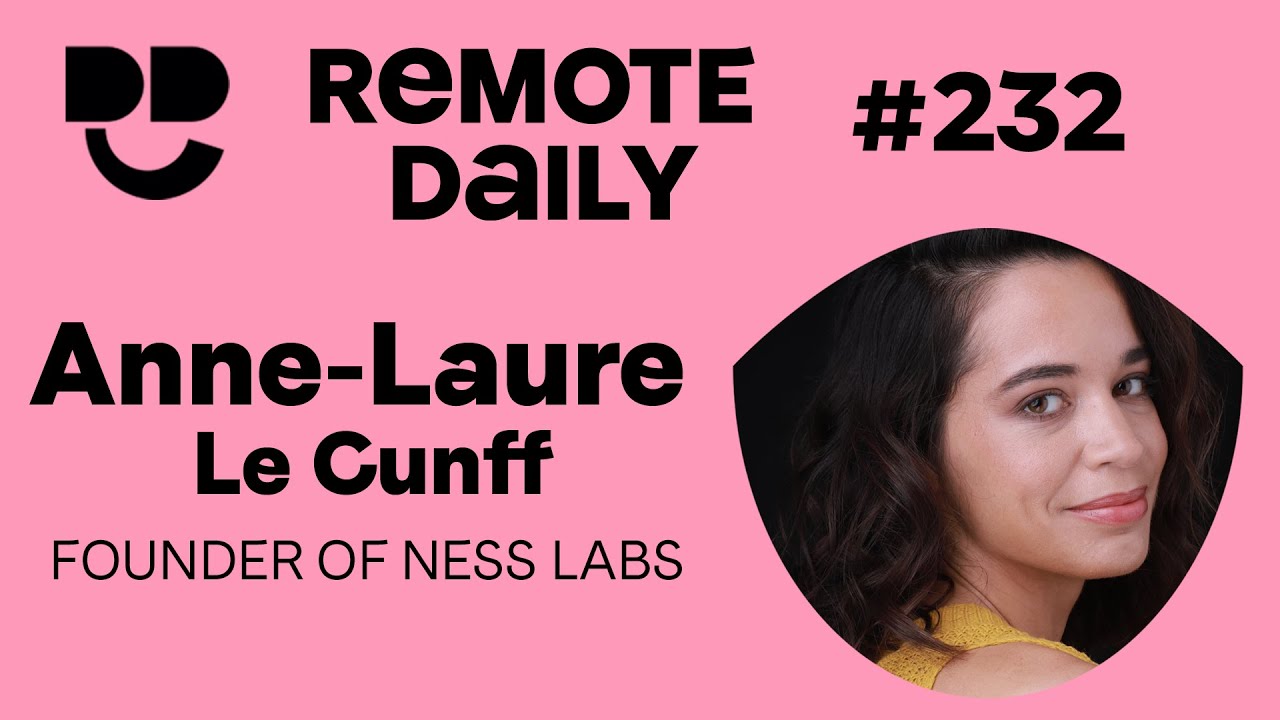
Anne-Laure Le Cunff, founder of Nest Labs, talks about recognizing burnout through time pressure, cancelled plans, and sleep loss, then shares concrete fixes: journaling with plus/minus/next, thinking buddies, and short movement breaks. Her newsletter reaches 50,000 people and the business pulls in roughly $10K monthly.
Chapters
This is Remote Daily.
On our agenda today, how to achieve more without sacrificing your mental health. We have had many people on the show, but we had no one with this particular angle at this particular point in time. She's an entrepreneur and PhD researcher at the Institute of Psychology and Neuroscience at King's College London. She founded Nest Labs, which is an online school, and the newsletter that she's writing reaches around 50,000 subscribers. Each week. So excited to welcome Anne-Laure Le Cunff. Anne-Laure, bonjour. Hi.
Thanks for having me.
Anne-Laure, you think the hotel Wi-Fi is not treating you well, so I would recommend let's go into podcasting mode for now and switch off your video so we can still hear you.
I'm so sorry about that. The joys of traveling.
That's totally fine, and we're so happy to have you with us. You're half French, half Algerian, born in Paris. You sold French wine in New York, if we're not, if we haven't researched that wrongly. You studied in Tokyo, you worked at Google in San Francisco, started a company in London most recently called Nest Labs. Where's home for you?
Ooh, that's a good question. Uh, I, uh, at the moment it's, it's London. I live in London, but I do really like the idea that I could call any place in the world home. And I think the internet has really helped with that. Uh, I feel very fortunate to have found this little corner of the internet, which Remote Daily is a part of, but also on Twitter, um, through different newsletters. But I feel like I've found this magical corner of the internet where everyone is kind and curious and wants to grow and learn and all of these people living from in different places in the world, which means that I do feel pretty confident that at this stage I could go to pretty much anywhere and ask around and I'd find at least one person that I could hang out with anywhere in the world, which is again, pretty magical.
Wow. Yes. The corner of the internet that feels safe. That's a great way to describe the community that you're building. Uh, you have parents that are also deeply involved in community. Actually, on your website it says your parents got married at Burning Man. Is that true? And how come, if, if it's correct?
Yeah, I think that's true. I was there, so I can testify that it was, it's true. Um, so yeah, I, I, at this point I had been to Burning Man a few times and I was talking to my parents and telling them that I went to a beautiful wedding there. And my parents had not been together for more than 30 years, but they had never married. And my dad, and I asked him, oh, sweetie, what do you think? Maybe we should do it there. And I can help. So I helped them organize it. And in 2017, the whole family flew to the Nevada desert and my parents got married there.
That's fabulous. 30 years being together, then getting married at Burning Man. That's all right. That's inspirational. That's a story to keep in mind for everyone who in the room who hasn't delivered or hasn't been part of a marriage yet. Think about it. Go to the Nevada desert and do it there no matter how many years you've been together. Anne-Laure, thanks for that story and back to you. I found you first through your newsletter, The Maker Mind. The link is in the chat. Newsletter.nestlabs.com is where you can sign up. I'm now one out of, I think, 50,000 people who are reading with you and have been, you know, following your thoughts. Nest Labs though is a name that I never understood. Like, why did you, where did you get up, come up with that name?
So, ness, the suffix that you use to describe the quality of things, like awareness, wellness, consciousness. Um, so that's, that's Ness. And then Labs is like a laboratory. I wanted to have a playground, a sandbox where I could experiment, where I could try new, new things, where I could fail and Learn.
Got it. So, "ness" is basically, it comes with a lot of great words like awesomeness, amazingness, loveliness. So, you're Nest Labs, you're where it all happens. And Liz was just so kind to describe a little bit in the chat here for the origin of this word. So, let's get to what you're doing every day, writing, researching. Around work-life balance, time management, the P word, the bad P word, productivity. What are maybe the most common myths that you see these days spread around work-life balance?
And I think something people really struggle with is that we've always been taught that you do need to find this balance between life and work. That means that you need to treat your life and your work as completely separate, which in the past was possible because you would go to work, your colleagues work on your projects, and then whenever you would close your laptop and leave the office and come back home, then life started. But I think there's been a couple of shifts that have been interesting, obviously, and you know that you're called Remote Daily, so the shift to remote work, which is pretty obvious, but also another shift is that a lot more people now do want to find joy in their work itself. So instead of seeing work as something that you need to do in order to then go and enjoy life, that you need to perform in order to be able to afford all of the good things in life, you can actually make work part of your life. You can enjoy that. You can grow through your work and you see that a lot with people who are in any kind of entrepreneurial kind of job. And by this, I don't necessarily mean having your own company because you can be very entrepreneurial as an employee as well. Um, but I need people who own their projects, who can shape them, who can be quite creative, uh, or also freelancers actually. A lot of these people do want to find joy and delight in the work that they do every day. And because of that, the traditional definition of work-life balance doesn't work anymore, cuz you're not trying to find to, you're not trying to work as, as little as possible to have more balance and to have more time for life. What you want is actually to design your work in a way where you don't feel like you don't, you need to reduce to a minimum the number of hours you're spending at work. Mm-hmm.
So the two myths that you just described is A, work and life are, are two different entities in that every day. And second, work kind of has to suck because it always did. And it's just, you know, you just have to get through it so you can enjoy the rest of the day or the post-retirement stage of your life or whatever it is that you spend outside of work. And you say there's, through the pandemic and through the digital means of working, there's now much higher expectations actually towards work, which means I actually want to find something where I can feel good about, A, and where this blurred line between work and life is totally fine because I make it part of my life, which is really interesting because it means the expectations towards the job are very, very high. It also, I think, is part of why so many people quit their job or are still quitting. I think in May we saw again between 3 and 4 million Americans quitting their jobs. So it's this, this whole wave has not stopped yet. So your, your whole concept that you derived from these myths is called mindful productivity. So, so back, so let's go to solution stage. How do you actually help people find that and, and, and also sustain it?
Yeah. So just to, uh, first share a bit of a definition of what I, I mean by mindful productivity. Um, so what was really interesting is that when personally that I did struggle a lot when it comes to that elusive work-life balance that I was looking for, because I was trying to apply the traditional models of work-life balance and it didn't work. I went through, I experienced burnout several times in my career. And so I started looking into, uh, ways basically to have a healthier relationship with work. And the problem is that there were basically two schools of thought that were very popular. And the first one was very much focused on productivity itself. Um, so you have books, if you, you look at the self-development section of some, uh, bookshops that are called Productivity Ninja, those kind of things, right? Uh, and that give you those recipes to be productive step by step, very rigid, and that promise you that if you apply the strategy, because the author supposedly use that strategy themselves, you're going to turn into a productivity ninja. Um, and this, these things are very often very hard to apply. They look really good on paper. Uh, they, they sound great and that's why these books are very popular and, and they sell so well, right? But they don't take into account the messiness of life. If you have kids running around and deadlines, uh, that are very fastly approaching or lots of external factors that make it a bit hard to control and just apply a neat, perfect framework to the way you work. A lot of people find that translating what the author is saying on paper to their messy, very messy lives is very often difficult. And even if they can do it for a week or so, usually they can't sustain it over the long term. So that for me, this very, this approach that was very focused on productivity didn't work. And then you have the other end of the spectrum. The, the focus on mindfulness. And I think mindfulness is really important. There's lots of research showing that it has a lot of benefits when it comes to your well-being, to your mental health. So mindfulness is great, but, um, when it comes to work, uh, a lot of those books are basically telling you that you need to disconnect. You need to do a digital detox. Uh, just turn off Slack. Put your phone away, uninstall all of the apps from your phone and start living like a monk. Again, not very sustainable. So you have people again who do maybe a one-week digital detox or these kind of things. Great. And I know it feels good. It can be a really good way to focus again on yourself and your thoughts, your feelings, but it's not something sustainable that you can implement over the long term in your daily work. So mindful productivity is basically saying that you don't have to go in either of those extreme directions when it comes to your daily work, that there are good things in both, and by combining them, you get the benefits of both without getting any of the drawbacks. And what it says is that it is possible to be productive, to be ambitious, to work hard, to be creative, to have dreams when it comes to your work, and also to be mindful of your wellbeing, to be mindful of your mental health, And to make sure that you do all of this great work that you deeply care about in a way that is sustainable for yourself. So that's mindful productivity in general. And then of course we can talk about more specific strategies, but I just want to share definition first.
Very interesting. The ever, the ever-expanding self-help department in any bookstore, uh, and then the entire different— I just saw a cartoon that says reading, uh, buying and reading books are two entirely different hobbies because I also feel like these books sell a lot, but it would be interesting to know how many, how many people actually went through and applied all these self-help techniques. And you say it's just another regimen that forces you to do something that you probably are not able to do. And then you end up feeling guilty about it and you hate yourself more than before reading the book. It's a, it's a whole conundrum.
The question I would like to ask people is, have you ever experienced burnout at work before? And if so, what did you do? Being aware that you're experiencing burnout is the first massive step that you need to take in order to take care of it. It doesn't mean that it's going to be fixed straight away or that you have the perfect answer in terms of how you should address it, but a lot of people are burned out without even realizing that this is what's going on. And so they keep on pushing themselves, uh, they keep on adding more work, they keep on pushing down all of the emotions, uh, and the struggle that they're experiencing. So having this self-awareness, just being aware of recognizing the symptoms of burnout is such an important step. So I think—
Wow. Anne-Laure, before we get to, to the, I think what you call metacognition stage, what is this recognizing of burnout? Can you just remind us? Because I feel like I experienced some of the symptoms sometimes, then I don't know if it's really the symptoms, right? What would you describe as like the, the most important flags, uh, when it's time to do something?
Yes. Uh, one of the first things that you'll notice is a shift in your relationship with time. It will feel like you never have enough of it. And, uh, you would, you may start noticing that you start saying no to things that you know would be good for you, uh, because of work, for example. So for example, you may know that exercising is good for you. You know it's good for your mental health, not only your physical health, but also your mental health. But you may stop going to the gym or skipping gym sessions or skipping runs because there's too much work. Um, and so you can see how that creates a vicious cycle. Another thing, again, with time is that you may know that it's good for you to spend time with your friends, with your family, that this is a really good way for you to recharge, to talk through your problems and your challenges, but again, you may cancel, cancel dinner plans with friends because you have this big presentation that's coming up. So even though you know that, even though you know that's a good thing for you to spend time with your friends and your family, that's not the priority anymore because you feel like you don't have enough time and you really need to get that work done. So that relationship with time and the shift in priorities towards work at the expense of things that are good for you is one of the biggest, biggest symptoms of burnout. And then there's other things, obviously, uh, people struggle with sleep very often. They have trouble shutting down their thoughts when they go to bed. It's just spinning and spinning, and they keep on thinking about work. So this inability to shut down these work-related thoughts, even when they're trying to go to bed, is another sign. And another one that people have is, uh, maybe a lack of appetite because you're stressed. So all of the signs of stress, if you add that to this, and, uh, lack of enjoyment in food, lack of appetite, you'll see a lot of people who are burning out quickly eating a sandwich at the desk without even really tasting it or paying attention to what they're eating. Food becomes a very functional thing just to keep on being able to work, to keep on working, rather than something that you do because you actually enjoy it. So those would be 3 big signs of burnout. Wow.
Oh my God. Uh, where do you start here? I feel so caught.
Sorry, that's heavy.
I feel like you just caught me. Um, no, no, it's not heavy. It's, it's, I think it's reality for many of us. I just talked to a CEO, hundreds of people company. He's from Europe. Uh, he's from Central Europe. He's used to the way of working over there. And so I asked him, what's the biggest difference for you being a CEO in, uh, in the US versus Europe? And he said, A, I can't get everyone from— I can't bring everyone to not eat their lunch at their desks. So the sad desk lunch, right? Which you actually just described. It's just a function. It's not enjoying lunch. It's just doing it so you can continue to work or even work while you're eating. And the second thing he said, I can't get everyone to take 2 months of vacation at once. And he even does it as CEO, but people won't do it in his company. As a European, he's very aware of that. And I think to me, those two signs of— are two signs of people in the company not dealing probably well with their productivity and mental health. And he has a CEO struggling because he's seeing it, but he is not able to change it. Let's get to your solutions though. What do you recommend? What is the mindful productivity piece that has helped you and is now helping others through your community? To solve that?
I'm not a big fan, as I've mentioned with all of what they call toxic productivity, I'm not a big fan of one-size-fits-all solutions because I don't really think there's a, there's a blanket framework that you can use for everyone. But something that I do know works is something called metacognition. And that sounds like a big word, but it just means thinking about thinking. And basically what it means is that instead of keeping on doing the same thing over and over again, a bit like if you were a machine in an automated way, it's about taking some distance and really think about your thoughts, really think about your emotion, thinking about what is going on in your mind and trying to be as connected as possible with all of that. So you can notice as quickly as possible. When something is wrong. Uh, it's the same with a lot of aspects of health in general, whether it's physical or mental health, but the earlier you notice that something is not quite right, the easier it is going to be to correct course and to fix it. So metacognition is really a way to embed in your life self-reflection and connecting with everything that's going on inside. However, busy you are or busy you feel like you are. It's making space and taking the time for connecting with your thoughts. And the different ways of doing this, and this is where not all methods are going to work for everyone, but the metacognitive aspect, the thinking about thinking aspect, that's what really matters. For some people, journaling is a really good method, for example. Um, so that works for me. I journaled very often. That's, uh, I don't, I don't force myself to do it every day, but I end up doing it most mornings with my cup of coffee just because it helps me a lot. And it's almost like these people who tell you that if they skip a gym session, they don't, it doesn't feel quite right. So it's the same for me with journaling. So journaling is a really good method, writing out your thoughts, the simple step of formulating that all of these funny thoughts that you have in your mind and putting them on paper is a really good way to see what's actually going on and to try and have a more constructive approach to what the problem is. So instead of just feeling that something's wrong, you can start analyzing it and thinking about solutions. That being said, journaling, I know, we know it's good. There's so much research showing that it's really good for you. We also know it's really, really hard to build that habit. And, uh, you're smiling. Yeah. Um, and so it doesn't work for everyone. It's the same for, you know, meditation is really good and I'm really bad at it. I can't build the habit. So I am very, very cognizant of the fact that Knowing that something is good for you and being able to build the habit are two very different things. So for people where journaling is not something that they've managed to build a habit for, despite knowing that it's good, there are other ways to go about it. You could have a metacognition slash like a thinking buddy, uh, a friend or a family member or trusted colleague that you feel safe with, where you feel psychologically safe around. Where you could meet maybe once a week and it could be over coffee, or if you like food, it could be over breakfast, whatever little ritual that makes you both happy. And during that time, both of you share the challenges that you've been experiencing during that week. And the goal here is really not for the other person to give you advice. It's really just for you to have a way to express these thoughts, because for most people, it's a bit weird to talk to yourself. The goal here is just to have to talk to someone and the other person, including yourself when it's your friend talking, should refrain from giving advice or trying to provide solutions. The goal is really to just encourage the person that's in front of you and for the person who's in front of you to do the same with you, to really just tease your thoughts out of you, to really help you formulate them, articulate them so you can start thinking about what really is wrong and potential solutions. So that's another way, for example, to do it, but you can design any kind of ritual that works for you and that encourages metacognition, that encourages you to really articulate your thoughts.
Wow. Well, I, I, I love the second part, the journaling. It doesn't work for me, but the thinking buddy, I just talked to, um, a friend who is older than me, has 4 children, and I asked him, how do you, why are your, why is your family running so well, like all the vibes I'm getting from you are amazing. And he said, what we did for a long time is once a week we would sit down, all 6 of us, and we would ask that exact same question that you just brought up. Like, what did go well for this, for you this week and what didn't? And it changed a lot of things in the household. It changed all of the roles that we're taking on. It were, it changed a lot of the tasks that need to be, that needed to be done to actually get done. And it changed the entire vibe in, in, in the family. Is that, even if it's a larger group, is that something you would recommend?
Yes, I, uh, I think really it's about figuring out what works for you when it comes to metacognition. And if for you it works better to do it as a group, especially if you struggle to build a habit, group pressure, peer pressure can sometimes be very helpful if you use it in the right way. So if you make it a family ritual, that maybe will make it a bit easier for you to stick with it. Um, so that's, you know, that's why my company is called NestLabs. I'm a big fan of experimenting. So rather than saying that this is the right thing to do or not the right thing to do, I think I would encourage, and I think it's so lovely to, to see such a really good example of metacognition that is implemented, but in, in a family setting. I absolutely love that, but I would encourage anyone listening to this too. Oh, sorry. Go ahead.
Anne says, how do you not feel guilty for taking time for yourself when you are a caretaker? How can you actually do that so you can get into the ritual of journaling, of meditation, like all the things that require me time?
Um, I think you can, you can see almost yourself. It's going to sound a little bit mechanistic, but you can see yourself as a car almost. And if you want to keep on driving the car, at some point you need to stop and put some fuel in it. So there are going to be a few minutes where the car is not moving, but you do need the fuel in the car if you want to be able to keep on going. So you really need to see these as ways to recharge yourself, to get the energy you need to give the love and the care that you want to give to the people around you, including your children, and just think about the kind of energy and support that you're going to be able to give them if you're completely burned out versus if you took 10 minutes just to take care of yourself. And the problem is that very often when we start burning out, it's not that we don't have those 10 minutes in the day. We do have them. We can find them. It can be a bit late at night when the kids are in bed. It's just that because we're already, uh, kind of like, you know, we're on the path to burnout. We're denying ourselves those very precious moments that we do actually need. So really see it as an investment in yourself and in the care and the love that you want to give to your family to take those 10 minutes. And it's not true that you need a full hour of meditation, a full hour of journaling, a full hour of metacognition or any self-care practice to have benefits. Even 10 minutes is already really good because you're already sending the signal to your mind that you are caring about, you're caring about it, you're caring about your mind. So it's, it's just shifting psychologically your mindset and what you're, the signal you're sending to yourself is I am going to take care of myself so I can take care of the people around me, just 10 minutes, just, you can take them. Another thing that you can do that can be nice sometimes, and that is also more practical is to stack that self-care with the care of the people around you. So maybe you can have a little ritual of weekly drawing with your children where they're drawing and you're journaling, uh, or, you know, you're, you're doing it at the same time. So it's not that someone else is taking care of them and you feel guilty about doing your own thing. You can all be together. Everyone is working on their little project and you can do your metacognition practice during that time with your children next to you.
Uh, so two, two great advices here. One is to actually defend the time that you take for yourself by saying, hey, I need that in order to be good at what it's, what is needed here. I need that other time. Otherwise it's not gonna work. I'm the car, right? I need the fuel. And the other one is, hey, let's just do it together while I do my yoga or while I do my journaling, you do this and we just spend time together while doing that. But everybody is on their own and does their own thing. I think that's both beautiful. I see Anne nodding. So question answered in a way, thumbs up. How about you yourself, Anne-Laure? Like what are the techniques or I should say, what are the solutions or the rituals that you are working on right now and you're maybe that you maybe find challenging right now, but you're working on them?
Yeah. So as I said, journaling. So I finally, it finally clicked for me a few months ago. And so I'm doing proper long-form journaling at the moment. I don't know how long it will stick. I'm being realistic. I'm just enjoying it while it lasts. So very, yeah, I'm very happy about it. So I haven't found a miracle technique. Technique to be able to stick with it. So that's why I'm not pretending that that's the case, but right now I'm doing that. Before that though, I had a little technique that I can share for journaling because I've been terrible at it most of my life. Uh, terrible at building that habit. And something that worked for me is something I call, it's not a really good name, but it's just, uh, it's, it describes what it is. I call it plus minus next journaling. And it's something I would do once a week, uh, and that was very easy to stick to because it would take 5 minutes and I would just draw 3 columns. Plus is what went well that week, minus what didn't go so well, next what I want to focus on next week. Just bullet points, very messy, 5 minutes, but that was the kind of minimal check-in with myself that I would have every week. And again, there's no way you don't have 5 minutes in a week. It could be 5 minutes before a meeting, a bit in a rush on Monday morning. It doesn't matter. I would try to do it on Sunday personally, because it just felt more relaxing. But that's something that I did for, like, a few years and really worked for me. Sometimes I did skip it. I was not perfect, but that was way easier for me to, to stick with that. So for people who want to experience some of the benefits of journaling, but haven't found the time or managed to build a habit of traditional journaling, plus minus net journaling. Could be a way to do this. Um, and another thing that, uh, so I've been doing that my whole life and, and that's been really good for me. I'm really bad at yoga. I'm really bad at meditation, but I dance in my living room with a mirror and I just put music and I just dance. I mean, I was going to say like no one's watching. It's very lucky that no one's watching actually. No one's watching at all. Uh, so I just, I just dance in a very silly way. I just, you know, try and like let everything go. And, um, and that's, that's my yoga, basically. I just do that, uh, a few times a week, whenever I feel like it. It's one of the benefits of working from home. I can just close my laptop for a few minutes, put some music on, and I just dance.
Fantastic. I love that. I love both of that. As a journalist, especially journaling, I find incredibly difficult because I start thinking about sentences and grammar and paragraphs. Plus minus next. That's the way for me to do it, definitely. And we have had an amazing dance session here on Remote Daily. It's been a year plus with Piera Gelardi. She's still doing it on Zoom. She invites people just to dance it out, and it felt so great. It was, yeah, really a favorite, and I can very much relate to what you said here. And of course, as Angus puts in the chat, the dance party with the kids. You combine all of what you just said, Anne-Laure, right? You're taking you time. You're taking time with the family. You create a ritual. You have fun together. You kind of meditate even because you let loose. You order the spaghetti in your head and, uh, you just have a good time. So thank you for that. Let's talk, um, before we close this out, let's briefly talk business because you have managed, it all sounds so, you know, amazing and you're, you're shedding, you're sharing all these like all this great advice and you're doing this amazing research as a PhD researcher, but Nest Labs is a real business. You have 2,000+ paying members, subscribers, and 50,000, around 50,000 people receiving your newsletter. So are you actually living off of Nest Labs? Is it making enough money for you to make a living in the center of Europe?
Uh, yes. I, my numbers are already available on the internet. I love working in public. I share absolutely everything. My Anne-Laure Le Cunff thinks I show too much, but, uh, my business is making $10K a month. So, uh, that's enough for me and for my employees as well. So I have a team, uh, so that's not all going in my pocket because I would be living in Bora Bora if that was the case, but, uh, I have employees and, uh, and so yes, I can live off it and, uh, and it allows me because it's very flexible. It's a fully remote business. We're all working from wherever we want to, so that allows me to do the PhD at the same time, which is a very, I feel very privileged.
How big is your team by now? How many people work with you?
3 people.
Fantastic. And they are in what function? Are they writing, uh, are they putting together the newsletter or the website or what's the, what's the team roles you're working with?
Uh, I have someone who does social, social media and community management. Uh, as you mentioned, we have 2,000 paid community members. So I have someone helping with this. I have someone who's in partnerships. So we, uh, also work with founders of tools for productivity, for creativity and mental health. And we tell their stories and we do profiles. So, uh, that's someone that manages all of that, as well as the sponsorships and the newsletters, any kind of paid engagements or partnerships that we do. And then the last person is in, in an editorial role. Helping manage the editorial calendar, all of the articles we publish. Every week we publish one science-based article that we share in the newsletter. And so the editorial manager is helping with that, uh, with a bit of the research and, um, all of these things.
Fantastic. So this also means if you are a productivity-based company watching right now, you can reach out, you can become part of the Nest Labs community and newsletter. And I just want to give a shout out to our very First speaker on Remote Daily, March 20th, 2020, Jeremy Ratliff on at Cave Day, co-founder at Cave Day together with his co-founders. Now I think front page of the New York Times today. I just posted the article in the chat. Would you pay $40 a month to have strangers watch you work? Fantastic headline. And it sparked a huge discussion in the comments actually about productivity. So this conversation is hot. It is ongoing and you are playing such an important role with it because now reading your newsletter and now learning from you, you are on the end of sharing, even oversharing, as your mom would say, and really helping people, um, to find this weird blurred line between work and life that we have all been, or many of us have been experiencing, uh, over the last 2 years. One last question, um, Anne-Laure, what are you currently most curious about when it comes to the neuroscience research and our brains, like what, what is around the corner that all of us who are not neuroscientists can't see yet?
Uh, so more, more at a personal level, I'm very interested in, uh, the potential for psychedelics, uh, in terms of mental health research at the moment. Uh, it's, uh, very unfortunate that we stopped all research in, uh, a few decades ago, but it's starting again. There's amazing research being done in London and New York. And when it comes to depression, PTSD, anxiety, it's really, really promising, very early, but very promising, and that's an area that I'm very excited about.
Wow, fantastic. Yeah, I see a lot of conversation in that space. We have not done enough on Remote Daily to really get into it. Anne-Laure, we are so excited to have you here. So good to have you with us, Anne-Laure.
Thanks for having me.
Uh, you were fantastic. Last question to you. How can we support you?
Uh, the only thing you can do, and it's completely free and would make me really happy, is to subscribe to my newsletter. It's, uh, something I absolutely love writing every week, and the more people read it, the happier I am. So that's it.
Fantastic. Um, we are so excited to have you, and we will all subscribe, uh, to your newsletter, of course. It is really an amazing resource. Maybe as a personal mantra, an announcement, anything you would like to share with us before we say goodbye?
Anne-Laure? I just passed my PhD upgrade yesterday, which means that I can't get kicked out anymore of the PhD program, so it's really good news. That's it for my personal announcement, and sorry, I turned my camera back on. I don't know how bad this looks, but I just want to say thank you to everyone.
Again, this is Remote Daily. Good to see you. I'm Felix. Bye-bye. Remotely.
More from Anne-Laure

How to Use Curiosity & Experimentation to Flourish, with Dr. Anne-Laure Le Cunff

Stop chasing goals and start running tiny experiments with Anne-Laure Le Cunff

Why You’re Still Waiting To Figure It All Out | Anne-Laure Le Cunff | EP. 391


Tiny Experiments: How to Learn, Grow, and Navigate Uncertainty — Anne-Laure Le Cunff



Stop Setting Goals. Try This Instead | Tiny Experiments with Anne-Laure Le Cunff


