Rethinking and Achieving Goals with Anne-Laure Le Cunff | Dream Think Do
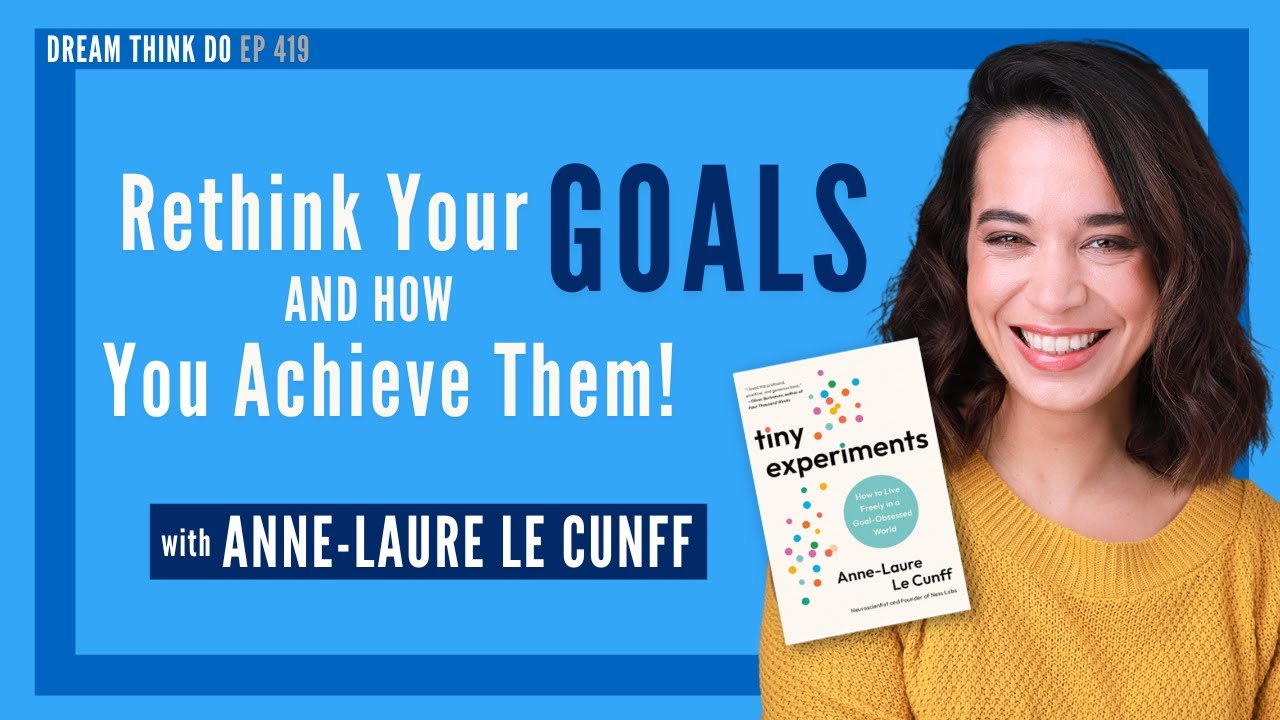
In this interview, host Mitch Matthews talks with neuroscientist, entrepreneur, and author Anne‑Laure Le Cunff about reimagining goal‑setting and living a more experimental life. Le Cunff critiques traditional "linear" goals—fixed outcomes driven by subconscious assumptions that happiness will follow achievement—and proposes a cyclical, hypothesis‑driven approach she calls "tiny experiments." She explains how framing actions as experiments shifts success from a binary outcome to learning, and walks through the scientific‑method steps: hypothesis, small‑scale trial, repeated data collection, and delayed judgment. The conversation delves into human responses to uncertainty, tracing them to ancient survival mechanisms, and distinguishes between burnout and a newer concept she names "bored out," where clear rubrics and predictable pathways sap excitement. Le Cunff shares personal stories, including leaving a well‑paid role at Google, navigating fear, and conducting a YouTube experiment that yielded strong external metrics but poor internal satisfaction, leading her to quit the channel. They discuss how to assess risk, the role of faith (broadly defined as belief) in counteracting fear, and the myth that ambition must always be hard. Le Cunff emphasizes lifelong neuroplasticity, encouraging older adults to keep learning using AI‑driven tutors. The interview closes with practical calls to action: ordering her book Tiny Experiments, subscribing to the Ness Labs newsletter, and applying the tiny‑experiment framework to personal and professional goals.
Chapters
If you see that it's just hard all the time, it's been month and month and month that you're grinding, you should question that. Because being ambitious doesn't mean that you have to sacrifice your mental health in the process.
All right guys, get excited. This is going to be an amazing conversation. Today's guest is creating a new and inspiring pathway when it comes to embracing curiosity, thinking differently, and doing life in bold and unconventional ways. All Are you ready for this? It's going to be freaking awesome. We are talking with Anne-Laure Le Cunff, and Anne-Laure is a powerhouse neuroscientist. She's an entrepreneur, and she's the brilliant mind behind Ness Labs, a platform dedicated to helping people to think better, learn faster, and work happier. You need to be checking it out. It's great. Her weekly newsletter inspires over 100,000 curious minds diving into science of creativity, lifelong learning, and mindful productivity. And that's just the beginning. Anne-Laure is also the author of a brand new book. It's so good. And the title is awesome. The title is simply Tiny Experiments, a game-changing book that changes us to ditch rigid goals, embrace uncertainty, and turn our lives into a series of small but powerful experiments. It's like she is made for Dream, Think, Do. Come on. All right. She's currently researching neuroscience of curiosity and adaptability at King's College London, digging into how different brains learn in different ways. I can't wait for more of that research. But before all of this awesomeness, she was at Google. Little company startup. We'll see how they do. But you've probably heard of it, right? But she was at Google leading digital health projects and shaping the future of well-being through tech. Uh, she has been featured in Rolling Stone, Forbes, Financial Times, Wired, and more. She's lived in Paris, New York, Tokyo, and London, and currently she's in Austin as we have this conversation for her book launch. Uh, and whether she's researching, writing, or challenging how we think about success, one thing's for sure, she is living a life of dreaming bigger, thinking better, and doing more With life, with curiosity, freedom, and fun. I can't wait for this, so let's get to it. Anne-Laure, welcome to Dream Think Do.
Thanks so much for having me, Mitch. That was an incredible introduction.
I love it. I always say a good intro is my gift to my guest. You, and you certainly deserve it. Yours are— that was easy. It was like, oh my gosh, the, the first draft was 45 minutes long, so I had to cut it down. But you're up to some great stuff. And I love, I love what you're doing. I love the book because it is so in line, like we were talking about before I hit record, so in line with what we talk about with Dream, Think, Do. So I just want to dive right in. I, I've got a thousand stories about your history, but I— you've, you've done so much great work and the book is so good. I want to dive into some of the stuff that we're talking about here. One of which is, I know you are big on kind of breaking down some of the misconceptions about goal setting and, and truly going after a life that you want. Um, you know, I think it's that— why is it shifting away from kind of the typical way that a lot of people, the rigid way that a lot of people think about goal setting? Why is that so important?
The way we typically set goals is based on a lot of assumptions, and a lot of these assumptions are actually subconscious.
Yeah.
Some of the assumptions include that we'll be happy once we get there. Another assumption is that this is actually where we want to go. This is what we want.
Right.
And another one is that if we have a clear vision and a clear plan, then we'll get there. Right. And this is how most people think about goal setting. But if you look at the world as it is today, and even us as human beings, the way we think, the way we evolve, Things keep on changing.
Right.
And so very often halfway through working towards a goal, you realize actually maybe that's not what I wanted. Or maybe you actually get there and you look back and you realize, oh, happiness was not hiding just behind that milestone. I'm still the same person I always was. My problems are still here. My relationships are the same. It's not like it magically solved everything.
Yeah, right. The clouds didn't part and angels started to sing and all of a sudden every— everything in life was perfect, right? Absolutely. Absolutely. Exactly.
I love that.
I love that.
And so you found a different way. Yeah, exactly. And so that's why I feel like it, you know, based on, on both psychological research and also my own experience, this is why I wanted to have this conversation with people and say, hey, what about we start thinking about our goals in a different way? And that's kind of the premise of the book. That's how I started writing this book.
I love that. I love that. So, so fill us in on that. Like, it really is about looking at goals because you're not saying just kind of live life, laissez-faire, you know, don't, don't try to do amazing things. Don't, don't seek out amazing experiences. You're not saying, you know, just like live life on a beach somewhere, which wouldn't be the worst if that was your goal, right? But you're saying live intentionally, but, but again, maybe loosen the grip on the way that we've thought about going after goals in the past. So, uh, obviously, you know, like you said, achieving goals or the way that we've been taught to achieve goals often don't lead people to the happiness or that, that fulfillment that they hope for. What's the better way?
Yeah, so that old way of like seeking goals and success and pursuing success in general, I call linear goals. This is very linear. Planned approach, right? And the alternative is conducting experiments, and it's a more cyclical approach to your goals. When what you do is that instead of starting from a fixed outcome that you have in mind and you're kind of hell-bent on getting there and you'll do everything you can to get there, yep, you start with more of a hypothesis, a research question. Maybe you have an inkling that maybe this is something you would like to explore. Maybe you'd be interested in finding out more about a potential career path or a different project or a topic, and you start from there. And the big mindset shift here, having this more experimental mindset, is that instead of having this binary definition of success where it's like either you get there or you don't get there, your only definition of success is learning something new. Yeah, as long as you conduct the experiment, you collect new data about yourself, about the world, about the project, and you learn something new, that success, even if the outcome is unexpected.
Yeah, I love that. I love that when you look up the definition of hypothesis right there in the dictionary, it says a best guess, right? A well-informed guess at how you think it's gonna go. And I love that, cuz I think that that is probably the better definition of a plan, cuz all we're doing is just guessing, right? But I love your emphasis of putting the value on learning as opposed to one particular outcome, because that really does free you up. And, and really is, it, it, it puts our focus on the right things because if we are learning, then we're progressing. Even if it does go a different way, if we can have that mindset, it's like, oh, all right, I picked up something else I need to know. Let's keep going in that direction. And I think that that is so powerful. And I know one of the things you talk about, and, and I think it's so important, especially with Dream Think Doers, they know I am a recovering worrier. I grew up a worrier. I'm not— I haven't completely overcome worry, but I get better every day. Right. But there's a lot of Dream Think Doers that have dealt with uncertainty, and that uncertainty and fear of the unknown is oftentimes what holds people back. I know that's a big subject for you, too, and kind of the playground in some ways that you play in. Right. So how would you say you've you've learned, uh, to deal with uncertainty?
Yeah, I think the, for me, the first step was just understanding what uncertainty was and why we relate to it in the way we normally do instinctively.
Yeah.
And basically, if you think about our relationship to uncertainty, think about thousands of years ago when we were in the jungle. Uncertainty was very dangerous then, right?
Right.
That if you don't have, if you don't know what's going to happen, if you don't know what's lurking in the bushes, right? Being uncertain was a signal that maybe you had to run away or you had to collect more information to know more, right? And our brains haven't changed that much, even though the world has changed a lot. And so when we find ourselves in those moments of uncertainty, those are the responses that we have. Either we want to run away, we want to really get as far as possible from this space where we don't really understand what's going on. We don't understand the rules. We don't know who the players are. We feel like, please get me out of there as quickly as possible. Or we try to hoard information to understand as much as possible and to basically have this illusion of control, this illusion of certainty. To feel like we know what's going to happen and we can really predict the future. We're trying to predict the future, which obviously nobody can do. So I think the first step for me, and this is what I would encourage anyone to do also, is just take this little step back and try to understand what is uncertainty and how this is just, uh, our relationship to it. The fear we have of uncertainty is just, uh, almost like a self-protection mechanism, right? We— Yep. We just want— it's a survival mechanism. Once you understand this, it becomes a lot easier to say, okay, I understand my brain is trying to protect me, but I know actually that this situation is actually not so dangerous. I'm not going to die here, right? I might fail. Sure, I might not know all of the answers. I might not be perceived as an expert. A lot of things might happen, but my survival is really not on the line here, right?
I'm not being chased by a tiger or a lion, right? Like, exactly. And but our, our brain makes it feel like we are, right? Because that is the part of our brain that has been trying to keep us safe for thousands of years, is it's not really great at distinguishing between lions and tigers and bears and a boss that gives you the side eye, or, you know, the fear of stepping in front of a group of people which you may not perform it the way that you want to, but they're not going to probably kill you, right? So it is, it's a very interesting distinction. And I love— even I was talking with somebody this week prepping them to, to stand in front of a group of 500 people, and they were feeling a lot of fear. And I said, you know, isn't it interesting, your brain has identified that as fear, but you realize it's probably about 1 to 2 degrees different from excitement. And she's like, what? I was like, well, think about the feelings, the experience of excitement, um, and, and what does that feel like? Describe that. And she's like, well, it's not that far from what I'm feeling right now. It's like, absolutely right. So it is, it's that— I love the work that you're doing to help people identify that difference and start to embrace the uncertainty, the thing that used to cause that fear of death, and to go, eh, probably, probably not going to die here, and I might really learn some great stuff, right? So I love that. And I know from From reading your story and hearing some interviews and things, this is something I love it when, when I talk with somebody who's done research but also lived their message. And I know you've lived this message because you were, as I mentioned in your inter— or your introduction, you had a great role and a great run at that little company called Google, right? And I think a lot of people would've said, oh my gosh, you've made it. Don't change anything, don't do anything, just keep going at what you're doing because you're set. And you decided to leave. And I, I did— I love the phrase that you use, and from what I've understood, part of that was because of what you called bored out. Not burnout, but bored out. So talk us through how you had to apply this to doing something— I'm sure people told you you were crazy to leave Google to go do something uncertain, right? So walk us through how, how you did something like that, how you made this decision. And do, do talk through the, the bored-out concept, because oh my gosh, that's amazing. So, uh, tell, tell us about how you had to apply this to do something like leave Google and start something completely new.
I'm glad you noticed this because it's true, a lot of people talk about burnout. I talk a lot about burnout in my work as well, but the cause and like a kind of a different feeling that we might have, a different experience we might have. Being bored out is something we don't really talk about enough. And in my case, what it looked like and what it might like for a lot of people is waking up in the morning and not having this sense of excitement because you feel like you have everything already mapped out in front of you. You, it's the opposite of this sense of excitement slash uncertainty we just talked about where when you're bored out, you feel like you know the rules, you know the players, you know the game, you know what you're supposed to do. And you know that if you apply those different— if you go through those different steps in the right order with the right amount of effort, if you're in the right rooms with the right people and you have the right conversations, then you'll get to that specific point, this specific milestone of success that is based on the traditional definition of success. So for me at Google, I actually— which is the case in a lot of tech companies, companies there, which is great, I think, for people who'd like this level of transparency, but they make it very clear what you're supposed to do in order to be successful. And they have an actual rubric that is public within the company, anyone can access it. And that tells you, here are the 5 to 10 things that you need to demonstrate in order to move on to the next rung on the ladder in order to get that promotion. You do these things, And then you apply for a promotion and then normally you get the promotion. And so that's how it works. And for me, it felt like somebody had spoiled the movie and I didn't want to watch it anymore. I just, I said, well, I know how it ends.
Yeah, exactly. Yeah. Yeah.
Um, so that's what being bored out for me. And that was a big driver in leaving Google.
That's amazing. So what I love about that is I think there's a lot of people who just went, Oh, whoa. Because I love the differentiation between burnout and bored out. Like a lot of people experience or what they think they're experiencing is burnout in that they feel overwhelmed, they feel tired, they feel exhausted. But I do— the minute I heard you say that phrase, I was like, oh, how often are we misdiagnosing burnout for bored out? Which is exactly right. Like, you, you know the game, you've played it so much. And in like Google's sense, and I'm sure for for some people that put a high value on safety and security, that algorithm, that rubric makes them go, oh, taking all the risk away, this is fantastic. But for most people, whether it's conscious or subconscious, the removal of that risk, the removal of the variety, the removal of chance kind of takes a lot of the fun out of it and the game and, and part of what, what we look to for that feeling of life, right? So I, I love that. Now, at the same time, I know you are a wickedly smart person So you're probably also wildly able to assess the risks because I'm guessing Google probably paid you pretty well, right? And that, that income was coming in on a regular basis. So was there any part of you that said, ah, maybe I shouldn't do this, right? Like, did you have to deal with fear yourself personally to do a move like that? And one thing with Dream, Think, Do, we always try to clarify that going after a dream does not always involve quitting your job or moving to Fiji or, you know, those kinds of things. Like, those kinds of things can be a part of some dreams, but they don't have to be. But sometimes for those big moves, you do have to take a big step. So how about for you personally? What, what elements of fear popped up for you with that move, and how— like, what's a specific thing that you did to overcome it?
Yeah, that's very interesting because this is something I I would actually do differently today. I was, I was much younger at the time and I did feel some fear, but I chose to ignore it because the script around me in Silicon Valley was that if you wanted to take that next big step, you had to leave your job at the big tech company you were working at and then you had to raise money and do a startup. And, and because I was younger and I thought everybody around me knew better and that was again the script that I saw everywhere, I didn't I didn't even question it at the time. And similar, I love that what you just said about the— that you tell people in your community as well that you don't necessarily have to quit because that's also what I tell people now. I tell them that's what I did at the time. I think this was completely unnecessary. I didn't have to quit. I didn't have to do it in such a reckless way. The reason why it ended up being okay for me, which I'm also very transparent about, is that I had a really good salary at Google before, so I had saved up some money. So I I could do that. I could afford to do this. And the other reason why was because I had, again, because I had started my career at Google, I was able to freelance on the side and to keep on consulting. And so I still had a little bit of income while I was exploring what was next. And so I tell people, try to figure out what is the level of risk of the decisions that you're taking, because when I was in my 20s and I made that choice, I definitely didn't think this through properly.
Right, I love that. But I love, I love what you're talking about, especially again with hindsight. Sometimes the crazy things, and we might even live them stupid things by like the norm standard, are the very things that set us on the right trajectory. I know for me, that's— I was in pharma before having our own business, and, and when I looked to quit pharma, that seemed crazy because I mean the good salary and bonuses and car and all the stuff, right? Um, and it seemed probably a little crazy to leave it. And now I look back and say, the income that we've experienced, the impact that we've had, all that stuff far surpasses what I, what I thought was the kind of the top, the ceiling. And so we had to in some ways take that, that step, um, when we didn't know the outcome. But yeah, sometimes you look back and go, boy, that might, that got to be stupid. I don't know that I'd recommend that exact approach, but boy, I'm glad I did it, right? But I love what you're talking about, is to say, hey, there's our— there are ways to break this down in tiny experiments, right? To break this down so that it can be steps of faith. It doesn't have to be this big blind leap of faith off a cliff, right? So I love, I love what you're talking about there because I think that, that, that matters. And sometimes there are— we're called to take that one big leap, but most of the time it really can be through tiny experiments. So let's talk about that. Let's talk about how do you define A tiny experiment and why is that important?
A tiny experiment is inspired by the scientific method. And as we talked about before, it's really about starting from a hypothesis and taking this small step where the goal is just to learn more. And so the way it works is that you decide on something you want to try, an action that could be, I don't know, writing a newsletter, that could be consulting, that could be something with your health, taking walks, meditating. It works with literally anything, and then you commit to a specific duration. So you say, for example, I'm going to send a newsletter every week for the next 3 months. I'm going to go for a 20-minute walk every day for the next 20 days. What's really important with an experiment is that you go through several trials, just like in a scientific experiment, right? You need to see if you get the same result over time when you do it. And second, you withhold judgment until you're done collecting the data. So you don't stop after one trial saying, eh, I'm not quite sure. You commit to conducting the experiment, you finish the experiment, and only at the end of the experiment you can look back, analyze the data, and decide if you want to keep going or tweak it or just abandon it completely. That's fine too.
I love that. I love that. And I think that that is— I love taking a neuroscientist's approach to life, right? Because that is— it's exactly the way that we do the scientific method. And you and I talked before I hit record that we have a coach training and certification program, and our coaching model, teaching people how to coach, is based on the scientific method. Because I just so believe in this approach, uh, because it is— it's all about assessing and hypothesizing how you think it might go, and then do a series of experiments, and then to evaluate and adjust. Now, I, you know, I always try to stay just this side of stalker laws, you know, uh, when I research and prep for an interview. But I heard you once talk about how you did a tiny experiment on YouTube, uh, trying out YouTube. And what I love about that was you talked about, even though the results were good, quote unquote, you decided to go a different way. So, so walk us through that as an example, because it's such a great example that that you're— when you say evaluate, you're not just evaluating did it work, but it's also in that case, you know, uh, how did it feel? Do you want to continue to do that? Those kinds of things. So walk us through that example because it's such a good example.
Yes. Um, so it's really about evaluating both the internal signals, as you said, how you feel, and the external signals of success. And in my case for YouTube, so My hypothesis was maybe I like creating videos on YouTube. I've been really enjoying writing my newsletter every week, and YouTube is just another medium to communicate information. And so maybe I like it, and I have a lot of friends who absolutely love YouTube, so maybe I like it. That's the hypothesis. And so I designed an experiment and I said, I'm going to publish a video on YouTube every week until the end of the year, and then we'll see at the end of the year how I feel about that. Then I looked at the results. So I actually completed the experiment. I designed it in a way— that's why the book is called Tiny Experiment, right? Like small enough that it's something I can do. I commit to it. I complete it. I publish my videos. And at the end, I evaluate the results. External results, number of subscribers, comments, engagement, etc., pretty good. I got to about 10,000 subscribers. People seem to like the videos.
And that would— knowing a little bit about YouTube, that would have been what most people would have considered significant success, right? Like, that's amazing. But I love how you continue to evaluate beyond what some people might label a success.
So yeah, exactly. So that's why I mean external— and external metrics usually are based on what most people would value, right? And I think that's important to look at. So you look at that success or, or not, and this was successful. And then I looked at the internal data How did it feel to actually produce and publish these videos? That didn't look so good because I had noticed that I actually hated the process.
Yeah.
Every time I knew it was one of the days during the week where I had to sit down in front of my camera and record something, I was dreading it. And I learned something about myself, which is that I'm actually really comfortable with Zoom conversations, podcasts, being in meetings with people where I can see their face. I can see your facial reactions and I can adapt what I'm saying based on your reactions, right? If you look a bit confused, I will explain a little bit more. If you look a bit bored, I'll go a bit faster. And this is what makes me feel comfortable and engaging with someone. With a camera, you get none of that feedback. You're just looking at this sort of like black dead eye that doesn't give you anything back. Right. And that I did not enjoy it at all. So the internal metrics, the internal data was not looking so good. And based on all of the data, evaluating all of the data together, I decided to stop making YouTube videos because even though I was technically successful based on traditional definitions of success, this was not bringing me any joy. And so that was not aligned with the kind of life that I wanted to design for myself.
I love that. And I think what I love about that is that is, you know, tangible data. You were looking at number of subscribers and engagement and all of those things, which is one indicator, but it's almost like you were looking at a dashboard, right? And, and some of those lights were green and some of those lights were red and yellow. And I love that you as a researcher and a scientist also went, you know, analyzed how are you feeling, because I do think a lot of people in their careers, in their jobs, they look at a number of the green lights, don't pay attention to the red lights. And for you, those red lights were, hey, this is draining. Like when I write, it flows out of me. When I do podcast interviews, it's easy. I walk away feeling energized. When I look in the dead eye and the red blinking of the, you know, camera, like nothing. Or I feel exhausted or it wears me out twice as fast. Like those are the kinds of things that I think some people, you know, if we're talking about the dashboard, you know, analogy, they're almost putting pieces of tape over those red lights and those red lights are wildly important. So I love you as a researcher. I know some people would be like, but isn't that more gut than numbers? Like you can look at subscribers and say those numbers, but like your gut when it comes to things like this, especially when we're talking tiny experiments, you know, it can be for your business. It can be for your career, but boy, this is a way to live life, right? And you are creating— you're using this to create the life that you want. And I think that's what's so powerful. And I think, again, I always love it, and I get a little cautious when I talk to somebody who's written a good book, but you can almost tell immediately they're not living it. Like, there's, there's wisdom that is written that sometimes you're like, I don't know if you're actually, you know, buying it. I love the fact that you are walking this out. So, uh, so good. All right, with Dream Thing Do, once in a while I get really excited. I put it out to Dream Think Doers like, hey, I'm getting to talk to this person, you know, what, what questions would you ask? And holy smokes, uh, people got excited about our potential conversation. So I want to get to a couple of these questions because I think they're just fun. Um, and I really would love to get your thoughts. I got one from Kevin Lowe, who's a longtime Dream Think Doer. What's up, Kevin? Um, and Kevin is interesting. He lost his sight as a teenager, so he's completely blind. He's amazing. He's a speaker and a coach and, um, just has an incredible story. But one of the things he was curious about, looking at your history and your background, because it does seem like you are totally willing to look at the research but also say, hey, what do we need to dismantle? What do we need to break down about our understanding of things? So he's like, he said, I'm curious. He's By the way, this might be totally off topic, but I'm curious, so I am going to ask it. And I love that about Kevin. He said, to understand what else is the brain capable of that we are led to believe is impossible. He said, for instance, we have been taught that we see with our eyes, and yet I've retained or retrained my brain to be able to do things almost like a sound echolocation. That he said is pretty amazing. It's allowed him to live and thrive and all that stuff. So he's like, what's her thought on what are we not taking advantage of with our own brain? So I was like, oh, I love that question. I don't know how you'll respond, but I was like, oh, that's definitely one I want to talk with you about. What do you think? What, like, where, what's, what's some of the untapped regions of our brain right now that you would love to see more people tap into?
There are so many of them. I'm familiar with some of the Dextreit, the brain research where they're actually building those amazing exoskeletons now for blind people to be able to navigate the world just using other sensory inputs, which is absolutely fascinating. And there's also new research where we're now like being able for people to see what other people are seeing in their mind. So we can actually connect to people and I can actually see by decoding the brainwaves, I can see what you're seeing in your mind. This— so to answer your question first, I don't really know what we don't know because the research is moving so fast and there's so much going on that I honestly, I feel like in 5 years we'll look back and we'll be mind-blown by everything that we discovered. So I'm going to go with just maybe something less sci-fi.
Yeah, that's okay. That's great.
I think is really, really important. But I think there is this misconception that you cannot really retrain yourself or learn new skills in old age. And that's one of the ones that makes me the most sad. And so that's the one I'm going to pick for to answer this question, because we have found that although, you know, this is more of a metaphor, that like learning is a muscle, right? And so the more you use it, the easier it becomes to use it. And we also see that the more engaged cognitively people stay, the longer they live. So there are lots of different amazing positive downstream effects of just staying engaged, staying connected, keeping on learning new things. And so I would really encourage anyone who feels like I'm a little bit older now, probably, you know, just have to rely on whatever skills I have acquired so far. It's going to be so hard to learn something new. I would say no, you can actually teach yourself whatever you want. And now with AI, what's amazing is that you can actually design your own custom tutor. That's going to teach you whatever you want to learn based on what you already know. So the bottleneck used to be not your brain really, but more the tools that we had at our disposal, because obviously most of the educational content is designed for kids who are in school. And so it's just harder to find stuff that you can learn from when you're older. Now that bottleneck is gone, so you can go and learn whatever it is you want to learn, whatever age you are right now.
Yeah, that's awesome. I love that. And I think it is so important. I just met— we met— we're helping a couple last night that were in their 70s, and they were as young and vibrant. It seemed like maybe their bodies didn't feel that way, but their, their brains were as young and vibrant as high schoolers because that— they were in a class and they were so excited about the content of the class. They were by far the, the oldest people in the room, but boy, by their attitude and the way they were living life, it felt like they were, you know, again in their teens. Um, and I love that because it's that, that approach, right? To be able to say, what do I want to be learning right now? And then not count yourself out for age. So I love that. That is so good. All right, another question. Again, kind of different, uh, realm, but exciting. And I know for me, my faith is important to me. A lot of Dream Think Doers, their faith is big, but we have people from all faith backgrounds that listen to Dream Think Do. We welcome that. Uh, but Risa Stanley wrote in, she said, hey, what do you think when it comes to fear and the fear mode of the brain, where does faith play into that? And I know Risa, you know, for her, I know Risa, so, uh, you know, her faith is a part of her faith walk and, and kind of, uh, Christian walk for her, I know. But like faith in general, where do you think when it comes to neuroscience, where does faith come into when, when you look at people navigating uncertainty, where do you think faith plays into that for you? Like, what do you think?
Yeah, no, that's very interesting because when we think about faith, you might immediately think about the more religious aspect of it, but actually this applies to anyone, even if you're not religious. Faith is really believing, right? It's just believing. And as human beings, we can choose to believe, believe in whatever makes sense for us and whatever gives us the confidence to take that next step. And the thing is that, again, you can't really remove uncertainty. You can't resolve it. It is literally just part of the environment. We cannot predict the future. And so it can become a conscious choice to say, I can choose fear, or I can choose to believe that it will be all right. And I might be wrong, but it's just a choice right now because based on the information I have, I actually don't know. So I can make that choice to believe. And so it can help alleviate fear by just making the opposite choice, the choice of believing in whatever is going to happen next.
Yeah. So faith, it is wild how faith plays a role, whether that is from a religious background or faith journey like that, or like you are going to believe something, right? So it is amazing how often, you know, again, what you, what you believe will happen often will happen, whether that's good or bad. I know as a worrier, I talk about this all the time, that I would worry in my brain of all of the terrible things. I would always joke that I had a Tesla, you know, I could go from 0 to 60 in 2.3 seconds when it comes to worry, right? Because my brain was so creative with the thousand different ways something could go down in flames, right? And so I would see those things over and over in my head, but it's like, wait, what if I pointed that creativity towards like things— the, the thousands of ways it could go great, right? Or could go beyond what I could even imagine. And it is— it's amazing how often when that's what you expect, it, it often is more of what you see, because your brain is also looking for things that will bolster the evidence of what you think is going to happen. So I, I love that. And I know, you know, again, everybody's got a different faith journey. And, and, uh, it's just important to say, all right, what do you, what do you believe? So I love that. Oh my gosh, we could talk for hours. I've got one last question I want to go after, but Anne-Laure, I know that people are loving you, loving this idea of tiny experiments. What's the best way to, to track you down, to grab the book, all of those times, spend time with you on the web and all that?
Where should people start? So yeah, please do order the book and let me know what you think. I love feedback. I really truly do love feedback. So you can just type Tiny Experiments anywhere books are sold or go to your local bookstore and support them. That is even better. And, um, and then I also have a newsletter called Nest Labs, which I send every week. So you can go to nestlabs.com and subscribe there. I send this one every Thursday.
I love it. I love it. We'll put all that in the show notes as well. So last question, and we could probably spend another 45 minutes on this, but what do you think? What's one of the biggest myths around ambition and going after goals? Like what most people think that you would love to see completely dismantled? What's, what's one of those things that one of those beliefs out there that you were like, okay, when it comes to ambition and going after goals, What's one of those that you just want to put an end to for all time?
Yeah, that it has to be hard. And it can be hard. It can be hard, but it doesn't have to be. And you used the word intentionality earlier in our conversation. And I think that is so important. And that's the keyword here. Knowing when in a very intentional manner, you do want to push really hard for a certain period of time for whatever reason it is, you know, I'm currently launching this book, for example, and I'm actually working quite hard at the the moment and it makes sense for this particular project and this particular moment in time. But if you see that it's just hard all the time, it's been month and month and month that you're grinding, you should question that because being ambitious doesn't mean that you have to sacrifice your mental health in the process.
Yeah. Ah, I love the simplicity of that and also the depth of that, right? That it has to be hard. I think that is so true because it is— that's one more of those indicator lights on the dash, right? And it's that thing, I think it is that belief a lot of times, you know, it's that, well, if it's worth it, it'll be hard work. And it's like, well, there are seasons of hard work, but if it's constantly hard work, that's a dash, that's a light on your dash going, hey, I need to pay attention to that. I, I love that. It's just one more thing that you said that I love. So thank you so much for writing the book. It's so needed. I'm looking forward to having you back on Dream, Think, Do, Anne-Laure Le Cunff, uh, because this is, this is Awesome. And this is exactly what the world's needing right now. And I know Dream Think Doers are going to eat this up. So thanks so much for taking the time and being generous, uh, with the conversation.
Thanks so much for having me, Mitch. This was great.
More from Anne-Laure

How to Use Curiosity & Experimentation to Flourish, with Dr. Anne-Laure Le Cunff

Stop chasing goals and start running tiny experiments with Anne-Laure Le Cunff

Why You’re Still Waiting To Figure It All Out | Anne-Laure Le Cunff | EP. 391


Tiny Experiments: How to Learn, Grow, and Navigate Uncertainty — Anne-Laure Le Cunff



Stop Setting Goals. Try This Instead | Tiny Experiments with Anne-Laure Le Cunff


