Tiny Experiments for a Better Life: Why Big Change Starts Small—with Anne-Laure Le Cunff - Ep25
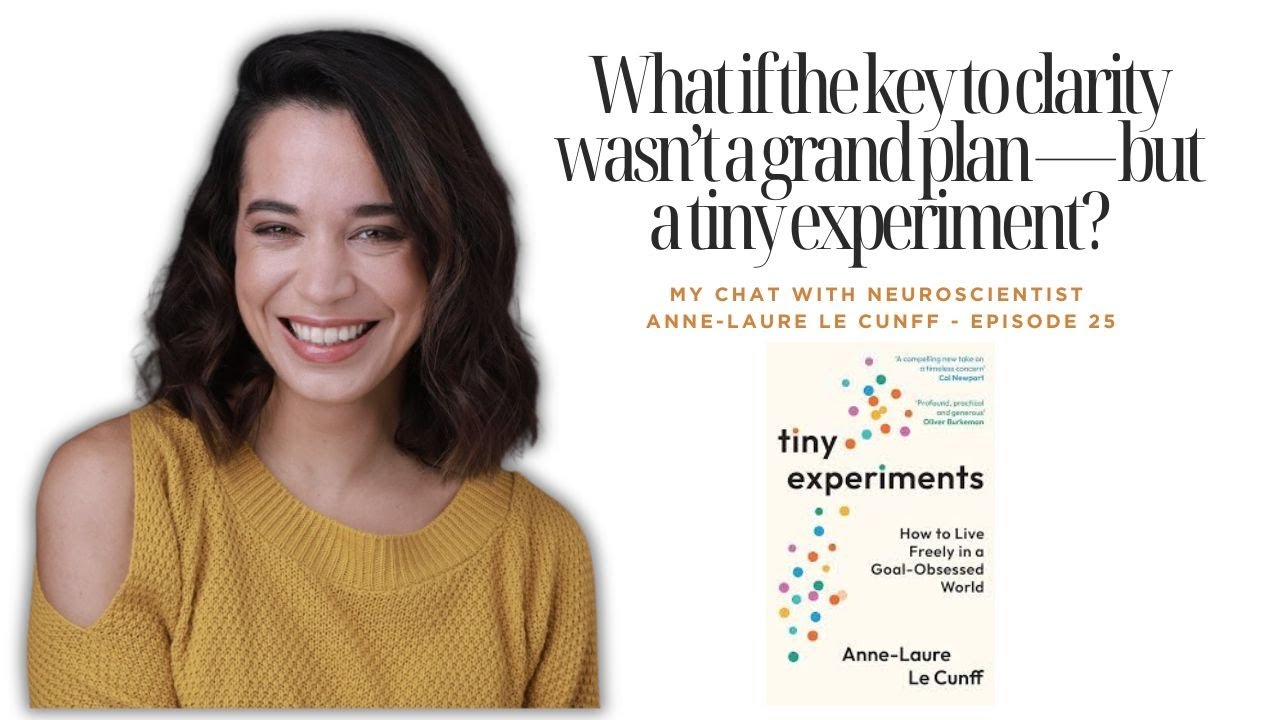
Neuroscientist Anne-Laure Le Cunff explains how running small, structured experiments can reshape how we handle uncertainty and fear of failure. She breaks down three societal scripts that trap people in linear thinking, and shows how to turn habits, career moves, and relationships into time-boxed trials that reclaim how children naturally learn.
Chapters
because we live in a society that is designed around very linear definitions of success, we start being rewarded for the answers we provide, not the questions that we ask. And so there is an incentive to stop trying things where you're not quite sure what the answer is going to be. So we try to avoid failure. This is my new habit. And whenever you don't manage to stick to it, inevitably because life gets in the way, instead of having this approach that is all or nothing, what if you conducted a tiny experiment instead?
Hi, I'm Tessa Arcilia. In Choices and Chances, I use my own style of interviewing, honed through decades as an international news presenter and correspondent, to delve into a new topic each week and interview some of the most inspiring people in the world. Life is a series of choices, choices that give us chances to live our best lives. My goal is to turn the wisdom of people I talk to and lessons from my own experience into ideas you can use. So if you'd like to be inspired by other stories, hit the subscribe button and join the community.
Hi Anne-Laure, thank you so much for joining today. I really appreciate your time. I know you've had such a busy month since your book launched, so thank you for being here.
Thanks so much for having me.
Pretty sure people have come across you because your book is doing so well. It's called Tiny Experiments, and it's on the top 10 list of a lot of bookstores. I see it on Amazon. You've got great reviews. So you're one of those people who straddles science, neuroscience, and creativity, because you, you talk a lot about being creative and using that part of our brain. So you were formerly with Google. Do you call that a Googler? What do you call a person from Google?
That's how they called us and we called ourselves. So you hear a lot of people say ex-Googler.
And now you're a neuroscience researcher. So you went back to university to study neuroscience. You're of course a writer. There's so much of your writing online. You're an entrepreneur. You have Nest Labs, which is great. Lots of— I love your emails, by the way. So this is, it's not just going to be a conversation about hacks. I know that's very useful for people, but I'm really interested in how your, your mind works. Because when you talk about tiny experiments and the concepts you talk about there, I think there's a lot of echoes on the concept of freedom, which I love. I, you know, the podcast is called Choices and Chances. For me, it's all about freedom. Freedom from judgment, from fear, fear of failure, from the golden handcuffs, from the pressure, all of that. So I'm really excited to talk to you about all these things, the nonlinear life, embracing all these things. So look, first of all, again, congratulations. It's, it's great. I'm not surprised at all that you're successful with this book. Has the book changed your life, by the way? The success of the book?
It has changed my life, but it started changing my life way before it came out. I had to completely reorganize my entire life around this book. It really took over my life. I, in terms of just being able to write it, finding the time, the mental energy, the nurturing my creativity in a way where I could actually find ideas that I thought would be interesting, relevant, and then translating them in a way that would be helpful to people, that actually was a lot of work. And so over the past few years, just creating the book, producing the book already changed my life. And, uh, the launch itself, it's too early to say. It really feels like, you know, when you hear about people who have this kind of overnight success and it's never really that. This is the way it feels. I feel like a lot of people who are reading the book and a lot of the, the reason why this is, the book is successful is because I've spent years building the NestLabs community and engaging with people. And I, at least I tried in a thoughtful way. So I don't feel like it's the launch that changed my life. I feel like it's all of the work of the past few years.
That's a great point to make because I don't know that there is really such a thing as overnight success. It's true that people just see the success that's very public, but there's a lot of work that goes into it. And you, before you started Nest Labs, you had other businesses. So it's interesting to me because you're very soft-spoken, you seem like an introvert, but you are entrepreneur and entrepreneurs are not soft. They have a lot of drive. You need to have the stomach for failure. So did you always know that you wanted a business? You wanted to be an entrepreneur? Was that always something you wanted?
I didn't always know I wanted to be an entrepreneur, but I always knew I wanted to create something of my own. As a child already, I was writing novels, drawing. I loved making up stories. I was inventing new languages and I, yeah, I wanted to create something and I didn't know what it would look like. And I don't think building a business in the sense I did, like the adult definition of a business, was something that crossed my mind as a child. But it is creating something. It is creating something new. It does come with this creativity. It does come with this level of uncertainty, of risk, of not knowing what you're doing. And this is what I love about it. I love that I actually am not sure. In terms of where I'm going, that every day is a new big question mark and I have to figure it out as I go.
That's the perfect way of starting. I understand why you call it tiny experiments. And that's, you're, as I said before we hit record, you're preaching to the choir. So I, I've always been driven by curiosity. I became a journalist because I'm curious and every day is not the same. So you never know what's going to happen. But for people who might not be thinking the way we think now. Let's talk about what Tiny Experiments is all about. What is the heart of the concept that you're trying to share with this book?
Yeah, with this book, I'm trying to encourage people to reimagine their relationship to uncertainty. Just like a scientist gets excited when they don't understand something, we can also be excited, be curious whenever we face a challenge, whenever we're faced with uncertainty. And the building block of this mindset is conducting tiny experiments. So whenever there is something that you're curious about, whenever there is a path that you might want to explore, but you're not sure you want to commit to, whenever there's something that doesn't quite work, but you're not 100% sure how to address it, instead of trying to have this clear vision, this clear plan, this big goal, this big change that you want to go through. Instead, you can just conduct a tiny experiment. And just like a scientist, you'll, you start from a hypothesis. You're not quite sure. You have a question. You might have the intuition that this thing might work or might not work, but then you collect data and you make your decisions based on that data. So it really helps you go from a place of fear and anxiety whenever you're facing uncertainty to a place of curiosity and almost playfulness.
Yeah, you know, that's, I would say, easier said than done in the sense that human beings, we crave certainty and security, right? That's, it's just built into our system. And you and I, I think I saw your background, you're French with Algerian, uh, parents, I think, Algerian-born parents. You lived in Japan, you live in London, you live in New York now. And like myself, I've moved around. So the curiosity for people like us who've had that as a child, that was not within our control. We had no control over where we live, but it, for me, triggered a curious mind. But not everyone has that background and that experience and that exposure. So how do you talk about what you just talked to me about to someone who might not see curiosity as something natural or innate? And it's a scary first step to be curious.
A place I like starting with is habits, because I feel like everybody is convinced that they need to build better habits. This is never something people debate. If you tell people, oh, you know, you could build better habits, a lot of people will tell you they struggle to do it, but nobody will argue around whether it's a good thing or not to build better habits. And it's kind of crazy when you think about habits that when we decide to build a new habit, we pick something and it's very often something we've never tried ever. And we commit to it for the rest of our lives. And so I ask people, what if you took a habit that you're curious about, and instead of saying, this is my new habit, and whenever you don't manage to stick to it, inevitably, because life gets in the way, instead of having this approach that is all or nothing, what if you conducted a tiny experiment instead? The big difference between a habit and an experiment is that an experiment is for a specific duration. So you decide on what you're going to test and the trial period, just like a scientist. So you could say, I'm going to go for a daily walk for 15 days. I'm going to write a daily newsletter for 3 weeks. I'm going to publish a YouTube video every week for 2 months. So you have the action and the duration. And the great thing about this approach is that whenever you miss a trial, a repetition. So whenever you miss a day or a week, that's just data. You make a note of it and you just capture why, why you didn't do it that day. Was it because you were procrastinating? Was it because something happened? Why didn't you do it that day? It's just data, and you withhold judgment until you're done conducting your experiment. When I frame it this way, when I tell people this is really just about trying something you're curious about in a way that is a little bit more structured and systematic, where you say, this is my experiment, this is what I'm curious about, this is what I'm going to try, and I'm going to try it for this period of time, and I'm going to withhold judgment until I'm done. It makes a lot of sense for people. It does. All of a sudden, it doesn't sound like— because that's not what I'm saying in the book. I'm not saying experiment with everything, quit your job, follow your passion. Quite the contrary. I'm telling people, follow your curiosity, ask those little questions. It starts from a hypothesis and conduct those tiny experiments to figure out what you actually want to explore.
You're not telling people to do some drastic thing. So just ask these tiny questions. Is that applicable to everything in life? Like, for example, I see why you can apply it to career and life decisions. Can you apply it to something very emotional, like a relationship? Or I don't know what else to get as an example. Are these tiny experiments doable in that setting as well?
There are very rare settings where it doesn't work. So for relationships, emotional work, self-work, all of that, it works really, really well. I've seen people in my community run experiments even with their partner where they said, how about we do an experiment where we're going to do a date every Friday and we alternate? So one Friday I organize it, the other Friday you organize it. And we do that for 2 months. And at the end of the 2 months, we do a little check-in, we analyze the data together, and we decide whether we want to keep going or whether we want to tweak it, or maybe we want to stop and do something different to bond together. Maybe that version of the experiment is not what's working for us. The, the times where it doesn't work is, unfortunately, although experiments are such a great way to figure it figure out what works and what doesn't. Our society is designed around a linear definition of success. And so there are aspects of your life, if that's something that you want, where you don't really have a choice. So if you want to save money for a mortgage to buy a house, I don't have a tiny experiment version of that for you. And, um, and that's okay. That's really okay. It's really about being intentional and asking yourself, Is there a more experimental approach to this part of my life that is important to me? Sometimes, again, unfortunately, and especially with things that are linked to traditional versions of a traditional definition of success in our society, it can actually be very difficult. You could come up with an idea for an experiment, but it would be really hard to actually execute on it and run it. But for most things where you have at least a little bit of agency, you can most of the time come up with a more experimental version of this idea that you have before committing to it and helping you put your assumptions aside and starting from a question instead of that big linear goal where you want to get to a specific destination.
It's great to put it in, put the nuance that way that, you know, it's, it's not an absolute, it's not an all or nothing. And as a neuroscientist, when you explain it that way, what you learned when you studied neuroscience is, are our brains, is our brain built for these tiny experiments? So is there almost to give us some confidence that if we did embark on this, we are actually built to succeed in doing that?
Well, this is how children learn. This is literally how children learn. They might not have the structured approach that scientists have designed with the scientific method in order to better collect and analyze the data. But the way we learn as children when we grow up is literally by having a hypothesis. We make our prediction, um, and this is how— so neuroscientists call it the perception-action cycle. And the way it works is that your brain scans the environment based on the information that's there, is going to make a prediction, then you're going to take an action, and you're going to compare what happens to the prediction. And sometimes the prediction is correct. That's great. And sometimes the prediction is wrong and that's actually completely okay too. Your brain is going to look at this new data and adjust your next prediction based on that. And this is how children learn. Unfortunately, as we grow up, and again, because we live in a society that is designed around very linear definitions of success, we start being rewarded for the answers we provide, not the questions that we we ask. And so there is an incentive to stop or to stop trying things where you're not quite sure what the answer is going to be. So we start actually spending more time and energy working in a way where we feel a little bit more certain of the outcome versus working on projects where the outcome is uncertain and we might fail. So we try to avoid failure, which we know is a big part of learning, but as adults, we try to avoid failure as much as possible. And especially public failure, where there's a risk of being judged by others, because that's another part, evolutionary speaking, where as human beings, if you, if you think back about, um, our evolutionary past, being judged for not knowing what you're doing, making a mistake, et cetera, being rejected by the tribe could mean certain death for you. So that's where it gets a little bit complicated too. We also develop that sense that we don't want people to know that we're failing. So if you combine all of this together, the fact that we lose that sense of childlike exploration in favor of being able to look like we're the experts and we know the answers, plus the fact that we live fairly public lives, and so there's this added layer of not wanting other people to see when we don't know what we're doing, that puts us in a situation where as adults we optimize for doing things when we know what the outcome is going to be.
So how do you put the two together? Because you rightly pointed out that there's a reason why we react the way we do, because there's an evolutionary reason behind it. So it's not just there for nothing. So are we rebelling against something that we had evolved to become? So what are, how do you mix the two together?
I think it's just about reclaiming that space for personal experimentation. Before we had such a public square, the giant leaderboard where everybody was comparing each other to in terms of success. And, you know, when you think about it, it's a, it is actually not natural that, um, I'm able to go online and see how successful everybody is and being able to compare that across hundreds and hundreds of people. Like, at most in the past, you would be aware of the success of people from your village, but not the entirety of humanity. And, uh, and so I think it's really mostly about saying, I know there's this giant leaderboard. I know this fear of being judged is completely natural, but I'm going to reclaim a little bit of that experimental mindset, and I'm going to have at least one tiny experiment running at any given time. And the next step, I talk about that in the book, is that you can run your, your tiny experiments on your own, but if you wanna really take it to the next level, and really reclaim that childlike sense of exploration and asking questions and really re-falling in love again with problems. You can also do it in public, which feels very unnatural, but which is really a great way to build those spaces with other people where you can learn together and where failure and making mistakes and sharing what you learned is celebrated instead of coming with this sense of fear and anxiety. So yes, it is rebelling a little bit against our natural responses, but our natural responses, the ones that we have right now, they're in a very unnatural world, if you want to use that word, because what is natural, what is not, that's an entire other debate. But our modern world is at odds with our brains and the way they developed. And so you can actually rebel against that.
Yeah, that's a great way of putting it. And When we talk about something that I like when in some of your writings, when you talked about the different scripts that we have in life, because you're— so here we're talking about evolutionary development, but also we have where does that fear of failure come from, the anxiety come from, and you talked about different mindsets and different scripts that we have. Talk to us about what those are, and does everybody fall into one of those? I think you mentioned three. Does everybody fall into one of those? Categories?
This is fascinating research from the late '70s that I discovered in the process of writing this book. It's, um, so scientists conducted a very simple study where they asked people, given this situation, how do you act? How do you behave? And they asked that to a lot of participants in lots of different situations. And what they found is that most people given a specific situation, will have a specific behavior. And in lots of situations, this is helpful. If you go to the doctor, it's helpful to know that you're supposed to sit in the waiting room and wait until they call your name, and then you go in the doctor's office. If you go to the restaurant, it's helpful to know that you're supposed to stand at the front, talk to someone, and they'll check if there's space for you, and then you go and sit down. And so as a society, those scripts, that we follow, because that's what they are. Just like an actor knowing those are— this is your script. They can be very helpful, they're very efficient, and they allow you to not overthink every single decision that you're making because you do that without even thinking about it. The problem is that researchers then found that we actually follow those cognitive scripts in lots of areas of our lives. And it's okay to follow a script if you just show up at a restaurant and You don't want to think about how to behave, but it might be a little bit more problematic if you follow a script to choose your career, your relationships, the way you dress, the way you communicate with others. And in the book, I share what I think are the 3 biggest— so there are lots of scripts, lots and lots of scripts. Literally, given any situation, there's a script for it. But in the book, I decided to create 3 buckets based on my work with the Nest Labs community and what I've seen in people. And I think those 3 buckets of scripts are the most common ones that we go through and that have an impact in terms of the way we live our lives. So the first one is the sequel script. The sequel script is the script we follow when we think that whatever decision we make today needs to make sense based on the decisions we made in the past. It needs to follow a nice narrative, a nice story that makes sense.. And this is the script we follow when, for example, you studied a specific topic in university and you only look at jobs that align with this topic. This is also, by the way, the script we all follow when we update our resumes before applying for jobs and we rewrite the entire story so it makes sense and it looks like it has those nice chapters and this nice story. The second common script that I found many people following is what I call the crowd pleaser script. And this is the script you follow when you make decisions based on what is going to make other people around you happy, not necessarily what you want, what people around you want. Very common to do this when you've had very supportive parents that helped you with your studies and things like that. And then maybe you make choices based on what you know would make them happy. But it can also be a little bit more subtle where it's choosing a job because you know that that's the job where people around you, your friends, will say, I can't believe you got that job. That is so impressive. That is amazing. And you want people around you to be happy for you. So you pick those kinds of jobs and you miss on opportunities that might make you happy in the long run, but don't look as impressive in the short term. And the last one, is the one that I think is the most insidious one, because as a society, we've decided that this is actually a good script to follow. And, uh, I call it the epic script. It's inspired by Hollywood movies. It's the script where you feel like whatever you decide to do, it needs to be big, it needs to be impressive. You need to follow your passion. You need to wake up every morning feeling like you're changing the world and Anything less than that is failure. And, uh, the reason why this one I think is so dangerous is that, well, first it forces people to put all of their eggs in the same basket. They feel like they have to have this one big thing that is tied to their identity that is really big and impressive. And when that thing doesn't work out, which you see very often with startup founders, for example, then all of their identity, their sense of identity crumbles with that, and they feel like their entire life is a failure. And the other reason why I think this is very dangerous is that for everyone, which is most people who haven't found that one thing yet, who haven't found their passion yet, they feel like their life is less meaningful. They look around at people who have found their passion, found their thing, and they ask themselves, why is it that I haven't found my purpose yet? And the reality is that when you ask people who have found their purpose, how did you find it? How did you start? Did you figure out that thing? None of them will tell you that they found it by obsessing over it. They all found it by trying things, working on different projects, collaborating with people, trying that word project where someone reached out and said, hey, I'm working on this thing. Do you think you want to collaborate on this? And they said, sure, I've never done that before, but let's give it a try. And one day they woke up and they realized, oh, I'm actually pretty excited to wake up this morning and to work on this thing. I actually like what I'm working on right now. And this is how you figure out your thing, by trying, by experimenting, not by obsessing over finding it.
Yeah, my— one of my favorite lines is, um, action breeds clarity. You— a lot of people think, think, and think, and just do it. And if you make a mistake, you can course correct. And that's the beauty of just taking the first step, right? One part of the book that really stood out to me was towards the end when you talked about multi-hyphenate people and founders who came up with all sorts of disparate businesses. I love that because, yeah, I have a strong identity with being a journalist, for example. But then I always find that I've tried to rebel against one identity because I'm so many things. I cannot even answer the question, where are you from?
I don't know.
And so I want to ask you if you think that someone who's multi-hyphenated and presents themselves like that to the world, I mean, even marketing and branding tells you niche down, make sure your message is one thing, make sure I'm trying to rebel against that. From your studies and what you draw from, do you think there is a place in the world for that kind of presenting yourself to the world, or is that just confusing for people?
I think you can have multiple audiences. I think it can be confusing or not necessarily confusing. If people are quite smart, they will get it, but not as helpful if you tell them, I do these 5 different things and they might not be interested in these 5 different things. Um, but the great thing is that nowadays with the internet, you can actually have two different websites. And one of them is about that, you know, one of them is about video editing, if that's your thing. Another one can be for consulting. That's okay. You can also have one website with different pages. It doesn't matter, but I would still probably tailor the message and whatever service you're offering to the audience, because that's ultimately what they care about. They want to know, how can you help me? And so they might not necessarily be interested in all of your other projects and hobbies, but you can absolutely have all of these different projects and hobbies. Like, I have lots of them and I don't try to put myself in that one box, but I'm also trying to have different platforms for different kinds of ideas, different kinds of projects. And this way people can follow me across those different platforms depending on what they're interested in. So that gives you as a creator, an entrepreneur, a lot of freedom. But that gives you as a creator, as an entrepreneur, that gives you a lot of freedom, but that also gives your audience, your community, the freedom to engage with whatever content you're putting out there that is most helpful to them.
Something you talked about as well is coming up with a mental gym. I like that because, you know, we work out, we go to the gym and we try to exercise our physical themselves, but we do need that for our mental health. Can you just give us a brief overview or tips on how to keep— make sure that our mental fitness is, is okay?
Well, it's really about just making space for it. And this is the thing, a lot of people go to the gym regularly every week, and somehow they don't block time for taking care of their mental health. So this is really just the recommendation I'm giving people. If you take care of your physical health by going to a gym regularly or going for runs or going to yoga or stretching and all of that, then why not do the same for your mental health? Then what goes in that block of time that you use to take care of your mental health is actually something you can experiment with because it's going to be different for everyone. And it's the same when people go to the gym. Everybody has a different gym routine depending on what they want to achieve, depending on where they are, their current health priorities. So for your, your mental gym and taking care of your mental well-being, you can try different things. And for some people, it might look like meditation. For other people, it might be a bit of journaling. Actually, also spending time with people you love is a great way to take care of your mental health. And, uh, so I would really recommend First, blocking that time and saying that, is it Sunday afternoon? Is it on Friday? Is it whenever it is. And during the week, have at least 1 hour that is just for taking care of your mental health. And that is in addition to everything else you might already be doing, right? A lot of people are already trying to be more present and maybe spending less time on social media. So you might be doing some things already. But having this one dedicated hour where you might be journaling, meditating, doing whatever it is, and you can design that as a tiny experiment. So you can say, for the next month, every Friday morning, I'm going to block this one hour and I'm going to do these two things during this hour. And at the end of the month, you can review and see how that felt. Did that work? Did the mental health quote unquote interventions that you decided to implement, were they good for you? Do you want to tweak them? And you can keep on experimenting. Experimenting in this way. So you design your perfect mental, mental gym over time.
And what would you say to people, given—
again, we talk about choices and chances— what would you tell people who might have fewer choices than we do? I remember one of the books that made an impact on me is Viktor Frankl's Man's Search for Meaning, because he, at— when in that situation, he had few choices, but he had choices. What would you tell to people who might not be, you know, as privileged to have so many choices, to conduct tiny experiments? In life?
Well, tiny experiments are actually perfect for any kind, even if you, and especially if you don't have a lot of wiggle room or freedom, because again, there, that's why the book is called Tiny Experiments, not Big Experiments. You can run tiny experiments by just dedicating 10 minutes a week. Like it could be a 10-minute meditation every week. Most people can find this. You can do it even on the bus going to work. You can do it instead of scrolling in the morning on your phone. A lot of us are guilty of this. I know I am when I'm stressed. So it's really not about— again, I have a pet peeve when it comes to books that tell you quit your job, follow your passion, and not everybody can do this. You might not have the financial means to do this. You might be the primary caregiver for someone. You might have you know, in terms of your current health or whatever it is, you might not be able to do this. Tiny experiments are, again, are the opposite of this. This is really about thinking, what is one thing in my life that I might want to do differently? I'm not quite sure how to approach. And what's the smallest, smallest version of an experiment that I can design around that question? And that's it. And I really don't believe that there's any life situation where you cannot find 5 minutes a week or 10 minutes a week to run a tiny experiment.
Yeah, I agree with you very much so. And look, Anne-Laure, you conduct experiments publicly as well. There was one you talked about your public speaking and how you moved from being afraid to talk about it. You talked, well, we, we read about your failed, well, say failed, your businesses that didn't work out and you moved on from them. What has been the biggest challenges for you that maybe you're still working through, but just rather than just talking to Anne-Laure, the author, we want to talk to Anne-Laure, the human. So what are some of the challenges that you yourself face and you have to conduct tiny experiments for yourself?
I'm still to this point, I still have this fear of being judged that hasn't gone, still, still here. Um, and so I sometimes have the temptation to go and pick experiments that might be more impressive, that might be more interesting to other people. And this is something where I still have to constantly work on myself and make sure that I choose experiments based on what I'm actually curious about and not what will be more impressive or interesting to other people. So this fear of being judged and this desire to be judged positively, which is the other side of this, is very much still here. And this is why I always tell people that having an experimental mindset is not about getting rid of those natural responses and those emotions. We're human beings and we're literally hardwired to have certain responses in certain situations. And especially when it comes to connecting with fellow human beings, this is really, really hard to rewire our responses. And so instead of blaming ourselves when we feel this way, It's about noticing it and being curious about it. So whenever I notice that this is the response that I have, or that my decisions might be driven by this fear of being judged, I notice it. And I try to ask myself in a very non-judgmental way, huh, why are you so scared of, about these people thinking this or that? Is it actually true? Is that something you can test? How about you design a little, a tiny experiment around this and see what happens and let the data speak for itself instead of letting your fears make your decisions for you. And so yes, very much still struggling with a lot of those, this internal dialogue. And for me, the experimental approach is just about making this dialogue a bit more gentle and a little bit more constructive.
Yeah. Remember there's a post on your Instagram about that one negative comment that you got but you had like 90% or 99% good comments and you dwell on that. That's very human. I don't know that, yeah, as you said, we can't really get rid of it. I don't know that we want to get rid of it, but why wouldn't we want to get rid of these natural responses?
Well, ultimately, this is what allows us to connect with other people. And this feedback is still, is still good. It's still interesting. You see how people respond to your work, to the way you present yourself, to how you're trying to contribute. And so that's not necessarily bad. What's important is then having the ability to adjust your own response to this feedback and being able to say, thank you, I actually don't agree with this feedback. And so I'm not necessarily going to implement this, or, huh, that's really helpful. I actually hadn't thought about that. Let me actually use that to change the way I approach things and being able to detach the feedback about your work. From your own sense of identity, knowing that someone can be critical of some of the work that you've produced and it doesn't mean anything about you because you're still learning. You're always evolving, you're growing, and you actually almost, you want that. You wanna be able to look back in a few years and almost have this, uh, I, I think about it as a sense of almost positive cringe where you, you look back and you feel like, oh no, I can't believe I used to write this way, or I wrote that, wow. But it's because you've grown so much that you almost don't recognize yourself anymore in the work that you've produced years ago. You want that to happen. That means there's growth.
I want to talk to you about so many things, but maybe I'll pick this one before we end— the, the nonlinear path— because I love a nonlinear path. As I said, you're preaching to the choir, but now there's a lot of people losing jobs. There's a lot people who are forced to pivot or forced to experiment. I suppose, what would you tell people like that who are going through a hard time through no decision of their own?
You can actually decide to follow a more linear career if it's intentional. I don't think this is at odds with having an experimental mindset. To me, the keyword here is being intentional. And actually, I've seen a lot of people do that. And if in the future I have to do that, I will also do it. It's really saying, actually, with my current circumstances right now, I need the stability and the safety of a more linear career. And it might mean that you're in a job that is not the most intellectually stimulating, because maybe you could do it with your eyes closed. You know what you're, you're doing already. You've been doing it for years. You've been working on the kind of projects that you, you understand very deeply. And this is safe. This is stable, gives you a stable income. And then because you have the stability here, you can decide, now I can experiment in other areas of my life. Maybe I'm going to experiment with my health. Maybe I'm going to experiment with my diet. Maybe I'm going to experiment with my relationships, my personal relationships, because I have this stability. So that's one thing. First is that having a linear approach in certain areas of your life because you have decided to do so in an intentional way, is not incompatible with having an experimental mindset overall and with conducting tiny experiments in other areas of your life. So that's one thing. The second thing is I want to address when things actually don't go to plan at all and you're in actually a very difficult situation where you might not even have that stable job. And actually, I was giving a keynote a few weeks ago, and someone as part of the Q&A asked that question where they said, how can I have an experimental mindset when I just lost my job? How can I even think about conducting experiments? And my response to this person was to say that you can actually use that time as an opportunity for experimentation. Because when you think about it, a big barrier to experimentation, as we discussed, during this conversation is sometimes lack of time, lack of energy. You might have a 9 to 5 and feel like you don't have time for experimentation. When you don't have a job and you're looking for a job, you can actually experiment with that as well. And so the linear approach to trying to find a job would be sending as many applications as possible and just hoping for the best. The experimental approach to that would be to say, for the next week, this is the approach that I'm going to have, and I'm going to pay attention to what works and what doesn't. And then based on that data, I'm going to adjust the week after. I'm going to go for another week and I'm going to apply in a slightly different way using the feedback that I got from the first week. And this is, those are the growth loops that I describe in, in the book. When it comes down to it and the essence of it, which again, works in any situation, even the most difficult ones, and maybe especially the most difficult ones. Having an experimental mindset is about not having this illusion of certainty that a fixed plan gives you, where you feel like, this is what I need to do. I have this plan, I have this vision, and I'm going to work really hard to do it. Instead, it's embracing the fact that you probably don't really know what you're doing. The world is changing, you're changing, everything is changing. And so instead of having this illusion of certainty saying, Okay, there is a lot of uncertainty right now. How can I experiment to collect my own data? How can I build my own knowledge of what's working and what's not working? And how can I keep on adapting accordingly so I can grow in the process?
Intentionality was my takeaway from that. That's a brilliant way of putting it, where it doesn't really matter what path you choose as long as you choose it. Mindfully. It wasn't dictated to you. It wasn't something you got out of a societal expectation. Um, I love that. If we, if someone were to listen to this and they have a couple of key takeaways to walk away with, what would you want them to take away with them and challenge themselves to do?
I would probably just leave them with a question. I think just thinking about what may be your first tiny experiment, however tiny it is. Whatever is possible for you right now, what might be your first tiny experiment?
Thank you so much, Anne-Laure. I think there's a lot people can explore with just that one question. Really appreciate your time. And again, congratulations and have a great break, a well-deserved break for you.
Thank you so much. Thanks for having me.
If you enjoyed this episode, please consider giving us a 5-star rating so others can find the podcast. Thank you for your company and see you next time.
More from Anne-Laure

How to Use Curiosity & Experimentation to Flourish, with Dr. Anne-Laure Le Cunff

Stop chasing goals and start running tiny experiments with Anne-Laure Le Cunff

Why You’re Still Waiting To Figure It All Out | Anne-Laure Le Cunff | EP. 391


Tiny Experiments: How to Learn, Grow, and Navigate Uncertainty — Anne-Laure Le Cunff



Stop Setting Goals. Try This Instead | Tiny Experiments with Anne-Laure Le Cunff


